Tag: visualpath blogs

  • Which Is the Best Salesforce DevOps Training Institute

    Which Is the Best Salesforce DevOps Training Institute

    Which Is the Best Salesforce DevOps Training Institute

    Introduction

    Salesforce DevOps Training is now a must-have skill. It connects development and operations into one smooth flow. Teams release faster and with fewer errors.

    By 2025, Salesforce projects became more complex. Manual deployments started failing more often. This pushed companies toward DevOps automation.

    Industry reports in late 2024 showed strong growth. DevOps roles in Salesforce grew by over 30 percent. This trend will continue into 2026.

    Choosing the right institute now matters a lot. The wrong choice wastes time and money. The right choice builds long-term careers.


    Understanding Salesforce DevOps Basics

    Salesforce DevOps combines people, process, and tools. It improves deployment speed and code quality.

    Earlier, teams used change sets. They were slow and risky. DevOps replaced them with pipelines.

    Version control became standard after 2023. Git-based workflows are now common. This shift improved tracking and rollback.

    Many learners also aim for Salesforce DevOps Certification. It proves hands-on deployment knowledge. It helps during hiring rounds.


    Salesforce DevOps Training Market Demand in 2026

    The demand for Salesforce DevOps experts continues to grow in 2026. With Salesforce releasing updates three times a year, companies need skilled teams to manage deployments efficiently.

    By mid-2025, enterprises adopting CI/CD reduced release failures by 50%, creating more job opportunities.

    Remote hiring has also increased demand, with global clients preferring certified professionals.

    This makes Copado Training essential for those looking to advance in Salesforce DevOps and stay ahead in the market.


    Salesforce DevOps Roadmap


    Salesforce DevOps Training: Key Skills You Must Learn

    These skills match real project needs.

    Step 1: Learn version control basics. Git and branching strategies are essential.

    Step 2: Understand automated testing. Test classes must run in pipelines.

    Step 3: Practice deployment strategies. Blue-green and rollback methods matter.

    A structured Salesforce DevOps Online Training helps here. It follows step-by-step learning. Beginners gain confidence quickly.


    Tools Driving Salesforce DevOps in 2025

    Modern DevOps relies on strong tools. Automation reduces human errors.

    CI/CD tools now integrate with Salesforce. They support metadata and data deployment.

    Security scanning became important after 2024. Static code analysis is now standard.

    Learners prefer Salesforce DevOps Course. It offers tool access from anywhere. This suits working professionals.


    Understanding Copado in Salesforce DevOps

    Copado is a Salesforce-native DevOps platform that helps teams automate deployments and efficiently manage pipelines.

    It simplifies critical tasks such as version control, testing, and release planning, ensuring fewer errors and faster releases. Teams use Copado to track changes, integrate Git, and streamline collaboration across departments.

    For professionals looking to gain practical, job-ready skills, Copado Online Training provides hands-on experience, making it easier to master the platform and succeed in Salesforce DevOps roles.


    Importance of Copado in Salesforce DevOps

    Copado is a leading DevOps platform. It is built only for Salesforce.

    Copado supports user stories and pipelines. It connects Git and Salesforce smoothly.

    Salesforce DevOps With Copado Training teaches real flows. It covers commits, merges, and promotions.

    Many teams now demand Copado skills. This trend grew after 2023.


    Why Visualpath Stands Out as the Best Institute

    Visualpath follows industry-focused teaching. It updates content with every Salesforce release.

    Trainers have real project experience. They explain concepts in simple steps.

    Each module includes practice tasks. Learners work on real DevOps scenarios.

    The Salesforce DevOps Training in Hyderabad program is popular. It supports both classroom and online modes. It suits learners seeking structured guidance.

    Visualpath also serves learners across regions. Salesforce DevOps Training in Chennai is fully supported online. It helps remote professionals upskill effectively.


    Learning Modes and Flexibility

    Flexibility matters for modern learners. Visualpath offers multiple schedules.

    Weekday and weekend options exist. Recorded sessions help revision.

    The Salesforce DevOps Training In Bangalore batch suits IT hubs. It aligns with enterprise project needs. It supports fast-paced professionals.

    Assignments follow each topic. Mentors guide learners closely.

    This approach improves retention. Learners gain confidence before interviews.


    Career Outcomes after Salesforce DevOps Training

    DevOps skills open many roles. Release manager is one option. DevOps engineer is another.

    The Salesforce DevOps Training in India option helps freshers. It focuses on strong foundations. It builds confidence step by step.

    Salaries improved after 2024. Certified DevOps experts earn more.

    Companies value practical knowledge. Training with projects makes a difference.


    FAQs

    Q. What is Salesforce DevOps and why is it important?
    A. Salesforce DevOps automates development and deployment. It reduces errors and speeds releases. Visualpath explains it with simple workflows and real project practice for beginners and professionals.
    Q. Which institute is best for Salesforce DevOps training in 2025?
    A. Visualpath is considered one of the best institutes. It offers updated content, expert trainers, and hands-on DevOps tools aligned with current Salesforce release cycles.
    Q. Is Copado required for Salesforce DevOps roles?
    A. Yes, many companies prefer Copado skills. Visualpath covers Copado deeply with practical labs, helping learners manage pipelines, testing, and deployments confidently.
    Q. Can beginners learn Salesforce DevOps easily?
    A. Yes, beginners can learn with the right guidance. Visualpath teaches DevOps step by step, using simple language, examples, and guided practice sessions.
    Q. Does Salesforce DevOps training help in career growth?
    A. Yes, it improves job roles and salary potential. Visualpath focuses on real-world DevOps skills that employers look for in modern Salesforce projects.

    Conclusion

    Choosing the right Salesforce DevOps training institute shapes your career path. It decides how well you handle real projects. It also impacts your long-term growth. By 2025, DevOps became essential for Salesforce teams. Automation is no longer optional. Skilled professionals are in high demand.

    A good institute teaches tools and thinking. It focuses on practice, not theory. It prepares you for real release challenges. Visualpath follows this exact approach. It offers updated content and expert guidance. This helps learner’s stay industry ready.

    Visualpath is a leading software and online training institute in Hyderabad, offering industry-focused courses with expert trainers.

    For More Information about Salesforce DevOps Online Training

    Contact Call/WhatsApp: +91-7032290546
    Visit:
    https://www.visualpath.in/online-salesforce-devops-training.html

  • Top 50 SAP Ariba Interview Q&A for Experienced Pros (2026) Guide

    Top 50 SAP Ariba Interview Q&A for Experienced Pros (2026) Guide

    Top 50 SAP Ariba Interview Q&A for Experienced Pros (2026) Guide

    Introduction

    If you already work with SAP Ariba or plan to move into a senior role, interview preparation becomes very different from entry-level learning. Employers no longer test only definitions. They look for real-world understanding, implementation experience, and the ability to solve business problems.

    This guide on SAP Ariba interview questions and answers is written specifically for experienced professionals targeting roles in procurement, sourcing, supplier management, and cloud transformation projects in 2026. As someone who has spent years writing for tech learners and professionals, I understand what hiring managers expect and where candidates usually struggle.

    You will find practical explanations, scenario-based answers, and clarity on advanced concepts. Whether you aim for a consultant, architect, or lead role, this guide will help you connect theory with hands-on knowledge and career growth.

    Why SAP Ariba Skills Matter in 2026

    SAP Ariba continues to play a major role in digital procurement strategies worldwide. Organizations prefer cloud-based solutions that deliver transparency, compliance, and cost control. As businesses adopt AI-driven sourcing and supplier intelligence, experienced Ariba professionals are in high demand.

    Professionals with deep knowledge of integrations, contract lifecycle management, supplier collaboration, and analytics stand out in interviews. With proper preparation, you can confidently demonstrate both technical and functional expertise.

    Top 50 SAP Ariba Interview Questions and Answers

    Core SAP Ariba Concepts

    1. What is SAP Ariba and how does it support procurement transformation?
    SAP Ariba is a cloud-based procurement solution that helps organizations manage sourcing, contracts, suppliers, and spending through a unified digital platform.

    2. How does SAP Ariba differ from traditional ERP procurement modules?
    SAP Ariba focuses on cloud scalability, supplier collaboration, and real-time analytics, while traditional ERP modules rely on on-premise transactional processing.

    3. What are the main components of SAP Ariba?
    Key components include Ariba Sourcing, Contracts, Buying and Invoicing, Supplier Lifecycle and Performance, and Ariba Network.

    4. Explain the role of Ariba Network.
    Ariba Network connects buyers and suppliers globally, enabling electronic transactions, invoice automation, and real-time collaboration.

    5. What industries commonly use SAP Ariba?
    Manufacturing, retail, healthcare, energy, and public sector organizations widely use SAP Ariba for global procurement operations.

    Sourcing and Contracts

    6. What is SAP Ariba Sourcing?
    It helps organizations manage RFIs, RFPs, auctions, and supplier negotiations in a structured and transparent way.

    7. How does Ariba support strategic sourcing?
    It enables competitive bidding, supplier comparison, scenario analysis, and data-driven award decisions.

    8. What is Contract Lifecycle Management in Ariba?
    It manages contract creation, approval, execution, compliance tracking, and renewal from a single system.

    9. How are contract compliance issues handled?
    The system flags non-compliant purchases and ensures buyers follow negotiated terms.

    10. What is clause library usage in Ariba Contracts?
    Clause libraries standardize legal language and reduce risk during contract creation.

    Buying and Invoicing

    11. What is guided buying in SAP Ariba?
    Guided buying simplifies purchasing by steering users toward preferred suppliers and compliant items.

    12. How does invoice automation work in Ariba?
    Invoices are matched automatically with purchase orders and receipts, reducing manual errors.

    13. What is three-way matching?
    It compares purchase orders, goods receipts, and invoices before payment approval.

    14. How does Ariba improve spend visibility?
    It provides real-time dashboards and reports across categories, suppliers, and departments.

    15. What are catalog and non-catalog items?
    Catalog items come from approved supplier lists, while non-catalog items allow flexible purchasing.

    Supplier Management

    16. What is Supplier Lifecycle and Performance (SLP)?
    SLP manages supplier onboarding, qualification, performance evaluation, and risk assessment.

    17. How does Ariba handle supplier onboarding?
    Suppliers complete digital registration, compliance checks, and validation workflows.

    18. What are supplier scorecards?
    Scorecards measure performance based on KPIs such as quality, delivery, and compliance.

    19. How does Ariba support supplier risk management?
    It integrates external risk data and monitors financial, operational, and compliance risks.

    20. What is supplier segmentation?
    Suppliers are categorized based on spend, risk, and strategic importance.

    Integration and Architecture

    21. How does SAP Ariba integrate with SAP S/4HANA?
    Integration occurs through APIs and middleware like SAP Integration Suite.

    22. What master data is shared between ERP and Ariba?
    Vendors, materials, chart of accounts, and cost centers are commonly shared.

    23. What is the role of CIG (Cloud Integration Gateway)?
    CIG manages secure and standardized integration between SAP Ariba and ERP systems.

    24. What challenges arise during Ariba integration projects?
    Data consistency, error handling, and change management often require careful planning.

    25. How do you troubleshoot integration failures?
    Logs, monitoring tools, and interface reprocessing help identify and resolve issues.

    Reporting, Analytics, and AI

    26. What reporting tools are available in SAP Ariba?
    Ariba provides built-in dashboards, analytical reports, and data export options.

    27. How does SAP Ariba support spend analysis?
    It categorizes spend data to uncover savings opportunities and supplier consolidation.

    28. What AI features exist in SAP Ariba?
    AI supports guided buying, supplier recommendations, and anomaly detection.

    29. How does predictive analytics help procurement teams?
    It forecasts demand, supplier risks, and cost trends.

    30. How is data security maintained in Ariba?
    Role-based access, encryption, and compliance with global standards ensure security.

    Implementation and Best Practices

    31. What phases are involved in an Ariba implementation?
    Assessment, design, configuration, testing, deployment, and post-go-live support.

    32. What is the role of a SAP Ariba consultant?
    Consultants design solutions, configure modules, manage integrations, and support users.

    33. How do you handle change management in Ariba projects?
    Training, communication, and stakeholder involvement ensure user adoption.

    34. What testing types are used in Ariba implementations?
    Unit testing, integration testing, UAT, and performance testing are essential.

    35. How do you ensure compliance during rollout?
    Approval workflows, audit trails, and policy enforcement are configured.

    Advanced and Scenario-Based Questions

    36. How do you optimize supplier collaboration?
    Clear processes, performance reviews, and automated communication improve collaboration.

    37. How would you reduce maverick spending using Ariba?
    Guided buying and preferred supplier catalogs help control off-contract purchases.

    38. How does Ariba support global procurement teams?
    Multi-language, multi-currency, and regional compliance features support global use.

    39. What KPIs matter most in Ariba reporting?
    Savings achieved, supplier performance, cycle time, and compliance rates.

    40. How do you handle large supplier networks?
    Automation, segmentation, and performance monitoring ensure scalability.

    Career-Focused Questions

    41. What skills are essential for senior SAP Ariba roles?
    Functional expertise, integration knowledge, analytics, and stakeholder communication.

    42. How can professionals stay relevant in 2026?
    Continuous learning in cloud, AI, and procurement transformation is essential.

    43. What certifications support SAP Ariba careers?
    SAP Ariba certifications and cloud-related credentials add strong value.

    44. How does Ariba align with AI-driven procurement?
    AI improves sourcing decisions, supplier insights, and user experience.

    45. What makes a successful Ariba project leader?
    Strong domain knowledge, planning skills, and team collaboration.

    Final Expert-Level Questions

    46. How do you measure ROI from SAP Ariba implementations?
    Cost savings, efficiency improvements, and compliance gains show ROI.

    47. How does Ariba support sustainability goals?
    Supplier data tracking and ethical sourcing features support sustainability.

    48. What common mistakes occur during Ariba rollouts?
    Underestimating change management and integration complexity causes delays.

    49. How do you handle user resistance?
    Training, support, and clear benefits communication reduce resistance.

    50. Why should companies invest in SAP Ariba long-term?
    It supports scalable, intelligent, and compliant procurement operations.

    How Training Impacts SAP Ariba Career Growth

    Strong interview performance comes from structured learning and real project exposure. Platforms like Visualpath help professionals gain confidence by offering SAP Ariba online training worldwide. Learners benefit from expert-led sessions, practical insights, and flexible schedules.

    Visualpath also provides online training for all related Cloud and AI courses, helping professionals align procurement skills with modern digital trends.

    Top 5 SAP Ariba interview questions and answers FAQs

    1. Is SAP Ariba suitable for experienced professionals?
    Yes, advanced roles focus on strategy, integrations, and optimization rather than basics.
    2. How long does it take to master SAP Ariba?
    With hands-on practice, experienced professionals can gain expertise within months.
    3. Are SAP Ariba roles future-proof?
    Cloud adoption and AI integration make Ariba skills highly relevant in 2026 and beyond.
    4. What background helps in learning SAP Ariba faster?
    Procurement, ERP, supply chain, or finance experience helps significantly.
    5. Does Visualpath offer SAP Ariba training?
    Yes, Visualpath provides SAP Ariba online training worldwide along with Cloud and AI courses.

    Conclusion

    Preparing for senior SAP Ariba interviews requires more than memorizing answers. You need clarity, confidence, and the ability to explain how technology supports real business goals. This guide on SAP Ariba interview questions and answers equips you with the insights needed to succeed in 2026.

    With the right training, practical exposure, and consistent learning, you can move forward confidently in your SAP Ariba career and stand out in a competitive job market.

    “Learn SAP Ariba implementation best practices in 2026 with Visualpath’s expert online training, real-time projects, and hands-on learning. Visualpathoffers worldwide SAP Ariba training with in-depth sessions, daily recordings, and cloud& AI coursesto boost your career growth.”

    Visit: https://www.visualpath.in/online-sap-ariba-training.html

    Contact Call/WhatsApp: +91-7032290546

  • How are approval workflows built in 2025’s SAP Ariba Explained

    How are approval workflows built in 2025’s SAP Ariba Explained

    How are approval workflows built in 2025’s SAP Ariba Explained

    Introduction: Why approval workflows matter in SAP Ariba

    If you are exploring SAP Ariba as a career option, approval workflows are one of the first concepts you need to understand clearly. In real-world procurement, nothing moves forward without proper approvals. Every purchase request, contract, or invoice must follow a defined path before it becomes official.

    In 2025, SAP Ariba has evolved into a smarter, more flexible, and business-friendly platform. Approval workflows now reflect how modern organizations actually work. They adapt to business rules, budgets, roles, and even risk levels. As someone who has written about enterprise tools for years, I can confidently say that mastering this topic gives students and professionals a strong advantage in SAP Ariba projects.

    This article explains how approval workflows are built in 2025’s SAP Ariba in simple terms, without jargon overload, while also helping you see how this knowledge supports career growth.

    What is an approval workflow in SAP Ariba?

    An approval workflow in SAP Ariba is a structured process that decides who must review and approve a business document. These documents can include purchase requisitions, purchase orders, contracts, sourcing events, and invoices.

    Instead of manual emails or paper approvals, SAP Ariba automates the entire process. Once a user submits a document, the system checks predefined rules and routes it to the right approvers. This approach reduces delays, prevents errors, and improves compliance.

    In 2025, workflows are more intelligent and configurable than ever. Organizations can design them to match real approval hierarchies instead of forcing users to follow rigid paths.

    Core components of approval workflows in 2025

    Understanding how workflows are built becomes easier when you break them into key components.

    Approval rules

    Approval rules define when approval is required. For example, a purchase above a certain value may need manager approval, while a high-risk supplier may trigger legal review.

    Approval conditions

    Conditions decide which approver gets involved. These conditions can depend on cost center, commodity, region, department, or project code.

    Approval nodes

    Approval nodes represent individuals or groups responsible for approving a document. In 2025, nodes can include dynamic roles, not just fixed users.

    Workflow hierarchy

    The hierarchy determines the order of approvals. Some workflows run sequentially, while others allow parallel approvals to save time.

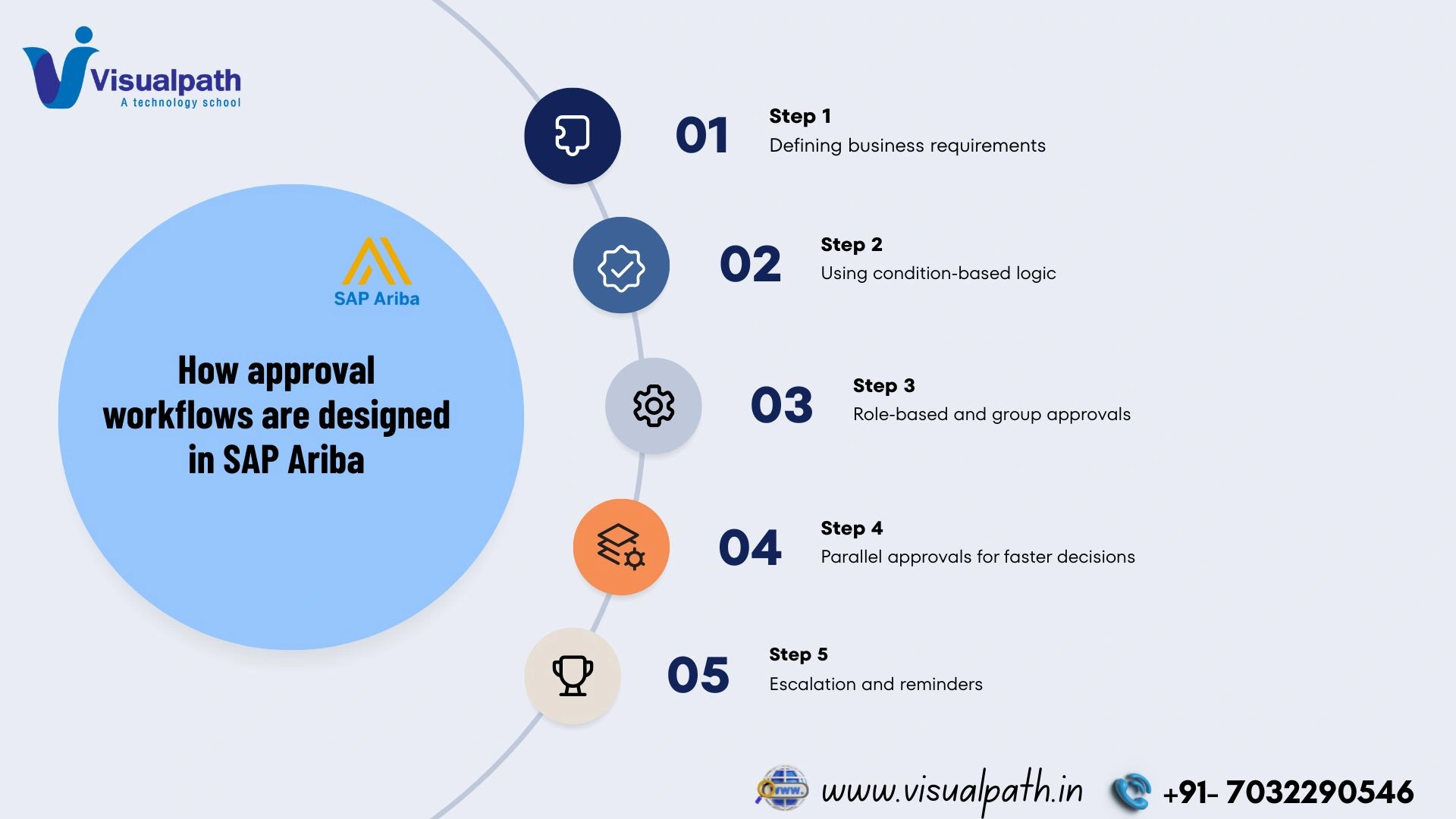
    How approval workflows are designed in SAP Ariba 2025

    Step 1: Defining business requirements

    Every workflow begins with business needs. Procurement teams work with finance, legal, and compliance teams to identify approval expectations. In SAP Ariba, consultants translate these requirements into system logic.

    For students learning SAP Ariba, this step highlights why functional understanding matters just as much as tool knowledge.

    Step 2: Using condition-based logic

    In 2025, SAP Ariba relies heavily on condition-based workflows. Instead of creating dozens of workflows, one intelligent workflow can handle multiple scenarios.

    For example, a single workflow can adjust automatically based on:

    • Total value of the request
    • Supplier risk rating
    • Contract type
    • Location of the requester

    This flexibility makes workflows easier to maintain and scale.

    Step 3: Role-based and group approvals

    Modern SAP Ariba workflows rely more on roles than individuals. Approvals go to job roles like “Procurement Manager” or “Finance Controller” instead of specific names.

    This design reduces dependency on user maintenance. When someone leaves the organization, workflows continue to function smoothly.

    Step 4: Parallel approvals for faster decisions

    One major improvement in 2025 is the wider use of parallel approvals. Legal and finance teams can review documents at the same time instead of waiting for each other.

    This change significantly reduces cycle times, which businesses value highly.

    Step 5: Escalation and reminders

    Approval delays cost money. SAP Ariba workflows now include automated reminders and escalation rules. If an approver does not respond within a defined time, the request moves to the next authority.

    This feature improves accountability without creating manual follow-ups.

    How AI enhances approval workflows in 2025

    SAP Ariba now integrates AI-driven insights into workflow decisions. This does not replace human approvals but supports smarter routing.

    For example:

    • High-risk suppliers trigger additional approval layers automatically
    • Repetitive low-value purchases may skip unnecessary approvals
    • Historical data helps predict approval bottlenecks

    Students interested in Cloud and AI careers will appreciate how SAP Ariba blends automation with business control. This is also why training providers like Visualpath include AI context along with core SAP Ariba learning.

    Real-life example of an approval workflow

    Imagine a procurement executive raising a purchase requisition for office equipment worth a moderate amount.

    The system first checks the value and assigns approval to the department manager. Because the supplier is pre-approved and low risk, legal review is skipped. Finance approval runs in parallel. Once both approvals are complete, the purchase order is created automatically.

    This smooth flow reflects how workflows support productivity rather than slowing it down.

    Career relevance of workflow knowledge

    Approval workflows form the backbone of SAP Ariba implementations. Interviewers often test candidates on workflow logic rather than navigation alone.

    Visualpath, known for SAP Ariba online training worldwide, emphasizes hands-on workflow understanding while also offering online training for related Cloud and AI courses. This combination helps learners stay relevant in a competitive job market.

    Common challenges and how 2025 addresses them

    Earlier versions of workflows felt rigid. Small changes required technical intervention. In 2025, configuration-driven design allows faster updates.

    Another challenge involved user confusion. Modern workflows now include clear approval status visibility, which improves user trust in the system.

    Best practices for students learning workflows

    Start by understanding procurement processes before diving into configuration. Learn why approvals exist, not just how they are set up.

    Practice mapping business scenarios to workflow rules. This habit helps you think like a consultant rather than a tool operator.

    Choose training programs that explain concepts clearly. Visualpath supports learners by breaking down workflows into simple, relatable examples.

    The future of SAP Ariba approval workflows

    Approval workflows will continue to evolve toward predictive and self-optimizing models. AI will recommend workflow improvements based on usage patterns.

    For students entering SAP Ariba careers now, learning workflows in 2025 means staying ahead of future trends.

    FAQs

    1. What is the main purpose of approval workflows in SAP Ariba?
    Approval workflows ensure business control and compliance for purchases and contracts.
    They also reduce delays by automating routing and approvals.
    2. Are approval workflows difficult to learn for beginners?
    They are easy to learn when explained with real examples.
    Structured training helps students understand logic step by step.
    3. How has SAP Ariba improved workflows in 2025?
    Workflows are more flexible, role-based, and AI-assisted.
    They adapt to business conditions instead of using fixed paths.
    4. Do approval workflows require coding knowledge?
    Most workflows are built using configuration, not coding.
    Functional understanding is more important than technical skills.
    5. Why are workflows important for SAP Ariba careers?
    They appear in almost every implementation and interview.
    Strong workflow knowledge increases project readiness and confidence.

    Conclusion

    Building approval workflows in 2025’s SAP Ariba is an art form that combines business strategy with smart technology. As organizations strive for “Autonomous Procurement,” the ability to design efficient, compliant, and AI-enhanced workflows will be the most valuable skill in your toolkit.

    If you’re ready to take the next step in your professional journey, specialized training is the key. Remember, Visualpath offers expert-led SAP Ariba online training worldwide, ensuring you stay ahead of the curve in Cloud and AI technologies.

    “Learn SAP Ariba implementation best practices in 2025 with Visualpath’s expert online training, real-time projects, and hands-on learning. Visualpath offers worldwide SAP Ariba training with in-depth sessions, daily recordings, and cloud & AI courses to boost your career growth.”

    Visit: https://www.visualpath.in/online-sap-ariba-training.html

    Contact Call/WhatsApp: +91-7032290546

  • Can D365 SCM Improve Real-Time Supply Visibility Now?

    Can D365 SCM Improve Real-Time Supply Visibility Now?

    Can D365 SCM Improve Real-Time Supply Visibility Now?

    Introduction

    In the fast-moving global market, organizations are under pressure to make quicker, smarter, and more precise supply chain decisions. Visibility is the backbone of efficiency yet many businesses still struggle with data silos, delayed reporting, and limited operational transparency. Modern tools like Dynamics 365 Supply Chain Management aim to change this by offering real-time insights across procurement, production, logistics, and delivery. With built-in automation, AI, and live dashboards, D365 SCM empowers companies to gain complete visibility and respond instantly to supply chain disruptions.

    How D365 SCM Enhances Real-Time Supply Chain Visibility

    1. End-to-End Tracking Across the Supply Chain

    One of the biggest advantages of Dynamics Supply Chain is its ability to unify fragmented data into a single digital environment. Operations that were previously managed separately such as warehousing, production, and transportation can now be viewed in one integrated platform. Real-time updates allow decision-makers to track orders, inventory movements, production status, and logistics in seconds.

    Key visibility benefits include:

    • Real-time order tracking
    • Up-to-date inventory availability
    • Production progress insights
    • Automated alerts for delays or disruptions

    This unified view eliminates guesswork and allows businesses to act faster and smarter.

    2. IoT-Driven Visibility for Smarter Operations

    IoT has become a powerful element in modern supply chain management. When integrated with D365 SCM, IoT devices transmit live data from warehouses, equipment, and transportation fleets.
    This connectivity enables:

    • Real-time temperature, location, and condition tracking
    • Predictive maintenance alerts
    • Machine performance insights
    • Live visibility into warehouse assets and equipment

    With IoT, supply chain leaders have precise visibility into every moving part of the operation improving speed, safety, and customer satisfaction.

    3. Inventory Visibility with AI and Real-Time Signals

    Inventory mismanagement is one of the major causes of supply chain delays, stockouts, and excess costs. The new Inventory Visibility Add-In for D365 SCM provides instant access to multi-channel inventory levels.
    Benefits include:

    • Global inventory visibility across locations
    • Real-time ATP (Available-To-Promise)
    • Demand-driven replenishment signals
    • Stockout and overstock prevention through automation

    AI-driven forecasting ensures inventory decisions are not based on old data but on real-time demand patterns.

    4. Enhanced Procurement and Supplier Transparency

    Supply chain visibility relies heavily on supplier performance. With the help of D365 SCM analytics, businesses can monitor supplier lead times, shipment accuracy, and compliance.
    This improves:

    • Supplier communication
    • Contract adherence
    • Lead time predictability
    • Risk identification in the supplier network

    When businesses know potential supply risks ahead of time, they can take early action to prevent disruptions.

    5. Transportation Visibility for Faster Delivery

    Real-time logistics visibility is essential for meeting customer expectations. D365 SCM’s transportation management tools provide:

    • Real-time shipment tracking
    • Route optimization
    • Carrier performance scoring
    • Delivery accuracy reporting
    • Predictive delay alerts

    Companies gain visibility from the moment goods leave the warehouse until they reach the customer’s hands.

    6. Warehouse Visibility with Automation and Sensors

    Modern warehouses are adopting automation, sensors, and robotics to improve accuracy and speed. When paired with D365 SCM, these tools create:

    • Real-time workforce and task visibility
    • Up-to-date picking and packing status
    • Live stock location updates
    • Automated cycle counting
    • Intelligent space utilization

    Operations become more predictable, accurate, and efficient.

    FAQs

    1. Why is real-time visibility important for supply chains?
    It helps businesses respond quickly to disruptions, reduce delays, improve customer satisfaction, and manage inventory more efficiently.
    2. Does D365 SCM support multi-location visibility?
    Yes, D365 SCM provides global visibility across warehouses, plants, transportation routes, and supplier networks.
    3. Can AI improve supply chain visibility?
    Absolutely. AI identifies patterns, predicts future risks, and automates decision-making for better accuracy and efficiency.
    4. Is IoT required for real-time visibility?
    Not required, but highly beneficial. IoT sensors enhance accuracy and allow real-time tracking of assets, machines, and shipments.
    5. Do users need training to use D365 visibility tools?
    Some training is helpful, especially for analytics, dashboards, and automation features. Advanced users gain full value through guided learning.

    Conclusion

    Real-time visibility is no longer an optional advantage it is a critical necessity for modern businesses. D365 SCM delivers a unified, intelligent, and data-driven approach to achieving complete supply chain transparency. With live dashboards, AI-powered insights, IoT connectivity, and predictive tools, companies can prevent disruptions before they occur and operate with greater confidence. As organizations strive for a more resilient and efficient supply chain, the role of Microsoft D365 Supply Chain Management becomes increasingly vital. Companies that embrace these capabilities now will be better prepared for future challenges and competitive opportunities.

    Visualpath is the Leading and Best Software Online Training Institute in Hyderabad

    For More Information about Best: Dynamics 365 Supply Chain Management (SCM)

    Contact Call/WhatsApp: +91-7032290546

    Visit: https://www.visualpath.in/online-dynamics-365-supply-chain-management.html

  • How Does PowerApps Manage Version Control for App Updates?

    How Does PowerApps Manage Version Control for App Updates?

    How Does PowerApps Manage Version Control for App Updates?

    Building your career with PowerApps or preparing for advanced Power Platform roles, understanding version control is one of the best ways to stand out. PowerApps is powerful, but many learners wonder how versioning actually works since it doesn’t follow traditional code-based tools like Git. This article walks you through how PowerApps handles version control for app updates in a clear, student-friendly way so you can strengthen your skills and become more confident as you grow in your Power Platform journey.

    As someone who has worked with many learners and career switchers, I’ve seen how critical version control becomes the moment your apps grow in complexity or start being used by teams. PowerApps offers built-in features to help you manage versions easily without needing coding or external systems. Even though it isn’t as advanced as Git-based pipelines by default, it’s more than enough for most business apps, especially when you understand how to use it properly.

    If you want more structured learning, Visualpath is one of the institutes offering PowerApps online training worldwide, helping learners gain the clarity and practice them need. We’ll mention more about their offerings as we go.

    Let’s break everything down step by step.

    Understanding How Version Control Works in PowerApps

    Version control in PowerApps revolves around the concept of auto-saving, versions, and publishing. Each time you save or publish your app, PowerApps stores a version of it inside the environment. These versions are not only stored but can also be restored anytime.

    This approach is particularly useful for teams that iterate fast, test often, and need the ability to revert changes in case something breaks. While it is not the same as having a branching strategy in a source control tool, it offers a practical, built-in solution that keeps things simple.

    PowerApps really shines for non-coders, and this versioning approach aligns perfectly with its low-code mission.

    Auto-Save and Manual Save: What’s the Difference?

    PowerApps automatically saves your changes while you work in the editor. This is helpful because you don’t have to worry about losing your progress. However, the auto-save feature creates draft versions that are visible only to you.

    For the rest of your organization to see changes, you must publish your app. Publishing creates a clear snapshot that becomes the latest available version for end users.

    This setup is ideal for learners and early-career professionals because it eliminates the complexity of managing multiple branches. At the same time, it provides clarity between a draft you’re experimenting with and a version that users rely on.

    Viewing and Restoring Previous Versions

    One of the most empowering features in PowerApps is the ability to browse every version ever saved.

    You can:

    • Open older versions
    • Compare how the app changed over time
    • Restore any earlier version instantly

    This feature can save you from hours of debugging. If a change accidentally breaks the layout, logic, or connectors, you can restore a stable version with a single click. Companies value this skill because it shows that you can manage risk, reduce downtime, and maintain stable applications—something hiring managers often look for.

    This is also why online PowerApps training, like the one offered by Visualpath, emphasizes hands-on practice with version management. Real-world projects often require troubleshooting, rollback, and testing—all skills that develop naturally as you work with versions.

    Publishing and Sharing Versions with Users

    Saving a version does not automatically release it to your users. Only publishing does.

    Publishing a version makes it live, meaning:

    • Users immediately access the new version
    • Any edits still in draft remain private
    • Your app maintains stability for people relying on it

    This process encourages good development practices, similar to staging and production environments even though everything happens inside PowerApps.

    For students and professionals moving toward Power Platform roles, this understanding is important. Organizations rely on stable apps, and knowing when and how to publish updates reflects your maturity as a developer.

    Exporting and Importing Versions

    PowerApps also allows exporting an app as a package.

    This is valuable when:

    • Migrating apps between environments
    • Backing up work for safety
    • Sharing apps with teammates

    You can import the package into another environment and either create a new app or update an existing one. This feature is especially useful for enterprise environments where apps move through development, testing, and production stages.

    As your career grows, you’ll likely interact with Application Lifecycle Management (ALM) concepts inside the Power Platform. Exporting and importing versions is the first step toward understanding ALM before you transition into more advanced tools like Azure DevOps or GitHub Actions.

    Enhanced Version Control with Power Platform ALM

    For those who want more advanced version control—especially those working toward long-term Power Platform roles—Microsoft offers the Power Platform Build Tools and integration with Azure DevOps or GitHub.

    These offer:

    • Source control via Git
    • Automated deployment pipelines
    • Environment-based testing
    • Continuous integration and continuous delivery (CI/CD)

    This is where many learners begin exploring deeper career paths like Power Platform Solution Architect or DevOps integration for low-code platforms.

    Visualpath, in addition to teaching PowerApps, also provides training in cloud and AI technologies like Azure and other Power Platform components. Learning these together gives you an advantage in higher-paying roles where system integration and workflow automation are needed.

    Best Practices for Managing App Versions in PowerApps

    To avoid confusion and maintain consistency, follow these reliable best practices:

    1. Publish only after testing

    Keep draft changes private until you thoroughly test them.

    2. Add detailed version notes

    This helps your team—and your future self—understand what changed and why.

    3. Restore responsibly

    When rolling back a version, make sure you review what functionality will be affected.

    4. Keep backups through export packages

    This adds a layer of safety, especially for enterprise-level apps.

    5. Move toward ALM as your skills grow

    Learning proper ALM tools increases your credibility and career opportunities.

    These practices not only protect your app but also demonstrate professionalism—qualities employers actively seek.

    Why Version Control Knowledge Boosts Your PowerApps Career

    PowerApps is becoming one of the most in-demand tools for automation and app building in modern organizations. Companies want professionals who can build solutions but also maintain and update them safely. Understanding version control is a sign that you can work effectively in real-world development environments.

    When you combine PowerApps skills with cloud or AI knowledge, your career options expand even further. This is why training providers like Visualpath emphasize practical, industry-oriented curriculum to help learners prepare for global job markets.

    Whether you’re aiming for roles like PowerApps Developer, Power Platform Consultant, or Solution Architect, version control is an essential foundation that will help you grow.

    FAQs

    1. How many versions of a PowerApps app are stored?
    PowerApps stores multiple versions automatically. You can view and restore any previous version at any time. This gives flexibility during development and troubleshooting.
    2. Do auto-saved versions become visible to users?
    No, auto-saved versions are visible only to the creator. Only published versions become available for end users in your organization.
    3. Can a restored version be published again?
    Yes. After restoring an older version, you can republish it so users receive the stable version. This protects workflows from breaking.
    4. Is external version control like Git required for PowerApps?
    Not required for basic apps, but helpful for large enterprise solutions. Advanced users integrate PowerApps with DevOps pipelines for full ALM.
    5. Can I move app versions between environments?
    Yes. You can export an app package and import it into another environment. This supports backup, migration, and team collaboration.

    Your Next Step in PowerApps Mastery

    Understanding the versioning and deployment process is a core pillar of a successful PowerApps career. It’s what separates a casual app maker from a professional Power Platform developer who can manage complex enterprise solutions.

    To accelerate your growth and master these advanced topics, including the implementation of professional ALM practices, consider dedicated training. Visualpath provides PowerApps online training worldwide, offering flexible, expert-led courses designed to give you hands-on skills for real-world projects. Beyond PowerApps, Visualpath also offers online training for all related Cloud and AI courses, ensuring you have the comprehensive skills needed for the future of tech. Start building a resilient, high-demand skill set today.

    Conclusion

    PowerApps makes version control simple and accessible, even for beginners who are just starting their journey in low-code app development. Its built-in features—such as auto-saving, version history, publishing controls, and environment-based exports—allow creators to experiment confidently while keeping user-facing versions stable. As you grow in your PowerApps career, learning how to manage versions effectively shows employers that you understand not just app development, but also responsible lifecycle management.

    For those who want to build deeper expertise, combining PowerApps skills with knowledge of cloud and AI tools opens the door to higher-level opportunities. Training providers like Visualpath support this growth by offering PowerApps online training worldwide along with courses on all major Cloud and AI technologies. With the right guidance and consistent practice, you can build apps that are easy to update, safe to deploy, and reliable for business users—key strengths that will set you apart in the evolving Power Platform job market.

    Visualpath is a leading online training provider delivering expert-led courses in Cloud, DevOps, PowerApps, and AI technologies. With real-time projects and hands-on learning, Visualpath helps professionals build job-ready skills worldwide.

    Visit: https://www.visualpath.in/microsoft-powerapps-training.html

    Contact Call/WhatsApp: +91-7032290546

  • Most Effective PowerApps Performance Optimization Techniques

    Most Effective PowerApps Performance Optimization Techniques

    Most Effective PowerApps Performance Optimization Techniques

    Building high-performing PowerApps applications is not only a technical skill—it is a career advantage. As businesses continue embracing low-code development for digital transformation, organizations look for professionals who can build apps that run smoothly, load quickly, and scale efficiently. If you are learning PowerApps or want to boost your skill set, understanding performance optimization techniques will set you apart in the job market.

    This article breaks down the most effective PowerApps performance optimization techniques in a clear, student-friendly way. It is written from the perspective of an experienced tech blog writer who understands both the technical and career growth aspects of learning PowerApps. You will also find insights on how expert training providers like Visualpath, known for delivering PowerApps online training worldwide, can help accelerate your learning journey.

    Data Optimization: The Foundation of Fast Apps

    The single biggest source of slow performance in PowerApps often comes down to how your app handles data. Master these techniques, and you’ll solve 80% of your performance problems.

    1. Embrace Delegation—it’s Non-Negotiable

    Delegation is the most critical concept for high-performance PowerApps. It means you let the data source (like Dataverse, SharePoint, or SQL Server) do the heavy lifting of filtering, sorting, and searching data, instead of pulling all the data into the app itself and processing it locally.

    When you use delegable functions (like Filter, LookUp, and Sort with compatible data sources), PowerApps sends the request to the server, which is far more efficient, especially with large datasets. If you use a non-delegable function (like Search on SharePoint or GroupBy), PowerApps can only process the first few hundred or a couple thousand records locally, which is slow and inaccurate. Always strive for the little blue dot that confirms your formula is fully delegable!

    2. Go Concurrent for Speedy Loading

    Ever had an app that needs to load data from three different sources when it starts up? If you write your formulas sequentially, each data call waits for the previous one to complete. This is a massive time-waster! PowerApps Online Training

    The Concurrent function is your best friend here. It allows you to run multiple formulas (specifically those making data/connector calls) simultaneously. Instead of:

    ClearCollect (A, SourceA); ClearCollect (B, SourceB); ClearCollect(C, SourceC);

    Use the concurrent version:

    Concurrent (ClearCollect (A, SourceA), ClearCollect (B, SourceB), ClearCollect(C, SourceC));

    This simple change can dramatically cut down on your app’s loading time, improving the user’s perception of speed right from the start.

    3. Cache Data Wisely in Collections

    While delegation is king for large, changing datasets, collections are perfect for smaller, relatively static reference data. Data stored in a collection resides in the device’s memory and is accessed almost instantly, avoiding repeated network calls.

    Use ClearCollect at app startup (OnStart) or on a screen’s OnVisible property to pull in things like:

    • Static lookup tables (e.g., a list of U.S. states).
    • User-specific profile data (e.g., the user’s name and department).

    Be careful not to overload collections with huge amounts of transactional data, as this can crash the app on memory-constrained devices.

    UI/UX and Control Optimization

    A fast backend isn’t enough if your front end is bogged down by too many visual elements. How you structure your screens and controls impacts performance just as much as your data calls.

    4. Limit Controls on a Single Screen

    Every control on a screen requires resources to load and render. A common anti-pattern for beginners is cramming too many text inputs, labels, and buttons onto a single screen. This creates a sluggish, unresponsive experience.

    Best Practice: Keep your screen design simple and focused. If a screen has more than 50-100 controls, you should consider:

    • Breaking up complex functionality into multiple, smaller screens.
    • Using Components to house repeating groups of controls (a component counts as just one control, regardless of its internal complexity!).
    • Employing Galleries to display repetitive data rows instead of individual labels for each item. A gallery item’s template only counts as one control instance.

    5. Be Smart About the OnStart Property

    The OnStart property runs every single time your app loads. Overloading it with slow, sequential data calls, complex calculations, or heavy-media loading is a surefire way to frustrate users with a long white startup screen.

    The Fix:

    • Only include essential global variables and some small collection initialization here.
    • Use the Concurrent function for any necessary parallel data loads (as discussed above).
    • Move any data loading that isn’t absolutely required for the first screen to the OnVisible property of the screen where that data is needed. This defers the load, making the initial app startup feel much faster. PowerApps Training

    6. Avoid Cross-Screen Dependencies

    A less obvious performance drain is referencing controls or data on a different screen. For example, if a formula on ScreenA refers to a Text Input control on ScreenB, PowerApps must load and keep ScreenB in memory, even if the user isn’t looking at it.

    Solution: Use variables and collections to pass data between screens. This decouples the screens, allowing PowerApps to efficiently manage memory and only load what’s actively required.

    The PowerApps Performance Toolkit

    Don’t just guess where the slowdowns are. PowerApps provides tools to help you diagnose performance issues like a pro.

    Use the PowerApps Monitor Tool

    The PowerApps Monitor tool is essential for serious optimization. It allows you to see all network calls, formula executions, and loading times in your app in real-time. By reviewing the monitor logs, you can pinpoint exactly which data calls are taking too long, which formulas are being executed unnecessarily, and which screen loads are the slowest. This moves you from guesswork to data-driven performance tuning.

    Consider Dataverse and Power Automate

    For high-volume, complex business processes, the ultimate optimization often involves moving heavy processing to the server side.

    • Dataverse: Using Dataverse as your primary data source is often a performance booster because it supports far more delegable functions and offers superior performance characteristics compared to other sources like SharePoint.
    • Power Automate: For complex, non-time-sensitive actions (like bulk data updates, generating large reports, or sending multiple notifications), offload the task to a Power Automate flow. This frees up the PowerApps client to respond instantly to the user while the heavy work runs asynchronously in the background.

    PowerApps Performance FAQs

    Q: What is PowerApps delegation and why is it important for speed?
    A: Delegation means the app sends data operations like filtering and sorting to the data source (server) to process. This is vital for performance because it avoids pulling massive datasets into the app’s memory for local, slower processing.
    Q: How can I speed up my app’s startup time?
    A: Limit the code and data calls in the OnStart property, use the Concurrent function for parallel loading of essential data, and defer non-critical data loading to the individual screen’s OnVisible property.
    Q: Should I use collections or delegation for all my data?
    A: Use delegation for large, frequently changing transactional data to ensure performance. Use collections for small, static lookup or reference data to cache it locally and minimize network calls.
    Q: What is the “N+1” problem in PowerApps and how do I avoid it?
    A: The N+1 problem is when an app makes one initial data request (N) and then makes an additional (often slow) request for every single row in the result set (+1). Avoid it by pre-fetching related data into a collection or leveraging Dataverse’s deep delegation support.
    Q: Does the number of controls on a screen really affect performance?
    A: Yes, absolutely. Each control consumes memory and requires time to render. Too many controls on one screen will make your app feel sluggish; use components and galleries to keep control counts low.

    Your Path to PowerApps Mastery

    Optimizing PowerApps performance is a key skill that separates an amateur builder from a sought-after professional. As the demand for low-code experts continues to grow, mastering these techniques directly translates into better job opportunities.

    If you are serious about a career in this field, finding the right training is the first step. Visualpath provides comprehensive PowerApps online training worldwide, giving you the hands-on, expert guidance you need to implement all these optimization techniques effectively. Furthermore, Visualpath offers online training for all related Cloud and AI courses, ensuring you are future-proofed with skills across the entire Microsoft ecosystem, from Azure to Power Automate. Stop building slow apps and start building solutions that get noticed!

    Visualpath is a leading online training provider delivering expert-led courses in Cloud, DevOps, PowerApps, and AI technologies. With real-time projects and hands-on learning, Visualpath helps professionals build job-ready skills worldwide.

    Visit: https://www.visualpath.in/microsoft-powerapps-training.html

    Contact Call/WhatsApp: +91-7032290546

  • How to Streamline Project Management Workflows with PowerApps?

    How to Streamline Project Management Workflows with PowerApps?

    How to Streamline Project Management Workflows with PowerApps?

    The world of project management is constantly looking for ways to move faster, smarter, and with fewer bottlenecks. If you’re a student or professional interested in career growth in the tech space, particularly in the Microsoft ecosystem, mastering PowerApps is your ticket to becoming indispensable.

    PowerApps, part of the Microsoft Power Platform, is a low-code platform that lets you build custom business applications without needing a traditional developer background. For project management, this means you can ditch clunky spreadsheets and manual updates for sleek, automated, and mobile-friendly custom apps. This is about more than just efficiency—it’s about turning you into a digital transformation leader.

    The Problem: Project Management Chaos

    Why do project workflows often feel so slow?

    • Manual Data Entry: Updating task status, logging time, or submitting a change request often involves emails or filling out complicated forms. This is slow and prone to error.
    • Data Silos: Project data lives across multiple platforms—SharePoint for documents, Excel for budgets, and Outlook for approvals. Getting a clear, real-time picture of a project’s health is nearly impossible.
    • Inefficient Approvals: Waiting for a manager to approve a crucial document or a change request can be the single biggest bottleneck, stalling entire project phases.

    The PowerApps Solution: Building the New Workflow

    PowerApps, especially when paired with Power Automate (for automation flows), offers a powerful solution by letting you create custom applications tailored exactly to your team’s needs.

    1. Custom Project Tracking Dashboards

    Forget generic dashboards. With PowerApps, you can create a centralized, single-screen view of all your projects.

    • Real-Time Status: Connect your app to data sources like Dataverse, SharePoint, or SQL Server. Your project manager can see a live-updating status of task completion, budget spend, and resource allocation—all in one place.
    • Mobile Access: The custom app works on a phone or tablet. Field teams or remote workers can update their task status or log an issue instantly, providing real-time data without needing to be at a desk.

    2. Automating the Pain Points

    PowerApps shines when you use it to automate repetitive, high-friction tasks.

    • Instant Change Requests: Build a “Change Request” app. A team member submits a request directly through the app, which automatically triggers a Power Automate flow. This flow routes the request to the correct manager, sends an urgent Teams notification, and logs the decision back into the app’s database—all in minutes, not days.
    • Time and Expense Logging: Create an app for team members to log their project hours or submit expenses on the go. The submission automatically attaches the receipt and kicks off the approval workflow, eliminating manual email trails and speeding up payroll.

    3. Enhancing Collaboration and Quality Control

    Project success hinges on communication and quality.

    • Quality Control Apps: For projects involving inspection or quality checks, a PowerApp can guide a user through a checklist, capture photos (using the mobile device camera), and automatically file a non-conformance report if a failure is detected. This ensures standardized quality across all deliverables.
    • Seamless Microsoft Integration: PowerApps integrates natively with Microsoft Teams, SharePoint, and Outlook. You can embed your custom project tracking app directly into a Teams channel, making it the single source of truth for the project team.

    Career Growth and Getting Started

    Companies worldwide are desperate for professionals who can bridge the gap between business needs and IT solutions using low-code tools.

    If you’re serious about building this in-demand skillset, finding the right training is essential. For comprehensive and flexible learning, Visualpath provides PowerApps online training worldwide, giving you the hands-on skills needed to build these transformative project management solutions. They understand the low-code revolution is here and offer online training for all related Cloud and AI courses as well, making them a great partner for your entire career journey.

    Building solutions that save time and money shows your value and accelerates your career. Professional training will help you turn complex project problems into simple, automated app solutions quickly.Visualpath is a leading option that can help you master the platform and build a portfolio of impactful applications.

    FAQ Questions

    Q1. What is the difference between a Canvas app and a Model-driven app for project management?
    A Canvas app offers maximum customization for a user interface, great for a specific task like time entry, while a Model-driven app is built around your data structure (like Dataverse) and is better for complex, process-heavy solutions like a full Project Management Office (PMO) system.
    Q2. Do I need coding experience to build a project app in PowerApps?
    No, PowerApps is a low-code platform that uses a formula language called Power Fx, which is similar to Excel formulas; anyone with strong logical and Excel skills can learn it quickly.
    Q3. Which Microsoft service should I use to store my project data for a PowerApp?
    For simple projects, a SharePoint list is often enough, but for enterprise-level applications needing complex business logic and security, you should use Dataverse.
    Q4. Can PowerApps handle task assignments and notifications?
    Yes, PowerApps works seamlessly with Power Automate to trigger flows, which can automatically send task assignment emails, Teams notifications, or follow-up reminders based on deadlines or status changes.
    Q5. Is PowerApps a replacement for Microsoft Project or Planner?
    No, PowerApps is a tool to extend and simplify them; you can build custom interfaces and workflows that connect to data stored in Microsoft Project or Planner, making the user experience much more efficient.

    Conclusion

    In an era where productivity and efficiency define success, PowerApps stands out as a transformative tool for project management. It empowers professionals and students to automate tasks, enhance collaboration, and make informed decisions — without needing to write complex code.

    Learning to streamline project management workflows with PowerApps simplifies work processes. It also opens doors to exciting career opportunities in the growing Power Platform ecosystem.

    With Visualpath’s PowerApps online training, you’ll gain the skills to build innovative business solutions. Whether you’re advancing your career or starting fresh in digital transformation, Visualpath provides the foundation you need to succeed.

    Visualpath is a leading online training provider delivering expert-led courses in Cloud, DevOps, PowerApps, and AI technologies. With real-time projects and hands-on learning, Visualpath helps professionals build job-ready skills worldwide.

    Visit: https://www.visualpath.in/microsoft-powerapps-training.html

    Contact Call/WhatsApp: +91-7032290546

  • What SAP Ariba capabilities does Spend Visibility provide in 2025?

    What SAP Ariba capabilities does Spend Visibility provide in 2025?

    What SAP Ariba capabilities does Spend Visibility provide in 2025?

    If you’re stepping into the world of procurement technology and aiming to grow your career in SAP Ariba, you’re in the right place. In this article I’ll walk you through the key capabilities of the Spend Visibility module in 2025—clearly, student-friendly, and from the perspective of someone who’s walked this path. I’ll also mention how Visualpath supports you with online training globally (including SAP Ariba and related Cloud & AI courses) so you understand how to move from interest to action.

    Understanding Spend Visibility in SAP Ariba

    When we talk about Spend Visibility, we’re referring to a core capability of the Ariba suite that helps organisations see what they’re spending, with whom, and where opportunities lie. At its heart, it aggregates procurement spend and supply-chain data across systems and presents that insight in a usable form. According to SAP documentation, Spend Visibility “aggregates and analyses disparate expenditure data to reveal near-real-time insights into organizational spend, suppliers.

    For you as a learner or aspiring SAP Ariba professional, learning the Spend Visibility module means you’re equipped to help organisations reduce cost leakage, improve supplier relationships, and make data-driven procurement decisions. It’s a strong differentiator on your resume.

    Key Capabilities of Spend Visibility in 2025

    Here’s a breakdown of the top capabilities that the Spend Visibility module in 2025 offers — and how these map to career-relevant skills:

    1. Centralised spend data aggregation and standardisation

    One of the foundational capabilities is gathering spend data from multiple sources: ERP, procurement systems, AP (accounts payable), even spreadsheets. The idea is to bring all that spend into one central view for analysis. As noted: “aggregates and standardises spend data from various sources, including ERP systems, procurement solutions, accounts payable, and spreadsheets.
    Career tip: Mastering how data is pulled, cleaned and standardised is key — this means you’ll learn about taxonomies, data cleansing rules, and how to make disparate systems talk to each other.

    2. Classification and enrichment of spend

    Raw data alone doesn’t help unless it’s useable. Spend Visibility applies classification (e.g., what was bought, category of spend) and enrichment (e.g., market intelligence, supplier info) so that the data becomes meaningful. According to the module description: “machine-learning based data classification and enrichment, market intelligence, advanced reporting, analytics”
    Career tip: Learning how classification and enrichment works means you’ll be able to turn messy procurement data into actionable insight — a major plus for any job in procurement analytics or Ariba consulting.

    3. Advanced analytics, dashboards and reporting

    Once the data is clean, the next capability is to analyse it: producing dashboards, pre-packaged reports and customizable views so stakeholders can see key metrics such as spend by category, supplier performance, contract compliance, and sourcing opportunities. One source mentions Spend Visibility “helps organizations analyse spend data, identify savings opportunities, improve supplier performance, and ensure better decision-making.
    Career tip: Gaining fluency in creating, reading and interpreting these analytics dashboards is a strong skill you can highlight—especially if you can show how you used Spend Visibility to make or recommend changes.

    4. Opportunity identification & cost savings focus

    A major business driver of Spend Visibility is to identify where savings can be made. Whether it’s spotted via maverick spend (off-contract purchases), duplicated suppliers, or opportunities to consolidate categories—this module is about turning insight into value. The best practice guide for Ariba notes you can “identify, quantify and prioritise sourcing opportunities that drive planned savings.
    Career tip: Being able to speak to “I identified X opportunity and that could save Y%” is a powerful story for interviews, especially when you’ve used Spend Visibility as your tool.

    5. Supplier and risk visibility

    Beyond spend, this capability helps you see supplier-level insights: who you’re buying from, are you concentrated with a few suppliers, are there risk indicators (supplier performance, contract adherence, geographic risk). One article states Spend Visibility brings “360-degree visibility of enterprise-wide procurement data … across all source systems.
    Career tip: In roles like Ariba consultancy or procurement analytics, being able to link spend patterns with supplier risk or performance gives you a broader strategic value. You’ll want to learn how to set up alerts or dashboards for supplier risk.

    6. Integration and alignment with broader Ariba / SAP ecosystem

    In 2025, Spend Visibility isn’t standalone—it’s integrated with other modules in the Ariba suite and with bigger SAP enterprise systems (such as SAP S/4HANA). One blog suggests that Ariba as a whole offers “a wide range of functionalities… driving efficiency, compliance, and cost savings” in procurement and sourcing.
    Career tip: Understanding how Spend Visibility fits into the broader Ariba architecture—knowing where outputs feed into sourcing, contract management, and procurement workflows—gives you that higher-level understanding employers look for.

    How this capability applies to your career and skill-growth

    If you’re targeting a career in SAP Ariba (consulting, procurement analytics, system implementation), mastering Spend Visibility is a smart move. Here’s how you can position it:

    • Analyst role: As a procurement analyst or category manager, you’ll use Spend Visibility to surface insights and support sourcing decisions.
    • Implementation consultant: You’ll help organisations set up, configure and customise Spend Visibility dashboards, data pipelines, taxonomy rules, and integrate them with Ariba and SAP systems.
    • Hybrid roles: Many organisations now expect procurement professionals to have data-skills (analytics, dashboards) along with system skills (Ariba modules). Spend Visibility bridges that gap nicely.

    This is where Visualpath enters the picture. At Visualpath, you can access global online training for SAP Ariba. The courses cover modules like Spend Visibility, sourcing, and contract management. You can also take Cloud and AI courses that complement the Ariba ecosystem. This kind of blended skill-set (procurement systems + cloud/AI analytics) positions you well for 2025-and-beyond roles.

    FAQ

    1. What is SAP Ariba Spend Visibility?
    It is a module within SAP Ariba that brings together procurement spend data from multiple sources, cleanses and classifies it, and presents dashboards and reports to help organisations understand spending, suppliers, and savings opportunities.
    2. Why is Spend Visibility important for an SAP Ariba career?
    Because organisations increasingly expect analytics-driven procurement professionals who can surface insights from spend data, not just run sourcing or contracts.
    3. What skills should I learn to use Spend Visibility effectively?
    You should focus on data aggregation and standardisation, classification (taxonomy), dashboard/report design, spend analytics (trend/variance), supplier risk insights, and understanding how this module links to sourcing/contract workflows.
    4. How does Spend Visibility integrate with other SAP Ariba modules?
    It feeds insights into the sourcing pipeline (helping identify sourcing opportunities), contract management (showing contract compliance & savings), and supplier management (supplier performance and risk).
    5. As a student or new professional, how can I get hands-on experience?
    You can enrol in online training programmes (such as the ones offered by Visualpath) that provide real spend datasets, training labs and dashboards.

    Practical tips for learners

    1. Start with data fundamentals: Before you dive deeply into Ariba, ensure you understand fundamentals of data aggregation, classification, and cleansing.
    2. Many training programs, like those from Visualpath, offer sample spend datasets. Use them to build dashboards or reports in Spend Visibility.
    3. When learning new capabilities, always ask, ‘What value does this bring to the business?’ This enhances your credibility.
    4. Explore how insights from Spend Visibility link to sourcing, contract lifecycle, and supplier management. This holistic view is powerful.
    5. Stay updated on Cloud & AI. As procurement tech evolves, understanding how cloud platforms and AI-driven analytics enhance Spend Visibility keeps you future-proof.

    Summary

    To wrap up: the focus keyphrase SAP Ariba Spend Visibility capabilities is central to the procurement analytics story in 2025. “The module provides data aggregation, classification, enrichment, advanced analytics, dashboards, and opportunity identification. It also offers supplier risk visibility and integrates with the broader Ariba/SAP ecosystem.” For you as a learner or aspiring professional, mastering this module is a strong career move. “Platforms like Visualpath offer training in SAP Ariba and related Cloud & AI courses. This helps you not only learn the tools but also drive business outcomes.” Embrace Spend Visibility, embrace procurement data intelligence, and you’ll be ready for a flourishing career in the SAP Ariba space.

    “Learn SAP Ariba implementation best practices in 2025 with Visualpath’s expert online training, real-time projects, and hands-on learning. Visualpath offers worldwide SAP Ariba training with in-depth sessions, daily recordings, and cloud & AI courses to boost your career growth.”

    Visit: https://www.visualpath.in/online-sap-ariba-training.html

    Contact Call/WhatsApp: +91-7032290546

  • How to Manage User Access and Permissions in PowerApps Securely

    How to Manage User Access and Permissions in PowerApps Securely

    How to Manage User Access and Permissions in PowerApps Securely

    Introduction

    PowerApps is one of Microsoft’s most powerful tools for creating business applications without heavy coding. However, with great power comes great responsibility—especially when it comes to managing user access and permissions. If you’re building a career in PowerApps, understanding how to secure your apps is one of the most valuable skills you can have.

    This guide will walk you through the best practices for managing user access and permissions in PowerApps securely. You’ll also discover how training programs like Visualpath’s PowerApps online training can help you gain the expertise needed to stand out in the Power Platform ecosystem.

    Why Secure Access Management Matters in PowerApps

    When developing apps in PowerApps, it’s essential to control who can view, edit, or manage your apps and data. Poorly managed access can lead to data leaks, compliance issues, or even accidental data loss.

    Good security practices protect your organization’s data and build trust among users. They also demonstrate your professional maturity—something employers actively seek in PowerApps professionals.

    Structuring Environments for Better Security

    Every PowerApps setup includes environments, and structuring them properly is your first step toward secure access control.

    • Development environment: For testing and experimenting safely.
    • Production environment: Where live business apps run—access should be tightly controlled.
    • Training environment: Used for demos and learning exercises.

    For students and professionals training throughVisualpath, creating separate environments helps you practice security and app deployment in real-world scenarios.

    Assigning the Right Roles and Permissions

    PowerApps uses roles to determine what each user can do within an environment. Common roles include:

    • Environment Admin: Manages all apps, flows, and data policies.
    • Environment Maker: Builds and shares apps but doesn’t manage admin settings.
    • User roles: Limited to running and using apps.

    Following the “principle of least privilege” means assigning users only the permissions they need to complete their tasks. This minimizes risks and ensures accountability.

    Using Groups for Efficient Access Control

    Instead of assigning permissions to individual users, it’s more efficient to use security groups. Security groups allow administrators to manage access for teams or departments collectively.

    For instance, you can create groups like “App Users,” “Approvers,” or “Admins” and assign roles to these groups within PowerApps. Whenever someone joins or leaves a team, their permissions update automatically when their group membership changes.

    This streamlined approach reduces administrative workload and prevents access errors.

    Implementing App-Level Security

    Beyond environment-level roles, it’s important to control what users can do inside the app. Different users might need different access:

    • End users can view or submit data.
    • Super users can approve or reject entries.
    • Admins can modify app settings or manage other users.

    Defining and documenting these roles ensures clarity and helps maintain security consistency across all your applications.

    Protecting Data Sources and Connectors

    Every app connects to data sources like SharePoint, Microsoft Dataverse, or SQL Server. Managing access to these data sources is as critical as controlling access to the app itself.

    To ensure data protection:

    • Limit access to data sources based on user roles.
    • Regularly review permissions to identify unnecessary access.
    • Use data policies to prevent unauthorized sharing of sensitive information.
    • Enable auditing to track who accesses or modifies data.

    By securing data sources, you prevent accidental exposure of critical information.

    Monitoring, Auditing, and Reviewing Access

    Security is not a one-time setup—it’s an ongoing process. Schedule regular reviews to ensure only authorized users have access to apps and data.

    Audit logs in the Power Platform help you track who creates, edits, or shares apps. Reviewing these logs can reveal unusual activity, such as changes made by users who shouldn’t have permission.

    Maintaining visibility into access patterns strengthens your governance model and keeps your environment compliant with company policies.

    Applying Conditional Access and Multi-Factor Authentication

    Another important layer of security is using Conditional Access and Multi-Factor Authentication (MFA). These features help confirm that only verified users access your apps, reducing risks from stolen credentials.

    For example, you can set policies that restrict access to corporate devices or require MFA for administrators. This aligns with the “zero-trust” security principle—never trust, always verify.

    By enforcing these measures, you ensure PowerApps environments stay secure even as teams grow and apps expand.

    Building a Governance Framework

    Governance is the foundation of long-term PowerApps success. A governance framework defines how permissions, environments, and policies are managed.

    Your framework should include:

    • A clear policy document outlining roles and responsibilities.
    • Procedures for granting and revoking access.
    • Regular security audits.
    • Guidelines for app sharing and publishing.

    Having structured governance not only keeps your organization secure but also showcases your professionalism when pursuing PowerApps-related career roles.

    Importance of Continuous Learning

    Technology evolves quickly, and so do PowerApps security practices. Continuous learning helps you stay updated on new features, compliance standards, and governance tools.

    Visualpath, a trusted name in online IT education, offers PowerApps online training worldwide. Their programs cover app building, automation, permissions management, and cloud integrations. Visualpath also provides courses in cloud computing and AI—helping you become a well-rounded professional in the Power Platform ecosystem.

    Investing in such training will strengthen your technical expertise and make you a valuable asset for organizations adopting Microsoft Power Platform solutions.

    FAQ Questions about the PowerApps Career Path in 2025

    What skills are essential for a PowerApps career in 2025?
    You need a mix of app development, data integration, automation, and security management skills.
    Why is understanding permissions important for PowerApps professionals?
    Because managing access securely ensures data integrity and is a top requirement for most Power Platform roles.
    How can I showcase my PowerApps skills to employers?
    Build sample projects, document governance models, and earn certifications through trusted training providers like Visualpath.
    What roles can I pursue after mastering PowerApps?
    You can become a PowerApps Developer, Power Platform Consultant, or Automation Specialist.
    How does Visualpath help in PowerApps career growth?
    Visualpath offers comprehensive PowerApps online training and related Cloud and AI courses, helping learners gain job-ready expertise.

    Conclusion

    Managing user access and permissions in PowerApps securely is vital for protecting data, maintaining compliance, and ensuring smooth collaboration. By setting up proper environments, assigning roles wisely, and monitoring permissions regularly, you create a secure and efficient ecosystem for your applications.

    For students and professionals looking to build a career in PowerApps, learning how to manage access securely is not just a technical skill—it’s a career booster. And with expert-led programs like Visualpath’s PowerApps online training, you can confidently take your PowerApps skills—and your career—to the next level.

    Visualpath is a leading online training provider delivering expert-led courses in Cloud, DevOps, PowerApps, and AI technologies. With real-time projects and hands-on learning, Visualpath helps professionals build job-ready skills worldwide.

    Visit: https://www.visualpath.in/microsoft-powerapps-training.html

    Contact Call/WhatsApp: +91-7032290546

  • How Does PowerApps Integrate with Dynamics 365 in 2025?

    How Does PowerApps Integrate with Dynamics 365 in 2025?

    How Does PowerApps Integrate with Dynamics 365 in 2025?

    In 2025, PowerApps continues to be an essential tool for businesses seeking to boost productivity and streamline operations. One of its most powerful integrations is with Microsoft Dynamics 365, a suite of enterprise resource planning (ERP) and customer relationship management (CRM) applications. This integration allows organizations to automate workflows, create custom applications, and drive digital transformation across various departments.

    If you are looking to enhance your career with skills in PowerApps and Dynamics 365 integration, Visualpath’s online training provides in-depth learning with real-time projects and hands-on experience. In this article, we will explore how PowerApps integrates with Dynamics 365 and why learning this powerful combination can significantly impact your professional growth.

    Understanding PowerApps and Dynamics 365 Integration

    PowerApps is a low-code development platform designed to help businesses create custom applications without deep technical expertise.

    • Automate workflows: PowerApps can trigger actions based on data changes in Dynamics 365, reducing manual work and improving efficiency.
    • Centralize data: Data from Dynamics 365 can be seamlessly accessed and used in custom PowerApps, ensuring that users have the most up-to-date information.
    • Enhance user experience: With PowerApps, you can build mobile-responsive applications that integrate directly with Dynamics 365, improving accessibility for users on the go.

    How PowerApps and Dynamics 365 Integration Enhances Business Processes

    The integration of PowerApps with Dynamics 365 delivers several key benefits for businesses. Here’s how:

    1. Streamlining Data Entry and Access
      PowerApps can connect directly to Dynamics 365, ensuring data is consistently synchronized across the organization.
    2. Improved Reporting and Analytics
      PowerApps can pull data from Dynamics 365 into custom reports and dashboards. These reports can be designed to provide key insights into sales, customer interactions, inventory, and more, empowering decision-makers with real-time analytics.
    3. Automating Repetitive Tasks
      the integration allows businesses to automate repetitive tasks like invoice generation, follow-up emails, or task assignments. Using PowerApps, workflows can be triggered automatically based on Dynamics 365 events, which saves time and enhances productivity.
    4. Custom Solutions for Specific Needs
      ChatGPT said:
    5. Connecting with Third-Party Applications
      one of the most valuable aspects of the PowerApps and Dynamics 365 integration is the ability to connect with third-party applications. You can link your apps built in PowerApps with other software systems you use, creating a seamless workflow across all platforms.

    Why Choose Visualpath for PowerApps and Dynamics 365 Training?

    As businesses continue to evolve and adopt cutting-edge technologies, the demand for skilled professionals in tools like PowerApps and Dynamics 365 is growing. Visualpath provides a comprehensive online training program that prepares you for success in these technologies.

    Here are some reasons why Visualpath is the right choice for your learning journey:

    1. In-depth Online Training

    Visualpath offers a structured online training curriculum that covers the full spectrum of PowerApps and Dynamics 365 integration.

    2. Real-Time Projects and Hands-On Learning

    One of the key benefits of Visualpath’s training is the hands-on approach. Students work on real-time projects, simulating actual business environments. This practical experience is invaluable as it allows you to solve real-world problems using PowerApps and Dynamics 365.

    3. Daily Recorded Sessions for Reference

    For those who may need to revisit topics or need extra clarification, Visualpath records daily sessions that students can access anytime. This flexibility ensures that learning can continue at your own pace, even after live sessions have ended.

    4. Comprehensive Cloud and AI Courses

    In addition to PowerApps and Dynamics 365, Visualpath offers a wide range of cloud and AI-related courses. These courses provide the latest knowledge on technologies such as cloud computing, artificial intelligence, machine learning, and more, all of which are increasingly integrated into modern business applications like Dynamics 365.

    Key Features of PowerApps and Dynamics 365 Integration

    As the world moves toward digital transformation, staying ahead of the curve is crucial. Understanding the key features of PowerApps and Dynamics 365 integration is essential for any business professional looking to thrive in the ever-evolving tech landscape.

    • No-Code/Low-Code Development: Even without deep coding knowledge, PowerApps enables you to create fully functional applications. This user-friendly feature makes it accessible to a broader audience, from business analysts to non-technical users.
    • AI Capabilities: Integrating AI tools within Dynamics 365 and PowerApps enables predictive analytics and automated decision-making, enhancing business processes.

    FAQs about PowerApps and Dynamics 365 Integration

    1. How can PowerApps help streamline my business workflows?
    PowerApps automates repetitive tasks and allows you to build custom applications that integrate seamlessly with Dynamics 365, reducing manual work and improving productivity.
    2. Do I need coding experience to use PowerApps with Dynamics 365?
    No, PowerApps is a low-code/no-code platform. This means that even non-technical users can create applications and workflows that integrate with Dynamics 365.
    3. How do I get started with learning PowerApps and Dynamics 365 integration?
    Enrolling in Visualpath’s online training courses is a great way to get started. Their in-depth curriculum and hands-on approach ensure you gain practical experience with PowerApps and Dynamics 365 integration.
    4. Can PowerApps integrate with other Microsoft tools besides Dynamics 365?
    Yes, PowerApps can integrate with other Microsoft tools like SharePoint, Teams, and Azure, as well as external data sources, making it a versatile solution for a variety of business needs.
    5. What are the benefits of real-time projects in PowerApps and Dynamics 365 training?
    Real-time projects allow you to apply what you’ve learned to real-world scenarios, helping you build the skills and confidence needed to solve business problems using PowerApps and Dynamics 365.

    Conclusion

    The integration of PowerApps with Dynamics 365 has revolutionized how businesses operate, making it easier to automate tasks, build custom solutions, and access real-time data. For professionals looking to enhance their skills in this area, Visualpath offers an excellent training opportunity to learn PowerApps and Dynamics 365 integration with hands-on experience, real-time projects, and expert guidance.

    As demand grows for experts in cloud computing, AI, and low-code development, mastering tools like PowerApps and Dynamics 365 can unlock exciting career opportunities.

    Visualpath is a leading online training provider delivering expert-led courses in Cloud, DevOps, PowerApps, and AI technologies. With real-time projects and hands-on learning, Visualpath helps professionals build job-ready skills worldwide.

    Visit: https://www.visualpath.in/microsoft-powerapps-training.html

    Contact Call/WhatsApp: +91-7032290546

  • What is SAP Ariba Contracts & Compliance Management Like in 2025?

    What is SAP Ariba Contracts & Compliance Management Like in 2025?

    What is SAP Ariba Contracts & Compliance Management Like in 2025?

    SAP Ariba has become a dominant force, streamlining complex business processes for companies of all sizes. As we move into 2025, SAP Ariba Contracts & Compliance Management continues to evolve, integrating new technologies and features that enhance contract lifecycle management, compliance checks, and supplier collaboration.

    In this article, we will explore what SAP Ariba Contracts & Compliance Management looks like in 2025, why it’s crucial for businesses, and how professionals can leverage Visualpath SAP Ariba online training to stay ahead of the curve in this fast-evolving space.

    What is SAP Ariba Contracts & Compliance Management?

    SAP Ariba is a cloud-based procurement platform that offers comprehensive solutions for managing the entire procurement process, from sourcing to supplier collaboration, and most importantly, contract and compliance management. This module is designed to ensure that organizations effectively manage supplier contracts while adhering to regulatory and internal compliance requirements.

    In 2025, the focus is shifting towards automation, AI-driven insights, and deeper integration with other enterprise systems to improve procurement efficiency. This will significantly reduce manual tasks, speed up the contract process, and ensure that businesses are meeting compliance standards seamlessly.

    SAP Ariba Contracts & Compliance Management is designed to handle the following:

    • Contract Lifecycle Management: This ensures that contracts are efficiently created, negotiated, approved, and executed while maintaining visibility throughout the entire lifecycle.
    • Compliance Monitoring: With AI and machine learning, SAP Ariba automatically flags potential compliance risks in contracts and procurement activities, helping companies mitigate risks before they escalate.
    • Supplier Collaboration: This is a critical aspect of the procurement process. SAP Ariba allows businesses to communicate and collaborate with suppliers in real-time, ensuring smooth contract execution and reducing potential delays.

    Key Features of SAP Ariba Contracts & Compliance Management in 2025

    1. AI-Powered Automation

    As artificial intelligence continues to evolve, SAP Ariba’s Contracts & Compliance Management system in 2025 is expected to be more intelligent than ever. AI will automate repetitive tasks like contract drafting, risk analysis, and approval workflows, allowing procurement teams to focus on strategic decision-making.

    AI will also enhance compliance management by continuously scanning contracts for non-compliant clauses or missing regulatory requirements. These capabilities will help organizations avoid costly fines or legal challenges related to contract violations.

    2. Integration with Cloud and Other Enterprise Systems

    In 2025, SAP Ariba will likely continue its deep integration with other enterprise systems like SAP S/4HANA, SAP Success Factors, and third-party tools. This enables a seamless flow of information between procurement, finance, HR, and other departments, ensuring that compliance is monitored across various touchpoints in an organization.

    This integration makes it easier for businesses to track and report on contracts and compliance activities in real time, giving better visibility into potential risks or contract breaches.

    3. Improved Supplier Risk Management

    Supplier compliance and risk management have always been a priority for businesses, and with SAP Ariba’s enhanced compliance features, this is becoming even easier. In 2025, the system will be able to predict and mitigate supplier risks using predictive analytics, helping organizations avoid potential disruptions in their supply chain.

    By leveraging real-time data, companies can better evaluate their suppliers’ financial health, ethical standards, and adherence to regulatory frameworks.

    4. Data-Driven Insights

    SAP Ariba Contracts & Compliance Management will continue to provide data-driven insights through advanced analytics and reporting tools. These insights help businesses make informed decisions about contract negotiations, supplier relationships, and risk management. With this data, organizations can drive better contract performance and improve compliance with internal and external standards.

    Why Choose Visualpath for SAP Ariba Training?

    Visualpath’s SAP Ariba online training offers comprehensive lessons and hands-on experience that prepare professionals for success in 2025’s procurement landscape.

    Real-Time Projects & Hands-On Learning

    What sets Visualpath apart is our emphasis on real-time projects and hands-on learning. Our SAP Ariba online training allows you to work on actual projects that simulate real-world procurement scenarios.

    Daily Recorded Sessions for Reference

    One of the most valuable aspects of Visualpath’s training is our daily recorded sessions. This flexibility lets you learn at your own pace and ensures you don’t miss any critical information.

    Comprehensive Coverage of Cloud and AI Courses

    These technologies are deeply integrated into SAP Ariba’s functionality in 2025. Taking these courses boosts career prospects by building expertise in cloud-based procurement solutions and AI-driven contract management systems.

    How SAP Ariba Enhances Career Growth

    SAP Ariba is a platform that is in demand across various industries, including manufacturing, retail, healthcare, and more. As organizations seek to optimize their procurement processes, professionals with expertise in SAP Ariba’s Contracts & Compliance Management are in high demand.

    • Procurement Manager
    • Contract Manager
    • Compliance Officer
    • SAP Ariba Consultant

    FAQs about SAP Ariba Contracts & Compliance Management

    1. What is the primary function of SAP Ariba Contracts & Compliance Management?
    SAP Ariba’s Contracts & Compliance Management helps businesses automate contract creation, monitor compliance, and manage supplier relationships efficiently.
    2. How does SAP Ariba enhance contract compliance?
    SAP Ariba uses AI and machine learning to automatically flag compliance risks and ensure that contracts meet regulatory standards.
    3. Why should I choose Visualpath for SAP Ariba training?
    Visualpath offers in-depth training with hands-on learning, real-time projects, and daily recorded sessions that help you master SAP Ariba effectively.
    4. How will SAP Ariba evolve in 2025?
    In 2025, SAP Ariba is expected to enhance its AI-driven automation and integrate more deeply with other cloud-based enterprise systems to improve efficiency and compliance.
    5. Can I get certified in SAP Ariba?
    Yes, after completing Visualpath’s training, you will be well-prepared for certification exams, which can further enhance your career prospects in procurement and compliance management.

    Conclusion

    As organizations strive to stay compliant and streamline operations, the demand for professionals skilled in SAP Ariba will only increase.

    With Visualpath’s SAP Ariba online training, you can position yourself as a leader in this field, mastering the tools and techniques required to navigate the evolving procurement landscape. Take the next step in your career by gaining hands-on experience, learning from real-time projects, and accessing valuable training resources tailored for today’s fast-paced business world.

    “Learn SAP Ariba implementation best practices in 2025 with Visualpath’s expert online training, real-time projects, and hands-on learning. Visualpath offers worldwide SAP Ariba training with in-depth sessions, daily recordings, and cloud & AI courses to boost your career growth.”

    Visit: https://www.visualpath.in/online-sap-ariba-training.html

    Contact Call/WhatsApp: +91-7032290546

  • How to Create Custom Forms and Dashboards in PowerApps?

    How to Create Custom Forms and Dashboards in PowerApps?

    How to Create Custom Forms and Dashboards in PowerApps?

    Introduction

    PowerApps is a robust platform that allows businesses to create custom apps and solutions without extensive coding knowledge. One of the most powerful features of PowerApps is its ability to help you create custom forms and dashboards. These can significantly improve your business workflows, data collection, and decision-making processes. If you’re looking to enhance your PowerApps skills, Visualpath’s PowerApps online training offers in-depth learning to guide you through the complexities of form creation, dashboard development, and much more.

    In this article, we will walk you through the process of creating custom forms and dashboards in PowerApps. By the end of this guide, you’ll have a strong understanding of the tools and techniques needed to build powerful applications that suit your specific business needs.

    Why Create Custom Forms and Dashboards in PowerApps?

    Creating custom forms and dashboards in PowerApps allows businesses to streamline data collection, enhance user experiences, and make data-driven decisions faster. Custom forms provide an intuitive interface for users to input data, while dashboards offer a visual overview of key metrics and insights. These features are crucial for organizations looking to simplify operations and improve productivity.

    Some of the reasons to create custom forms and dashboards in PowerApps include:

    • Improved User Experience: Custom forms can be tailored to specific data entry needs, improving the ease of use for users.
    • Better Data Management: With custom dashboards, you can display real-time data and track key performance indicators (KPIs).
    • Increased Productivity: By automating data collection and reporting, teams can focus on higher-value tasks.

    Now, let’s dive into the step-by-step process of creating custom forms and dashboards.

    How to Create Custom Forms in PowerApps?

    Custom forms in PowerApps can be created using a variety of data sources, such as SharePoint, Excel, and SQL databases. Follow these steps to create a simple custom form:

    1. Set Up Your Data Source
      first, you need to set up your data source. PowerApps supports various connectors to data sources such as SharePoint, SQL Server, and even custom APIs. Choose the source you want to connect to and ensure it’s properly configured.
    2. Create a New PowerApp
      Once your data source is ready, go to the PowerApps home screen and select Create. Choose the Canvas App option, which is ideal for creating custom forms.
    3. Design the Form Layout
      In the PowerApps editor, you can drag and drop controls such as text fields, drop-down lists, and date pickers onto the canvas to design your form. Ensure the layout is intuitive for users to input their data easily.
    4. Connect the Form to Your Data Source
      after adding the necessary controls, connect each control to the relevant data field from your data source. This step is essential as it ensures that the form fields are correctly populated when users submit data.
    5. Add Logic and Validation
      you can add logic to your form using PowerApps formulas. For example, you might want to validate that certain fields are filled in before the form is submitted. You can also set rules that trigger specific actions based on user input.
    6. Publish and Share Your Form
      once the form is complete, publish it so users can start filling it out. PowerApps also allows you to set permissions to control who can access and submit data through the form.

    Creating custom forms in PowerApps is a simple yet powerful way to enhance your data collection and business processes.

    How to Create Dashboards in PowerApps?

    Dashboards in PowerApps provide a consolidated view of key metrics and data, helping users make informed decisions. Here’s how you can create a custom dashboard:

    1. Start with a New Canvas App
      Just like custom forms, dashboards are also created using the Canvas App option. Choose Blank App to start a new dashboard project.
    2. Add Visual Elements
      PowerApps provides several charting controls such as bar charts, pie charts, and line charts. Use these to represent your data visually. You can also add other visual components like tables, maps, and KPIs to enhance the dashboard.
    3. Connect to Your Data Source
      just as with forms, your dashboard needs a data source to pull real-time information. Connect your dashboard to a data source like SharePoint or SQL Server and set up queries to fetch the relevant data.
    4. Design the Dashboard Layout
      Use the drag-and-drop interface in PowerApps to organize your charts, tables, and other components. Customize the design to ensure it’s easy to navigate and visually appealing.
    5. Add Filters and Interactivity
      you can add filters to your dashboard to allow users to drill down into specific data. For example, users could filter a sales dashboard by region or time period. Adding interactive elements enhances the user experience.
    6. Publish and Share the Dashboard
      After completing the dashboard, publish it and share it with your team or stakeholders. You can set up real-time data refreshes to ensure the dashboard always displays up-to-date information.

    Why Choose Visualpath for PowerApps Training?

    When it comes to mastering PowerApps, having a strong foundation in the platform’s capabilities is crucial. Visualpath offers specialized PowerApps online training worldwide, ensuring that learners can acquire the skills necessary to build custom forms, dashboards, and apps from scratch.

    Here’s why Visualpath stands out:

    1. In-Depth Online Training

    Visualpath’s PowerApps training provides a comprehensive understanding of all PowerApps features, from form creation to dashboard development. The course covers both beginner and advanced topics, ensuring that you’ll master PowerApps in no time.

    2. Real-Time Projects & Hands-On Learning

    What sets Visualpath apart is their focus on real-world, hands-on experience. Through practical projects and assignments, learners can apply the concepts they’ve learned in a real-world setting, enhancing their understanding and boosting confidence.

    3. Daily Recorded Sessions for Reference

    Visualpath provides daily recorded sessions of their live classes, ensuring that students can revisit lessons and reinforce their learning whenever they need to. This is especially helpful for learners who prefer a flexible learning schedule.

    4. Cloud and AI Courses

    In addition to PowerApps, Visualpath also offers courses on a wide range of cloud and AI technologies, giving you the opportunity to upskill in multiple areas. Whether you want to learn Azure, AWS, or AI, Visualpath’s diverse training options can help you build a future-ready skill set.

    Top 5 FAQ Questions

    What is PowerApps used for?
    PowerApps is used to create custom business applications without extensive coding knowledge. It allows users to build forms, dashboards, and apps to streamline processes.
    Can I create a custom form without coding in PowerApps?
    Yes, PowerApps allows you to design custom forms using a drag-and-drop interface, with minimal to no coding required.
    What types of data sources can I connect to PowerApps?
    PowerApps supports various data sources like SharePoint, Excel, SQL Server, and more. You can also connect to custom APIs.
    What are the benefits of PowerApps dashboards?
    Dashboards in PowerApps offer real-time data visualization, helping users track key metrics and make data-driven decisions.
    How does Visualpath’s PowerApps training help learners?
    Visualpath offers comprehensive PowerApps training with real-time projects, hands-on learning, and daily recorded sessions, making it an ideal choice for anyone looking to learn PowerApps from scratch.

    Conclusion

    Creating custom forms and dashboards in PowerApps is a valuable skill that can significantly improve your business processes and data management. With the right training, such as the PowerApps online training provided by Visualpath, you can unlock the full potential of PowerApps and build applications that streamline operations, enhance decision-making, and boost productivity.

    Whether you’re looking to start a career in app development or simply want to enhance your PowerApps knowledge, Visualpath’s in-depth online training offers the perfect platform to get started. With real-time projects, hands-on learning, and daily recorded sessions, you’ll have all the resources you need to succeed.

    Visualpath is a leading online training provider delivering expert-led courses in Cloud, DevOps, PowerApps, and AI technologies. With real-time projects and hands-on learning, Visualpath helps professionals build job-ready skills worldwide.

    Visit: https://www.visualpath.in/microsoft-powerapps-training.html

    Contact Call/WhatsApp: +91-7032290546

  • How does the Buying and Invoicing function in SAP Ariba 2025?

    How does the Buying and Invoicing function in SAP Ariba 2025?

    How does the Buying and Invoicing function in SAP Ariba 2025?

    Introduction

    The digital transformation of procurement is accelerating in 2025, with SAP Ariba emerging as a leader in simplifying buying and invoicing for organizations. As businesses aim for greater efficiency, compliance, and visibility, mastering SAP Ariba’s buying and invoicing workflows becomes crucial for career growth. This guide explores how the buying and invoicing function in SAP Ariba 2025 works, with practical insights and tips from Visualpath, a top provider of SAP Ariba online training worldwide.

    How Does the Buying Process Work in SAP Ariba 2025?

    • Catalog Access: Employees access pre-approved supplier catalogs, ensuring procurement from verified sources.
    • Requisition Creation: Users create purchase requisitions through self-service, supported by AI recommendations for faster selection and compliance.
    • Approval Workflow: Requisitions route automatically to designated approvers based on company policy. Real-time dashboards help track status.
    • Purchase Order Generation: Once approved, the system automatically generates and sends purchase orders to suppliers, ensuring compliance and transparency.

    A robust SAP Ariba invoicing workflow integrates buying and payment processes seamlessly, driving efficiency and visibility for procurement teams.

    Buying Process Work in SAP Ariba 2025?

    • Catalog Access: Employees access pre-approved supplier catalogs, ensuring procurement from verified sources.
    • Requisition Creation: Users create purchase requisitions through self-service, supported by AI recommendations for faster selection and compliance.
    • Approval Workflow: Requisitions route automatically to designated approvers based on company policy. Real-time dashboards help track status.
    • Purchase Order Generation: Once approved, the system automatically generates and sends purchase orders to suppliers, ensuring compliance and transparency.

    A robust SAP Ariba invoicing workflow integrates buying and payment processes seamlessly, driving efficiency and visibility for procurement teams.

    Invoicing Works in SAP Ariba 2025

    • Invoice Submission: Suppliers submit invoices electronically through the Ariba Network, which is integrated directly with the buyer’s system.
    • Invoice Validation: SAP Ariba checks invoices against purchase orders and receipts, automatically flagging discrepancies for review.

    Why Choose Visualpath for SAP Ariba Training?

    In-Online Training Depth

    Real-Time Projects & Hands-On Learning

    Training includes real-time scenarios and hands-on projects, allowing professionals to gain practical skills that are immediately applicable to the workplace.

    Daily Recorded Sessions for Reference

    Extensive Course Portfolio

    The SAP Ariba invoicing feature is central to procurement transformation, reducing cycle times and empowering finance teams to work strategically.

    Career Growth with SAP Ariba Skills

    With SAP Ariba becoming the global standard for procurement automation, mastering its buying and invoicing functions is a valuable asset for professionals. Visualpath’s expert-led, hands-on training ensures participants are job-ready and positioned for advancement in the digital supply chain era.

    FAQs about SAP Ariba Buying and Invoicing

    1. What are the main features of SAP Ariba invoicing?
    A. Automated invoice matching, real-time tracking, electronic submission, and compliance with procurement policies.
    2. How does SAP Ariba improve procurement efficiency?
    A. It automates requisition, approval, order, and payment processes, reducing manual effort and errors.
    3. Can Visualpath’s SAP Ariba training be accessed worldwide?
    A. Yes, Visualpath provides comprehensive SAP Ariba online training accessible to learners globally.
    4. Does Visualpath offer training for cloud and AI courses?
    A. Absolutely, Visualpath offers a range of online training for SAP, cloud, and AI courses to keep professionals future-ready.
    5. Are recorded SAP Ariba training sessions available for review?
    A. Yes, daily recorded sessions are available for reference, letting learners revisit material anytime.

    Conclusion

    Understanding how SAP Ariba invoicing functions in 2025 is essential for anyone pursuing a career in procurement or finance. The move towards automated, AI-driven buying and invoicing processes presents significant opportunities for skill development and advancement. Visualpath offers leading SAP Ariba invoicing training, along with a diverse selection of cloud and AI courses, empowering professionals to stay at the forefront of digital transformation. Start elevating your career with Visualpath’s expert-driven, real-world online training today.

    “Learn SAP Ariba implementation best practices in 2025 with Visualpath’s expert online training, real-time projects, and hands-on learning. Visualpath offers worldwide SAP Ariba training with in-depth sessions, daily recordings, and cloud & AI courses to boost your career growth.”

    Visit: https://www.visualpath.in/online-sap-ariba-training.html

    Contact Call/WhatsApp: +91-7032290546

  • Why Microsoft Dynamics CRM is Key for 2025 Success

    Why Microsoft Dynamics CRM is Key for 2025 Success

    Why Microsoft Dynamics CRM is Key for 2025 Success

    In this article, we’ll explore why Microsoft Dynamics CRM is key for business success in 2025 and why Visualpath’s Microsoft Dynamics CRM online training is an excellent option to accelerate your career in this field. With the ever-growing demand for CRM expertise, enhancing your skills through trusted platforms like Visualpath could be your gateway to exciting career opportunities.

    The Growing Importance of CRM in 2025

    Customer relationship management (CRM) has long been a critical aspect of business success.

    These integrations allow businesses to centralize customer data, automate workflows, and deliver more personalized experiences.

    Key Benefits of Microsoft Dynamics CRM in 2025:

    • Seamless Integration: With Microsoft Dynamics CRM, businesses can leverage existing tools like Outlook and Excel, creating a unified experience that reduces the learning curve for employees.
    • Data-Driven Insights: The platform offers powerful analytics capabilities, enabling businesses to harness customer data and make informed decisions based on real-time insights.
    • Customer Engagement: Personalized marketing, customer support, and sales automation features ensure that businesses can create long-lasting relationships with their customers.
    • AI-Powered Automation: As AI continues to advance, Dynamics CRM integrates intelligent automation to handle routine tasks, allowing teams to focus on higher-value work.

    As businesses increasingly prioritize customer-centric strategies, Microsoft Dynamics CRM will be a cornerstone for achieving these goals, making it a key tool for future success.

    Why Choose Visualpath for Microsoft Dynamics CRM Training?

    For anyone looking to harness the power of Microsoft Dynamics CRM in their career, enrolling in a high-quality training program is essential. Visualpath, known for its comprehensive and globally recognized training programs, offers top-tier online courses that are designed to prepare you for success in this rapidly growing field.

    Visualpath’s Microsoft Dynamics CRM Online Training

    Visualpath provides Microsoft Dynamics CRM online training worldwide, catering to professionals at all levels.

    Here’s why Visualpath is the best choice for your Dynamics CRM training:

    1. In-Depth Online Training

    Visualpath’s Microsoft Dynamics CRM course offers detailed modules that cover everything from the basics to advanced functionalities.

    2. Real-Time Projects & Hands-On Learning

    In the fast-paced world of CRM, hands-on experience is crucial. Visualpath’s training goes beyond lectures and theoretical content by providing real-time projects that allow students to apply their knowledge in practical settings. By working on these live projects, you gain real-world experience that boosts your confidence and expertise.

    This hands-on approach ensures you are ready to tackle real business challenges using Microsoft Dynamics CRM, which is a crucial factor for success in today’s job market.

    3. Daily Recorded Sessions for Reference

    One of the standout features of Visualpath’s online training is the availability of daily recorded sessions.

    4. Comprehensive Cloud & AI Courses

    As the demand for Cloud and AI-related skills continues to rise, Visualpath offers specialized courses that integrate these technologies with Microsoft Dynamics CRM.

    5. Global Recognition and Support

    Visualpath’s training programs are recognized worldwide, making it an excellent choice for students and professionals looking to enhance their careers globally.

    How Microsoft Dynamics CRM Can Shape Your Career in 2025

    By gaining expertise in Microsoft Dynamics CRM, you’ll be equipped to:

    • Drive Sales Growth: Utilize the advanced analytics and automation tools within Dynamics CRM to optimize sales strategies and boost revenue.
    • Streamline Business Operations: By automating key business processes and centralizing customer data, you’ll help businesses run more efficiently.

    With the right training, you can position yourself as an expert in a field that’s set to see enormous growth in the coming years.

    FAQ About Microsoft Dynamics CRM

    What is Microsoft Dynamics CRM, and why is it important?
    Microsoft Dynamics CRM is a platform designed to manage customer relationships, automate processes, and analyze customer data. It’s crucial for businesses aiming to streamline their operations and provide better customer experiences.
    How long does it take to learn Microsoft Dynamics CRM?
    The time it takes to learn Microsoft Dynamics CRM depends on your prior knowledge and the depth of the course you’re taking. Generally, it can take anywhere from a few weeks to a few months to gain proficiency.
    Can I take Microsoft Dynamics CRM training online?
    Yes, Visualpath offers comprehensive online training for Microsoft Dynamics CRM that allows you to learn at your own pace, with hands-on projects and recorded sessions for reference.
    What career opportunities are available after learning Microsoft Dynamics CRM?
    After completing training, you can pursue roles such as CRM Developer, CRM Consultant, CRM Administrator, and more, in industries ranging from IT to healthcare, retail, and finance.
    Why should I choose Visualpath for Microsoft Dynamics CRM training?
    Visualpath provides in-depth online training with hands-on projects, daily recorded sessions, and global recognition. The company also offers courses on Cloud and AI technologies, which enhance your CRM skills.

    Conclusion

    As we move closer to 2025, Microsoft Dynamics CRM will continue to be an essential tool for businesses aiming to succeed in a customer-centric world. By gaining proficiency in Dynamics CRM, you’ll be equipped with the skills necessary to drive business success and advance your career.

    Visualpath’s Microsoft Dynamics CRM online training offers the perfect opportunity to develop these skills with real-time projects, hands-on learning, and flexible study options.

    Visualpath is a leading online training provider offering expert-led courses in Cloud, AI, DevOps, and enterprise technologies worldwide. With real-time projects and daily recorded sessions, Visualpath ensures hands-on learning for career growth.

    Contact Call/WhatsApp: +91-7032290546

    Visit: https://www.visualpath.in/online-microsoft-dynamics-crm.html

  • SAP Ariba handle multi-geography or multi-currency scenarios in 2025

    SAP Ariba handle multi-geography or multi-currency scenarios in 2025

    SAP Ariba handle multi-geography or multi-currency scenarios in 2025

    Global enterprises in 2025 face unique challenges: managing suppliers across multiple countries, transacting in different currencies, and complying with varied regulatory frameworks. SAP Ariba continues to be one of the most reliable procurement platforms that helps organizations navigate multi-geography and multi-currency needs efficiently.

    This article explores how SAP Ariba scenarios are handled in today’s business environment, why adopting the right approach matters, and how professionals can build skills to thrive in this global procurement ecosystem.

    Understanding Multi-Geography and Multi-Currency Needs

    Businesses expanding globally encounter multiple geographies with distinct complexities. These include language barriers, unique tax rules, local compliance requirements, and cultural dynamics. Alongside geography, organizations must also manage transactions in multiple currencies, where exchange rates, financial policies, and localized reporting add layers of complexity.

    SAP Ariba scenarios are designed to simplify both. It enables procurement teams to:

    • Adopt standardized procurement templates while allowing for country-level customization.
    • Manage supplier onboarding workflows across different regions.
    • Integrate seamlessly with ERP systems to handle multiple currencies.
    • Apply compliance monitoring and rule-based workflows for each market.

    How SAP Ariba Handles Multi-Geography Scenarios in 2025

    In 2025, SAP Ariba has evolved with advanced AI-driven and cloud-based capabilities to help global procurement and supplier management. Some key capabilities for multi-geography include:

    • Localized Compliance and Regulations: The system supports region-specific compliance checks, reducing legal risks.
    • Global Supplier Collaboration: Enterprises can onboard suppliers worldwide on a single platform while customizing workflows by country or region.
    • Language and Tax Localization: Support for multiple languages and tax frameworks ensures that teams from different geographies collaborate without barriers.
    • AI-driven Risk Insights: Predictive analytics help identify regional risks before they impact operations.

    By centralizing procurement processes and still offering flexibility for local needs, SAP Ariba scenarios ensure organizations remain competitive in diverse markets.

    How SAP Ariba Handles Multi-Currency Scenarios in 2025

    For multinational companies, handling different currencies is critical. Ariba introduces multiple features that businesses use in 2025 to address cross-border transactions:

    • Dynamic Currency Conversion: Real-time exchange rate updates allow accurate cost projections in procurement.
    • Multi-Currency Approvals: PO approvals, invoicing, and contracts can be handled in native local currencies.
    • Consolidated Reporting: Finance teams can generate reports in a base currency while still tracking details in local currencies.
    • Risk Mitigation: Currency fluctuation risks are reduced through automated adjustment mechanisms embedded in procurement workflows.

    These functionalities mean global procurement teams can minimize complexity and ensure transparency in supplier payments and cross-border sourcing.

    Career Growth with SAP Ariba in 2025

    Understanding SAP Ariba scenarios is more than just a business requirement—it’s a career booster. Companies want professionals who can manage global operations seamlessly. Skills in handling both multi-geography and multi-currency complexities make a candidate highly valuable.

    Training in SAP Ariba equips professionals to:

    • Configure workflows for international procurement.
    • Build strategies to mitigate currency and regional risks.
    • Gain expertise in integrated supplier and contract management.
    • Deliver measurable value to global organizations.

    This is why many professionals turn to specialized learning platforms like Visualpath, which offers in-depth SAP Ariba and cloud-related training worldwide.

    Why Choose Visualpath?

    If you want to gain expertise in SAP Ariba scenarios in 2025, structured learning is essential. Visualpath is recognized as a trusted provider of SAP Ariba online training globally, delivering both foundational and advanced learning.

    Here’s what makes Visualpath stand out:

    • In-Online Training Depth: The course covers the full SAP Ariba lifecycle with focus on practical implementations.
    • Real-Time Projects & Hands-On Learning: Learners work on projects that replicate real global procurement conditions.
    • Daily Recorded Sessions for Reference: Each session is recorded, giving professionals the ability to revisit lessons anytime.
    • All Cloud and AI Courses Provided: In addition to SAP Ariba, Visualpath trains professionals in cloud technologies and AI for broader career opportunities.

    By choosing Visualpath, professionals benefit from comprehensive global training that aligns perfectly with modern enterprise needs.

    Best Practices for Handling Multi-Geography and Multi-Currency in SAP Ariba

    To get the most out of SAP Ariba in handling multi-geography and multi-currency scenarios, follow these best practices:

    1. Standardize Procurement Processes: While every geography may have its own regulations, it’s important to standardize core procurement processes across regions. SAP Ariba offers the flexibility to tailor workflows, while ensuring compliance with local requirements.
    2. Use Real-Time Currency Data: Leverage SAP Ariba’s integration with financial systems to access real-time exchange rate data. This ensures that currency conversions are accurate and up-to-date, reducing financial discrepancies.
    3. Training and Education: Train your procurement team on how to effectively use SAP Ariba for global operations. Visualpath’s SAP Ariba online training programs, which are available worldwide, offer in-depth coverage of these complex scenarios, equipping you with the skills you need to succeed.
    4. Enable Cross-Regional Communication: Foster clear communication between teams in different geographies. Use collaboration tools integrated within SAP Ariba to streamline communication and reduce delays.
    5. Leverage Analytics for Decision-Making: Use SAP Ariba’s reporting and analytics capabilities to gain insights into procurement trends across different geographies. This helps in making data-driven decisions for cost reduction and supplier optimization.

    FAQs

    1. What are multi-geography scenarios in SAP Ariba?
    A. They refer to procurement processes customized for different geographies, including compliance, local languages, and supplier onboarding.
    2. How does SAP Ariba manage multi-currency transactions?
    A. It uses real-time currency conversion, allows invoices and approvals in local currencies, and provides consolidated reporting.
    3. Why should professionals learn SAP Ariba in 2025?
    A. It’s a critical skill for managing global procurement and offers high career growth opportunities.
    4. How does Visualpath support SAP Ariba training?
    A. Visualpath offers online training with real-time projects, recorded sessions, and complete SAP Ariba lifecycle coverage.
    5. Can SAP Ariba integrate with ERP systems for global operations?
    A. Yes, SAP Ariba integrates seamlessly with multiple ERP systems to support multi-geography and multi-currency workflows.

    Conclusion

    Handling multi-geography and multi-currency procurement is no longer optional—it’s an essential competitive strategy for truly global enterprises in 2025. SAP Ariba scenarios empower businesses to manage supplier relationships, navigate compliance, and streamline financial consistency across borders.

    For professionals, expertise in this area opens doors to career advancement. Platforms like Visualpath make this journey accessible with quality SAP Ariba training, practical projects, recorded sessions, and additional cloud and AI learning opportunities.

    If your goal is to handle complex procurement challenges and accelerate your career growth, mastering SAP Ariba scenarios is the way forward.

    “Learn SAP Ariba implementation best practices in 2025 with Visualpath’s expert online training, real-time projects, and hands-on learning. Visualpath offers worldwide SAP Ariba training with in-depth sessions, daily recordings, and cloud & AI courses to boost your career growth.”

    Visit: https://www.visualpath.in/online-sap-ariba-training.html

    Contact Call/WhatsApp: +91-7032290546