Tag: SAP AI Course Online

  • What Role Does SAP AI Play in Data Intelligence Workflows?

    What Role Does SAP AI Play in Data Intelligence Workflows?

    What Role Does SAP AI Play in Data Intelligence Workflows?

    What Role Does SAP AI Play in Data Intelligence Workflows?

    Introduction

    SAP Artificial Intelligence Course Online helps learners understand how AI fits into SAP’s modern data workflows. SAP AI connects data, models, and business logic to help companies make faster decisions. Data Intelligence workflows use AI to transform raw data into insights and automation. This article explains how SAP AI supports these workflows with the latest 2025 updates.

    1. Key concepts of SAP AI in data workflows

    Data Intelligence connects data from many sources and prepares it for business use. SAP AI adds learning, prediction, and automation to those pipelines. AI Core manages model training and inference. AI Foundation manages governance and monitoring. Together they create reliable AI-driven workflows. Good data quality makes AI stronger and more accurate.

    2. Key differences across components

    SAP Data Intelligence handles ingestion, transformation, metadata, and pipeline flow. It connects cloud systems, databases, and applications. SAP AI adds modelling, scoring, and automation. HANA provides fast storage and processing. Pipelines push data into AI models and return predictions to business systems. These elements work together as one unified system.

    3. Key examples and real use cases

    • One example is demand forecasting. Retail companies collect sales data and convert it into features. SAP AI models predict customer needs and write results back to the system. This helps planners reduce stock issues.
    • Another example is quality inspection. Images or sensor readings go through pipelines. AI models detect defects and signal production teams. This reduces waste and speeds up delivery.
    • A third example is fraud detection. Data Intelligence gathers transaction data. AI models find unusual patterns and warn teams before damage occurs. These use cases show how SAP AI adds intelligence directly into operations.

    4. Benefits for better understanding

    SAP AI makes decisions faster. It reduces manual effort. It increases accuracy in predictions. It helps teams work with clean data. It creates automated processes that reduce delays. It improves governance through trackable models. It also supports both cloud and edge deployments for flexible operations.

    5. Step-by-step workflow with clear results

    Step 1: Ingest and catalo data

    Pipelines collect data from SAP and non-SAP sources. Data Intelligence catalogues everything for quick tracing. This builds trust in the data.

    Step 2: Prepare and transform

    Teams clean and reshape data. They apply business rules and create features. These features power the AI models.

    Step 3: Train AI models

    Models train in SAP AI Core. They use structured and unstructured data. Teams test different versions to improve results. This step finds the most useful model for the task.

    Step 4: Validate and govern

    Models go through fairness, accuracy, and robustness checks. AI Foundation stores versions and logs approval steps. Businesses avoid risk by keeping the best models ready for use.

    Step 5: Deploy the model

    Deployment happens in cloud or edge environments. Low-latency cases use edge nodes. Large-scale tasks use cloud runtimes.

    Step 6: Integrate with business workflows

    Predictions flow back into SAP S/4HANA or other systems. Automated workflows use these predictions to trigger actions like reorders, alerts, or scheduling changes.

    Step 7: Monitor and retrain

    Model drift happens over time. Teams watch performance and retrain when accuracy drops. This keeps AI reliable and useful.

    6. Extended view of integration patterns

    Data pipelines run across hybrid environments. HANA manages high-speed access. Data Intelligence controls connectors and logic. SAP AI supports advanced models for text, images, and tabular data. This gives companies many options for automation. Joule copilots use these models to assist users across SAP apps.

    7. Latest trends and 2025 updates

    SAP expanded AutoML features to make model creation easier. This supports teams with less coding experience. New governance tools help companies control data use and protect sensitive fields. Edge AI support improved so factories and stores can run real-time insights. Unified APIs reduce integration effort and shorten project timelines. These updates make SAP AI easier to adopt in many industries.

    8. Where to begin for learners and teams

    Start with defined business problems. Choose small tasks that show visible gains. Collect high-quality data before training. Practice building pipelines and models. A structured SAP Artificial Intelligence Course Online helps learners build these skills. Hands-on projects teach how to move models from prototype to production.

    9. Practical tips for real AI projects

    Always keep data lineage updated. Store feature sets for reuse. Encrypt sensitive data. Track business KPIs along with model accuracy. Set retraining rules early. Build simple dashboards for monitoring. Use pipeline alerts to catch failures quickly. These habits make AI reliable and trustworthy.

    10. Business impact from real projects

    Retail companies reduce lost sales by improving forecasts. Manufacturing plants reduce defects and downtime. Finance teams catch fraud faster. Supply chains run more smoothly with predictive models. Field teams save time through automation. These outcomes prove why SAP AI is becoming essential in every industry.

    11. Examples revisited with outcomes

    A retail brand improved stock accuracy within weeks. A manufacturing company reduced inspection errors. A logistics firm improved delivery planning with predictive routing. These companies used AI pipelines built with SAP Data Intelligence. Learners can study such patterns through SAP AI Training to understand real project journeys.

    FAQs

    Q. What is the role of AI in SAP?

    A. AI supports predictions, automation, and decision-making inside SAP systems. Visualpath explains these roles in practical labs.

    Q. What is the role of AI in data exploration?

    A. AI highlights patterns, detects issues, and suggests insights during data analysis.

    Q. What is SAP data intelligence used for?

    A. It manages data pipelines, transformations, metadata, and feature preparation for AI workflows.

    Q. How do you see the role of AI in your workflow?

    A. AI reduces manual work and improves insight quality for faster decisions and smoother operations.

    Conclusion

    SAP AI plays a major role in modern data intelligence workflows. It enhances data pipelines, improves accuracy, and supports real-time decisions. SAP’s 2025 updates make AI more powerful, more governed, and easier to integrate. Small pilots help teams learn what works and scale safely. Learners can gain deep understanding through SAP AI Training programs designed for practical experience. Those needing structured classroom learning can choose SAP Artificial Intelligence Course Online to build job-ready expertise. With the right skills and tools, SAP AI can transform any data-driven workflow.

    Visualpath offers hands-on learning to help you grow your career with enterprise-ready AI skills. Visit our website:- https://www.visualpath.in/sap-artificial-intelligence-training.html

    Or contact:- https://wa.me/c/917032290546

    Us to join the next batch.

  • How SAP AI and BTP Transform Business Intelligence Today

    How SAP AI and BTP Transform Business Intelligence Today

    How SAP AI and BTP Transform Business Intelligence Today

    How SAP BTP and AI Transform Business Intelligence Today

    Introduction

    SAP AI is helping companies make faster and smarter decisions.
    It uses machine learning and automation to improve data analysis.
    With SAP BTP as a support platform, it brings real-time insights into every business process. Professionals who wish to master these tools can join SAP AI Training in Bangalore to gain real-world experience.

    Latest Update: 2025 – SAP has added advanced AI models and natural language tools for business users.

    Table of contents

    • Key concepts of SAP AI
    • How SAP AI works (step-by-step)
    • Key differences between old and new BI
    • Key examples and benefits
    • Step-by-step business results
    • FAQs

    1. Key concepts of SAP AI

    SAP AI combines machine learning, predictive analytics, and automation.
    It helps users find insights hidden in complex data. SAP BTP connects all these AI tools with business applications. Together, they bring better speed, accuracy, and smarter reporting.

    2. How SAP AI works (step-by-step)

    Step 1: Gather all data from SAP and non-SAP systems.
    Step 2: Clean and prepare it using AI models.

    Step 3: Train predictive models for key areas like sales or finance.

    Step 4: Get instant dashboards through SAP Analytics Cloud.

    Step 5: Make faster decisions using live reports.

    To understand these steps in detail, learners can join SAP AI Course Online for guided practice.

    3. Key differences between old and new BI

    Old BI used static reports and manual data entry. It required hours to update charts. New BI powered by SAP AI offers predictive analytics and automation. It helps users see what may happen next, not just what happened before. This new setup saves time and improves business accuracy.

    4. Key examples and benefits

    Example 1: Sales forecasting

    AI models in SAP predict demand with high accuracy.

    Benefit: Businesses reduce stock waste and plan better.

    Example 2: Finance automation

    AI automates invoice matching and fraud detection.

    Benefit: Fewer errors and faster closing cycles.

    Example 3: HR analytics

    AI checks skill gaps and hiring patterns.

    Benefit: Smarter workforce planning.

    Example 4: Customer support

    AI chatbots manage basic queries.

    Benefit: Employees can focus on complex requests.

    For a deeper understanding, professionals can explore SAP AI Training in Bangalore to gain real project experience with such examples.

    5. Step-by-step business results

    Step 1: Choose a process that needs improvement.

    Step 2: Connect data using SAP BTP.

    Step 3: Train a simple AI model in SAP AI.

    Step 4: Use the results in daily dashboards.

    Step 5: Monitor improvements over time.

    This process turns data into meaningful business actions.

    SAP AI and modern business trends

    In 2023, SAP introduced AI-driven predictive dashboards. In 2024, SAP added more low-code AI tools. In 2025, new natural language query features were launched. Now, anyone can type “Show sales growth for next month” and get instant reports. This makes SAP AI easy for both technical and non-technical users. Those who wish to learn these updates can take SAP AI Course Online for flexible learning options.

    Practical uses and industry success

    Many industries now rely on SAP AI to stay competitive. Retailers use it for demand prediction. Banks use it to detect fraud patterns. Manufacturers use it for equipment maintenance. These real-time insights drive better results with less effort. Visualpath offers practical learning paths where students apply such AI use cases.

    Learning and training options

    Visualpath provides hands-on training using real SAP AI projects.
    It helps students learn automation, data preparation, and analytics.
    Learners get practical exposure through guided labs.

    If you prefer classroom learning, SAP AI Training in Bangalore is ideal.
    It gives live mentorship and real industry examples.

    This helps learners build strong BI and AI skills.

    Those with busy schedules can go for SAP AI Course Online.
    It includes recorded videos, live sessions, and assignments.

    This option works well for professionals who study from home.

    SAP AI learning paths offer both flexibility and depth.

    With proper guidance, even beginners can master data analytics easily.

    Key benefits of SAP AI

    1. Real-time insights from business data.
    2. Less manual work through automation.
    3. Smarter reports with accurate predictions.
    4. Easy integration with SAP BTP applications.
    5. Enhanced decision-making across departments.

    SAP AI is growing fast, and 2025 trends show even deeper automation.
    Professionals can upskill through SAP AI Training in Bangalore to stay ready for these changes.

    FAQs

    Q. How is AI transforming business intelligence?

    A. AI finds patterns and predicts results. It turns data into fast, clear insights. Visualpath teaches these methods.

    Q. What is the primary purpose of AI Foundation on SAP BTP?

    A. It lets users create and manage AI models without complex coding.

    Q. How does SAP use artificial intelligence?

    A. SAP uses AI in finance, HR, and operations to automate and predict trends.

    Q. How can companies use SAP BTP in digital transformation?

    A. They connect data and apply SAP AI models for smart, digital workflows.

    Conclusion

    SAP AI is now the heart of business intelligence.

    It helps companies predict outcomes, automate work, and make data-driven choices.

    By learning through SAP AI Course Online or attending SAP AI Training in Bangalore, professionals can gain practical knowledge for real success.
    With these skills, businesses can grow faster in the intelligent era of 2025.

    Ready to unlock the power of SAP AI?
    Start your learning journey today with Visualpath your trusted partner for hands-on SAP AI skills.
    Get in touch with us to know more: https://www.visualpath.in/sap-artificial-intelligence-training.html

    Or https://wa.me/c/917032290546

  • Key Differences between SAP AI and Traditional AI Platforms

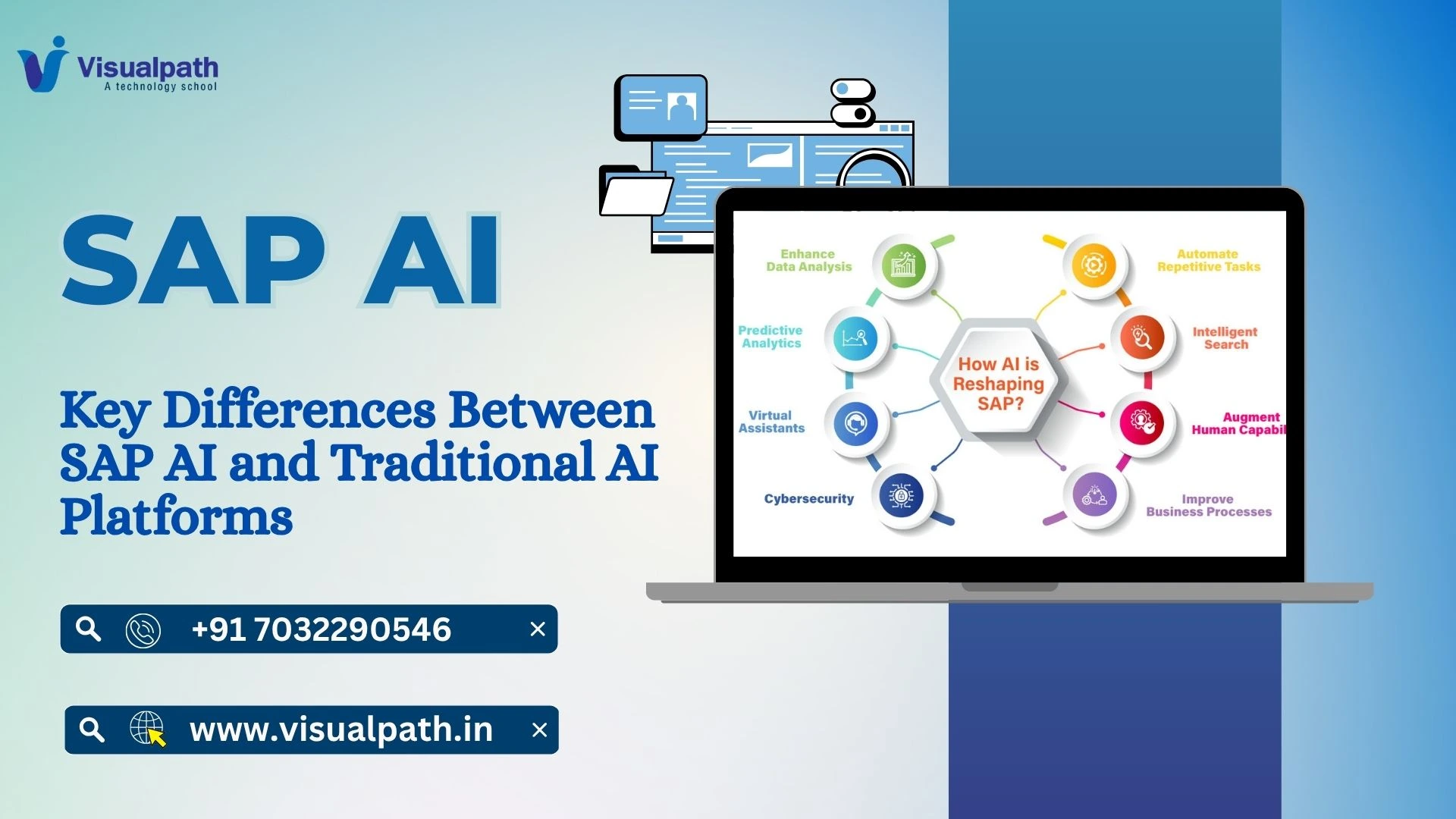
    Key Differences between SAP AI and Traditional AI Platforms

    In today’s digital-first world, businesses are increasingly adopting artificial intelligence to enhance efficiency, reduce operational costs, and make data-driven decisions. SAP AI Training has become crucial for professionals aiming to implement AI effectively within enterprises. Unlike traditional AI platforms, which often focus primarily on data analytics or standalone machine learning solutions, SAP AI is designed to seamlessly integrate with business processes. This integration allows organizations to harness AI for real-time insights, predictive analytics, and automated decision-making, making it a strategic choice for enterprise transformation.

    1. Integration with Enterprise Systems

    Traditional AI platforms usually operate as independent systems, requiring extensive customization to connect with ERP, CRM, or supply chain software. SAP AI, however, is natively designed to integrate with SAP S/4HANA, SAP Business Technology Platform (BTP), and SAP Data Intelligence. This deep integration ensures that AI can operate directly within business workflows, providing actionable insights without the need for complex middleware. Companies benefit from reduced implementation times, streamlined operations, and a more cohesive digital ecosystem.

    2. Pre-Built Business Services

    One of the standout features of SAP AI is its pre-built AI business services. These services include capabilities such as invoice processing, predictive maintenance, talent management, and customer service automation. Traditional AI platforms generally require businesses to build such solutions from scratch, which can be time-consuming and resource-intensive. SAP AI allows enterprises to quickly deploy AI-driven applications, improving operational efficiency and accelerating digital transformation initiatives.

    3. Scalability and MLOps

    Scalability is another area where SAP AI stands out. Through SAP AI Core and SAP AI Launchpad, organizations can deploy AI models at scale, monitor performance, and automate retraining using MLOps practices. Traditional AI platforms often lack these enterprise-grade operational capabilities, making it challenging to maintain and optimize AI models over time. Professionals undergoing SAP Artificial Intelligence Training gain the expertise to leverage these scalable solutions effectively, ensuring AI adoption aligns with long-term business goals.

    4. Data Management and Governance

    Data is the backbone of AI, and SAP AI excels in enterprise-grade data governance. It ensures that data quality, compliance, and orchestration are maintained across multiple sources. Traditional AI platforms might require additional tools to achieve the same level of governance, leading to fragmented systems and potential data silos. SAP AI simplifies data management, allowing organizations to trust the integrity of insights generated and maintain regulatory compliance effortlessly.

    5. Customization and Flexibility

    While traditional AI platforms offer significant flexibility for creating custom AI models, SAP AI provides a balance between pre-configured solutions and customization. Enterprises can extend or modify AI models according to specific business requirements while leveraging SAP’s secure and compliant infrastructure. This balance reduces development time, lowers operational risks, and enables faster time-to-market for AI-driven solutions.

    6. Support and Ecosystem

    SAP offers extensive support through its global partner network, training programs, and community forums. Organizations can leverage pre-configured AI applications, expert guidance, and industry best practices to implement AI faster and more effectively. Traditional AI platforms often rely heavily on in-house expertise or third-party vendors, which can slow down deployment and increase overall costs. With SAP AI, enterprises have a robust ecosystem that accelerates AI adoption and ensures continuous improvement.

    7. Advanced AI Capabilities

    SAP AI is continuously evolving, incorporating next-generation technologies like generative AI and AI-driven business process automation. Traditional AI platforms may struggle to integrate these cutting-edge capabilities into enterprise workflows. By participating in SAP Artificial Intelligence Course Online, professionals can stay updated on emerging AI trends, learn how to implement them within SAP environments, and ensure organizations remain competitive in an AI-driven economy.

    8. Improved ROI and Efficiency

    Choosing the right AI platform directly impacts an organization’s return on investment. SAP AI allows businesses to leverage existing enterprise data, pre-built AI services, and automated workflows to maximize efficiency. Traditional AI platforms, while powerful, often require more time, resources, and customization to deliver comparable outcomes. By investing in training such as SAP AI Training, enterprises can accelerate adoption, reduce operational costs, and enhance overall performance.

    9. Real-World Applications

    SAP AI’s advantages are most apparent when applied to real-world scenarios. For example, in supply chain management, SAP AI can predict inventory shortages and optimize logistics. In finance, it can enhance forecasting and detect anomalies. In HR, SAP AI helps improve talent acquisition and workforce planning. These solutions are integrated directly into business processes, unlike traditional AI, which often requires separate deployments and manual integration steps.

    FAQ,s

    1. What is SAP AI?
    AI integrated with SAP systems for enterprise automation and insights.
    2. How does SAP AI differ from traditional AI?
    SAP AI integrates with business processes; traditional AI is often standalone.
    3. What are SAP AI Core and Launchpad?
    Tools to deploy, monitor, and manage AI models at enterprise scale.
    4. What training is available for SAP AI?
    SAP AI Training, SAP Artificial Intelligence Training, SAP AI Course Online.
    5. Why choose SAP AI for enterprises?
    Faster adoption, scalable solutions, data governance, and higher ROI.

    Conclusion

    Understanding the key differences between SAP AI and traditional AI platforms is critical for enterprises aiming to adopt intelligent technologies. SAP AI’s integration with enterprise systems, pre-built services, scalable MLOps infrastructure, and strong support ecosystem make it a superior choice for organizations looking to achieve meaningful AI-driven transformation.

    Visualpath stands out as the best online software training institute in Hyderabad.

    For More Information about the SAP AI Online Training

    Contact Call/WhatsApp: +91-7032290546

    Visit: https://visualpath.in/sap-artificial-intelligence-training.html

  • What is SAP Conversational AI and how does it work?

    What is SAP Conversational AI and how does it work?

    SAP Conversational AI is an enterprise-grade chatbot development platform designed to help organizations automate communication and enhance customer experiences. It allows businesses to create intelligent chatbots capable of handling support queries, guiding users through processes, and integrating with SAP systems for seamless business operations. This AI solution focuses on natural language processing (NLP) to understand user intent and provide accurate responses.

    In today’s AI-driven business world, platforms like SAP AI Online Training have become essential for professionals looking to master these technologies and implement them effectively in real-world projects.

    How SAP Conversational AI Works

    1. Natural Language Understanding (NLU)

    SAP Conversational AI uses NLU to understand user messages, identify their intent, and extract key data. This enables bots to respond in a human-like manner.

    2. Bot Skills and Logic

    Developers can create bot skills such as FAQs, transactional processing, or guided workflows. These skills define how the bot reacts to specific user inputs.

    3. Integration with SAP Systems

    SAP Conversational AI integrates with SAP S/4HANA, SAP SuccessFactors, and other SAP solutions, enabling direct execution of business processes via chatbot commands.

    4. Multilingual Capabilities

    The platform supports multiple languages, making it suitable for global business communication.

    Key Features of SAP Conversational AI

    1. Easy Bot Training: Drag-and-drop tools for defining intents and training datasets.
    2. API Connectivity: Connects with SAP and non-SAP systems for automation.
    3. User Context Management: Maintains session data for personalized interactions.
    4. Analytics and Monitoring: Track bot performance and improve accuracy over time.

    Benefits of Using SAP Conversational AI

    1. 24/7 Customer Support: Automates common queries, reducing workload on support teams.
    2. Increased Efficiency: Speeds up workflows by integrating directly with SAP transactions.
    3. Cost Savings: Reduces operational costs by automating repetitive processes.
    4. Scalability: Easily expands to handle large user bases without extra human resources.

    In the modern enterprise ecosystem, SAP Artificial Intelligence Training is highly valuable for learning to design, deploy, and maintain such AI-driven chatbot systems effectively.

    Real-World Use Cases of SAP Conversational AI

    1. HR and Employee Self-Service: Assists employees in checking leave balances, payroll, or HR policies.
    2. Customer Service Automation: Handles product inquiries, complaints, and order status requests.
    3. Procurement Assistance: Guides users in creating purchase orders and tracking supplier deliveries.
    4. IT Helpdesk Support: Resolves technical issues and provides troubleshooting steps.

    Why Learn SAP Conversational AI?

    SAP Conversational AI is more than just a chatbot builder — it’s a strategic tool for digital transformation. As businesses increasingly adopt AI, professionals with SAP AI skills will be in high demand. A SAP Artificial Intelligence Course Online can help you master not only chatbot development but also AI integration with SAP’s entire ecosystem.

    Trending Courses: Artificial Intelligence, Azure Solutions Architect, SAP AI

    Visualpath stands out as the best online software training institute in Hyderabad.

    For More Information about the Azure Data Engineer Online Training

    Contact Call/WhatsApp: +91-7032290546

    Visit: https://www.visualpath.in/online-azure-data-engineer-course.html

  • Integrating TensorFlow or Scikit-learn Models into SAP  

    Integrating TensorFlow or Scikit-learn Models into SAP  

    Artificial Intelligence (AI) and Machine Learning (ML) are transforming how enterprises manage data, automate tasks, and drive innovation. SAP, with its robust Business Technology Platform (BTP), enables developers to bring AI capabilities directly into SAP systems. If you’re looking to integrate TensorFlow or Scikit-learn with SAP, this guide will walk you through the process.

    1. Understand the Use Case and SAP Landscape

    Before integration, identify the specific SAP module or application that will consume the AI model. For example, you may want to use a Scikit-learn model for customer churn prediction in SAP Customer Data Cloud or a TensorFlow model for invoice classification in SAP S/4HANA. Also, assess whether the integration will be real-time or batch-based.

    • Train and Export the Model in TensorFlow or Scikit-learn

    Develop your ML model using either TensorFlow or Scikit-learn in a Python environment. After training and validating your model, export it using formats such as .pb (for TensorFlow) or joblib/pickle (for Scikit-learn). This step ensures your model is ready for deployment outside the local environment.

    • Use SAP AI Core for Deployment

    SAP AI Core is the best way to manage and deploy your models. It acts as a runtime for ML operations and supports containerized model deployments. With SAP AI Online Training, learners can understand how to containerize models using Docker and manage lifecycle processes such as deployment, scaling, and monitoring with SAP AI Core.

    • Register the Model in SAP AI Launchpad

    Once deployed, register the model in SAP AI Launchpad to manage and execute it across SAP applications. Launchpad offers orchestration, versioning, and visibility into how your AI assets are being consumed. It serves as the central hub for your models in the SAP ecosystem.

    • Expose the Model via REST API

    Use SAP AI Core to expose your model through an HTTP endpoint. This RESTful API allows other SAP applications or custom-built apps within SAP BTP to interact with the model. REST APIs ensure seamless communication between the model and the consuming application.

    • Integrate with SAP Application (e.g., S/4HANA, SAP Fiori)

    Next, connect the REST API to your target SAP application. For instance, if using SAP Fiori, you can consume the API through JavaScript/HTML5 frontend logic. Similarly, for backend integration in S/4HANA, you can use ABAP code or CAP (Cloud Application Programming) model to fetch predictions from the API. This is where SAP Artificial Intelligence Training becomes crucial in teaching real-world integration techniques.

    • Test, Monitor, and Retrain When Needed

    Once deployed and integrated, test the solution for latency, prediction accuracy, and reliability. SAP AI Core allows logging and monitoring, while SAP AI Launchpad supports scheduling and alerting. Retrain your model as new data is ingested to maintain performance and relevance.

    • Security, Governance, and Scaling

    Ensure your model APIs are secured using SAP BTP’s security services like OAuth2, XSUAA, and role-based access. Use SAP’s monitoring dashboards and CI/CD integrations to scale your deployment efficiently across environments. Governance features are vital for audit trails, compliance, and model version tracking.

    • Practical Example: Predictive Maintenance in SAP

    Suppose you have a TensorFlow model that predicts machinery failure. By integrating it into SAP Asset Intelligence Network, businesses can automate maintenance workflows, reduce downtime, and save costs. With the right integration path, this predictive insight becomes a real-time tool across your SAP operations.

    1. Upskill with SAP AI Training

    For professionals looking to implement AI models in SAP, enrolling in a SAP Artificial Intelligence Course Online is a strategic investment. You’ll gain hands-on skills in BTP, AI Core, Launchpad, and real-world use cases involving TensorFlow and Scikit-learn integrations. With guided learning, project-based instruction, and expert support, you can fast-track your SAP AI career.

    Trending Courses: Artificial Intelligence, Azure Solutions Architect, SAP AI

    Visualpath stands out as the best online software training institute in Hyderabad.

    For More Information about the Azure Data Engineer Online Training

    Contact Call/WhatsApp: +91-7032290546

    Visit: https://www.visualpath.in/online-azure-data-engineer-course.html

  • Understanding SAP AI Services for Machine Learning

    Understanding SAP AI Services for Machine Learning

    SAP offers a variety of AI services that enable businesses to automate tasks, analyze data effectively, and make intelligent decisions. These services can be integrated with existing SAP applications, delivering significant value to enterprises of all sizes. Whether it’s document processing or predictive analytics, SAP AI is designed to enhance operational efficiency and deliver scalable AI-driven solutions.

    1. Document Information Extraction (DOX)

    This service helps businesses automate the extraction of data from invoices, purchase orders, and other structured or unstructured documents. By using machine learning models, DOX reduces manual entry errors and speeds up business operations.

    Enrolling in a professional course such as the SAP AI Online Training can provide deep insights into these services and how they can be implemented effectively.

    2. Business Entity Recognition (BER)

    BER is widely used to detect and categorize key entities in business text data. It can automatically identify names, addresses, amounts, and other critical information, ensuring faster data analysis and workflow optimization.

    3. Service Ticket Intelligence

    This service categorizes and routes customer service tickets automatically using machine learning models. It helps businesses improve customer service response times and reduce human intervention in ticket management.

    4. Data Attribute Recommendation (DAR)

    DAR assists in recommending missing attributes for business objects. For instance, if a product listing is missing specific information, DAR can predict and fill in the gaps based on historical data.

    5. Predictive Analytics Integrator (PAI)

    PAI is a powerful service that allows businesses to build and deploy predictive models quickly. It provides analytical insights that drive informed decision-making and improve business strategies.

    With the right SAP Artificial Intelligence Training, professionals can learn how to deploy these services seamlessly in real-world business environments.

    Benefits of Using SAP AI Services

    1. Automation: Reduces manual intervention in repetitive business processes.
    2. Efficiency: Speeds up document processing, ticket routing, and data categorization.
    3. Scalability: Easily integrated with multiple SAP applications and external platforms.
    4. Cost Savings: Lowers operational costs by reducing errors and increasing productivity.

    Enrolling in an advanced SAP Artificial Intelligence Course Online will help you master these services and apply them effectively in your organization.

    Conclusion

    SAP AI services for Machine Learning offer businesses the ability to automate workflows, extract meaningful insights from data, and improve customer experiences. These services are flexible, scalable, and cater to a variety of industries.

    Trending Courses: Artificial Intelligence, Azure Solutions Architect, Azure Data Engineering

    Visualpath stands out as the best online software training institute in Hyderabad.

    For More Information about the SAP AI Online Training

    Contact Call/WhatsApp: +91-7032290546

    Visit: https://visualpath.in/sap-artificial-intelligence-training.html

  • How Can You Train and Deploy Machine Learning Models in SAP?

    How Can You Train and Deploy Machine Learning Models in SAP?

    Training and deploying machine learning models in SAP has become an essential part of intelligent enterprise solutions. With SAP’s cloud-native tools and integrated services, organizations can automate complex workflows, analyze data in real-time, and make predictive decisions. In this article, we’ll explore the step-by-step process of building, training, and deploying machine learning models in SAP environments.

    Understanding SAP’s AI Architecture

      SAP provides a complete ecosystem for AI development through its Business Technology Platform (BTP). The two main components involved in the ML lifecycle are SAP AI Core and SAP AI Launchpad. SAP AI Core manages the execution and orchestration of ML pipelines, while the Launchpad allows users to monitor, deploy, and manage these models efficiently. If you’re aiming for career growth in this space, SAP AI Online Training can provide hands-on experience with these tools and prepare you for real-world AI projects.

      Data Preparation and Feature Engineering

      Before training a model, data preparation is crucial. This involves cleaning, transforming, and structuring data into a format suitable for machine learning. You can use SAP Data Intelligence or SAP HANA for handling large volumes of structured and unstructured data. Feature engineering plays a critical role in improving model performance by identifying the most relevant attributes.

      • Building Machine Learning Models

      Developers and data scientists can use popular ML frameworks like TensorFlow, PyTorch, and Scikit-learn within the SAP environment. You can create models using Jupyter Notebooks and register them in a GitHub repository, which is then integrated with SAP AI Core. The models are defined using YAML configuration files to specify training images, resources, input/output paths, and execution environments.

      • Training Models in SAP AI Core

      Training is initiated through execution templates that define the model’s parameters, datasets, and training logic. The training job runs in a containerized environment (Kubernetes) orchestrated by SAP AI Core. Once training is complete, the model artifacts (weights, configurations) are stored securely for deployment. At this stage, professionals familiar with SAP Artificial Intelligence Training will find it easier to configure pipelines and fine-tune models.

      Model Deployment Using SAP AI Launchpad

      SAP AI Launchpad provides a centralized UI to deploy, monitor, and manage machine learning models. Deployment can be triggered manually or automated via CI/CD pipelines. Deployed models are exposed as REST APIs that can be consumed by SAP applications like SAP S/4HANA, SAP Analytics Cloud, or even third-party apps. You can configure access controls, monitor performance, and scale deployments directly from the Launchpad.

      Integrating Models into Business Applications

      Trained models need to be integrated into the business logic for real value. This is achieved using SAP Business Application Studio or SAP CAP (Cloud Application Programming). These services allow seamless integration with front-end and back-end components. For example, a predictive maintenance model can be integrated with SAP Asset Management to prevent equipment failure in real-time.

      Monitoring, Retraining, and Governance

      Once deployed, models must be continuously monitored to ensure performance stability. SAP AI Core allows logging and tracing of predictions, while the Launchpad supports versioning and rollback. Models can be retrained with new data to maintain accuracy over time. Governance features include role-based access, audit trails, and compliance tools essential for enterprise environments. Professionals who undergo a SAP Artificial Intelligence Course Online will gain practical exposure to these enterprise-grade practices.

      Conclusion

      By following these steps, organizations can successfully train and deploy machine learning models in SAP to enhance decision-making and streamline operations. With SAP’s powerful AI infrastructure and the appropriate expertise, integrating AI into business processes becomes efficient and scalable. Whether you are a budding data scientist or a seasoned business analyst, gaining hands-on experience with these methods will prepare you to thrive in the rapidly advancing field of artificial intelligence.

      Trending Courses: Artificial Intelligence, Azure Solutions Architect, Azure Data Engineering

      Visualpath stands out as the best online software training institute in Hyderabad.

      For More Information about the SAP AI Online Training

      Contact Call/WhatsApp: +91-7032290546

      Visit: https://visualpath.in/sap-artificial-intelligence-training.html

    1. Understanding the Role of SAP AI Core and SAP AI Launchpad

      Understanding the Role of SAP AI Core and SAP AI Launchpad

      Artificial Intelligence (AI) has become a core driver in modern business innovation, and SAP is at the forefront of enabling enterprises to adopt AI capabilities seamlessly. Two central components that empower this transformation are SAP AI Core and SAP AI Launchpad. These tools help businesses manage, deploy, and monitor AI models efficiently within the SAP ecosystem.

      1. Introduction to SAP AI Core and SAP AI Launchpad

      SAP AI Core is the backend infrastructure for executing AI scenarios, providing services for training and inference. Together, they create a robust environment for end-to-end AI lifecycle management, making it easier for organizations to scale AI adoption.

      In the context of SAP AI Online Training, these tools are essential modules covered to help professionals understand how SAP operationalizes machine learning in real-world scenarios.

      • How SAP AI Core Works

      SAP AI Core handles the heavy lifting of AI workloads. It allows you to run machine learning training jobs, serve inference endpoints, and manage model versions. This component is fully integrated into the SAP Business Technology Platform (BTP), ensuring a secure and compliant environment.

      • The Importance of SAP AI Launchpad

      It provides a web-based interface where users can monitor pipelines, manage deployments, and view logs and metrics. This tool reduces the complexity of AI operations by offering an intuitive platform to oversee all AI assets within SAP BTP.

      One key benefit of using AI Launchpad is the unified view it provides across various AI projects, which simplifies governance and accelerates decision-making. In the middle of an SAP Artificial Intelligence Training curriculum, understanding Launchpad’s workflow capabilities becomes essential.

      • Benefits of Using SAP AI Core and Launchpad Together

      These tools are designed to complement each other.

      • Rapid deployment of AI models in production environments
      • Easy management of model lifecycle and retraining
      • Integration with SAP and non-SAP systems
      • Reduced operational overhead through automation

      Such a combination makes it feasible for enterprises to transition from experimental AI to scalable production-grade solutions.

      • Use Cases and Real-World Applications

      SAP AI Core and Launchpad have been used in a variety of use cases across industries:

      • Retail: Demand forecasting and personalized recommendations
      • Finance: Fraud detection and risk analytics
      • Manufacturing: Predictive maintenance and quality inspection
      • HR: Intelligent resume screening and workforce planning

      In all these cases, AI models need to be frequently updated and monitored — tasks that these two SAP components handle effectively.

      • Security and Compliance Considerations

      Security is a major consideration in enterprise AI, and SAP ensures that both AI Core and Launchpad adhere to strict standards. This is crucial for regulated industries where data privacy and traceability are non-negotiable.

      For those looking to build real-world expertise, SAP Artificial Intelligence Course Online often includes in-depth training on these tools, ensuring learners can navigate and apply AI capabilities effectively across business environments.

      Conclusion

      SAP AI Core and SAP AI Launchpad are instrumental in enabling a structured, scalable, and secure approach to enterprise AI. They simplify the technical complexity behind training and deploying machine learning models while ensuring robust governance and monitoring. Whether it’s for automating financial processes or predicting equipment failure, these tools help organizations turn AI strategies into practical, results-driven solutions.

      Trending Courses: Artificial Intelligence, Azure Solutions Architect, Azure Data Engineering

      Visualpath stands out as the best online software training institute in Hyderabad.

      For More Information about the SAP AI Online Training

      Contact Call/WhatsApp: +91-7032290546

      Visit: https://visualpath.in/sap-artificial-intelligence-training.html

    2. Differences between SAP AI and Traditional AI Platforms?

      Differences between SAP AI and Traditional AI Platforms?

      Understanding how SAP AI differs from traditional AI platforms is essential for professionals looking to make strategic decisions around enterprise AI adoption. While both aim to drive automation and intelligence, their approach, ecosystem, and integration levels vary significantly. Let’s explore the key differences that make SAP AI stand out in modern business environments.

      1. Enterprise-Centric Integration

      Traditional AI platforms like TensorFlow, PyTorch, or Amazon SageMaker are powerful and open, offering great flexibility for developers and data scientists. However, they often require extensive customization to integrate with enterprise systems.

      In contrast, SAP AI Online Training teaches how SAP AI is natively embedded into the SAP Business Technology Platform (BTP), making it enterprise-ready out of the box. This tight integration with SAP modules like S/4HANA, SAP Analytics Cloud, and SAP SuccessFactors gives SAP AI a major advantage in enterprise environments.

      2. Prebuilt AI Business Services

      Another major difference is the availability of prebuilt business AI services. Traditional platforms generally require users to build models from scratch or import third-party APIs.

      SAP offers pre-trained AI services such as Document Information Extraction, Business Entity Recognition, and Service Ticket Intelligence. These services can be deployed quickly, reducing time-to-value and technical overhead. This practical approach is a major highlight in SAP Artificial Intelligence Training, allowing professionals to deliver faster outcomes.

      3. End-to-End Lifecycle Management in SAP BTP

      While traditional AI platforms focus mainly on model development, SAP provides full lifecycle management through AI Core and AI Launchpad. These tools help you manage, deploy, monitor, and retrain models—all within SAP BTP.

      This integrated lifecycle management supports consistent AI governance and maintenance, which is essential for long-term enterprise use. Organizations benefit from seamless monitoring and version control without needing third-party tools.

      4. Business Process Automation and Contextual AI

      SAP AI emphasizes automation within business processes. For example, AI is integrated into workflows, allowing automation of invoice matching, purchase orders, and HR ticket resolution with minimal effort.

      This “contextual AI” concept—embedding intelligence into standard business operations—is not readily achievable with traditional AI platforms, which typically work as standalone components.

      5. Security, Compliance, and Responsible AI

      SAP includes built-in governance tools, access control, and compliance with GDPR and industry-specific regulations.

      In traditional platforms, these features must often be manually implemented, which increases the complexity and risk. With SAP AI, enterprises gain confidence in secure, scalable, and responsible AI deployment—topics deeply covered in SAP Artificial Intelligence Course Online.

      6. Focus on Line-of-Business Users

      Traditional AI tools are mostly designed for technical users. SAP AI, however, empowers both technical and non-technical users through low-code tools, prebuilt integrations, and user-friendly dashboards. This democratization of AI makes it easier for business users to build and manage intelligent workflows without coding expertise.

      Conclusion

      SAP AI offers an enterprise-focused, integrated, and secure environment compared to traditional AI platforms. Its prebuilt services, embedded lifecycle tools, and emphasis on business process automation make it uniquely suited for SAP-centric organizations. Whether you’re new to AI or seeking to modernize existing systems, understanding these differences is crucial.

      Trending Courses: Artificial Intelligence, Azure Solutions Architect, Azure Data Engineering

      Visualpath stands out as the best online software training institute in Hyderabad.

      For More Information about the SAP AI Online Training

      Contact Call/WhatsApp: +91-7032290546

      Visit: https://visualpath.in/sap-artificial-intelligence-training.html

    3. Why Learn SAP AI? Career Benefits – Artificial Intelligence

      Why Learn SAP AI? Career Benefits – Artificial Intelligence

      Why Learn SAP AI? Career Benefits in 2026

      Why Learn SAP AI? Career Benefits in 2026

      Introduction

      Enterprise systems are no longer just used to store and process data. They are now expected to make decisions. SAP has moved in this direction by embedding artificial intelligence directly into its core applications. This shift is clearly visible between 2024 and 2026, where AI is no longer treated as an optional add-on.

      SAP AI Training helps professionals understand how intelligent systems actually function inside real business workflows. Instead of learning theory alone, the focus is on how automation and prediction work within SAP environments.

      As companies move toward data-driven operations, learning SAP Artificial Intelligence is becoming a practical step for long-term career stability.

      Definition

      SAP Artificial Intelligence refers to the use of machine learning, data processing, and automation inside SAP systems. These capabilities are built into platforms like SAP S/4HANA and SAP Business Technology Platform. Instead of using external tools, businesses now run intelligent processes directly within their existing workflows.

      This approach allows systems to analyze data in real time and respond based on patterns. For example, instead of manually checking transactions, the system can identify anomalies automatically

      Why It Matters

      The importance of SAP Artificial Intelligence comes from its position inside core business processes. Earlier, Artificial Intelligence was mainly used for reporting or analysis. Now, it is used during execution stages such as invoice validation, demand planning, and risk detection.

      SAP Artificial Intelligence Training helps professionals understand how these changes impact daily operations. For instance, in finance teams, invoice verification can now be automated before posting, reducing errors and saving time.

      This kind of integration makes AI knowledge directly relevant to real job roles rather than theoretical understanding.

      Core Components

      SAP AI works through a combination of integrated tools that operate within SAP BTP. Artificial Intelligence Core is responsible for executing machine learning models in production environments. SAP Artificial Intelligence Launchpad is used to manage these models, track their performance, and monitor updates over time.

      SAP Data Intelligence plays a critical role by connecting different data sources and preparing structured pipelines. These components do not function independently. They work together to support end-to-end intelligent processes within enterprise systems.

      How It Works

      The process begins with collecting data from SAP modules such as finance, procurement, or supply chain. This data includes transaction records, historical trends, and user inputs. Once collected, the data is cleaned and structured so that it can be used effectively by machine learning models.

      The models then analyze patterns such as spending behavior, seasonal demand, or operational risks. The final output is integrated back into SAP workflows. For example, low-risk invoices may be automatically approved based on historical data, reducing manual effort and processing time.

      Key Features

      SAP Artificial Intelligence includes features that directly support business operations. Predictive analytics helps in forecasting demand and financial outcomes. Automation reduces repetitive manual work such as invoice matching and ticket handling.

      Natural language processing is used in chat-based systems and support tools, while image recognition helps in document processing and quality inspection. These features are embedded within SAP applications, making them part of everyday workflows instead of separate tools.

      Practical Use Cases

      In finance departments, companies use SAP AI to reduce invoice processing time. A task that usually takes hours can be completed in minutes when automation is applied correctly. In supply chain management, systems predict demand using historical sales data along with seasonal trends.

      Retail organizations use SAP Artificial Intelligence to analyze customer behavior and purchasing patterns. SAP AI Training helps learners understand how these use cases are implemented step by step, which makes the learning process more aligned with real project requirements.

      Benefits

      SAP Artificial Intelligence reduces manual workload across multiple departments by automating repetitive processes. It improves accuracy by identifying patterns in large datasets that are difficult to analyze manually. It also supports faster decision-making using real-time insights.

      SAP Artificial Intelligence Training builds skills that match these system requirements. These benefits are already visible in organizations that have adopted AI within SAP environments between 2024 and 2026.

      Common Mistakes

      One common mistake is starting AI implementation without proper data preparation. Poor-quality data leads to unreliable predictions. Another issue is treating AI as a separate layer instead of integrating it into existing workflows.

      Some teams also fail to monitor model performance after deployment.

      Future Scope

      Between 2024 and 2026, SAP has focused on embedding AI deeper into its applications. One major shift is the introduction of AI copilots that assist users during decision-making inside SAP interfaces. Automation is also expanding in areas like finance, procurement, and supply chain.

      As systems become more intelligent, the need for manual intervention continues to decrease. SAP AI Training will play an important role in helping professionals adapt to these changes and work effectively in evolving enterprise environments.

      FAQs

      Q. What are the benefits of AI in SAP?

      A. AI in SAP reduces manual work, improves accuracy, and enables faster decisions using real-time business data.

      Q. What are the benefits of learning about AI?

      A. Learning AI builds skills in automation, data analysis, and tools used in modern enterprise systems across industries.

      Q. What are good reasons to learn SAP skills?

      A. SAP skills are widely used in enterprise roles. Visualpath training institute helps learners build practical SAP knowledge.

      Q. What are some benefits of the SAP AI launchpad?

      A. SAP AI Launchpad helps manage models, monitor performance, and control deployments in one central system.

      Summary

      SAP AI is now integrated into core enterprise systems, making it part of everyday business operations. Companies expect professionals to understand how intelligent workflows function within SAP environments.

      SAP Artificial Intelligence Training provides practical exposure to tools, processes, and real use cases. SAP AI Training supports skill development aligned with current enterprise needs. For professionals planning long-term growth, learning SAP AI in 2026 is a logical and relevant step.

      Explore more about SAP AI learning, course details, and career support on our website. For guidance, batch details, and enrollment support, contact our team directly. Start building practical SAP skills with Visualpath. Visit:- https://www.visualpath.in/sap-artificial-intelligence-training.html

      Or Contact :- https://wa.me/c/917032290546

    4. SAP AI vs Traditional Automation: Key Differences

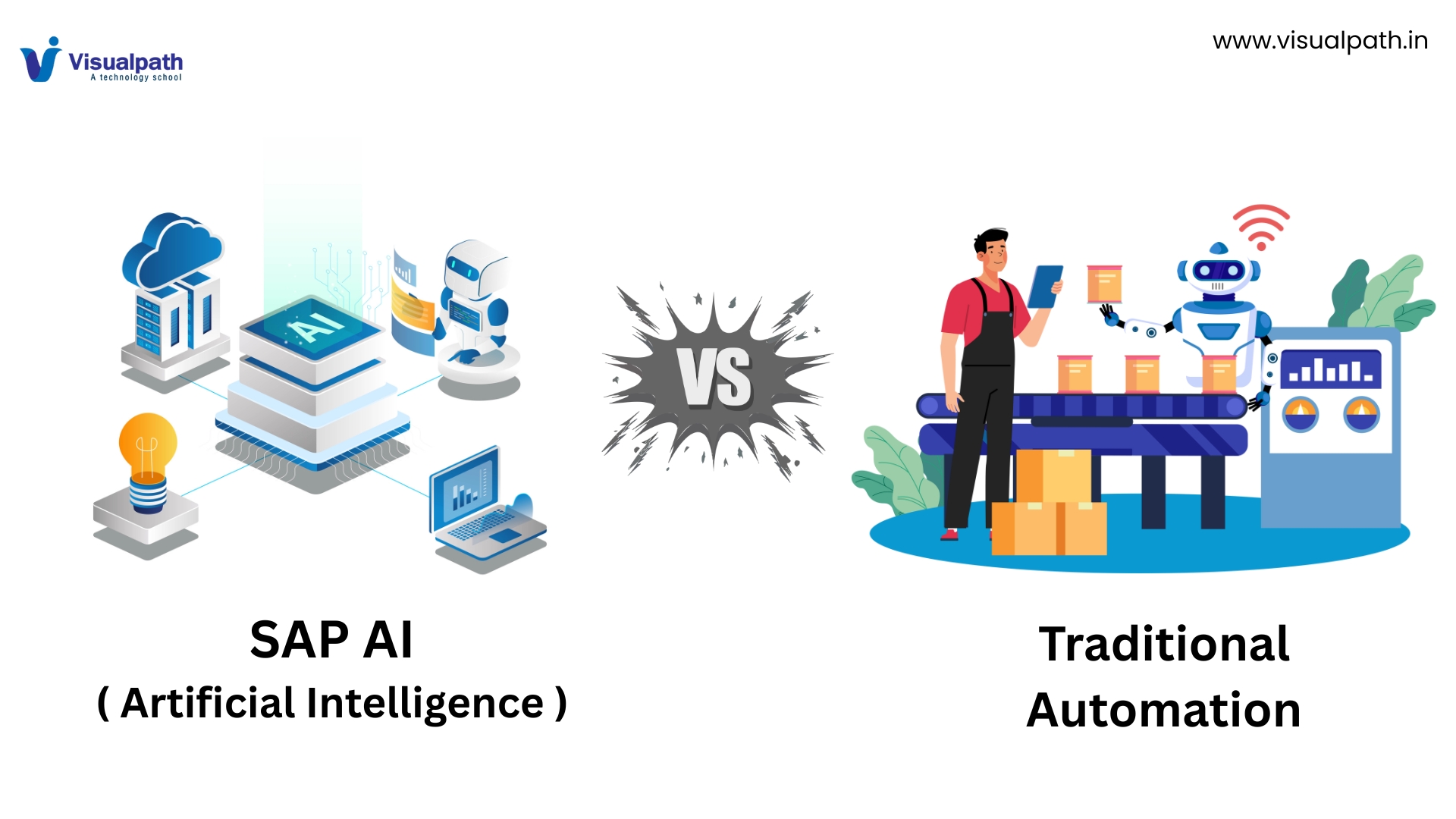
      SAP AI vs Traditional Automation: Key Differences

      Businesses are rapidly embracing automation to streamline operations, reduce errors, and improve efficiency. Traditional automation tools, such as scripts and macros, have long been used to handle repetitive tasks. However, these tools lack the flexibility to adapt to changing scenarios or interpret complex data.

      Today, technologies like Artificial Intelligence (AI), particularly when integrated into enterprise platforms such as SAP, are revolutionising automation. SAP AI brings intelligence into workflows—analysing patterns, learning from data, and making real-time decisions.

      To understand this evolution, it’s important to explore the fundamental differences between traditional automation and SAP AI. Many professionals are now opting for SAP AI Training to equip themselves for this intelligent future.

      What Is Traditional Automation?

      Traditional automation relies on static, rule-based logic. It performs tasks using predefined instructions without adapting or learning from data. While effective in controlled environments, it lacks intelligence.

      Key aspects of traditional automation include:

      • Works well with structured, repetitive tasks.
      • Depends entirely on pre-programmed rules.
      • Offers predictable outcomes but limited flexibility.
      • Cannot handle unstructured data like emails, images, or natural language.
      • Requires frequent manual updates when business processes change.

      Traditional automation is ideal for tasks like copying data between systems, generating reports, or scheduling repetitive jobs. However, it hits a wall when faced with complex, unpredictable business processes.

      What Makes SAP AI Different?

      SAP AI, integrated within the SAP Business Technology Platform, leverages machine learning, natural language processing, and data analytics to power intelligent automation. Instead of simply following rules, SAP AI understands context, predicts outcomes, and continuously improves.

      With SAP Artificial Intelligence Training, professionals gain insight into how SAP AI can optimise business processes far beyond what traditional methods can achieve.

      Core advantages of SAP AI include:

      • Self-Learning: Improves performance by analysing data and learning from past actions.
      • Decision Support: Assists or automates decision-making based on real-time insights.
      • Adaptability: Automatically adjusts to changes in data or process flow.
      • Human-Like Interaction: Interprets natural language and can respond contextually.
      • Process Optimisation: Identifies inefficiencies and recommends enhancements.

      SAP AI enables enterprises to move from reactive process handling to proactive business transformation.

      Real-World Applications of SAP AI

      SAP AI is not just theoretical—it’s already powering smarter business processes across industries:

      • Finance: Automates invoice matching, risk assessments, and financial forecasting.
      • HR & Recruitment: Screens resumes intelligently, predicts employee performance, and enhances workforce planning.
      • Supply Chain: Predicts inventory shortages, streamlines logistics, and reduces downtime.
      • Customer Support: AI-driven chatbots and virtual agents resolve customer queries in real time.

      These capabilities allow companies to shift their focus from task execution to strategic decision-making.

      Professionals working in any of these domains benefit significantly by enrolling in structured programs like SAP AI Training in Hyderabad, which provide hands-on experience and real-time use cases.

      Why Choose SAP AI Over Traditional Automation?

      • Greater Flexibility: SAP AI adapts to new inputs and evolving business environments.
      • Data-Driven: Makes intelligent decisions based on data, not just rules.
      • Reduced Manual Intervention: Minimizes the need for continuous oversight and reprogramming.
      • Scalability: Easily scales across business units and functions.
      • Competitive Edge: Enhances innovation, reduces errors, and improves user experiences.

      In short, SAP AI moves beyond automation—it creates a digital workforce that learns, evolves, and delivers smarter results.

      Conclusion:

      Traditional automation was a game-changer in its time, but in today’s fast-paced digital world, it’s no longer enough. The emergence of SAP AI offers a much more dynamic and intelligent approach to business process management. By integrating machine learning and decision-making capabilities into core enterprise functions, SAP AI allows companies to innovate, scale, and compete at a higher level.

      TRENDING COURSES: Oracle Fusion HCM, Microsoft Fabric, Scrum Master