Tag: SAP AI Course Online

  • SAP AI vs Power BI: Where AI Actually Adds Value

    SAP AI vs Power BI: Where AI Actually Adds Value

    SAP AI vs Power BI: Where AI Actually Adds Value

    SAP AI and Power BI solve different business problems. Power BI primarily helps organizations visualize and analyze data. SAP AI goes further by predicting outcomes, automating decisions, and generating intelligent recommendations. Understanding this difference is essential for choosing the right solution.

    Introduction

    Organizations today generate massive amounts of business data. The challenge is no longer collecting information. The challenge is turning information into decisions.

    This is where SAP AI and Power BI often enter the conversation.

    Many business leaders mistakenly compare them as direct competitors. In reality, they serve different purposes. Power BI is a business intelligence platform focused on reporting and visualization. SAP AI focuses on prediction, automation, machine learning, and intelligent decision support.

    Professionals exploring enterprise AI often begin with SAP AI Training to understand how artificial intelligence extends beyond traditional reporting tools.

    This article explains where SAP AI adds value, where Power BI excels, and how organizations can use both together.

    Definition and Overview

    What is SAP AI?

    SAP AI is a collection of artificial intelligence capabilities embedded across SAP products and platforms.

    Key technologies include:

    SAP Business AI

    • SAP AI Core
    • SAP AI Foundation
    • SAP HANA Cloud
    • SAP Business Technology Platform (BTP)
    • SAP Joule

    SAP AI enables organizations to:

    • Predict future outcomes
    • Automate workflows
    • Detect anomalies
    • Generate recommendations
    • Improve decision-making

    What is Power BI?

    Power BI is a business intelligence and data visualization platform from Microsoft.

    It helps organizations:

    • Create dashboards
    • Build reports
    • Monitor KPIs
    • Analyze historical data
    • Share business insights

    Power BI specializes in helping users understand what happened and what is happening.

    The Fundamental Difference

    The simplest way to understand the difference is this:

    Power BI answers:

    • What happened?
    • What is happening?
    • Where is the problem?

    SAP AI answers:

    • Why did it happen?
    • What will happen next?
    • What action should we take?

    This distinction explains where AI delivers its greatest value.

    How SAP AI Works

    SAP AI follows a structured intelligence process.

    Step 1: Data Collection

    Information flows from:

    • SAP S/4HANA
    • SAP SuccessFactors
    • SAP Ariba
    • SAP Customer Experience
    • External systems

    Step 2: Data Processing

    Data is prepared and validated.

    Step 3: Model Training

    Machine learning models identify patterns.

    Step 4: Prediction

    Models forecast future outcomes.

    Step 5: Business Action

    Recommendations are delivered directly inside business workflows.

    This creates a closed-loop intelligence system rather than static reporting.

    Core Concepts Behind SAP AI

    Several important concepts drive SAP AI value.

    Predictive Analytics

    Forecast future events using historical patterns.

    Examples:

    • Demand forecasting
    • Revenue prediction
    • Employee attrition prediction

    Machine Learning

    Models improve automatically as new data arrives.

    Generative AI

    Large Language Models help users interact naturally with business systems.

    Intelligent Automation

    Routine tasks become automated using AI-driven decisions.

    Professionals learning through SAP AI Course Online programs often focus on these core concepts before moving into implementation scenarios.

    Where Power BI Delivers Strong Value

    Power BI remains one of the most effective analytics tools available.

    Its strengths include:

    Reporting

    Executives can quickly view performance metrics.

    Dashboard Creation

    Interactive dashboards simplify analysis.

    Data Visualization

    Charts make complex information easier to understand.

    Data Integration

    Power BI connects with hundreds of data sources.

    For organizations primarily focused on reporting and analytics, Power BI provides excellent value.

    Where SAP AI Actually Adds Value

    This is where the comparison becomes more interesting.

    SAP AI creates value when organizations need action rather than observation.

    Supply Chain Optimization

    Power BI can show inventory shortages.

    SAP AI can predict shortages before they occur.

    Finance Operations

    Power BI can report unusual transactions.

    SAP AI can detect fraud risks automatically.

    Human Resources

    Power BI can display turnover metrics.

    SAP AI can predict which employees may leave.

    Customer Experience

    Power BI can show customer behavior trends.

    SAP AI can recommend personalized actions.

    This predictive capability is what separates AI from traditional BI.

    Real-World Use Cases

    Manufacturing

    A manufacturer uses SAP AI to predict equipment failures.

    Maintenance occurs before breakdowns happen.

    Power BI then visualizes performance improvements.

    Retail

    SAP AI forecasts demand fluctuations.

    Inventory is optimized automatically.

    Power BI tracks sales performance.

    Banking

    SAP AI identifies suspicious transactions.

    Risk teams receive alerts immediately.

    Power BI provides executive reporting dashboards.

    These examples show that SAP AI and Power BI often complement each other rather than compete.

    Benefits of SAP AI

    Organizations implementing SAP AI correctly often achieve:

    Faster Decision-Making

    Predictions reduce uncertainty.

    Lower Costs

    Automation eliminates manual effort.

    Better Customer Experiences

    Recommendations become more relevant.

    Higher Productivity

    Employees focus on strategic work.

    Improved Forecasting

    Business planning becomes more accurate.

    Many enterprise teams pursue SAP AI Training to understand how these benefits translate into measurable business outcomes.

    Challenges and Limitations

    SAP AI is powerful but not perfect.

    Data Quality Requirements

    Poor data leads to poor predictions.

    Implementation Complexity

    AI projects require governance and planning.

    Skills Gap

    Organizations need expertise in:

    • SAP BTP
    • Data Engineering
    • Machine Learning
    • Business Processes

    Cost Considerations

    AI initiatives often require larger investments than reporting projects.

    Organizations evaluating SAP AI should understand both benefits and limitations.

    Common Misconceptions

    Misconception 1: SAP AI Replaces Power BI

    Reality:

    SAP AI and Power BI serve different purposes.

    Misconception 2: AI Automatically Solves Business Problems

    Reality:

    AI succeeds only when aligned with business goals.

    Misconception 3: Dashboards Are AI

    Reality:

    Visualization alone is not artificial intelligence.

    Misconception 4: More Data Means Better AI

    Reality:

    Data quality matters more than data volume.

    Future Trends

    Several trends are shaping the future of enterprise analytics.

    AI Copilots

    SAP Joule is changing how users interact with enterprise systems.

    Embedded AI

    AI is increasingly integrated directly into workflows.

    Real-Time Decision Intelligence

    Organizations want decisions during transactions, not after.

    Generative AI

    Large Language Models are becoming standard business tools.

    Professionals taking SAP AI Course Online programs increasingly focus on these emerging capabilities.

    Should You Choose SAP AI or Power BI?

    Choose Power BI if your primary goal is:

    • Reporting
    • Dashboarding
    • KPI monitoring
    • Data visualization

    Choose SAP AI if your primary goal is:

    • Prediction
    • Automation
    • Optimization
    • Decision intelligence

    Many organizations benefit from both.

    Power BI helps explain what happened.

    SAP AI helps determine what happens next.

    Conclusion

    The question is not whether SAP AI is better than Power BI.

    The real question is where artificial intelligence adds value.

    Power BI remains one of the strongest business intelligence platforms available. It excels at reporting, visualization, and performance monitoring.

    SAP AI delivers value when organizations need predictive insights, intelligent automation, and decision support.

    The most mature organizations combine both technologies. They use Power BI for visibility and SAP AI for intelligence.

    As enterprise systems continue evolving, the future belongs to organizations that move beyond reporting and embrace predictive decision-making.

    Professionals building careers in this space often combine business analytics knowledge with SAP AI Training and hands-on SAP AI Course Online learning to stay aligned with emerging enterprise technology trends.

    FAQ Section

    Q. What is the main difference between SAP AI and Power BI?

    A. Power BI focuses on reporting and visualization, while SAP AI focuses on prediction, automation, and intelligent recommendations.

    Q. Can SAP AI replace Power BI?

    A. Not completely. SAP AI and Power BI solve different problems and often work best together.

    Q. Is SAP AI better for forecasting?

    A. Yes. SAP AI uses machine learning models that can predict future outcomes more effectively than traditional BI dashboards.

    Q. Can Power BI use AI?

    A. Power BI includes AI features, but it remains primarily a business intelligence platform rather than a full enterprise AI platform.

    Q. Which skill has better future demand?

    A. Both are valuable. However, enterprise demand for AI, machine learning, and intelligent automation continues growing rapidly.

    Visit:- https://www.visualpath.in/sap-artificial-intelligence-training.html our website or contact us:- +91-7032290546. Today to start your SAP AI learning journey with Visualpath.

  • When Should You Avoid SAP AI? Key Limitations

    When Should You Avoid SAP AI? Key Limitations

    When Should You Avoid SAP AI? Key Limitations

    You should avoid SAP AI when your organization lacks clean data, operates on highly customized legacy systems without SAP Business Technology Platform (BTP), or requires a generic, low-cost creative automation tool. SAP AI is optimized strictly for structured, enterprise-level business workflows and deep integration with native SAP ecosystems.

    Introduction

    Artificial intelligence has become a major focus for enterprise software strategy. Leaders regularly look for new ways to implement automated workflows into their enterprise resource planning (ERP) tech stacks. However, implementing these solutions without clear boundaries can lead to costly project delays.

    Knowing when to deploy an architecture is just as important as knowing when to step back. This comprehensive guide outlines the specific operational conditions and architectural limits under which you should skip these tools. For teams aiming to navigate these technical guardrails, getting a proper SAP AI Training in India provides the practical skills required to assess system readiness.

    Definition and Structural Overview

    SAP AI is a specialized framework of embedded machine learning models, semantic layers, and generative capabilities built directly on the SAP Business Technology Platform (BTP). It is designed to optimize native business processes like cash application, automated matching, and predictive procurement.

    Unlike open-source machine learning libraries or public large language models, this system requires a highly structured ecosystem to function. It relies heavily on structured transactional databases such as SAP S/4HANA. Without this native underlying technical framework, deploying the software becomes highly inefficient.

    How It Works: The Pipeline and Its Limits

    The operational pipeline relies on a clean lifecycle to translate incoming information into structured business choices. Understanding this workflow helps highlight where the technical system can break down.

    • Data Ingestion: The architecture pulls transactional logs through secure pipelines into SAP BTP.
    • Context Mapping: The system applies business logic via the SAP AI Core to match records against native workflows.
    • Model Inference: Pre-trained or custom machine learning models evaluate the trends.
    • Prescriptive Execution: Interfaces like SAP Joule deliver recommendations directly to the user interface.

    If a company modifies its central tables using custom code that deviates from standard configurations, this pipeline breaks. The models cannot map the context correctly, resulting in faulty predictions. For professionals who study this engine through an SAP AI Course Online, learning how to recognize these pipeline failures is a core competency.

    Core Concepts: When Enterprise AI Fails

    To evaluate when you should bypass this technology, you must understand three core technical dependencies:

    • Data Consistency: Models require clean, standardized historical logs. If your master records are filled with missing tables or duplicates, the algorithm will deliver inaccurate insights.
    • Ecosystem Alignment: The architecture is built for companies using modern environments. If your organization operates primarily on non-SAP databases, the translation cost outweighs the benefits.
    • Cost-to-Value Ratio: Running heavy computing pipelines requires premium BTP credits. Using it for simple, repetitive office scripts that standard robotic process automation (RPA) can handle is an expensive operational mistake.

    Examples and Use Cases of AI Failure

    Let us evaluate a practical example in financial planning. A multinational company wants to use machine learning to forecast consumer demand. However, the business recently went through three mergers, resulting in four different legacy database structures with mismatched product IDs.

    If the firm attempts to deploy the predictive model directly over this fragmented stack, the results will fail. The algorithm cannot reconcile the different data schemas. In this scenario, the company must build a unified data layer before touching any intelligent software.

    Another bad use case involves generic creative writing. If an HR team wants software to draft casual company newsletters, using the Generative AI Hub within an enterprise environment is unnecessary and costly. A simple public tool is a much cheaper and faster alternative.

    Benefits of Knowing When to Stand Down

    Choosing to bypass a complex tool when your infrastructure is not ready provides several distinct business advantages:

    • Capital Preservation: You prevent wasting IT budgets on licenses and compute credits that your data cannot support.
    • Architectural Stability: Your core ERP remains stable, unburdened by heavy integration layers that create data traffic jams.
    • Strategic Focus: Your engineering teams can focus on foundational data cleansing projects instead of troubleshooting broken models.

    Challenges and Technical Limitations

    The main technical challenges tied to the platform involve rigid boundaries built into its enterprise design:

    Technical AttributeEnterprise ConstraintRisk Factor
    Data RequirementsRequires standard, clean SAP data objectsHigh error rate with custom schemas
    Platform Lock-inHighly dependent on SAP BTP infrastructureIncreased cloud subscription costs
    CustomizationPre-trained models have fixed configurationsLow flexibility for niche workflows

    These limitations mean that organizations with unique, non-standard business rules will struggle to achieve a high return on investment without extensive, costly re-engineering.

    Common Misconceptions

    A frequent mistake among business leaders is assuming that enterprise-grade software can automatically fix messy historical logs. This is false. A machine learning model only amplifies the quality of the information it receives.

    Another misconception is that the software requires deep data science coding from scratch. In reality, the platform offers many low-code tools. The challenge is not writing the code; the challenge is setting up the underlying system architecture correctly. This structural balance is a primary lesson emphasized during SAP AI Training in India at Visualpath.

    Future Trends: Will These Limits Vanish?

    As we look toward 2027, developments point toward more flexible data connectors. Future updates may allow the core engines to ingest unstructured data from external third-party platforms with less friction.

    However, the core focus on structured business logic will remain. The software will never become a general-purpose tool for every casual application. It will always stay focused on compliance, safety, and corporate transactions. Keeping up with these updates requires constant learning through specialized programs.

    Conclusion

    You should clearly avoid SAP AI if your company has messy data, heavily modified legacy configurations, or works outside the SAP BTP cloud environment. The tool is highly efficient when used inside a clean, modern infrastructure, but it is not a cure-all for broken database systems.

    For engineers and business analysts who want to accurately assess these deployment conditions, taking a formal SAP AI Course Online is a vital step. Gaining this technical depth ensures you can lead your company toward smart automation without falling into expensive deployment traps.

    FAQs

    Q. What are the use cases of AI in healthcare?

    A. It is used to forecast patient admissions, track inventory, and automate billing. Visualpath training institute teaches you how to map these workflows to secure cloud systems.

    Q. What is one of the biggest challenges of AI in healthcare?

    A. Protecting patient data privacy under strict regulations while handling unstructured medical records is a massive technical hurdle.

    Q. What is the use case of AI in SAP?

    A. It automates financial audits, matches invoices, and optimizes logistics by identifying anomalies within huge enterprise datasets.

    Q. What are 5 current common use cases for AI?

    A. In 2026, the top uses are fraud detection, supply chain forecasting, automated customer routing, resume screening, and smart predictive maintenance.

    Contact Information:

    Visit:- https://www.visualpath.in/sap-artificial-intelligence-training.html

    WhatsApp: https://wa.me/c/917032290546

  • Is SAP AI Better Than Traditional BI Tools?

    Is SAP AI Better Than Traditional BI Tools?

    Is SAP AI Better Than Traditional BI Tools?

    Is SAP AI Better Than Traditional BI Tools?

    SAP AI is a set of advanced machine learning and generative tools designed to predict future outcomes and automate decisions. Traditional BI (Business Intelligence) focuses on historical data reporting and visualization. While BI tells you what happened, SAP AI tells you what will happen and how to respond, making it a more proactive solution for modern enterprises.

    Introduction: The Shift from Hindsight to Foresight

    For decades, businesses relied on Traditional BI tools to understand their performance. These tools were excellent at creating dashboards and balance sheets based on past events. However, in 2026, looking at the past is no longer enough to stay competitive.

    The emergence of SAP AI has changed the landscape. By integrating Artificial Intelligence directly into business processes, companies are moving beyond simple data visualization. This article explores whether SAP AI is truly “better” than traditional BI or if they serve different, complementary purposes in a modern data strategy.

    What is the Difference? An Overview

    To understand the comparison, we must define the two entities clearly.

    Traditional BI is like a rearview mirror. It uses structured data to generate reports, KPIs, and charts. It requires human intervention to interpret the data and decide on an action.

    SAP AI is like a GPS with real-time traffic updates. It uses both structured and unstructured data to identify patterns, forecast trends, and even trigger automated workflows. If you are looking to master these advanced capabilities, seeking SAP AI Training in Ameerpet can provide the hands-on expertise needed to navigate this shift.

    How SAP AI Works vs. Traditional BI

    The fundamental difference lies in the “engine” under the hood.

    • Traditional BI Workflow: Data Collection → ETL (Extract, Transform, Load) → Data Warehousing → Manual Querying → Static Dashboard.
    • SAP AI Workflow: Data Ingestion → Neural Network Processing → Predictive Modeling → Automated Insights → Proactive Recommendation (e.g., SAP Joule).

    Traditional BI relies on pre-defined schemas. If you didn’t build a report for a specific question, you can’t get the answer. SAP AI, particularly through the Generative AI Hub, allows users to ask questions in natural language and receive context-aware answers.

    Core Concepts: Descriptive vs. Predictive vs. Prescriptive

    To evaluate which is “better,” we look at the levels of analytics maturity:

    • Descriptive Analytics (Traditional BI): “Our sales dropped by 10% last month.”
    • Predictive Analytics (SAP AI): “Our sales are likely to drop by 15% next month due to supply chain delays.”
    • Prescriptive Analytics (SAP AI): “To prevent a sales drop, we suggest shifting inventory from Region A to Region B immediately.”

    SAP AI covers all three levels, whereas traditional BI is mostly stuck at level one. This depth is why many professionals are enrolling in an SAP AI Course Online to upgrade their skills from basic reporting to advanced data science.

    Real-World Use Cases

    Traditional BI Example

    A retail manager looks at a BI dashboard on Monday morning. They see that umbrellas sold out during a rainstorm over the weekend. The information is accurate, but the opportunity to sell more is already gone.

    SAP AI Example

    An AI-powered system analyzes weather forecasts and historical buying behavior three days before the storm. It automatically alerts the logistics team to increase umbrella stock in specific stores. The AI creates value before the event occurs.

    Key Benefits of SAP AI Over Traditional BI

    • Speed to Insight: AI finds correlations in seconds that would take a human analyst weeks to discover.
    • Handling Unstructured Data: Traditional BI struggles with emails, images, and voice notes. SAP AI thrives on them.
    • Automation: AI can act on its findings. For example, it can automatically block a fraudulent payment without human approval.
    • Personalization: SAP AI can provide hyper-personalized recommendations for thousands of individual customers simultaneously.

    Challenges and Limitations

    It is important to remain realistic. SAP AI is powerful, but it has hurdles:

    • Data Quality: AI is “garbage in, garbage out.” If your underlying SAP data is messy, the AI’s predictions will be wrong.
    • Complexity: Setting up AI models requires more technical expertise than building a standard SQL report.
    • Cost: Initial implementation of SAP AI environments (like SAP AI Core) can be higher than standard BI licenses.
    • Trust: Business leaders are sometimes hesitant to let a machine make “prescriptive” decisions without human oversight.

    Common Misconceptions

    • AI will replace BI”: False. AI needs the structured foundation that BI provides. They usually exist together within the SAP Business Technology Platform (BTP).
    • “AI is only for big companies”: False. With cloud-based SAP AI services, even mid-sized firms can use pre-trained models for specific tasks like invoice matching.

    Future Trends: The 2026 Outlook

    By late 2026, we expect “Autonomous Analytics” to become the norm. This means the system will not just suggest an action but will perform it and report back on the results. Natural language interfaces like SAP Joule will replace traditional drag-and-drop report builders, making data accessible to everyone in the company, not just data scientists.

    Conclusion: Which One is Better?

    Is SAP AI better than traditional BI? Yes, if your goal is competitive agility and proactive decision-making.

    For those looking to future-proof their careers, moving beyond static reporting is essential. Whether you choose an SAP AI Course Online or prefer local SAP AI Training in Ameerpet, the goal is the same: learning to use data to predict the future, not just record the past.

    FAQ Section

    1. Can SAP AI work without Traditional BI?

    A. Technically yes, but it’s not ideal. BI provides the “clean” historical data that AI uses to learn. Most successful companies use both.

    2. Is it hard to switch from BI to SAP AI?

    A. The transition requires a shift in mindset and skills. You need to move from learning “how to build a chart” to “how to train and monitor a model.”

    3. Does SAP AI require coding?

    A. While SAP offers “Low-code/No-code” AI tools through SAP Build, having a basic understanding of Python or SQL is very helpful for advanced performance tuning.

    4. Which industries benefit most from SAP AI?

    A. Supply chain, finance (fraud detection), and manufacturing (predictive maintenance) see the highest immediate return on investment.

    Visualpath provides practical SAP AI learning for real enterprise use cases. Visit our website:- https://www.visualpath.in/sap-artificial-intelligence-training.html

    or contact us:- https://wa.me/c/917032290546  today to begin your SAP AI journey.

  • How to Tune SAP AI Performance for Better Results

    How to Tune SAP AI Performance for Better Results

    How to Tune SAP AI Performance for Better Results

    How to Tune SAP AI Performance for Better Results

    In the modern business world, speed and accuracy are the most important factors for success. Many companies use artificial intelligence to handle their data, but simply having the tool is not enough. You must learn how to Tune SAP AI Performance to get the most value from your software.

    A slow system can lead to lost profits and frustrated employees. This is why many professionals choose SAP AI Training in India to master these specific technical skills. When you optimize your models, you ensure that your business stays ahead of the competition in 2026. This guide will show you how to improve your system results step by step.

    Understanding Performance Tuning

    Tuning performance means making your AI tools work faster and more accurately. It involves adjusting the settings of your software to match your specific business needs.

    In the SAP world, this means looking at how the AI Foundation connects with your data. It is not just about a single fix. It is a continuous process of checking and improving the digital workflow. This ensures that the intelligence layer provides the right answers at the right time.

    The Importance of Optimization

    A smart system is only useful if it can process information quickly. If a manager has to wait too long for a report, the AI is not doing its job. Proper tuning reduces the time it takes for the system to think. It also helps the AI avoid making mistakes when handling complex tasks.

    Many people who enroll in SAP AI Training in Ameerpet learn that efficiency is the key to enterprise success. Without tuning, even the most expensive software will fail to meet global business standards.

    6 Key Components (2026 Update)

    To improve your results, you must understand the six parts that drive the 2026 architecture:

    AI Foundation (SAP BTP): The secure base where all your tuning adjustments are made.

    SAP AI Core: The engine that needs regular maintenance to run models at top speed.

    Generative AI Hub: A place where you can refine prompts to get better text outputs.

    SAP Joule: The assistant that works best when the underlying data is well-organized.

    Embedded AI: Standard features that can be adjusted within your S/4HANA applications.

    AI API: The bridge that must be clear of data traffic jams for fast responses.

    Strategies for Data Quality

    The most common cause of poor AI performance is bad data. If your information is messy or old, the AI will produce poor results. You must clean your records before the AI looks at them. This means removing duplicates and fixing any errors in your database.

    Good data management is a core part of SAP AI Training in India at Visualpath. When the data is clean, the AI can find patterns much faster. This simple step can double the speed of your intelligence layer.

    The Optimization Workflow

    Optimizing a model involves choosing the right math for the right problem. You should follow these structured steps:

    Baseline Testing: Test your model with a small set of data to check current speed.

    Error Analysis: Identify where the AI is making incorrect predictions.

    Parameter Adjustment: Change the internal settings to favor accuracy or speed.

    Resource Allocation: Ensure the system has enough memory to process requests.

    Final Validation: Save your best settings as a template for future projects.

    Practical Tuning Techniques

    To truly Tune SAP AI Performance, you must monitor the system in real-time. This allows you to see exactly where the delays are happening. You might find that the connection between your database and the AI is too slow.

    In this case, you can use specialized tools to widen the digital path. Professionals often learn these advanced tricks during SAP AI Training in Ameerpet to solve real-world issues. Keeping your system lean and focused on specific goals is the best way to maintain speed. Regular audits of your AI models will prevent them from slowing down over time.

    Monitoring and Scaling for Growth

    Once your system is fast, you must make sure it stays that way. As your company grows, the amount of data will increase every month. You need to scale your resources so the AI does not become overwhelmed. Use automated alerts to notify you when the performance drops below a certain level.

     This proactive approach is a major theme in modern SAP AI Training in India. Scaling allows you to maintain high performance even when processing millions of records. It turns a small smart tool into a powerful global enterprise engine.

    Expert FAQs

    Q. How to optimize for AI results?

    A. Start by cleaning your business data and choosing the right models. Visualpath training institute shows you how to match tools to your goals.

    Q. How to improve performance of AI model?

    A. Use the AI Core to monitor response times and adjust your prompt logic. You can learn these technical steps at Visualpath training institute.

    Q. Which is the best AI tool for SAP?

    A. SAP Joule and the AI Foundation are the top choices in 2026. These tools are designed to integrate perfectly with your existing SAP workflows.

    Q. How to improve SAP system performance?

    A. Keep your core system clean and use APIs to handle heavy AI tasks. This prevents your main business apps from slowing down during data analysis.

    Summary and Career Path

    Learning to Tune SAP AI Performance is a vital skill for the digital era. It ensures that your technology works for you rather than against you. By focusing on the six key components, you can build a very fast system. Proper data cleaning and model optimization are the foundations of this process. As we move through 2026, experts in performance tuning will be in high demand.

    If you want to master these skills, choose a professional path. Programs like SAP AI Training in India provide the hands-on practice you need. You will learn to use tools like SAP AI Core and BTP effectively. This knowledge will help you drive better results for your company. The future of business is fast, and you can lead the way with optimized AI.

    Contact Information:

    Website: https://www.visualpath.in/sap-artificial-intelligence-training.html

    Call/WhatsApp: https://wa.me/c/917032290546

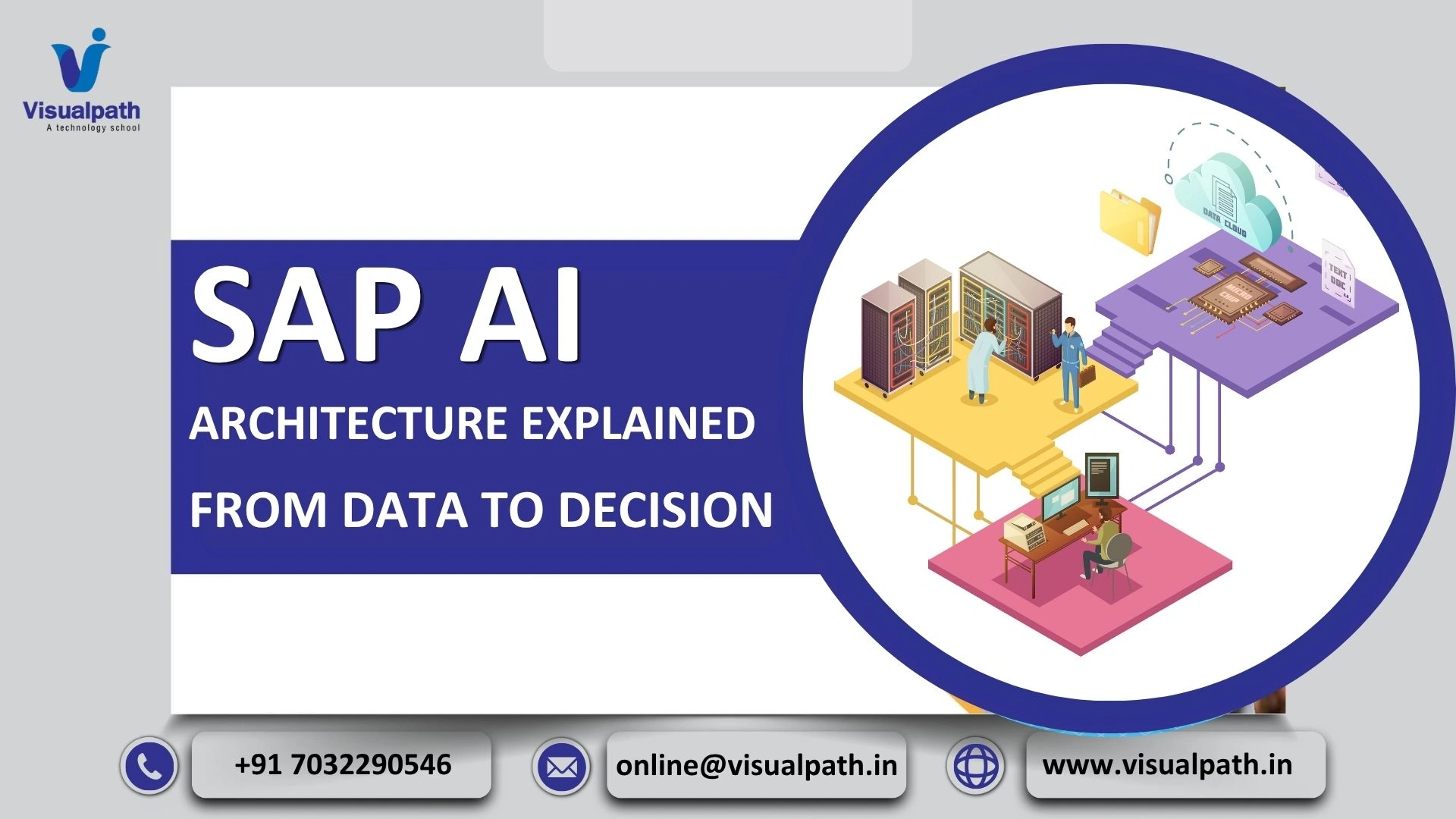
  • SAP AI Architecture Explained: From Data to Decision

    SAP AI Architecture Explained: From Data to Decision

    SAP AI Architecture Explained: From Data to Decision

    Imagine a massive global factory. Thousands of sensors are screaming data every second. How does a manager know which machine will break next Tuesday? This is where SAP AI Architecture Explained comes into play.

    It isn’t just a single app; it is a high-speed pipeline that turns raw numbers into profit. To master this flow, many experts start with a SAP Artificial Intelligence Course to learn the specialized layers. Let’s break down this “brain” of modern business.

    1. The Big Picture: What is Business AI?

    SAP AI is built for work, not just for fun. While some AI tools write poems, SAP AI manages supply chains and finances. It is “Context-Aware,” meaning it understands your company’s specific history and rules.

    2. The 4-Layer Stack (2026 Update)

    To understand the architecture, think of it like a four-story building:

    LayerComponentWhat it Does
    Top FloorSAP JouleThe “face.” It talks to the user in plain English.
    Third FloorAI FoundationThe “logic.” This is where the models live and learn.
    Second FloorAI Core & HubThe “engine.” It manages the speed and safety of the AI.
    Ground FloorSAP BTPThe “foundation.” Securely holds all your business data.

    3. The Data Journey: How It Works

    How does a click become a decision?

    Ingestion: Raw data enters through the SAP BTP layer.

    Processing: The AI Core looks for patterns (e.g., “This machine is vibrating too much”).

    Insight: The system predicts a failure.

    Action: SAP Joule notifies the manager: “Repair Machine A now to save $50k.”

    4. Key 2026 Features: Joule & GenAI Hub

    Taking a SAP Artificial Intelligence Training today means learning these two specific tools:

    SAP Joule: A copilot that works across all SAP apps (HR, Finance, Supply Chain).

    GenAI Hub: A safe “playground” where developers can use different AI models without risking company data.

    5. Clean Core Strategy: The Golden Rule

    In 2026, we keep the “Core” of the software clean. This means we don’t mess with the main code. Instead, we plug AI in from the side.

    Benefit: You can update your AI daily without breaking your accounting system.

    Reliability: This is why SAP AI Architecture Explained is trusted by 99% of the world’s biggest brands.

    6. Real-World Use Case: Smart Finance

    In many offices, checking invoices takes weeks. With this architecture, the AI reads the invoice, matches it to a purchase order, and flags errors in seconds. This allows humans to focus on strategy instead of typing data.

    7. Comparison: SAP AI vs. Generic AI

    FeatureSAP AI ArchitectureStandard Public AI
    Data PrivacyEnterprise-Grade (Secure)Basic (Data may be leaked)
    Business LogicBuilt-inNone (Must be taught)
    IntegrationOne-Click with S/4HANARequires Months of Coding

    8. Expert FAQs

    Q. What is the main goal of the SAP AI architecture?

    A. It turns raw data into useful decisions. Visualpath training helps you master the layers that make this process fast and accurate.

    Q. How does the AI Core manage different models?

    A. It acts as a runtime engine to deploy and monitor models. You can learn how to manage these workflows at Visualpath training institute.

    Q. Can I use non-SAP data with this architecture?

    A. Yes, the system can connect to many sources. This flexibility is a key part of the modern 2026 technical learning path.

    Q. What is the role of SAP Joule in this architecture?

    A. Joule is the user interface. It helps workers interact with complex data using natural language for easier daily tasks.

    9. Summary

    Mastering SAP AI Architecture Explained is your ticket to a high-paying career in 2026. It is a stable, secure, and incredibly powerful system. By learning how data moves from BTP to Joule, you become a bridge between technology and business.

    Start your journey with an SAP Artificial Intelligence Course at Visualpath. The hands-on labs will give you the confidence to manage real-world AI projects. The future isn’t just coming it’s already here, and it runs on SAP.

    Visit:- https://www.visualpath.in/sap-artificial-intelligence-training.html

    Contact:- +91 7032290546

  • What Makes SAP AI Different from Other AI Platforms?

    What Makes SAP AI Different from Other AI Platforms?

    What Makes SAP AI Different from Other AI Platforms?

    What Makes SAP AI Different from Other AI Platforms?

    Artificial intelligence is now a part of almost every software tool we use. However, not all AI platforms are created in the same way. Many people ask What Makes SAP AI Different compared to other generic systems. The answer lies in how the technology connects with real business data.

    Companies looking for specialized skills often choose SAP AI Training in India to understand these gaps. This platform does not just provide a simple chatbot. It offers a deeply integrated system designed for large global organizations. In this article, we will explore the unique factors of SAP AI.

    Definition

    SAP AI is often called “Business AI” because of its specific focus. Most AI platforms are built for general purposes like writing or making images. SAP AI is built directly into the apps that run big companies.

    It understands business processes like buying, selling, and managing employees. It uses the actual data of a company to give smart advice. This makes it much more practical for a workplace than a general AI tool.

    Why Business Context Matters

    For a large company, general AI can sometimes be too broad. It may not understand the complex rules of a global supply chain. This is exactly What Makes SAP AI Different because it is “context-aware.” This means it knows the history and the goals of the business. Professionals who want to lead in this field often take an SAP Artificial Intelligence Course Online. This helps them learn how to apply smart tools to specific business problems. Using the right AI can save millions of dollars in errors.

    6 Main Components

    To understand why it is different, we must look at the six core parts:

    1. AI Foundation (SAP BTP): This is the base that lets companies build and scale AI safely.
    2. SAP AI Core: This engine manages the lifecycle of AI models with high efficiency.
    3. Generative AI Hub: A secure place to use various large language models for work tasks.
    4. SAP Joule: The smart copilot that helps workers finish tasks by simply talking to it.
    5. Embedded AI: Smart features that are already inside apps like S/4HANA or SuccessFactors.
    6. AI API: A standard bridge that connects different business apps with AI models smoothly.

    Specific SAP AI Features

    Training programs today focus on what makes this system unique for the 2026 market. One major feature is the “Clean Core” strategy. This ensures that adding AI does not break the main business software. Another feature is the high level of data privacy. SAP AI does not use a company’s private data to train public models. Students who choose SAP AI Training in India learn how to keep data safe while being smart. This focus on security is a top priority for big corporations.

    Measured Business Benefits

    Feature CategorySAP Business AIGeneral AI Platforms
    Data ContextHigh: Uses your specific business data.Low: Uses general web knowledge.
    IntegrationBuilt-in: Already inside your SAP apps.Manual: Requires complex API setup.
    SecurityEnterprise-grade: Total data privacy.Basic: Data may be used for training.
    ReliabilityVerified: Built for financial accuracy.Creative: Can provide “hallucinations.”
    ComplianceStrict: Follows global business laws.Varies: May not meet corporate rules.

    Best Practices for Implementation

    When using SAP AI, it is important to follow a few simple rules. First, always start with a clear business problem. Do not use AI just because it is a new trend. Second, ensure your data is clean and organized before starting. Third, keep your main software core clean to allow for easy updates. Fourth, train your staff so they know how to work with AI. Many people find that an SAP Artificial Intelligence Course Online at Visualpath is a great way to learn these rules.

    Real Project Scenario

    Imagine a company that makes car parts for many countries. They have too much stock in one warehouse and not enough in another. A general AI might give basic advice on how to move boxes. However, SAP AI looks at the shipping costs and tax rules automatically.

    It suggests the cheapest and fastest way to move the parts. It even starts the paperwork for the move by itself. This project shows how integrated AI solves real problems without human confusion.

    FAQs

    Q. What is the difference between SAP based AI and premium AI?

    A. SAP based AI is built for business data and processes. Premium general AI is often for creative tasks and lacks deep business context.

    Q. What distinguishes SAP’s approach to artificial intelligence AI from other market solutions?

    A. SAP embeds AI directly into business apps. Visualpath training shows how this helps solve specific problems in HR and supply chains.

    Q. What is the difference between SAP AI Foundation and AI core?

    A. Foundation is the base for building and scaling. AI Core is the runtime engine that manages and executes the models in 2026.

    Q. What are the benefits of SAP AI?

    A. It improves speed, accuracy, and security. Learning at Visualpath prepares you to use these smart tools for

    Q. What are the benefits of SAP AI?

    A. It improves speed, accuracy, and security. Learning at Visualpath prepares you to use these smart tools for

    Summary

    Understanding Makes SAP AI Different is key to digital success. It stands out because it is built for the way businesses actually work. It is not just a tool for chatting or writing. It is a deep system that understands finance, stock, and people.

    It keeps company data safe and follows strict business rules. This makes it a trusted choice for the largest companies in the world.

    Options like SAP AI Training in India provide the knowledge you need. You will learn about Joule, AI Core, and the Generative AI Hub.

    As we move through 2026, the demand for Business AI experts will keep rising. Start your training today to lead the digital transformation of tomorrow.

    For more information on our training programs, please visit our website or contact our support team directly.

    Website: https://www.visualpath.in/sap-artificial-intelligence-training.html

    Contact: https://wa.me/c/917032290546

  • Step-by-Step Guide to Setting Up SAP AI on BTP

    Step-by-Step Guide to Setting Up SAP AI on BTP

    Step-by-Step Guide to Setting Up SAP AI on BTP

    Join SAP AI Training and Start Your Professional Journey

    SAP Business Technology Platform serves as the foundation for modern enterprise innovation. Setting up AI capabilities within this ecosystem requires a clear understanding of cloud architecture. Many professionals seek a structured SAP AI Training to navigate these complex technical environments successfully.

    This guide provides a factual roadmap for initializing your AI services on the BTP cockpit. Using SAP AI on BTP allows companies to scale their intelligence across many departments.

    Understanding the SAP AI Core Framework

    The AI Core is the primary engine for running machine learning workloads. It handles the execution and operations of your models at scale. It supports various open-source frameworks. This flexibility allows developers to use familiar tools within the SAP ecosystem.

    Enterprises use this service to automate repetitive business tasks. It integrates deeply with existing data structures. Understanding the lifecycle of an AI project is essential for long-term success. Most users find that a formal SAP AI Course Online helps clarify these architectural layers.

    Efficiency is the main goal of the AI Core. It manages infrastructure resources automatically. You do not need to worry about manual server provisioning. This abstraction lets your team focus on data science and business logic. Integrating SAP AI on BTP streamlines the entire development process.

    Global Account and Subaccount Preparation

    Your journey begins in the SAP BTP Cockpit. You must have administrative access to a Global Account. First, create a dedicated subaccount for your AI projects. This keeps your experimental work separate from production environments.

    Choose a region that supports the AI Core service. Not all data centers offer every AI feature. Select a provider like AWS or Azure that fits your corporate strategy. Ensure the subaccount has a clear, descriptive name for easy tracking.

    Proper organization prevents resource conflicts later. Set up your cloud foundry environment within the subaccount. This environment hosts the applications that will interact with your AI models. Consistency in naming conventions is a sign of professional administration.

    Entitlements for AI Services

    Entitlements act as your digital quota. You must assign the correct service plans to your subaccount. Navigate to the Entitlements section in the cockpit. Search for “SAP AI Core” in the service catalog.

    Add the “standard” or “extended” plan based on your needs. Click the plus icon to increase the quota for your subaccount. Without these units, you cannot create a service instance. Always save your changes before leaving the page.

    Resource management is a critical skill for cloud architects. Many students at Visualpath learn to monitor these quotas to avoid unexpected costs. Proper entitlement mapping ensures that your AI models have enough power to process large datasets.

    Creating the SAP AI Core Instance

    Go to the “Service Marketplace” within your subaccount. Find the SAP AI Core tile and click on it. Select the “Create” button to start the wizard. You will need to choose a specific service plan.

    Give your instance a unique name. Choose a space within your cloud foundry environment. Review the configuration details carefully. Click “Create” to finalize the process.

    The system will take a few moments to provision the resources. You can track the status in the “Instances and Subscriptions” tab. Once it shows a green “Created” status, your engine is ready. This instance is the heart of your machine learning operations.

    Service Key Generation and Configuration

    A service key provides the credentials needed for external tools to talk to BTP. It contains the client ID and secret. Click on your new AI Core instance to find the “Service Keys” tab. Click “Create” and provide a name for the key.

    Download the JSON file or copy the details to a secure location. You will need these details to authenticate your API calls. Treat this information like a password. Never share service keys in public code repositories.

    Technical teams use these keys to connect VS Code or Jupyter Notebooks to BTP. Mastering this authentication flow is a core part of an SAP AI Course Online. It bridges the gap between local development and cloud execution.

    Technical Steps for SAP AI on BTP

    Step 1: Log in to your BTP Global Account and navigate to the Subaccount level.

    Step 2: Check your quotas under the Entitlements tab for the AI Core service.

    Step 3: Subscribe to the SAP AI Launchpad to manage your AI assets visually.

    Step 4: Create the service instance within a Cloud Foundry space.

    Step 5: Generate a service key to obtain your authentication credentials.

    Step 6: Configure your Docker registry to host model images.

    Step 7: Sync your GitHub repository containing the AI workflow templates.

    Step 8: Initiate the connection via the SAP AI Core API.

    Following these steps ensures a clean installation. It minimizes common errors found in manual setups. Many learners find that following this sequence at Visualpath helps them master the platform quickly. A logical flow is key to successful cloud administration.

    Connecting AI with SAP Applications

    Integration is where the value of AI becomes visible. You can link your AI models to S/4HANA or SuccessFactors. Use the SAP BTP Destination service to create a secure path. This allows data to flow safely between systems.

    The Destination service manages the technical handshake. It uses the service key you generated earlier. This setup ensures that only authorized applications can trigger AI workflows. It protects sensitive enterprise data from unauthorized access.

    Visualpath experts recommend testing the connection with simple pings first. This verifies that your network settings and firewall rules are correct. Reliable connectivity is the backbone of any automated business process.

    Deploying Your First AI Model

    Once connected, you can upload your machine learning code. Use Git repositories to sync your templates with the AI Core. The system uses these templates to understand how to run your model. You must define the input and output requirements clearly.

    Create a “Deployment” through the API or the AI Launchpad. This process turns your code into a running service. The AI Core will provide an endpoint URL. This URL is what your business apps will call to get predictions.

    Monitoring the deployment is vital. Check the logs for any errors during the initialization phase. A successful deployment means your model is live and ready to serve requests. This marks a major milestone in your technical journey.

    Summary

    Setting up SAP AI on BTP is a structured process. It starts with account preparation and ends with successful model deployment. By following these steps, you create a robust environment for innovation. Technical proficiency in these areas is highly valued in today’s job market.

    If you want to dive deeper, an SAP AI Training program can provide hands-on experience. Visualpath offers comprehensive modules that cover everything from basic setup to advanced model tuning. Developing these skills will prepare you for the future of enterprise technology.

    Q. What is SAP BTP AI core?

    A. It is a specialized service on BTP used to build and run AI models. Visualpath teaches students how it manages scalable machine learning workloads.

    Q. How to setup SAP AI core?

    A. You must create a subaccount, assign entitlements, and launch a service instance. Visualpath provides a detailed checklist for this technical setup.

    Q. How to connect AI with SAP?

    A. Connections are made using service keys and the Destination service on BTP. This allows secure data exchange between AI models and business apps.

    Q. How to enable SAP business AI?

    A. Enable it by activating AI services in your Global Account and configuring the AI Launchpad. It helps businesses automate tasks with smart features.

    Visualpath provides practical training to help you understand SAP AI tools and workflows. Visit our website: https://www.visualpath.in/sap-artificial-intelligence-training.html  or contact us:- https://wa.me/c/917032290546  today to start learning SAP AI.

  • How SAP AI Is Transforming Retail Analytics

    How SAP AI Is Transforming Retail Analytics

    How SAP AI Is Transforming Retail Analytics

    How SAP AI Is Transforming Retail Analytics

    The retail industry is changing faster than ever in 2026. Stores no longer just sell products on shelves. They now use smart technology to understand what customers want. SAP AI Is Transforming Retail Analytics major tool used for this big change.

    It looks at millions of sales records to find hidden trends. Many professionals are now taking a SAP AI Course Online to learn these new skills. This technology helps managers decide which items to buy and when to sell them. In this article, we look at how these smart tools reshape modern shopping.

    Definition

    SAP AI for retail is a set of smart tools inside business software. It uses machine learning to study data from stores and websites. This technology is built to handle specific retail tasks. For example, it tracks inventory and predicts future sales.

    It is not just a general tool for computers. It is a business partner that understands how stores operate every day. It makes data entry and analysis much faster for everyone.

    Why It Matters

    Retail stores deal with huge amounts of data every second. Handling this data by hand is very slow and leads to errors. Small mistakes in stock levels can cost a company a lot of money. SAP AI prevents these issues by automating the analysis process

    It allows store owners to focus on making their customers happy. If you live in South India, SAP AI Training in Chennai offers great ways to learn.

    6 Key Components (2026 Update)

    To understand modern retail analytics, you must know these six parts:

    1. AI Foundation (SAP BTP): The base layer for scaling retail AI models.
    2. SAP AI Core: The engine that runs high-speed inventory simulations.
    3. Generative AI Hub: Used for creating personalized marketing content.
    4. SAP Joule: The AI assistant that answers store performance queries.
    5. Embedded AI: Pre-built features inside SAP S/4HANA for Retail.
    6. AI API: The bridge connecting store hardware to smart cloud models.

    Architecture Overview

    The 2026 retail architecture is built to be “Clean Core” and highly flexible.

    LayerComponentPurpose in Retail
    Top LayerSAP JouleReal-time chat for store managers.
    Middle LayerAI Core & HubProcessing sales and trend data.
    Bottom LayerSAP BTPSecure storage of customer information.

    How It Works

    Data Ingestion: Collects data from POS systems and e-commerce carts.

    Data Cleaning: AI removes duplicates or errors in the records.

    Pattern Recognition: Models identify which products sell during specific hours.

    Insight Generation: The system suggests moving stock to high-demand stores.

    Execution: SAP Joule automates the re-ordering process with one click.

    Key Features

    Learning these systems involves mastering several modern features. Training centers like Visualpath provide the hands-on practice needed.

    Demand Sensing: Predicts short-term changes in customer buying habits.

    Sentiment Analysis: Reads social media reviews to gauge product popularity.

    Dynamic Pricing: Automatically adjusts prices based on competitor stock.

    Sustainability Tracking: Measures the carbon footprint of the supply chain.

    Taking a SAP AI Course Online covers these features with real-world lab exercises.

    Practical Use Cases

    Reducing Food Waste: Supermarkets predict exact fresh produce needs.

    Hyper-Personalization: Online stores show items based on 2026 fashion trends.

    Loss Prevention: AI spots strange checkout patterns to prevent theft.

    Staffing Optimization: Predicts busy hours to schedule the right number of workers.

    Benefits

    BenefitDescriptionImpact
    AccuracyZero manual entry errors.Lower financial losses.
    EfficiencyAutomated stock re-fills.40% more time for strategy.
    SpeedInstant sales reports.Faster response to trends.

    For those starting their journey, SAP AI Training in Chennai is a great investment. It helps you bring these measurable gains to any global retail organization.

    Q. How does AI improve retail efficiency?

    A. AI automates stock counting and sales reports. Visualpath offers training to help you master these tools to save hours of manual work every week.

    Q. What is the role of predictive analytics in stores?

    A. It guesses future demand using past sales data. Learning this at Visualpath ensures you can help stores order the right amount of products.

    Q. Can SAP AI help with customer loyalty?

    A. Yes, it analyzes shopping habits to create personalized offers. This makes customers feel special and encourages them to shop at your store more often.

    Q. Is SAP AI training useful for career growth in 2026?

    A. Yes, as more retailers use AI, the demand for skilled pros is high. Visualpath provides the latest curriculum to keep your skills modern.

    Summary

    SAP AI is the engine driving the future of retail analytics. It turns millions of raw numbers into smart business choices. By using these tools, stores can work faster and with much better accuracy. It helps reduce waste and increases the happiness of every shopper. As we move through 2026, these skills will become a standard for all retail leaders.

    Programs like a SAP AI Course Online give you a clear roadmap to follow. You will learn how to handle data, models, and real-world store projects. This knowledge will help you stand out in the global job market. The journey toward a smarter retail world starts with understanding these powerful tools today.

    For more information on our training programs, please visit our website or reach out to us directly.

    Website: https://www.visualpath.in/sap-artificial-intelligence-training.html

    Contact: https://wa.me/c/917032290546

  • 6 Key Components of SAP’s AI Portfolio You Should Know

    6 Key Components of SAP’s AI Portfolio You Should Know

    6 Key Components of SAP’s AI Portfolio You Should Know

    Enroll Top SAP AI Training in Ameerpet at Visualpath

    SAP is a top name in business software. They have created a new set of smart tools for everyone. These tools use artificial intelligence to solve problems. This is very helpful for big companies in 2026.

    You can start learning today with an SAP AI Course Online. This class teaches you how the system works. Visualpath is the best place to get this training. They have helped many students find good jobs.

    AI is changing the way we handle data. It makes every business process much faster than before. You can gain these technical skills very quickly. This will help you become a leader at work.

    Definition

    SAP Business AI is a smart system for work. It is built into the apps you use. It helps you finish tasks with very little effort. These tools are safe and follow strict rules.

    They do not replace human workers at all. They act as a helpful partner for you. You can find these tools in the cloud. They are ready to help you every day.

    This makes work life much easier for everyone. You do not need to be a math expert. The system handles the hard parts for you. It is very simple to use.

    Why It Matters

    Data is growing very fast in every company. It is hard for humans to see patterns. AI can read millions of records very quickly. It finds errors that humans might miss easily.

    This saves companies a lot of money every year. It also helps workers stay focused on goals. AI handles the boring parts of the job. This is a big win for any business.

    Efficiency is the main reason companies use AI. It helps them stay ahead of the competition. Managers can make better choices using real facts. This builds a very strong company.

    Core SAP AI Portfolio Components

    There are six main parts to this portfolio. The first part is business processes for daily work. The second part is high quality enterprise data.

    This data is the fuel for the system. You can learn about this at Visualpath. They offer the best SAP AI Training in Ameerpet. Their experts explain how every part fits together.

    You will see how processes become much smarter. This knowledge is very valuable for your career. Every component has a specific job to do. Together they create a powerful system.

    Architecture Overview

    The system has a foundation built on BTP. This is a powerful technical platform for apps. It connects your data to smart AI models.

    The architecture is very secure and stays private. Visualpath teaches you how to manage this platform. You will learn about the different layers inside.

    This helps you build better solutions for clients. Every layer is made to work together perfectly. It uses a clean core to stay stable. This is a very modern way to build.

    How It Works

    The AI reads data from your business apps. It uses this info to give smart answers. It works with a tool called SAP Datasphere.

    This tool keeps all your records very clean. Then the AI uses models to understand you. You can talk to it like a friend. It gives you advice based on real facts.

    This process happens in just a few seconds. It uses a pattern called document grounding. This ensures that the answers are always correct. It is a very impressive piece of technology.

    Key Features

    Joule is a main feature of the system. It is a conversational copilot for all users. You can ask it for help any time.

    It knows your role in the company. Another feature is the new Generative AI Hub. It lets you use many different smart models.

    You can learn these features in an SAP AI Course Online. This will make you an expert very quickly. Visualpath shows you how to use these features. You will build real skills for the future.

    Practical Use Cases

    HR teams use AI to write job ads. This takes only a few minutes to finish. Finance teams use it to find bill errors.

    It catches mistakes before any money is lost. Supply chains use AI to track every shipment. It predicts if a delivery will be late.

    Experts at Visualpath show you these real examples. You can try these tools in an SAP AI Course Online. This makes the learning very fun and easy. You will see the impact immediately.

    Managing SAP AI Portfolio Components

    Management requires a very clear plan for success. You must pick the best cases to start. Always check your data quality before you begin.

    Clean data leads to the best AI results. You should also set clear goals for everyone. Visualpath is a leader for SAP AI Training in Ameerpet.

    They teach you the best management strategies. This ensures that your projects stay on track. Human oversight is always the most important part. You must check the AI results daily.

    6 Main Components (2026 Update)

    To understand how SAP AI drives efficiency, we must look at its six core parts:

    1. AI Foundation (SAP BTP): This is the backbone of the entire system. It provides the tools needed to build and scale custom AI solutions.
    2. SAP AI Core: This is a powerful engine that runs and manages AI models. It handles the heavy work of organizing complex digital workflows.
    3. Generative AI Hub: This is where users experiment with different smart models. It is the most important tool for managing how AI generates content.
    4. SAP Joule: This is a smart copilot that lives inside business workflows. It is more than a chatbot; it helps automate real tasks as you work.
    5. Embedded AI: These are smart features that come already built into apps like S/4HANA. You do not need a separate setup to use them.
    6. AI API: This is a bridge that connects SAP apps with AI models. It makes sure that all parts of the system talk to each other smoothly.

    Future Scope

    The future of business will be intent driven. This means the software will know your goals. It will plan your tasks without being asked.

    You will only need to give final approval. This will save hours of work every week. This technology will grow much more in 2026.

    This creates a huge demand for trained pros. People are looking for an SAP AI Training in Ameerpet. It is the best way to get ready. You can be part of this future.

    Summary

    SAP AI is a great tool for business. It makes work faster and much more accurate. You have learned about the core components today.

    You also saw how architecture and data work. Training is the key to a better future. An SAP AI Course Online is a smart step.

    Visualpath is here to help you succeed. They have the best trainers in the industry. Start your journey into the world of AI.

    This is the best time to learn more. You will be ready for the new world. Your skills will help many companies grow.

    FAQs

    Q. What are some components of SAP business AI?

    A. SAP Business AI uses relevant business processes, enterprise data, and a tech foundation. You can master these at Visualpath to improve your professional skills.

    Q. What are the 6 principles of responsible AI?

    A. Fairness, reliability, privacy, inclusiveness, transparency, and accountability guide every SAP AI tool. These rules ensure that technology is safe for all.

    Q. What are the main components of SAP AI core?

    A. The main parts are SAP AI Core, SAP AI Launchpad, and the AI API. These tools help run and manage smart models safely in the Visualpath training labs.

    Q. What are the 6 components of AI agent?

    A. An AI agent architecture includes LLM routing, identity, tools, memory, channels, and governance. Visualpath teaches these parts to help you build smart tools.

    Visualpath provides practical guidance to help professionals build strong SAP AI skills. Visit our website https://www.visualpath.in/sap-artificial-intelligence-training.html or contact us today https://wa.me/c/917032290546 to start learning SAP AI.

  • How Is SAP AI Shaping Intelligent Enterprises?

    How Is SAP AI Shaping Intelligent Enterprises?

    How Is SAP AI Shaping Intelligent Enterprises?

    How Is SAP AI Shaping Intelligent Enterprises?

    Introduction

    Learning about AI through SAP courses in Hyderabad gives workers real insight into smart tech changing today’s businesses. Right now, firms need tools going beyond just saving information.

    Instead of only recording facts, they expect technology to learn patterns, make forecasts, also suggest next steps. With SAP AI, those expectations turn into daily operations. Inside key workflows, it links data with automated steps through smart analysis. By 2026, SAP’s artificial intelligence starts shaping what a thinking business looks like.

    Definition

    From finance to operations, smart businesses lean on data-driven choices. Inside SAP tools, artificial intelligence quietly shapes how tasks evolve. Machines learn patterns, then help adjust workflows without fanfare. Decisions shift based on signals hidden in daily activity.

    This kind of system learns while working, not just when asked. Progress shows up in small corrections over time. What used to take weeks now adjusts overnight. Intelligence builds within familiar software layers. Not everything changes at once – just enough to matter.

    Out of heaps of company information, SAP AI pulls meaning. Patterns show up where chaos seemed normal. Predictions form based on what came before. Routine jobs? They run themselves now. Suddenly, waiting turns into anticipating. Decisions get made ahead of messes.

    Beyond gadgets sits something sharper. What matters grows from how things work.

    Why It Matters

    Faster shifts mark how companies work now. What buyers want changes often. When supplies break down, problems follow. Money troubles can show up without warning.

    What happened yesterday isn’t enough anymore. Future patterns now come into view through smarter tools. With SAP AI, raw numbers become live signals without delay.

    Faster responses from companies come out of this shift, while operational risks shrink at the same time. The SAP AI Enterprise approach matters more now, simply because staying ahead means planning years ahead.

    Core Components

    Out there among tools that learn, SAP AI breaks things into clear parts. Training models? That task goes to AI Core. When it comes to overseeing how systems grow and stay under control, AI Foundation takes charge.

    Flying through information fast, SAP HANA handles data with speed. Moving pieces where they need to go, SAP Data Intelligence keeps pipelines flowing. When combined, one backs up the other – scaling smoothly while locking down access.

    From watching machines learn, pros see how pieces fit together when pushed into live settings.

    One piece fits into place, shaping how businesses understand data. A separate part follows, building on that foundation quietly. This section works alongside others, forming a bigger picture without drawing attention. Another step comes next, supporting decisions behind the scenes. Each movement ties back to smarter operations, unfolding slowly.

    Architecture Overview

    From ERP, HR, finance, plus logistics setups, data moves into SAP HANA. Running on SAP Business Technology Platform is where SAP AI operates.

    Inside locked environments, AI systems work through the information. Back into SAP tools come the outcomes.

    Predictions show up right inside dashboards, built into daily tasks. One system handles it all, so extra tools aren’t used.

    Locked data stays locked by design, while who sees what depends on clear roles. Watching every move helps meet rules without fuss. Built tough so companies can step in without hesitation.

    How It Works

    Right off, companies set their aims – say, cutting down on late deliveries or getting better at predicting money movements.

    Fresh off the server, information pulls straight from SAP setups. After that comes sorting – fixing gaps, removing errors, shaping it right.

    After that, computers learn from old data. Once taught, they get checked to see if they work right.

    Once approved, models go live. Running nonstop, predictions feed into daily choices. Business moves follow what the data reveals. Decisions shift as insights come in.

    With each fresh batch of information, the process kicks off again. Accuracy climbs slowly, shaped by what comes in.

    Finding SAP AI training in Hyderabad usually means walking through each part with real-life cases. Step one gets shown, then another follows – each tied to how things work on the job.

    Practical Use Cases

    Payment delays get spotted by SAP AI in financial systems. Because of that, odd patterns show up more clearly. Risk handling becomes sharper as a result.

    Finding its way through supply chains, SAP AI spots potential hiccups before they grow. Thanks to live data, stock figures shift without waiting for input.

    Predicting staff turnover, SAP AI spots signs early in HR settings. Well ahead of departures, warnings reach managers about top performers at risk.

    These use cases show how SAP AI Enterprise principles apply across departments.

    Starting in 2025, big companies began testing AI helpers. Instead of complex commands, people could just type questions like they speak. Behind the scenes, these tools pulled answers from within SAP systems. By 2026, more teams relied on them for daily tasks.

    After finishing SAP AI Online Training, professionals start seeing how each application fits within larger company aims. Not just isolated tasks, but real links emerge between daily work and strategic targets. Goals seem less distant when tools match purpose. Understanding grows through practice, not theory alone. Connections take shape slowly, then all at once.

    Benefits

    With SAP AI, results show up fast. Slower decisions? Not anymore. Predictions land closer to reality now. Money spent on operations dips down. What once took hours shifts quicker than expected.

    Fewer hands-on jobs stick around once machines take over routine steps. Mistakes fade when smart systems scan deals and behaviors.

    Folks running companies find it easier to keep up with rules these days. When something out of the ordinary happens, artificial intelligence spots it right away.

    When workers spend less time typing numbers, their minds shift toward planning. Productivity grows because of that change.

    Faulty inputs weaken outcomes, so clear rules shape results.

    Future Scope

    Starting in 2024, SAP rolled out smarter generative AI tools by 2026. Because of these updates, reports can now run on their own while users ask questions using natural conversation instead.

    Faster adoption of AI helpers is expected across company operations soon. Because specialized artificial intelligence systems keep improving, they’ll show up more often where people work.

    Facing new challenges, companies find themselves relying on both smart systems and clear rules.

    Fresh SAP AI learning sessions in Hyderabad help workers grow ready for tomorrow’s jobs. Skills come together through hands-on practice, guided by real-world examples. The city becomes a classroom where tech meets daily challenges. Learning unfolds step by step, shaped by doing. Future roles take shape here – quietly, steadily.

    FAQs

    Q. How are AI and SAP solutions transforming enterprises?

    A. AI in SAP automates tasks and predicts risks, helping enterprises improve speed, accuracy, and smarter decisions.

    Q. What is the intelligent enterprise strategy in SAP?

    A. It connects data, analytics, and AI across systems. Visualpath explains this strategy in structured SAP AI programs.

    Q. What are the benefits of SAP business AI?

    A. SAP business AI improves forecasting, reduces manual work, and supports faster, data-driven enterprise decisions.

    Q. How does SAP ensure the enterprise readiness of its AI solutions?

    A. SAP uses secure architecture, governance controls, and lifecycle management to ensure scalable enterprise deployment.

    Summary

    Intelligence finds its way into daily workflows through what SAP builds. Insights emerge where data once sat untouched, guiding choices before they need making.

    By 2026, tools reach deeper into payroll tasks, hiring steps, and how goods move from place to place. Machines act not just when told, but because patterns suggest it. Hidden signals turn into alerts, adjustments, even replies without waiting. Work shifts subtly, shaped by learning that never stops.

    Visualpath provides structured learning to help you develop practical SAP AI skills. Visit our website: https://www.visualpath.in/sap-artificial-intelligence-training.html  or Contact us:- https://wa.me/c/917032290546  to begin your learning journey today.

  • SAP AI Trends to Watch in the Coming Year 2026

    SAP AI Trends to Watch in the Coming Year 2026

    SAP AI Training in Ameerpet for Job-Ready Skills

    SAP AI Trends to Watch in the Coming Year 2026

    Introduction

    SAP AI Training in Ameerpet is helping professionals stay aligned with rapid changes in enterprise AI. As we move into 2026, SAP AI is no longer experimental. It is deeply embedded into business processes. With updates till 2026, SAP has expanded AI across analytics, automation, planning, and decision support. This article explores the most important SAP AI trends to watch in the coming year and explains why they matter for businesses and careers.

    1. Definition

    SAP AI refers to artificial intelligence capabilities embedded into SAP systems. It includes machine learning, predictive analytics, automation, and generative AI. These capabilities help SAP applications learn from data and improve decisions.

    In 2026, SAP AI focuses more on business outcomes than algorithms. The goal is to help users act faster and smarter. Many learners understand these basics through SAP AI Course Online programs designed for beginners and professionals.

    2. Why It Matters

    Businesses face pressure to reduce costs and improve speed. Data volumes are increasing every day. Manual analysis cannot scale. SAP AI helps organizations turn data into insights automatically.

    In 2026, companies expect AI to guide decisions, not just report results. SAP AI supports predictive planning, intelligent automation, and proactive risk management. This is why SAP AI adoption continues to grow across industries.

    Professionals trained via SAP AI Training in Ameerpet often understand how these trends connect technology with real business value.

    3. Core Components and Main Modules

    SAP AI uses several core components. AI Core handles model training and inference. AI Foundation manages governance, lifecycle, and approvals. SAP HANA stores and processes enterprise data. SAP Data Intelligence manages data pipelines.

    These components work together to deliver scalable and secure AI solutions. Each module plays a clear role in the AI lifecycle. Teams often learn this flow through hands-on SAP AI Course Online learning paths.

    4. Architecture Overview

    SAP AI runs on SAP Business Technology Platform. Data flows from SAP and external systems into SAP HANA. AI models process this data inside secure runtimes. Results return to SAP applications like S/4HANA or SuccessFactors.

    Users receive insights directly in their workflows. There is no need for external tools. Security is enforced using role-based access, encryption, and audit logs. This architecture supports large-scale enterprise AI adoption.

    5. SAP AI Trends in Enterprise Operations

    SAP AI Trends in 2026 focus on deeper automation and intelligence. Copilot-style assistants are becoming more common. These assistants help users query data and trigger actions using natural language.

    Another key trend is predictive planning. SAP AI now forecasts outcomes and suggests actions before issues occur. Industry-specific AI models are also growing, especially in finance, HR, and supply chain.

    Edge AI adoption is increasing as well. Manufacturing and logistics teams use AI closer to operations for faster decisions.

    Many professionals track these SAP AI Trends through continuous learning and structured programs like SAP AI Training in Ameerpet.

    6. Practical Use Cases

    Finance teams use SAP AI to predict cash flow risks and automate reconciliations. This improves accuracy and reduces close cycles.

    HR teams use SAP AI to screen candidates and predict employee attrition. Workforce planning becomes more data-driven.

    Supply chain teams use SAP AI to forecast demand and optimize inventory. Delays are predicted earlier, and alternate routes are suggested.

    These use cases show how SAP AI trends translate into daily business value.

    7. Benefits and Challenges

    SAP AI delivers measurable benefits. Decision speed increases. Forecast accuracy improves. Manual work reduces. Customer satisfaction improves due to fewer disruptions.

    However, challenges remain. Data quality impacts results. Models require monitoring and retraining. Change management is needed for user trust.

    Organizations that invest in SAP AI Course Online programs often overcome these challenges faster by building internal skills.

    8. Future Scope of SAP AI Trends

    SAP AI Trends will continue evolving beyond 2026. Generative AI will play a larger role in reporting and planning. AI copilots will become standard across SAP applications. Industry-specific AI solutions will expand.

    SAP will also focus on responsible AI with stronger governance and explain ability. This ensures compliance and trust.

    For professionals, SAP AI remains a strong career path. Continuous learning through SAP AI Training in Ameerpet prepares learners for these future demands.

    9. Career Outlook Linked to SAP AI Trends

    SAP AI skills are becoming essential for consultants and analysts. Roles now require understanding AI-driven workflows. SAP AI Trends influence job roles, salaries, and project opportunities.

    Professionals who upskill early gain a competitive advantage. Learning platforms like SAP AI Course Online help learners stay updated with changing trends and tools.

    FAQs

    Q. What is the future of AI in SAP?

    A. SAP AI will be deeply embedded into all business processes, focusing on predictive insights and automation. Visualpath highlights this shift in training sessions.

    Q. What are the AI trends you will see more of in 2026?

    A. Expect more AI copilots, predictive planning, and industry-specific AI models integrated directly into SAP workflows.

    Q. Is SAP a good career in 2026?

    A. Yes. SAP combined with AI skills offers strong career growth. Visualpath notes rising demand for SAP AI professionals.

    Q. What industry will boom in 2026?

    A. Industries using enterprise AI like finance, supply chain, and manufacturing will grow fastest due to automation and data-driven decisions.

    Summary and Conclusion

    SAP AI is entering a new phase in 2026. The focus is shifting from experimentation to intelligent operations. SAP AI trends highlight automation, predictive planning, and user-friendly AI assistants. These trends help businesses reduce risk and grow faster.

    For professionals, understanding SAP AI trends is essential. Continuous learning builds future-ready skills. SAP AI will remain a key driver of enterprise innovation in the coming year and beyond.

    Stay Ahead with SAP AI Skills for 2026
    Visit our website:- https://www.visualpath.in/sap-artificial-intelligence-training.html  or

    Contact:- https://wa.me/c/917032290546  us today to begin your learning journey.

  • Top Benefits of Using SAP AI in Finance, HR, and Supply Chain

    Top Benefits of Using SAP AI in Finance, HR, and Supply Chain

    Top Benefits of Using SAP AI in Finance, HR, and Supply Chain

    Introduction

    One way to see change is through how workers learn about SAP artificial intelligence online. Soon enough, businesses stop treating SAP as just a tool for recording deals. Instead, they lean on its smart systems to guess what happens next, make choices fast, leave less room for errors  SAP artificial intelligence course online.

    Teams handling money matters, people tasks, product movement gain the most ground. What follows shows real perks in those spots – plain cases, straight paths shown.

    1. Clear Definition

    Artificial smarts built right into SAP tools – that is what SAP AI means. Not just coding, but patterns recognized by software adjusting itself. Learning happens when past numbers shape future guesses inside programs. Improvement sneaks in as systems spot trends others might miss.

    Over time, routines shift without needing fresh instructions each round. Data flows through these models, leaving behind smarter responses. No magic involved, only steady changes driven by repeated tasks. Predictions grow sharper because of constant background tweaks.

    Automation carries out steps once done by hand, quietly and fast. Inside every update lies a trace of prior decisions made before.

    Starting out, plenty of people dive into SAP AI Training so they can grasp core ideas through clear steps.

    2. Why It Matters

    Faster moves become expected, pushing business groups harder every day. With data piling up without pause, old ways of checking by hand fall behind. Instead of waiting, smart tools inside SAP take charge – sifting through masses of info at speed. Mistakes drop when machines handle what people used to do slowly.

    Spotting risks sooner helps finance do their job. When hiring improves, HR sees results right away. Seeing what happens now makes supply chains stronger. Predictions come early because of how SAP AI works. Problems slow down less when answers show up ahead of time.

    Faster uptake usually follows when companies back online SAP AI Training – workers then grasp tech details alongside real-world business effects.

    3. Core Parts and Key Sections

    Machine learning models come alive inside AI Core. Working behind the scenes, AI Foundation handles how systems evolve, get approved, or follow rules. Speed matters when dealing with business information – that is where SAP HANA steps in SAP artificial intelligence course online. Moving data smoothly from one place to another? That task lands with Data Intelligence. All parts connect, each playing its own role within SAP AI.

    A single job belongs to every piece. When combined, performance stays strong, safety holds firm, reliability follows through. Finance runs on them, HR leans into their structure, supply chains move because of what they carry.

    4. Architecture Overview

    On SAP Business Technology Platform lives the AI part of SAP. From ERP, HR, plus supply chains, information moves into SAP HANA. Inside locked spaces, artificial intelligence works through what it receives. Back into regular SAP tools goes whatever comes out.

    Access depends on roles, keeping data locked down by encryption while every move gets logged behind the scenes.

    5. How It Works Conceptual Flow

    Out of raw inputs from company tools, information begins to flow. Shaped and sorted, it loses errors and clutter. Past behaviors teach smart programs how things might go. Once checked for accuracy, those programs start working live.

    Inside SAP workflows, alerts pop up without stopping. As predictions flow, suggestions show where to act next. Action follows insight, each step shaped by what just happened SAP artificial intelligence course online. With every fresh piece of data, adjustments click into place – quietly, steadily refining how things work.

    Few people skip this full cycle when they follow online SAP AI classes.

    6. Practical Use Cases

    Early warnings come from spotting odd transactions. Cash flow risks get predicted by SAP AI in banking tasks. Matching invoices happens without manual steps. Fewer mistakes appear while meeting rules becomes easier.

    Sometimes machines guess how much product is needed, adjusting storage smartly. When shipments might lag, they quietly recommend different paths SAP artificial intelligence course online. Fewer empty shelves appear because of these shifts. Deliveries arrive more reliably now, almost without notice.

    From finance to HR, actual examples reveal how teams put SAP AI to work every day. Different parts of organizations find their own ways to make it useful.

    7. Benefits

    Faster book closing shows up in finance departments that work with SAP AI. Teams bringing people on board see timelines shrink when they run HR tasks through it. Inventory expenses drop for supply chains applying the tool. Measurable gains appear across companies putting SAP AI into practice.

    Faster outcomes tend to show up when companies put resources into SAP AI Training, since their teams start using proven methods right away.

    8. Limitations and Challenges

    When data slips, so does SAP AI. Predictions stumble without clean inputs. Watching models closely keeps them sharp over time. Retraining happens often, quietly. Trust grows only when people understand shifts. Adjusting workflows helps ease the transition.

    Facing these hurdles becomes easier through step-by-step practice, paired with clear guidance. Still, progress shows up most when effort stays steady over time.

    9. Future Outlook and Final Thoughts

    By late 2026, predictive planning takes hold across operations. Finance, HR, and supply chain see stronger AI woven into daily tasks. Instead of separate tools, guidance comes through built-in helpers – like a copilot showing next steps. Specialized AI, tuned for sectors like retail or manufacturing, spreads further. Smarter workflows emerge without fanfare.

    Folks who train using online SAP artificial intelligence course online will find themselves set when shifts happen. With time, groups that back SAP AI learning pull ahead – slow but steady wins here.

    FAQs

    Q. What are some potential benefits of using SAP Business AI in finance?

    A. SAP AI improves risk detection, automates reconciliations, and speeds up financial close. Visualpath explains these benefits with real finance use cases.

    Q. What are the benefits of AI in HR?

    A. AI improves hiring speed, predicts attrition, and supports workforce planning, helping HR teams focus more on people and strategy.

    Q. What are the benefits of AI in supply chain management?

    A. AI forecasts demand, optimizes inventory, and predicts delays, improving delivery reliability and reducing operational costs.

    Q. What is one of the primary purposes of SAP Business AI for HR?

    A. SAP AI helps HR teams make data-driven talent decisions, improve hiring quality, and plan workforce needs more accurately.

    Summary and Conclusion

    Now here comes a tool that changes how finance teams work. Instead of guessing, numbers make sense faster. What happens next often surprises even experienced staff. One moment tasks take hours, the next they finish in minutes. Updates arriving through 2026 keep things smoother than before.

    Some people thought adoption would be hard – turns out it isn’t. Behind every efficient team you see now, there’s likely this running quietly beneath. Careers shift when someone picks up what others overlook. Skills built today carry far beyond tomorrow’s job titles.

    Visualpath offers practical learning designed for real enterprise needs. Visit our website:- https://www.visualpath.in/sap-artificial-intelligence-training.html  or contact us:- https://wa.me/c/917032290546  today to start your SAP AI learning journey.

  • How Does SAP Use AI and Which AI Is Best for SAP?

    How Does SAP Use AI and Which AI Is Best for SAP?

    How Does SAP Use AI and Which AI Is Best for SAP?

    How Does SAP Use AI and Which AI Is Best for SAP?

    Introduction

    Nowhere else do machines interpret numbers like SAP does these days. By 2026, smart functions slipped into accounting, hiring, shipping, and reports without fanfare. Data doesn’t sit idle anymore; it speaks, warns, suggests  SAP AI training.

    Think of forecasts that shape decisions before problems appear. Some algorithms fit better – those trained on enterprise behavior stand out. Firms lean toward SAP because its logic follows real workflows, not theory. Surprise? The system learns while people act.

    Clear Definition

    Smart machines speed up how businesses run, thanks to SAP’s approach. What happens? Decisions get sharper because software learns over time. Instead of just following steps, programs spot trends on their own.

    Insights come from mixing data tools with automated responses. Language understanding lets people talk to systems like they chat with a coworker. Hidden logic turns raw numbers into useful suggestions.

    Far from being just one thing, SAP AI training comes as many tools woven right into its systems. Inside these platforms, smart features help make sense of information. One leads to another, shaping choices out of raw numbers.

    Some new learners begin by taking online courses on SAP AI, where ideas are broken down clearly. These programs help people understand artificial intelligence without confusion.

    Why It Matters

    Flooded with endless streams of information daily, companies struggle to stay afloat. Without enough speed, human review falls behind without warning. Built to act fast, SAP AI digests records on its own while revealing what matters right away.

    Machines that think help businesses make fewer mistakes, move faster, work smarter. Take SAP’s smart systems – they guess what customers will need before shelves go empty.

    Problems show up sooner, so fixes happen earlier. Losses get blocked before they grow. Focusing ahead instead of just fixing things – that’s what makes SAP AI key by 2026.

    Core Parts and Key Sections

    Machine learning models come alive inside SAP AI Course Online. Governance tasks? Handled by SAP AI Foundation with clear approval paths. Speed matters – data gets stored and moved fast in SAP HANA. Pipelines form and flow through SAP Data Intelligence automatically. Several key parts make up SAP’s AI setup overall.

    Security, scale, and dependability come from these pieces. One task fits each part in how AI works over time.

    When it comes to grasping these parts clearly, pros usually benefit most from organized training in SAP AI training– especially when it follows how actual projects move step by step.

    Architecture Overview

    Inside the SAP ecosystem, intelligence emerges through machine learning hosted on the company’s own cloud infrastructure. Information travels from both internal enterprise tools and outside sources toward a central database engine.

    Once there, algorithms analyze patterns within protected computing spaces. Insights then return where they started – feeding features inside familiar programs such as financial ledgers or HR dashboards.

    Right inside SAP, users spot key insights without leaving. External dashboards? Not required here. Because everything fits together smoothly, using AI feels natural. The blend just works better that way.

    Access levels depend on roles, data stays locked using encryption while actions get recorded automatically.

    How It Works Conceptual Flow

    Out of raw details pulled from company systems and outside spots comes messy information. Cleaning it up happens before anything else moves forward. Following that, past records teach computers how things might go next time SAP AI Course Online.

    Once checked, the models go live. As they run, predictions form one after another. Because of these outputs, systems might alert users, suggest steps, or act on their own.

    Each round begins again when fresh information shows up. Slowly, systems get better while adjusting to how companies evolve.

    A step like this shows up a lot when people go through the online SAP AI training. It fits right into how things are taught there.

    Key Features and Practical Use Cases

    Now here’s a system that guesses what might happen using data patterns instead of waiting around. Processing happens either all at once or right when needed – no delay. One part keeps an eye on performance while another spots slow changes over time.

    Now imagine retail shops tapping into SAP’s artificial intelligence to guess what customers will buy. Factories, meanwhile, rely on the same tech to spot broken parts before they cause trouble SAP AI Course Online.

    Banks apply these tools when hunting down shady transactions. Over in offices, human resources leans on it to map out team needs ahead of time.

    Every example reveals the way SAP AI links information to choices.

    Benefits and Limitations

    Speedy planning shows up fast when SAP AI gets involved. Better forecasts follow close behind. Less hand-done work turns out possible. Smarter choices emerge more often. Improved results stick around longer.

    Still, SAP AI works only if the data is clean. Messy inputs lead to wrong outputs. Watching how models perform matters just as much as updating them later. People adjust better when shifts are handled step by step.

    Facing these hurdles becomes easier when you have proper training along with clear methods to follow through.

    Some companies close the gap through team enrolment in SAP AI courses – developing skills from within. Instead of outsourcing, they choose structured learning paths that grow knowledge internally SAP AI Course Online.

    Future Outlook and Top AI Options for SAP

    Right now, SAP is weaving AI deeper into its main software tools. These smart helpers – similar to Copilot – are slowly getting sharper every update. On top of that, tailored AI setups for specific industries show steady progress.

    What kind of AI works well with SAP? Enterprise-grade systems get priority when it comes to SAP – those built for strong security, clear oversight, and room to grow. Different situations call for different tools: sometimes standard algorithms do the job, other times neural networks take over, while newer tasks might need AI that creates content out of patterns.

    Right now, different tasks guide which AI SAP uses. Picking smart means matching tools to goals. Because it adapts, change doesn’t catch it off guard.

    Staying current with shifting trends? That is where options such as the SAP AI Course Online come into play for working experts.

    FAQs

    Q. What kind of AI models does SAP use?

    A. Machine learning shows up in SAP’s tools when tasks demand it. Training from Visualpath walks through each model step by step. Deep networks get used only if the job fits. Generative AI comes into play where creativity helps solve problems.

    Q. What is the best AI for SAP?

    A. Fine-tuned intelligence inside big companies often handles SAP tasks securely while growing smoothly. Depending on what needs doing, along with information shape, SAP picks different smart systems.

    Q. How is AI being used in SAP?

    A. SAP uses AI for forecasting, automation, fraud detection, planning, and decision support across business functions.

    Q. What is the SAP AI tool?

    A. Finding your way through SAP’s AI pieces starts with knowing what fits where. One piece builds on another, forming a working set. Training shows when each part matters most. How they link changes how you use them.

    Summary and Conclusion

    Out in front, SAP applies artificial intelligence to turn standard business tools into smart assistants that learn over time. Because of this shift, apps can now forecast results while handling routine work, then show people what step comes next.

     Not locked into one universal model, different methods get picked depending on each situation. The right kind of AI fits the task at hand – no more, no less.

    By 2026, SAP AI becomes stronger, safer, yet easier to grow with. Speed shows up where companies choose it, accuracy follows close behind. Those using SAP AI stay ahead without chasing.

    People diving into SAP AI shape careers that last longer than trends. Learning happens step by step, guided by online courses built for real progress. Each lesson moves minds closer to what comes next.

    Start Learning SAP AI the Right Way
    Visualpath offers practical, job-focused learning to help you build strong SAP AI skills. Visit our website:- https://www.visualpath.in/sap-artificial-intelligence-training.html or contact us:- https://wa.me/c/917032290546  today to begin your SAP AI journey.

  • From Data to Decisions: The Role of SAP AI in Business Growth

    From Data to Decisions: The Role of SAP AI in Business Growth

    From Data to Decisions: The Role of SAP AI in Business Growth

    From Data to Decisions: The Role of SAP AI in Business Growth

    Introduction

    SAP AI Online Training in Hyderabad is helping professionals understand how SAP AI converts raw business data into useful decisions. In 2025, SAP expanded its AI features across analytics, automation, and planning modules. This made SAP AI a core part of modern business strategy. This article explains how SAP AI turns data into actions and how that drives real business growth.

    Clear Definition

    SAP AI combines artificial intelligence with SAP business systems to analyze data and guide business actions. It uses machine learning, analytics, and automation together. This allows companies to move quickly from data collection to business decision-making.

    Why It Matters

    Every business collects huge amounts of data daily. Without AI, most of this data remains unused. SAP AI processes this data and turns it into forecasts, alerts, and recommendations. This helps leaders act faster and with greater confidence.

    Core Components and Main Modules

    SAP AI uses AI Core for training and running models. It uses AI Foundation for governance and lifecycle control. SAP HANA stores and processes enterprise data. These components together form a reliable AI platform.

    Architecture Overview

    SAP AI runs on SAP Business Technology Platform. Data flows from business systems into HANA. AI models process this data. The results return to applications like S/4HANA and SuccessFactors where business users can act on them.

    How It Works Conceptual Flow

    First, data is collected from business systems. Next, it is cleaned and prepared. Then AI models are trained and validated. After that predictions are generated. Finally these predictions trigger business actions inside workflows.

    Key Features

    SAP AI provides built-in governance and security. It supports predictive analytics and automation. It works with real-time and batch data. It also offers monitoring and drift detection to keep models accurate.

    Practical Use Cases

    Retail companies use SAP AI to forecast demand and reduce stockouts. Manufacturing companies use it to detect defects early. Finance teams use it to detect fraud. HR teams use it to plan workforce needs. These examples show how data becomes decisions.

    Benefits Measured

    Businesses report faster planning cycles and fewer operational errors. Forecast accuracy improves. Manual work reduces. Customer satisfaction increases. These benefits lead to measurable business growth.

    Limitations and Challenges

    SAP AI depends on good data quality. Models require ongoing monitoring and retraining. Change management is needed across teams. A shortage of skilled professionals can slow adoption.

    Step-by-Step Workflow

    First identify a business problem. Then collect and clean relevant data. Next train and validate models. After that deploy the model into production. Finally monitor results and improve continuously.

    Best Practices and Common Mistakes

    Start with high-impact use cases. Ensure data quality before modelling. Involve business users early. Avoid building too many models at once. Do not skip validation or monitoring.

    Many learners practice these steps through SAP AI Course Online programs.

    Security and Integration Points

    SAP AI uses encryption and role-based access for security. Audit logs support compliance. Integration with SAP applications ensures smooth data flow and reliable automation.

    Real Project Scenario

    A retail company used SAP AI to predict seasonal demand. The system analyzed sales data daily and adjusted inventory automatically. Stockouts dropped and revenue increased within a few months.

    Such scenarios are practiced during SAP AI Online Training in Hyderabad programs.

    Future Scope and Upcoming Features

    SAP plans deeper AI integration into core applications. Smarter copilots will assist users. Industry-specific AI solutions will grow. These updates will further support business growth.

    SAP AI Business Growth in Action

    SAP AI Business Growth becomes visible when decisions become faster and smarter. Leaders receive insights early. Operations become predictive instead of reactive. This drives sustainable growth.

    SAP AI Business Growth for Enterprises

    SAP AI Business Growth also supports enterprise scale. As data grows, AI scales with it. This helps businesses expand while maintaining performance and control.

    FAQs

    Q. What is the role of AI in SAP?

    A. AI in SAP automates tasks, predicts outcomes, and supports decisions using enterprise data. Visualpath explains this integration clearly in training programs.


    Q. What is the role of AI in data analytics transforming data into decisions?

    A. AI analyses patterns, predicts trends, and converts raw data into insights that guide faster and more accurate business decisions.

    Q. What is the role of AI in business decision-making?

    A. AI supports leaders with data-driven recommendations so decisions are based on facts rather than assumptions.

    Q. What is the role of artificial intelligence in business growth?

    A. AI improves efficiency, reduces errors, and enables innovation which together drive revenue growth and competitive advantage.

    Summary and Conclusion

    SAP AI plays a critical role in turning data into business decisions. It enables faster planning, smarter operations, and sustainable growth. With the latest updates, SAP AI is easier to use and more powerful than ever.

    Companies now rely on SAP AI for daily decisions and long-term strategy. Professionals who learn SAP AI gain strong career advantages. Learning through SAP AI Course Online builds practical skills for this future.

    Start Building Data-Driven SAP AI Skills
    Learn how SAP AI turns business data into smart decisions. Visualpath offers practical learning for real enterprise use cases. Visit our website:- https://www.visualpath.in/sap-artificial-intelligence-training.html  or contact:- https://wa.me/c/917032290546  us to begin your SAP AI journey today.

  • How to Ensure Security and Compliance in SAP AI Projects?

    How to Ensure Security and Compliance in SAP AI Projects?

    How to Ensure Security and Compliance in SAP AI Projects?

    How to Ensure Security and Compliance in SAP AI Projects?

    Introduction

    SAP AI Training in India helps professionals understand how security and compliance fit into real SAP AI projects. As AI adoption grows across SAP landscapes, protecting data and meeting regulations has become critical. In 2025, SAP strengthened its AI security model with better governance, access control, and compliance tracking. This article explains how to ensure security and compliance in SAP AI projects using simple steps and practical guidance.

    Definition

    Security and compliance in SAP AI projects mean protecting data, models, and decisions while following laws and internal rules. This includes data privacy, access control, audit trails, and ethical AI use. SAP AI projects must ensure that AI outputs are trusted, explainable, and safe for business use.

    Why It Matters

    AI systems process sensitive enterprise data. If security fails, companies risk data leaks, fines, and loss of trust. Regulations like GDPR, industry standards, and internal policies demand strict control. In 2025, SAP aligned AI governance more closely with enterprise compliance needs. This makes security a core requirement, not an option.

    Core Components and Main Modules

    SAP AI projects rely on several components. SAP AI Core manages model training and execution. AI Foundation handles governance, approvals, and lifecycle tracking. SAP HANA stores data securely with role-based access. SAP Data Intelligence controls data pipelines and lineage. Together, these modules form a secure AI environment.

    Architecture Overview

    SAP AI security starts at the architecture level. Data flows through controlled pipelines. Access is managed using SAP Identity and Access Management. Models run in isolated runtimes. Logs capture every action. This layered architecture ensures that even if one layer fails, others still protect the system.

    How It Works Conceptual Flow

    First, data enters the system through secure connectors. Next, data is validated and masked where needed. Then, AI models are trained in controlled environments. After validation, models are deployed with approval workflows. Finally, monitoring tools track usage, drift, and compliance continuously.

    Key Features for SAP AI Security

    SAP AI Security includes strong identity management. It supports role-based access and least-privilege principles. It provides encryption for data at rest and in transit. It also offers model versioning and audit logs. In 2025, SAP added enhanced AI governance dashboards and compliance reporting features.

    Practical Use Cases

    In finance, SAP AI helps detect fraud while protecting transaction data. In healthcare, AI models analyze records with strict privacy controls. In manufacturing, vision models run at the edge with secure data handling. These use cases show how security and compliance enable safe AI adoption.

    Security Considerations and Best Practices

    Start by classifying data before using it. Apply masking for sensitive fields. Use role-based access for users and services. Validate models for bias and accuracy. Keep audit logs enabled. Review permissions regularly. Teams learning through SAP AI Online Training often practice these best practices using real scenarios.

    SAP AI Security in Real Projects

    In real SAP AI projects, security checks happen at every stage. During development, sandbox environments isolate experiments. During deployment, approval workflows ensure only validated models go live. During operations, continuous monitoring detects unusual behavior. This end-to-end approach reduces risk significantly.

    Step-by-Step Workflow for Secure SAP AI Projects

    Step 1: Identify data sources and classify sensitivity.

    Step 2: Secure data pipelines using encryption and access rules.

    Step 3: Train models in isolated AI runtimes.

    Step 4: Validate models for accuracy, bias, and compliance.

    Step 5: Approve deployment through governance workflows.

    Step 6: Monitor models continuously and log all actions.

    Step 7: Review compliance reports and retrain if required.

    Common Mistakes to Avoid

    Avoid giving broad access to AI services. Do not skip data classification. Do not deploy models without validation. Avoid ignoring audit logs. These mistakes weaken security and create compliance gaps.

    Benefits of Strong Security and Compliance

    Strong security builds trust in AI outputs. It reduces regulatory risk. It protects customer and business data. It enables faster audits. It also allows AI projects to scale safely across the enterprise. These benefits are measurable in reduced incidents and faster approvals.

    FAQs

    Q. How does AI affect cybersecurity and security compliance?

    A. AI increases data usage and automation, which raises security risks if unmanaged. SAP AI includes governance, access control, and monitoring to reduce threats. Visualpath explains how to balance AI innovation with strong cybersecurity practices.

    Q. How do you ensure data security and compliance?

    A. Data security is ensured through encryption, access control, masking, and audit logs. SAP AI projects also use governance workflows and continuous monitoring. Visualpath training shows how to apply these controls in real SAP environments.

    Q. Why is regulatory compliance important for ensuring both privacy and security in AI systems?

    A. Compliance protects user privacy and prevents misuse of AI outputs. Regulations guide how data is collected, processed, and stored. SAP AI aligns with these rules to ensure responsible AI use in enterprise projects.

    Q. How to implement AI in SAP?

    A. AI implementation in SAP starts with data preparation, model training, validation, and secure deployment. Governance and monitoring follow. Visualpath guides learners through each step using practical SAP AI project workflows.

    Summary and Conclusion

    Security and compliance are essential for successful SAP AI projects. They protect data, ensure trust, and meet regulatory demands. In 2025, SAP strengthened AI governance with better tools and controls. Teams that follow structured security practices can deploy AI with confidence. Learning through SAP AI Online Training helps professionals apply these concepts in real projects. For those seeking regional expertise and hands-on labs, SAP AI Training in India provides structured guidance. Secure AI is not just about technology. It is about discipline, process, and responsibility.

    Learn how to design SAP AI projects with strong security controls and regulatory compliance. Visualpath offers practical, industry-focused training to help you work confidently on real SAP AI implementations.

    Visit our website:- https://www.visualpath.in/sap-artificial-intelligence-training.html or

    contact:- https://wa.me/c/917032290546

    us today to join the next batch and strengthen your SAP AI skills.