
Why Is SAP ABAP RAP Important for Modern SAP Development?

Introduction
SAP development has changed significantly with the growth of SAP S/4HANA, cloud platforms, Fiori applications, and Clean Core strategies.
Traditional ABAP development is still important. However, modern SAP projects increasingly require developers to build cloud-ready applications and extensions.
This is where the ABAP RESTful Application Programming Model, commonly called RAP, becomes important.
SAP describes RAP as an architecture for developing HANA-optimized OData services, transactional Fiori applications, and Web APIs. RAP is built around technologies such as Core Data Services, behavior definitions, service models, and ABAP application services.
For developers, learning RAP provides a practical path from traditional ABAP development toward modern ABAP Cloud development.
Featured Snippet: Why Is SAP ABAP RAP Important?
SAP ABAP RAP is important because it provides a modern way to build SAP applications, Fiori apps, OData services, and business extensions. Visualpath helps learners understand RAP concepts through structured training. RAP supports ABAP Cloud, SAP S/4HANA, SAP BTP, and Clean Core development, making it a valuable skill for modern SAP developers.
Table of Contents
- What Is SAP ABAP RAP?
- Why Is RAP Important for Modern SAP Development?
- How RAP Works
- Tools and Technologies Used
- Real-World Use Cases
- Benefits and Advantages
- Career Opportunities and Salary Trends
- Common Mistakes to Avoid
- Future Trends and Industry Outlook
- Quick Summary
- FAQs
- Conclusion
What Is SAP ABAP RAP?
RAP stands for ABAP RESTful Application Programming Model.
It is a development model used to create modern SAP applications and services using ABAP.
In simple terms, RAP helps developers connect:
Business data → Business logic → OData service → Fiori application
A RAP application commonly uses CDS view entities to define data. Behavior definitions describe what users can do with that data. Service definitions and bindings expose the application for consumption.
SAP documentation also identifies managed and unmanaged implementation approaches for RAP business objects.
A developer learning an SAP ABAP RAP Course typically studies these components together instead of treating them as unrelated technologies.
Why Is RAP Important for Modern SAP Development?
1. RAP Supports Modern ABAP Cloud Development
SAP is moving toward cloud-ready development models.
ABAP Cloud provides a modern environment for creating applications and extensions on SAP BTP and SAP S/4HANA Cloud. SAP positions RAP as a core part of this development approach.
Therefore, RAP is not simply another ABAP framework. It is part of the modern development direction of SAP.
2. RAP Helps Build Fiori Applications
Fiori provides the user experience for many modern SAP applications.
RAP can provide the backend services needed by Fiori applications. Developers can model business objects, define behavior, and expose services through OData.
For example, imagine a company needs an employee travel application.
A RAP solution can model:
- Employee details
- Travel requests
- Approval status
- Travel expenses
- Approval actions
The resulting service can support a Fiori-based user interface.
3. RAP Supports Clean Core Principles
Clean Core aims to reduce unnecessary modifications and keep SAP systems easier to maintain and upgrade. Modern ABAP development emphasizes extensions that follow supported development models.
RAP fits naturally into this approach because it supports structured application development in ABAP Cloud environments. SAP describes RAP as central to building clean-core-compliant applications, services, and extensions.
4. RAP Supports Business APIs
Modern enterprises need applications to communicate with other systems. RAP can be used to publish Web APIs and OData services.
For example, an organization could expose a customer or product business object to another enterprise application through a service. This makes RAP useful beyond traditional SAP screens.
5. RAP Brings Data and Business Logic Together
RAP uses a business-object-oriented approach. A business object represents a real business concept, such as a purchase order, travel request, or sales order.
Its behavior can include:
- Create
- Read
- Update
- Delete
- Actions
- Validations
- Determinations
- Authorizations
SAP documentation identifies standard CRUD operations and additional business-specific operations in RAP.
How Does SAP ABAP RAP Work?
A beginner can understand the basic RAP development flow in these steps.
Step 1: Create the Data Model
Start by defining the data model with CDS view entities.
For example, a training application could contain a course entity with fields such as course ID, course name, duration, and price.
Step 2: Define Behavior
Next, define what users can do with the business object.
For example:
Create course → Update course → Delete course → Publish course
Behavior definitions control these operations.
Step 3: Implement Business Logic
Developers add validations, determinations, actions, and other business rules.
For example, a validation could prevent a course from being published when its price is missing.
Step 4: Define the Service
The required business object is exposed through a service definition. The service binding then makes the service available through the required protocol.
Step 5: Build or Consume the UI
The exposed service can support Fiori applications and other consumers.
SAP provides end-to-end RAP scenarios covering read-only applications, managed transactional applications, unmanaged applications, and draft-enabled applications.
Tools and Technologies Used
Modern RAP development commonly involves the following technologies:
| Technology | Purpose |
| ABAP Cloud | Modern ABAP development environment |
| CDS | Data modeling and semantic definitions |
| RAP | Application and business-object development |
| OData | Service communication |
| Fiori Elements | Faster UI development |
| SAPUI5 | Custom SAP user interfaces |
| SAP BTP | Cloud application and extension platform |
| Eclipse with ADT | ABAP development environment |
| EML | Programmatic consumption of RAP business objects |
RAP business objects can also be consumed using Entity Manipulation Language, or EML.
Real-World Use Cases and Industry Applications
RAP can support many enterprise scenarios.
Finance
Companies can create applications for invoice approvals, payment requests, and financial workflows.
Manufacturing
Manufacturing organizations can build applications around production orders, materials, and operational processes.
Supply Chain
RAP can support applications for inventory, procurement, deliveries, and supplier processes.
Human Resources
Organizations can develop applications for employee requests, approvals, and internal processes.
Sales
Businesses can build applications around customers, sales orders, quotations, and product information.
The key advantage is that developers can model business processes instead of creating isolated custom programs.
Benefits and Advantages
The major advantages of RAP include:
- Supports modern ABAP Cloud development.
- Enables transactional Fiori applications.
- Supports OData services and Web APIs.
- Encourages structured business-object development.
- Works with CDS-based data modeling.
- Supports managed and unmanaged scenarios.
- Provides behavior definitions for business logic.
- Supports validations, determinations, actions, and authorizations.
- Helps organizations follow Clean Core development practices.
- Creates transferable skills for modern SAP projects.
For professionals moving from traditional ABAP to newer SAP development, SAP ABAP RAP Training Online can provide a structured way to learn these concepts.
Career Opportunities and Salary Trends
RAP skills can strengthen an SAP developer’s profile because modern SAP development increasingly connects ABAP with cloud, APIs, Fiori, CDS, and S/4HANA.
Popular Job Roles
Common career paths include:
- SAP ABAP Developer
- SAP ABAP Cloud Developer
- SAP RAP Developer
- SAP S/4HANA Developer
- SAP Fiori Developer
- SAP Technical Consultant
- SAP BTP Developer
- SAP Extension Developer
India Market
India remains an important delivery and development market for SAP services.
Current salary data varies significantly by experience, location, company, and specialization. Glassdoor’s 2026 India data shows SAP ABAP Developer compensation around ₹4–8 lakh annually for base pay, with higher compensation reported for experienced professionals. Recent submissions also show substantially higher packages for senior developers. These figures are market indicators, not guaranteed salaries.
Adding RAP, CDS, OData, Fiori, ABAP Cloud, and SAP BTP can help developers target more modern technical roles.
Global Opportunities
Global SAP projects increasingly require developers who understand S/4HANA and cloud development.
Professionals who combine ABAP with RAP, APIs, Fiori, BTP, and Clean Core concepts can target international consulting and development opportunities.
For learners specifically searching for classroom-independent options, SAP ABAP RAP Training Ameerpet is a location-focused search phrase associated with SAP training demand in Hyderabad.
Common Challenges and Mistakes to Avoid
Beginners often make these mistakes:
Learning RAP Without ABAP Fundamentals
RAP becomes difficult when basic ABAP concepts are weak.
Memorizing Syntax
Understanding business objects and application flow is more valuable than memorizing code.
Ignoring CDS
CDS is a major part of RAP data modeling. SAP describes CDS entities as building blocks for RAP business objects.
Skipping Fiori Concepts
Backend development becomes more useful when developers understand how applications consume services.
Avoiding Hands-On Projects
RAP requires practical experience. Build small applications instead of only watching tutorials.
Future Trends and Industry Outlook
SAP development is moving toward cloud-ready, API-driven, and Clean Core architectures. RAP is well positioned within this direction because it supports ABAP Cloud development, transactional applications, and service-based integration.
Another emerging area is AI-assisted development. SAP is already promoting generative AI capabilities for ABAP development environments.
This means future SAP developers may need a combination of:
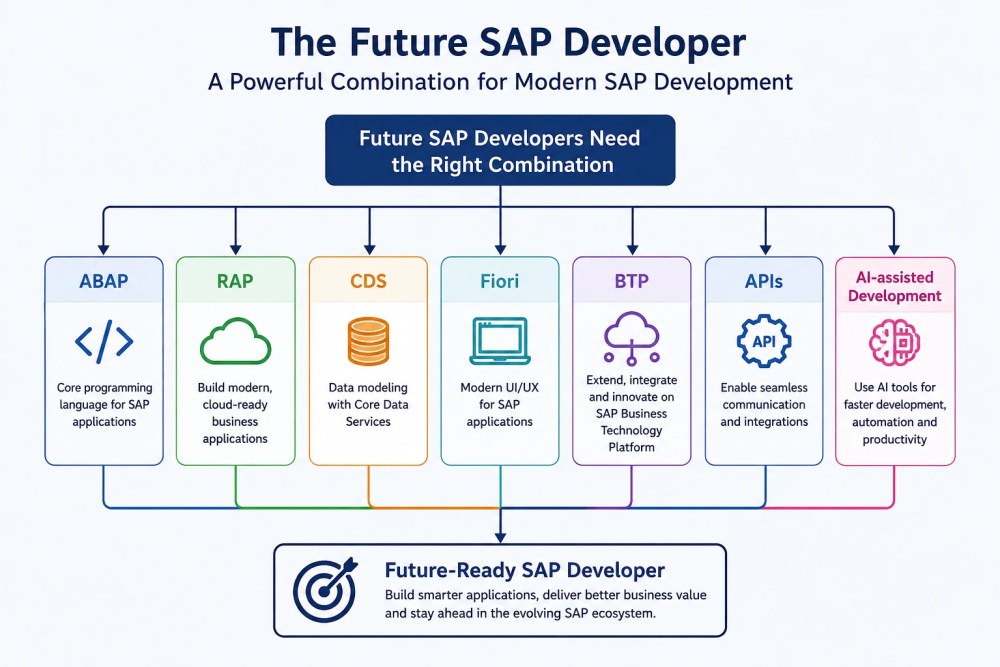
ABAP + RAP + CDS + Fiori + BTP + APIs + AI-assisted development
Learning this technology stack can help developers remain relevant as SAP landscapes evolve.
Quick Summary
- RAP means ABAP RESTful Application Programming Model.
- It supports modern SAP application development.
- RAP works closely with CDS, OData, Fiori, and ABAP Cloud.
- It supports transactional applications and Web APIs.
- RAP aligns with modern Clean Core development.
- Managed and unmanaged RAP scenarios support different development needs.
- RAP skills can improve an ABAP developer’s modern SAP profile.
- Future SAP development will increasingly involve cloud, APIs, automation, and AI.
Frequently Asked Questions
Q: What is SAP ABAP RAP?
A: SAP ABAP RAP is a modern ABAP development model for creating business applications, transactional Fiori apps, OData services, and Web APIs. It uses concepts such as CDS, behavior definitions, business objects, and service bindings.
Q: Is RAP difficult for beginners?
A: RAP can be challenging initially because it introduces several new concepts. However, beginners can learn it progressively by first understanding ABAP, CDS, OData, and basic Fiori concepts.
Q: Is RAP useful for SAP S/4HANA?
A: Yes. RAP is designed for modern SAP development and is used with SAP S/4HANA Cloud and ABAP Cloud environments. It is particularly relevant for developing applications and extensions using modern SAP architecture.
Q: Should traditional ABAP developers learn RAP?
A: Yes. Developers working with traditional ABAP can benefit from learning RAP, especially when moving toward S/4HANA, ABAP Cloud, Fiori, and Clean Core development.
Q: What should I learn before RAP?
A: Start with ABAP fundamentals. Then learn object-oriented ABAP, CDS, SQL concepts, OData, Fiori basics, and Eclipse ADT. After that, learn RAP business objects, behavior definitions, service definitions, and service bindings.
Conclusion
SAP ABAP RAP is important because SAP development is moving beyond traditional custom programming toward cloud-ready applications, APIs, Fiori experiences, and Clean Core architectures.
RAP provides a structured development model that connects data modeling, business logic, services, and application development. SAP’s current documentation positions RAP as a key part of ABAP Cloud development.
For ABAP developers, learning RAP can be a practical next step toward modern SAP careers. For beginners, a structured learning path can make the transition easier.
If you want to build practical skills in RAP, CDS, OData, Fiori, and modern ABAP development, consider joining an SAP ABAP RAP Course through Visualpath and develop hands-on knowledge for modern SAP projects.
Modern Development Concepts: SAP BTP, ABAP Cloud, CDS Views, OData Services, Fiori Applications
Visualpath stands out as the best online software training institute in Hyderabad.
For More Information about SAP ABAP RAP Training
Contact Call/WhatsApp: +91-7032290546
Visit: https://visualpath.in/sap-abap-rap-online-training.html