

Introduction
Modern SAP applications need more than database tables and user interfaces. They must also control how users create, update, delete, and process business data.
This is where behavior definitions become important in the RESTful Application Programming Model, commonly called SAP RAP.
A behavior definition tells the RAP framework what users can do with a business object. It can define operations such as create, update, and delete. It can also control validations, determinations, actions, authorizations, and other business behavior.
For beginners, the concept may appear complex. However, it becomes easier when you think of a behavior definition as a rulebook for a business object.
Learning this concept is important because SAP RAP is widely used for developing modern applications for SAP S/4HANA. Understanding behavior definitions also builds a strong foundation for developers preparing for SAP RAP Training.
Table of Contents
- What Is a Behavior Definition in SAP RAP?
- Why Are Behavior Definitions Important?
- How Behavior Definitions Work
- Step-by-Step Example
- Real-World Use Cases
- Tools and Technologies Used
- Benefits and Advantages
- Common Challenges
- Career Opportunities and Salary Trends
- Common Mistakes to Avoid
- Future Trends and Industry Outlook
- Quick Summary
- FAQs
- Conclusion
What Is a Behavior Definition in SAP RAP?
A behavior definition, or BDEF, describes the behavior that a RAP business object supports.
In simple terms:
A behavior definition specifies which operations are allowed on a RAP business object and which business rules control those operations.
For example, consider a purchase order application.
The business object may allow users to:
- Create a purchase order.
- Update purchase order information.
- Delete a purchase order.
- Approve a purchase order.
- Validate required information.
- Automatically calculate values.
- Control who can change the document.
These rules can be represented through the behavior definition.
The behavior definition works together with the RAP business object model. It is commonly associated with entities defined through CDS and implemented using ABAP behavior-related components.
Why Are Behavior Definitions Important?
A database table mainly stores data. A behavior definition describes how that data can be used and changed.
This separation makes application development more structured.
For example, a sales order may have a status such as “New,” “Approved,” or “Completed.” A user should not be able to change every field at every stage.
The behavior definition can help establish rules such as:
- Allow creation of a new order.
- Allow updates while the order is open.
- Prevent changes after completion.
- Provide an approval action.
- Validate mandatory information.
- Determine values automatically.
This makes business applications more consistent and easier to maintain.
How Do Behavior Definitions Work?
A simplified RAP development flow looks like this:
Database Table → CDS View Entity → Behavior Definition → Behavior Implementation → Service Definition → Service Binding → UI/API
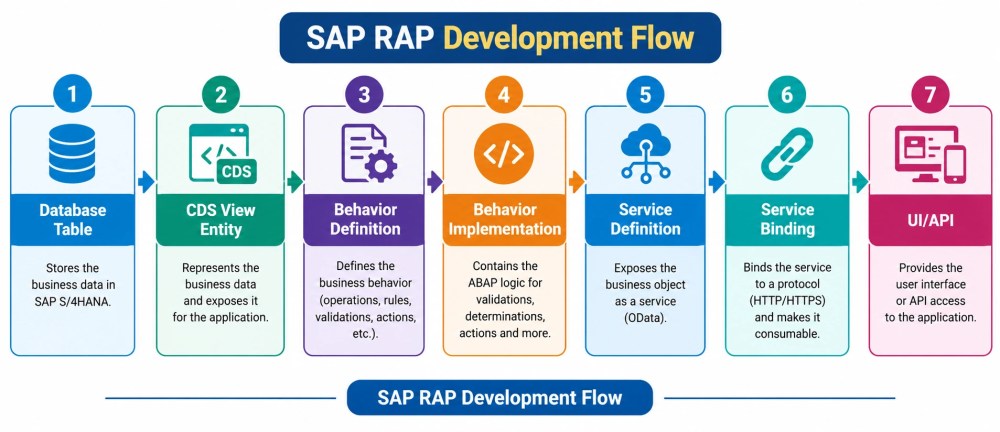
Each component has a different responsibility.
1. Define the Data Model
First, developers create or use the required database tables.
2. Create the CDS View Entity
The CDS view entity represents the business data that the RAP application exposes.
3. Create the Behavior Definition
The behavior definition specifies supported operations and business rules.
4. Implement Business Logic
Behavior implementation classes contain the logic required for validations, determinations, actions, and other operations.
5. Expose the Business Object
The service definition and service binding expose the RAP application through an appropriate service protocol.
Step-by-Step Example
Imagine an employee leave application.
The application contains an Employee Leave entity with fields such as:
- Employee ID
- Leave Type
- Start Date
- End Date
- Status
The business requires employees to create leave requests, but approved requests should not be freely changed.
1st Step: Allow Creation
The behavior definition can allow users to create leave requests.
2nd Step: Allow Updates
Users may update requests while they remain in an editable state.
3rd Step: Add Validation
A validation can check whether the end date occurs after the start date.
4th Step: Add an Action
An action such as “Approve” can change the request status.
5th Step: Add Authorization
Authorization logic can determine whether a particular user is permitted to approve the request.
This example shows how behavior definitions connect technical development with real business requirements.
Important Concepts in Behavior Definitions
Several concepts commonly appear when working with RAP behavior.
| Concept | Purpose |
| Create | Allows creation of instances |
| Update | Allows modification of instances |
| Delete | Allows removal of instances |
| Action | Performs a specific business operation |
| Validation | Checks whether data meets business rules |
| Determination | Automatically derives or changes values |
| Authorization | Controls access to business operations |
| Locking | Helps manage concurrent changes |
These concepts are important topics for learners taking an SAP ABAP RAP Course in Hyderabad.
Real-World Use Cases
Behavior definitions can support many enterprise applications.
Finance
They can control invoice processing, payment approvals, and financial document updates.
Manufacturing
Manufacturing applications can use business actions for production orders and operational processes.
Supply Chain
RAP applications can manage purchase orders, deliveries, stock-related processes, and supplier information.
Human Resources
Employee requests, leave applications, and approval workflows can use behavior-based business logic.
Sales
Sales applications can control customer orders, approvals, pricing-related processes, and document status changes.
Tools and Technologies Used
Developers commonly work with several SAP technologies when building RAP applications:
- SAP S/4HANA
- ABAP
- ABAP Development Tools
- Eclipse
- Core Data Services
- RAP Business Objects
- Behavior Definitions
- Behavior Implementations
- Service Definitions
- Service Bindings
- OData services
- SAP Fiori
Understanding how these components interact is essential for practical RAP development.
Benefits and Advantages
Behavior definitions provide several advantages.
Clear business rules: Business behavior is described in a structured way.
Better application design: Data modeling and business behavior have clear responsibilities.
Reusable business objects: RAP business objects can support different application scenarios.
Modern service development: RAP supports service-based application development for modern SAP environments.
Improved maintainability: Structured behavior makes applications easier to understand and modify.
Better control: Validations, actions, authorizations, and other rules can be managed systematically.
Common Challenges
Beginners may face several challenges when learning RAP behavior definitions.
One common challenge is understanding the difference between CDS modeling and behavior modeling.
Another challenge is knowing when to use a validation, determination, or action.
Developers may also find managed and unmanaged implementations confusing at first.
Debugging behavior implementation logic can require a good understanding of the RAP interaction and save sequences.
Hands-on exercises are therefore important in SAP ABAP RAP Training.
Career Opportunities and Salary Trends
RAP skills are relevant to modern SAP development because organizations continue to modernize SAP applications and business processes.
Global Demand
Organizations using SAP S/4HANA need developers who understand modern ABAP development, CDS, RAP, APIs, and SAP Fiori integration.
India Market Demand
India has a large SAP services and consulting ecosystem. RAP knowledge can complement traditional ABAP skills for developers working on S/4HANA projects.
Popular Job Roles
Relevant roles include:
- SAP ABAP Developer
- SAP RAP Developer
- SAP S/4HANA Developer
- SAP Technical Consultant
- SAP Fiori and ABAP Developer
- SAP Application Developer
Salary levels vary based on experience, technical specialization, location, employer, project complexity, and broader SAP skills.
Future Growth Opportunities
Developers can expand their knowledge into SAP Fiori, OData, APIs, cloud development, SAP BTP, CDS, and AI-enabled enterprise applications.
Common Mistakes to Avoid
Beginners should avoid these common mistakes:
- Treating behavior definitions as database structures.
- Confusing validations with determinations.
- Adding business logic without understanding the RAP lifecycle.
- Ignoring authorization requirements.
- Not testing different business scenarios.
- Learning syntax without building practical applications.
- Using actions when a simpler business rule is sufficient.
A strong understanding of business requirements is as important as knowing RAP syntax.
Future Trends and Industry Outlook
SAP development is moving toward modern, service-based application architectures. RAP is an important part of this direction.
Future SAP projects are expected to involve greater integration between S/4HANA, APIs, SAP BTP, cloud services, automation, and AI-enabled capabilities.
For ABAP developers, this means traditional programming knowledge can be strengthened by learning modern development models.
Behavior definitions will remain important because applications still need clear rules for how enterprise data can be created, changed, validated, and processed.
Featured Snippet: What Is a Behavior Definition?
A behavior definition in SAP RAP describes how a business object can be used and changed. It defines operations such as create, update, and delete, along with validations, actions, determinations, and authorizations. Visualpath explains these concepts through practical training focused on modern SAP development.
Quick Summary
- Behavior definitions control RAP business object behavior.
- They define supported operations and business rules.
- Create, update, and delete are common operations.
- Actions perform specific business processes.
- Validations check whether data follows rules.
- Determinations can automatically derive values.
- Authorizations control access to operations.
- Behavior implementations contain application logic.
- RAP works closely with CDS and OData services.
- Practical projects help developers understand RAP better.
Frequently Asked Questions
Q. What is the main purpose of a behavior definition in SAP RAP?
A: A behavior definition describes what operations are allowed on a RAP business object. It can define create, update, delete, actions, validations, determinations, authorizations, and other business behavior.
Q. What is the difference between CDS and a behavior definition?
A: CDS primarily defines the data model and data exposure structure. A behavior definition describes how users and applications can interact with that business object and what business operations are supported.
Q. What are actions in SAP RAP?
A: Actions are business operations that perform a specific task beyond basic create, update, or delete operations. For example, an approval action can change the status of a business document.
Q. Why are validations used in RAP?
A: Validations check whether data satisfies defined business rules. For example, a validation can ensure that an employee’s leave end date is not earlier than the start date.
Q. Is RAP useful for ABAP developers?
A: Yes. RAP provides a modern development model for building transactional and service-based applications in SAP environments. Developers can strengthen their skills through structured SAP ABAP RAP Training and practical projects.
Conclusion
Behavior definitions are a fundamental part of SAP RAP development. They provide a structured way to describe how business objects behave and how users can interact with enterprise data.
For beginners, the best approach is to learn each concept through practical examples. Start with basic create, update, and delete operations. Then move to validations, determinations, actions, locking, and authorization.
If you want to build practical skills in modern ABAP development, consider joining an online SAP ABAP RAP Training program. A structured SAP ABAP RAP Course in Hyderabad can help learners understand RAP concepts, build practical projects, and prepare for modern SAP development opportunities.
Explore Visualpath’s online training options and develop practical RAP skills for today’s SAP ecosystem.
Technologies: ABAP + RAP + CDS + Fiori + OData + S/4HANA + cloud development
Visualpath stands out as the best online software training institute in Hyderabad.
For More Information about SAP ABAP RAP Training
Contact Call/WhatsApp: +91-7032290546
Visit: https://visualpath.in/sap-abap-rap-online-training.html