Power Apps Canvas vs Model-Driven Apps: Key Differences
Introduction
Power Apps: Understanding Canvas and Model-Driven Apps
Power Apps makes it easier to build business applications without starting everything from complex code. It can help companies create apps for tasks such as employee requests, customer records, inventory, approvals, and service management. For beginners who want to learn app development, a Power Apps Course can provide a clear path to understanding app design, data connections, formulas, and business solutions. However, one important question often comes up: should you use a Canvas App or a Model-Driven App?
Both app types are part of Microsoft Power Apps, but they work in different ways. Canvas Apps give you more control over the screen and user experience. Model-Driven Apps focus more on business data, processes, and structured information. Understanding this difference can help you choose the right approach before you start building an application.
What Is a Canvas App?
A Canvas App gives developers and makers greater freedom over the design of an application. You start with a blank screen and decide where buttons, forms, menus, images, labels, and other controls should appear.
Think about a mobile shopping application. You may want the product image at the top, the price below it, and a large button at the bottom. With a Canvas App, you can arrange these elements based on the experience you want users to have.
Canvas Apps can connect to many data sources. These may include Microsoft Dataverse, SharePoint, Excel, SQL Server, and other supported services.
They are useful when the look and feel of the application is important.
Main Features of Canvas Apps
Canvas Apps provide:
- Flexible screen layouts
- Custom buttons and controls
- Connections to different data sources
- Mobile and desktop-friendly experiences
- Power Fx formulas for app logic
- Custom navigation between screens
- Greater control over the user interface
For example, a company could create a simple employee expense app. Employees can enter an expense, upload information, and submit it for approval. The screen can be designed specifically for quick and simple data entry.
What Is a Model-Driven App?
A Model-Driven App takes a different approach. Instead of starting with a completely blank screen, you begin with the business data model.
Model-Driven Apps are closely connected with Microsoft Dataverse. Tables, columns, relationships, forms, views, dashboards, and business processes help shape the application.
Imagine a customer service application. A support team may need to see customers, cases, contacts, activities, and service information. A Model-Driven App can organize this information into a structured business application.
The focus is less on manually designing every part of the screen and more on creating a consistent system around business data and processes.
Canvas Apps vs Model-Driven Apps
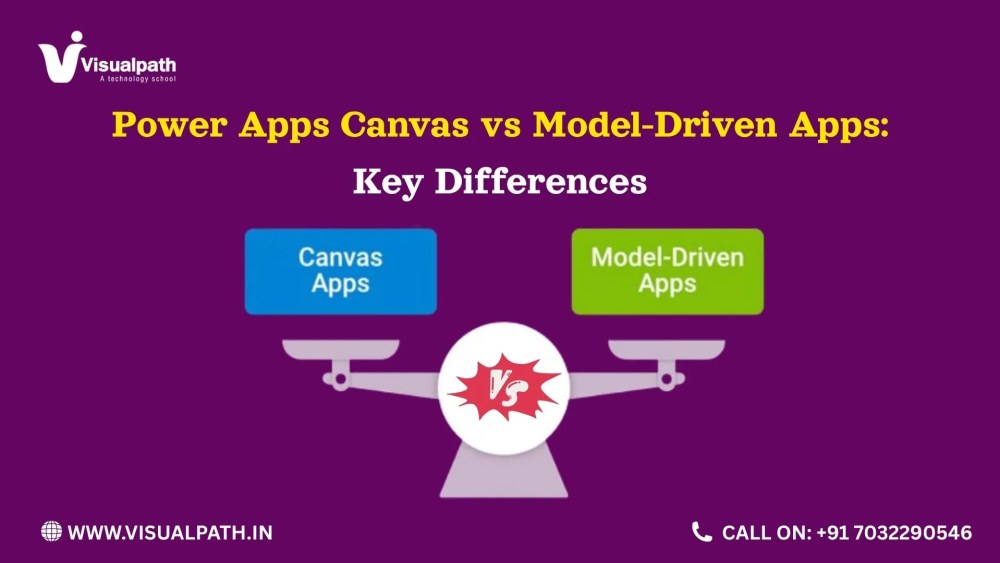
The biggest difference is design freedom versus data-driven structure.
With a Canvas App, you decide how the application should look. You have more control over the position and appearance of controls.
With a Model-Driven App, the data model plays a major role in determining the application structure. You configure tables, forms, views, dashboards, and processes to support the business requirement.
Canvas Apps are often suitable for focused applications where users need a simple and customized experience. Model-Driven Apps are generally useful for larger business applications where users work with related records and structured information.
Difference in User Interface
The user interface is one of the easiest differences to understand.
Canvas Apps provide a blank starting point. You can place controls almost anywhere and create a customized experience. This makes them useful for applications that need a specific design.
Model-Driven Apps provide a more structured interface. Forms, views, navigation, dashboards, and other components work together based on the data model.
For example, if you need a small application for employees to check office facilities and submit requests, a Canvas App may be a good choice.
If you need a complete system to manage customers, cases, activities, and business processes, a Model-Driven App may be more suitable.
Difference in Data Management
Data is important in both types of applications, but Model-Driven Apps are strongly centered around structured business data.
Dataverse is commonly used with Model-Driven Apps because it supports tables, relationships, security, business rules, and other data management capabilities.
Canvas Apps can also use Dataverse, but they can connect to a wider range of data sources depending on the requirement.
At around this stage of a project, understanding workflow automation is also useful. Microsoft Power Automate Training can help learners understand how applications can trigger workflows, send notifications, update records, and automate approval processes.
For example, a user could submit a request through an app, and a workflow could notify a manager. After approval, another action could update the related business record.
When Should You Choose a Canvas App?
Canvas Apps are a good option when the user experience needs to be highly customized.
Consider a Canvas App when:
- You need a simple and focused application.
- The screen design is important.
- Users need a mobile-friendly experience.
- You want to combine information from different sources.
- The application has a limited number of business processes.
- You need complete control over the layout.
A field worker application is one example. Workers could open the app on a phone, view assigned tasks, update their work status, add notes, and submit information.
The application can be designed around the exact steps that workers follow.
When Should You Choose a Model-Driven App?
Model-Driven Apps are useful when an application contains a large amount of structured business information.
They can be a good choice when:
- The application uses Dataverse heavily.
- Users work with many related records.
- Business processes are important.
- Different teams need access to the same information.
- You need forms, views, dashboards, and role-based access.
- The application may grow over time.
For example, a company managing customer service may need customer records, support cases, activities, contacts, and service history. A structured application can make it easier for employees to find and manage this information.
Can You Use Canvas and Model-Driven Apps Together?
Yes. Organizations do not always have to choose only one approach.
Canvas Apps and Model-Driven Apps can work together as part of a larger business solution. A company might use a Model-Driven App as the main system for managing business records and use a Canvas App for a specific task that requires a customized interface.
For example, employees may use a simple Canvas App to submit requests, while managers use a Model-Driven App to review requests, track records, and manage related information.
This approach allows each app type to handle the area where it works best.
Power Apps and Power Automate for Business Solutions
Applications often need more than screens and data. Businesses may also need approvals, alerts, scheduled tasks, emails, and automatic updates.
This is where Power Apps And Power Automate Training can be useful for people who want to understand how applications and workflows can work together.
For instance, an employee can submit a leave request through an application. An automated workflow can send the request to a manager, wait for a decision, notify the employee, and update the appropriate record.
This creates a connected business process instead of having employees perform every step manually.
Which One Is Easier for Beginners?
Canvas Apps may feel easier at first because you can immediately see the screen and add controls. Beginners can create a small application and gradually learn formulas and data connections.
Model-Driven Apps may require a better understanding of data structure. Users need to think about tables, relationships, forms, views, security roles, and business processes.
However, neither option is difficult if the concepts are learned step by step. The right choice depends mainly on the application requirement rather than which technology looks easier.
How to Decide Between Canvas and Model-Driven Apps
Start by asking a few simple questions.
Do you need a highly customized screen?
Canvas Apps may be better.
Does your application mainly manage structured business records?
A Model-Driven App may be a stronger option.
Do you need information from several different data sources?
A Canvas App can provide useful flexibility.
Does your application contain many related records and business processes?
A Model-Driven App can provide a more structured approach.
The best solution is the one that matches the business problem. Choosing an app type before understanding the requirement can create unnecessary work later.
Frequently Asked Questions
Canvas Apps provide more control over the user interface and screen layout. Model-Driven Apps are built around structured business data, usually using Dataverse.
Neither is always better. Canvas Apps are useful for customized user experiences, while Model-Driven Apps are suitable for structured business applications with data and processes.
Yes. Canvas Apps can connect to Dataverse along with several other supported data sources.
Yes. Model-Driven Apps use Dataverse as their main data platform and use its tables, relationships, forms, views, and other components to build the application.
Yes. They can be used together in a larger solution. A business can use a Model-Driven App for structured record management and a Canvas App for a customized user experience.
Conclusion
Canvas Apps and Model-Driven Apps solve different types of business problems. Canvas Apps are a strong choice when design flexibility and a customized user experience are important. Model-Driven Apps are better suited to structured data, related records, and business processes.
Before choosing one, understand what users need, where the data is stored, how much customization is required, and how the application may grow. A clear requirement at the beginning can make application development much easier and more effective.
Trending Courses: Azure Data Engineering, Azure AI, SAP UI5 Fiori, SAP BTP CAP with Fiori.
Visualpath is the Leading and Best Software Online Training Institute in Hyderabad.
For More Information about Best Microsoft Power Apps
Contact Call/WhatsApp: +91-7032290546
Visit: https://www.visualpath.in/microsoft-powerapps-training.html