
Introduction
Generative AI applications can answer questions, summarize documents, and create useful content. However, they need a reliable way to find information related to a user’s question, even when the wording differs from the source material.
For example, a user might search for “reduce cloud expenses,” while a company document discusses “cloud cost optimization.” A basic keyword search may miss this relationship.
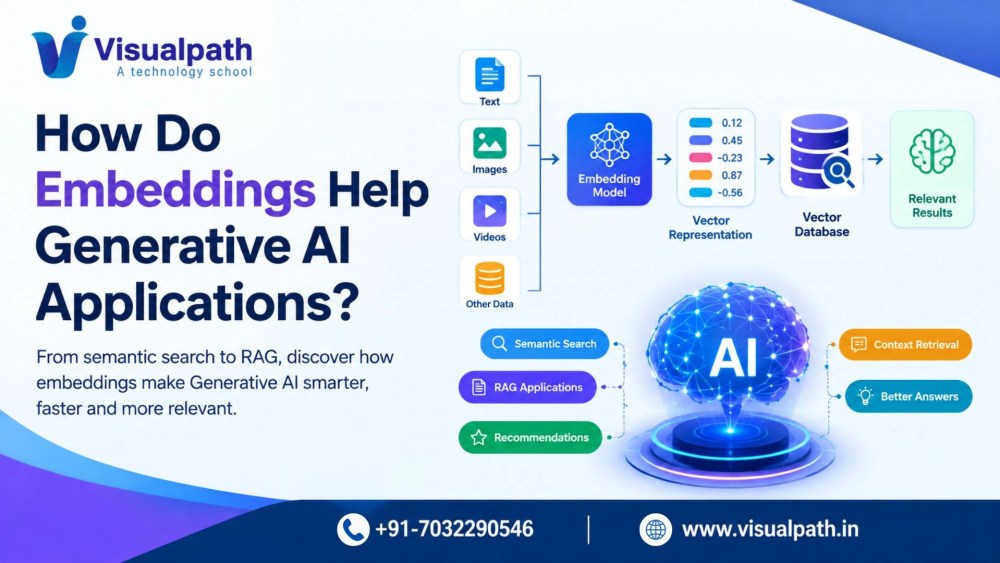
Embeddings help Generative AI applications connect information through learned patterns of meaning. They convert text, images, and other supported data into numerical vectors. AI systems can compare these vectors to find related content and retrieve useful context.
Embeddings are essential components of many semantic search, recommendation, and Retrieval-Augmented Generation (RAG) workflows. Understanding them is valuable for developers building practical AI solutions and professionals pursuing GenAI Training.
Table of Contents
- What Are Embeddings in Generative AI?
- How Do Embeddings Work?
- Real-World Examples and Applications
- Embeddings vs. Keyword Search
- Benefits and Advantages
- Tools and Technologies Used
- Career Opportunities and Salary Trends
- Future Trends and Industry Outlook
- Featured Snippet and Quick Summary
- Frequently Asked Questions
What Are Embeddings in Generative AI?
Embeddings are numerical representations of information. An embedding model converts an input, such as a sentence or image, into a list of numbers called a vector.
These numbers represent patterns and relationships learned during model training. Information with similar meanings may have vectors that are close together in the embedding space.
Consider these three phrases:
- “How can I protect my online account?”
- “Ways to improve login security.”
- “What is the capital of France?”
A suitable text embedding model may place the first two phrases closer together because their meanings are related.
An embedding does not represent complete human understanding. Its usefulness depends on the model, training data, and intended task.
How Do Embeddings Work in Generative AI Applications?
Embeddings generally support a larger information retrieval process. They do not usually generate the final answer themselves.
Here is how embeddings work in a typical document-question-answering application.
Step 1: Collect and Prepare Data
The application collects information from documents, websites, knowledge bases, product catalogs, or internal company resources.
The system cleans the content and divides longer documents into smaller sections called chunks. This helps retrieve relevant passages without processing entire documents for every question.
Step 2: Generate Embeddings
An embedding model converts each chunk into a numerical vector.
For example, a company policy describing password requirements becomes a vector that represents learned patterns in the text.
Step 3: Store Vectors in a Search System
The application stores the vectors alongside their original text and useful metadata.
A vector database or vector search engine organizes these representations and supports similarity searches.
Step 4: Convert the User’s Question
When a user asks a question, the application converts it into a vector using the same or a compatible embedding model.
This allows the system to compare the question with the stored document vectors.
Step 5: Retrieve Relevant Information
The system searches for vectors that closely match the question vector.
Common similarity measures include cosine similarity and dot product. The appropriate method depends on the embedding model and its configuration.
The application retrieves the associated text passages and may apply additional ranking or filtering.
Step 6: Generate a Contextual Answer
In a RAG application, the retrieved passages become context for a Generative AI model.
The model uses this context to create a response that addresses the user’s question.
Important: Embeddings help retrieve potentially relevant information, but they do not guarantee factual accuracy. The retrieved passages and final response still require appropriate evaluation.
Real-World Examples and Industry Applications
Embeddings support applications that need to identify relationships between different pieces of information.
1. Enterprise Knowledge Assistants
An employee asks, “How do I apply for parental leave?”
An embedding-based assistant can retrieve relevant HR policy sections, even if the documents use different wording. A language model can then summarize the process using the retrieved information.
2. E-Commerce Product Discovery
A customer searches for “comfortable shoes for long walks.”
The system may retrieve products described as lightweight walking shoes or cushioned footwear. This can improve product discovery when the customer’s wording differs from product descriptions.
3. Customer Support
Support teams can use embeddings to find previous tickets that resemble a new customer issue.
Agents can review relevant troubleshooting steps and earlier resolutions without searching manually through thousands of records.
4. Education and Learning
Educational platforms can retrieve lessons related to student questions and recommend relevant learning materials.
For example, a search for “how computers learn from examples” may lead to introductory machine learning lessons.
5. Healthcare Information Retrieval
Healthcare organizations can use embeddings to find relevant passages from approved clinical documents or internal knowledge resources.
These systems require strong privacy controls, suitable validation, and professional oversight. Similarity alone cannot establish a diagnosis or confirm clinical suitability.
Embeddings vs. Traditional Keyword Search
Traditional keyword search focuses on matching words or phrases. Embedding-based search compares numerical representations of learned meaning.
| Feature | Keyword Search | Embedding-Based Search |
| Search method | Matches terms | Compares vectors |
| Different wording | May miss related phrases | Can identify semantic similarity |
| Exact identifiers | Often effective | Depends on the model |
| Infrastructure | Often simpler | Requires embedding and vector-search components |
| Common uses | Product IDs, names, exact terms | Semantic search, RAG, recommendations |
Neither method is always better. Keyword search remains useful for exact identifiers, product codes, and precise phrases.
Many applications use hybrid search, which combines keyword matching and vector similarity. A ranking system can then reorder results according to relevance.
Benefits and Advantages of Embeddings
Embeddings offer several practical benefits for Generative AI applications.
- Semantic search: Finds related information when wording differs.
- Context retrieval: Helps locate useful passages for RAG systems.
- Recommendations: Identifies related products, articles, or learning resources.
- Scalable discovery: Supports searching large document collections.
- Flexible queries: Allows users to search using natural-language questions.
- Multimodal retrieval: Certain models can represent text and images in compatible embedding spaces.
The results depend on embedding quality, data preparation, retrieval configuration, and evaluation methods.
Tools and Technologies Used
Developers can use several tools to create embedding-based applications.
- Sentence Transformers: Generates text embeddings using pretrained models and supports similarity tasks.
- Hugging Face Transformers: Provides access to models and tools for processing text and other supported data types.
- OpenAI embedding models: Generate vector representations for supported search and retrieval workflows.
- FAISS: Provides efficient similarity search over dense vectors.
- Pinecone: Offers managed vector storage and retrieval.
- Weaviate: Supports vector search and hybrid retrieval.
- Chroma: Provides vector storage and retrieval capabilities for AI applications.
- LangChain and LlamaIndex: Help connect embedding models, document retrieval, and language models.
Choose tools based on privacy, cost, latency, scale, deployment requirements, and integration needs. Professionals exploring Generative AI Courses Online should look for practical projects covering document processing, embeddings, vector search, retrieval evaluation, and language model integration.
Career Opportunities and Salary Trends
Embeddings are relevant to AI engineering, semantic search, information retrieval, and RAG application development.
Globally, organizations are exploring AI assistants, enterprise search, and intelligent automation. In India, related opportunities exist across IT services, consulting, software companies, startups, and enterprise technology teams.
Popular job roles include:
- Generative AI Engineer
- AI/ML Engineer
- LLM Application Developer
- Machine Learning Engineer
- NLP Engineer
- Search and Information Retrieval Engineer
- AI Solutions Architect
Useful skills include Python, embedding models, vector databases, APIs, RAG pipelines, data preparation, model evaluation, and cloud platforms.
Salary levels vary by experience, location, employer, and specialization. Candidates should review current job listings for their target role rather than relying on unsupported salary estimates.
For learners in Telangana, Gen AI Training in Hyderabad is another option to explore when seeking structured learning and hands-on project experience.
Future Trends and Industry Outlook
Embeddings remain an important part of systems that retrieve, organize, and connect information.
Several developments are shaping their use:
- Multimodal embeddings: Represent text, images, and other supported data in related vector spaces.
- Domain-specific models: Support specialized retrieval tasks involving technical, legal, or scientific content.
- Hybrid retrieval: Combines keyword search with semantic similarity.
- Reranking models: Reorder retrieved passages according to their relevance to a question.
- Efficient vector search: Helps applications manage large datasets and practical response times.
- Advanced RAG pipelines: Combine embeddings with metadata filtering, query rewriting, and retrieval evaluation.
These developments do not remove the need for reliable data, appropriate security, and systematic testing.
Featured Snippet
Embeddings help Generative AI applications by converting text, images, and other supported data into numerical vectors that represent learned relationships. AI systems compare these vectors to find relevant information, power semantic search, recommend similar content, and retrieve context for RAG applications, helping language models generate more relevant responses.
Quick Summary
- Embeddings represent information as numerical vectors.
- Similar meanings can produce similar vector representations.
- Embeddings support semantic search and recommendation systems.
- RAG uses embeddings to retrieve context for language models.
- Vector databases store and search numerical representations.
- Hybrid search combines keyword matching with semantic retrieval.
- Data quality and evaluation influence retrieval performance.
- Python, embedding models, and vector databases are useful career skills.
Frequently Asked Questions
1. Why are embeddings important for Generative AI?
A: Embeddings help AI systems find related information through learned semantic relationships. They support semantic search, document retrieval, recommendations, and RAG applications.
2. Are embeddings the same as tokens?
A: No. Tokens are units of text processed by language models. Embeddings are numerical vectors that represent learned information about text, tokens, or other inputs.
3. What is the difference between embeddings and a vector database?
A: An embedding model creates numerical vectors. A vector database stores and searches those vectors, often alongside metadata and associated content.
4. Can Generative AI work without embeddings?
A: Yes. A language model can generate responses without an external embedding workflow. Embeddings become useful when applications need semantic retrieval, document search, or a RAG pipeline.
5. Do embeddings improve RAG accuracy?
A: Embeddings can improve the retrieval of relevant information. Overall RAG quality also depends on document quality, chunking, ranking, context construction, and the language model’s response.
Conclusion
Embeddings connect information retrieval with Generative AI. By converting information into numerical vectors, they help applications identify related concepts, retrieve useful context, and support more relevant responses.
From enterprise knowledge assistants to product discovery and RAG systems, embeddings enable applications to go beyond exact keyword matching. Successful implementation still requires suitable models, high-quality data, secure infrastructure, and systematic evaluation.
To build practical skills in embeddings, vector databases, semantic search, and RAG development, consider joining an online training program. Visualpath is a training institute offering online technology training for learners who want to strengthen their Generative AI knowledge and prepare for AI development opportunities.
AI Technologies: AI Agents for DevOps Engineers, RAG, Large Language Models, Python.
Visualpath stands out as the best online software training institute in Hyderabad.
For More Information about Generative AI Training
Contact Call/WhatsApp: +91-7032290546
Visit: https://www.visualpath.in/generative-ai-course-online-training.html