Tag: SpringBootandMicroservicesTraining

  • What are the main components of Spring Boot?

    What are the main components of Spring Boot?

    Introduction:

    Spring Boot is a powerful framework designed to simplify the development of production-ready applications in the Java ecosystem. It builds upon the Spring Framework but significantly reduces the configuration overhead, enabling developers to create stand-alone, production-grade Spring-based applications with minimal effort. Understanding its main components and how they work together is key to leveraging its full potential.

    1. Spring Boot Starter

    At the heart of Spring Boot’s simplicity is the concept of “starters.” Starters are a set of convenient dependency descriptors that you can include in your application’s build configuration to get a specific set of dependencies. For example, spring-boot-starter-web includes all the dependencies required to build a web application using Spring MVC. Starters abstract away the complexity of configuring multiple dependencies manually, ensuring that you get a cohesive set of libraries that work together seamlessly.

    2. Auto configuration

    Auto configuration is another key feature of Spring Boot. It leverages the starters and the concept of conditionals to automatically configure your Spring application based on the libraries and dependencies you have added to your project. When you include a starter, Spring Boot detects the libraries in your class path and automatically configures the application accordingly. This drastically reduces the amount of boilerplate configuration code you need to write, while still allowing for fine-grained customization through configuration properties. Spring Boot Micro Services Training Hyderabad 

    3. Spring Boot CLI

    The Spring Boot Command Line Interface (CLI) provides a quick and easy way to prototype with Spring. It allows you to run Groovy scripts that interact with your Spring Boot application. The CLI can also be used to generate new projects, making it a handy tool for quickly setting up and experimenting with Spring Boot applications without needing to use a full-fledged IDE.

    4. Embedded Server

    Spring Boot includes several embedded servers such as Tomcat, Jetty, and Undertow. These servers are included as dependencies when you use relevant starters like spring-boot-starter-web. This allows you to package your application as a self-contained JAR or WAR file that includes an embedded server, making deployment straightforward and reducing the need for external server setup.

    5. Spring Boot Actuator

    Actuator is a set of production-ready features that allow you to monitor and manage your application. It provides endpoints for health checks, metrics, info about your application, environment details, etc. Actuator endpoints can be easily customized and secured, providing valuable insights into the runtime of your application without needing to add custom monitoring code.

    6. Spring Boot Dev Tools

    Dev Tools is a set of tools that can make development faster and more efficient. It includes features like automatic restarts, which reload your application when files change, and a built-in H2 console for managing in-memory databases. Dev Tools are particularly useful in a development environment, where they can streamline the iterative process of writing, testing, and refining code. Spring Boot Online Training Course

    7. Spring Boot Annotations

    Spring Boot introduces several annotations that simplify the configuration of Spring applications. Annotations like @Spring Boot Application, @Rest Controller, and @Auto wired reduce the need for XML configuration and promote a more concise and readable codebase. These annotations encapsulate common patterns and best practices, allowing developers to focus more on business logic rather than infrastructure concerns.

    8. Spring Boot Test

    Testing is a crucial aspect of software development, and Spring Boot provides excellent support for writing and running tests. The spring-boot-starter-test dependency includes libraries such as JUnit, Miskito, and Spring Test that facilitate unit and integration testing. Annotations like @Spring Boot Test and @Mock Bean simplify the setup of test scenarios, enabling developers to write robust tests that verify the behaviour of their applications.

    9. Externalized Configuration

    Spring Boot allows you to externalize your configuration using properties files, YAML files, environment variables, or command-line arguments. This approach promotes the separation of configuration from code, making it easier to configure your application differently for different environments (e.g., development, testing, production). Spring Boot’s flexible configuration mechanism ensures that your application can be easily configured and deployed across various deployment scenarios.

    10. Spring Boot Data

    Spring Boot provides seamless integration with data access technologies such as JDBC, JPA (Java Persistence API), MongoDB, Radis, and others through starters like spring-boot-starter-data-jape. This integration simplifies database operations and reduces boilerplate code by providing automatic repository implementations, transaction management, and other features essential for data-centric applications. Spring Boot Micro Services Online Training

    Conclusion

    In conclusion, Spring Bootis a robust framework that significantly simplifies the development of Java applications by leveraging convention over configuration, auto configuration, and a range of powerful components and tools. By embracing Spring Boot’s philosophy and utilizing its main components effectively, developers can focus more on business logic and less on infrastructure concerns, thereby accelerating the development cycle and delivering high-quality, maintainable applications.

    Visualpath is the Best Software Online Training Institute in Hyderabad. Avail complete Spring Boot Micro services worldwide. You will get the best course at an affordable cost.

    Attend Free Demo

    Call on – +91-9989971070

    WhatsApp: https://www.whatsapp.com/catalog/917032290546/

    Visit: https://visualpath.in/spring-boot-microservices-online-training.html
  • What are the Features of Spring Boot?

    What are the Features of Spring Boot?

    Introduction:

    Spring Boot is a powerful framework designed to simplify the development of production-ready applications by providing a range of features that address various aspects of the application lifecycle. Here are some of its key features: Spring Boot Online Training Course

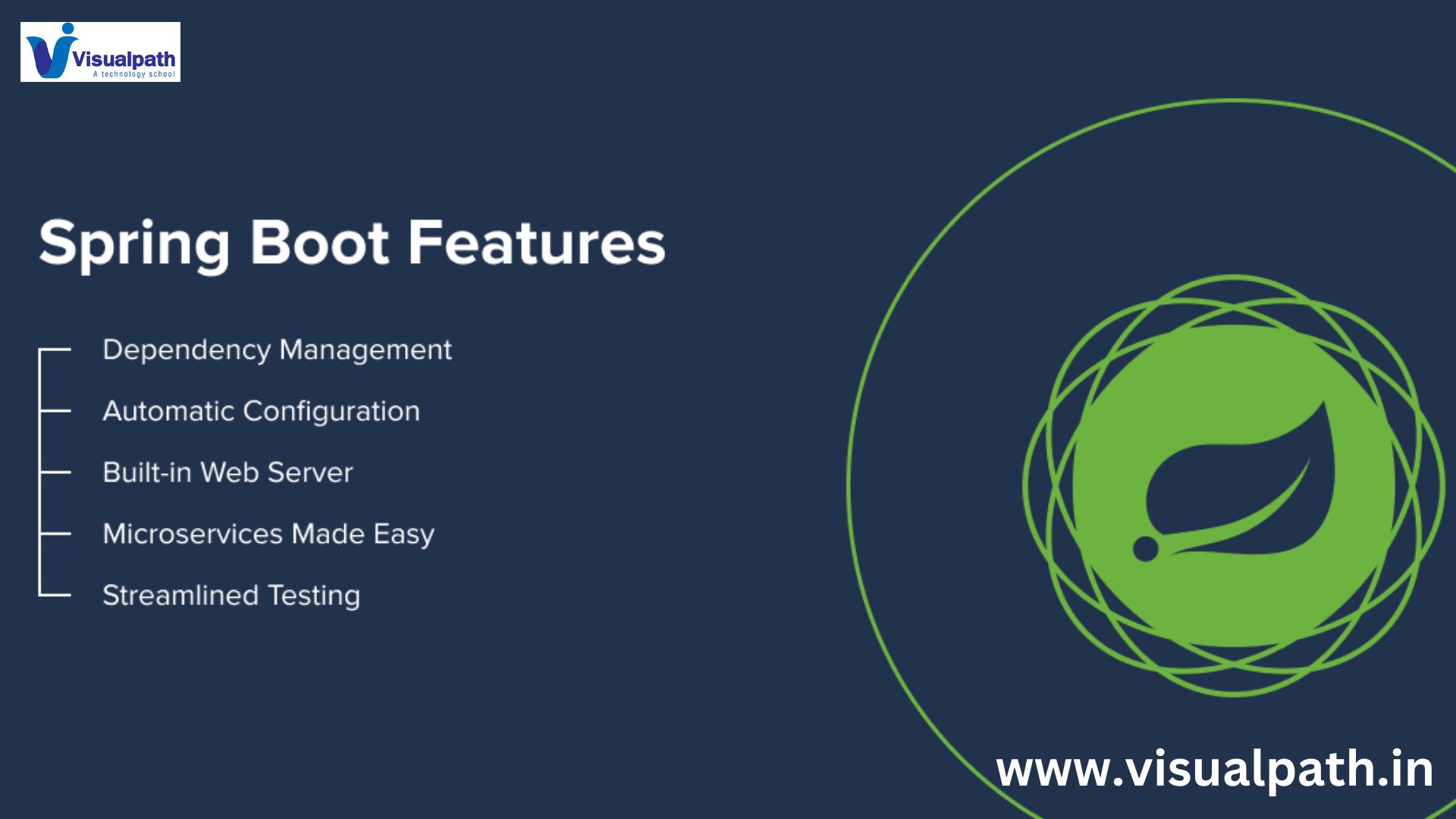
    1. Auto-Configuration: Spring Boot automatically configures your application based on the dependencies you have added to the project. This means you can get started with minimal configuration, and the framework will adjust settings to match the needs of the application.
    2. Standalone: Spring Boot applications can run independently without the need for an external web server. The embedded servers (like Tomcat, Jetty, or Undertow) allow applications to be deployed easily, simplifying the development and deployment processes.
    3. Spring Initializer: A web-based tool that generates a project structure and includes dependencies based on user selections. This tool accelerates the setup process by creating a ready-to-use project.
    4. Production-Ready Features: Spring Boot includes several features to help you run applications in production. These include health checks, metrics, application insights, and externalized configuration to handle different environments seamlessly. Spring Boot Microservices Training Institute in Hyderabad
    5. Opinionated Defaults: Spring Boot offers sensible defaults and pre-configured setups for various aspects of application development, such as data access, web services, and security, allowing developers to focus on writing business logic rather than configuration.
    6. Microservices Support: Spring Boot is designed to simplify the creation of microservices. Its features, such as easy integration with Spring Cloud, make it a popular choice for building distributed systems.
    7. Configuration Management: Spring Boot supports various configuration options, such as properties files, YAML files, environment variables, and command-line arguments, providing flexibility in managing application settings.
    8. Dev Tools: Spring Boot DevTools offers a range of features to enhance the development experience, including automatic restarts, live reload, and configurations aimed at speeding up the coding and testing processes.
    9. Security: Spring Boot simplifies the integration of security features into applications, with Spring Security providing comprehensive authentication and authorization mechanisms.
    10. Extensive Documentation and Community Support: Spring Boot is backed by comprehensive documentation and a large, active community, making it easier for developers to find resources, tutorials, and support.

    In summary, Spring Boot provides a streamlined, efficient approach to building and deploying Spring applications, emphasizing convention over configuration, and offering a suite of tools and features to simplify and accelerate the development process. Spring Boot Microservices Training Ameerpet

    Visualpath is the Best Software Online Training Institute in Hyderabad. Avail complete Spring Boot  worldwide. You will get the best course at an affordable cost.

    Call on – +91-9989971070

    WhatsApp: https://www.whatsapp.com/catalog/917032290546/

    Visit: https://visualpath.in/spring-boot-microservices-online-training.html
  • Spring Boot Microservices Concepts?

    Spring Boot Microservices Concepts?

    Introduction:

    Building a microservice with Spring Boot is a streamlined and efficient way to develop scalable, maintainable, and independently deployable services. Spring Boot, part of the larger Spring framework, simplifies the configuration and setup process, enabling developers to focus more on the business logic and less on boilerplate code. Spring Boot Microservices Training Hyderabad 

    Key Steps to Build a Microservice with Spring Boot

    1. Set Up Your Development Environment:
      • Ensure you have JDK 8 or higher installed.
      • Use a build tool like Maven or Gradle. Maven is often preferred for Spring Boot projects due to its extensive repository of libraries.
    2. Create a Spring Boot Application:
      • Use Spring Initializer to bootstrap your application. Select dependencies relevant to your microservice, such as Spring Web for RESTful APIs, Spring Data JPA for database interactions, and Spring Boot Actuator for monitoring.
    3. Define the Service Domain:
    4. Develop RESTful APIs:
      • Spring Boot makes it easy to create RESTful endpoints. Annotate your classes with @RestController and use @RequestMapping or @GetMapping, @PostMapping, etc., to define your API methods.
    5. Implement Data Access Layer:
      • Use Spring Data JPA to interact with the database. Define repositories by extending Premonitory to perform CRUD operations.
    6. Configuration Management:
      • Externalize configurations using application. Properties or application. This allows for flexibility and environment-specific settings.
    7. Service Discovery and Registration:
      • For service-to-service communication, consider using Spring Cloud Netflix Eureka for service discovery and registration.
    8. Inter-service Communication:
      • Use REST template or Feign Client for synchronous communication between microservices. For asynchronous communication, integrate with messaging systems like RabbitMQ or Kafka. Spring Boot Online Training Course
    9. Security:
      • Secure your endpoints using Spring Security. Implement authentication and authorization mechanisms to protect your microservice.
    10. Testing:
      • Write unit and integration tests using JUnit and Mockito. Ensure your APIs and data layers are thoroughly tested.
    11. Containerization and Deployment:
      • Package your microservice into a Docker container. Use tools like Kubernetes for orchestration and managing deployments.
    12. Monitoring and Logging:

    Use Spring Boot Actuator for health checks and metrics. Integrate with monitoring tools like Prometheus and Grafana, and use centralized logging solutions like ELK Stack. Spring Boot Microservices Course Online

    By following these steps, you can efficiently build and manage microservices using Spring Boot, ensuring they are scalable, reliable, and maintainable.

    Visualpath is the Best Software Online Training Institute in Hyderabad. Avail complete Spring Boot Microservices worldwide. You will get the best course at an affordable cost.

    Call on – +91-9989971070

    WhatsApp: https://www.whatsapp.com/catalog/917032290546/

    Visit: https://visualpath.in/spring-boot-microservices-online-training.html