Tag: software training

  • Understanding EL, ELT, and ETL in GCP Data Engineering

    Understanding EL, ELT, and ETL in GCP Data Engineering

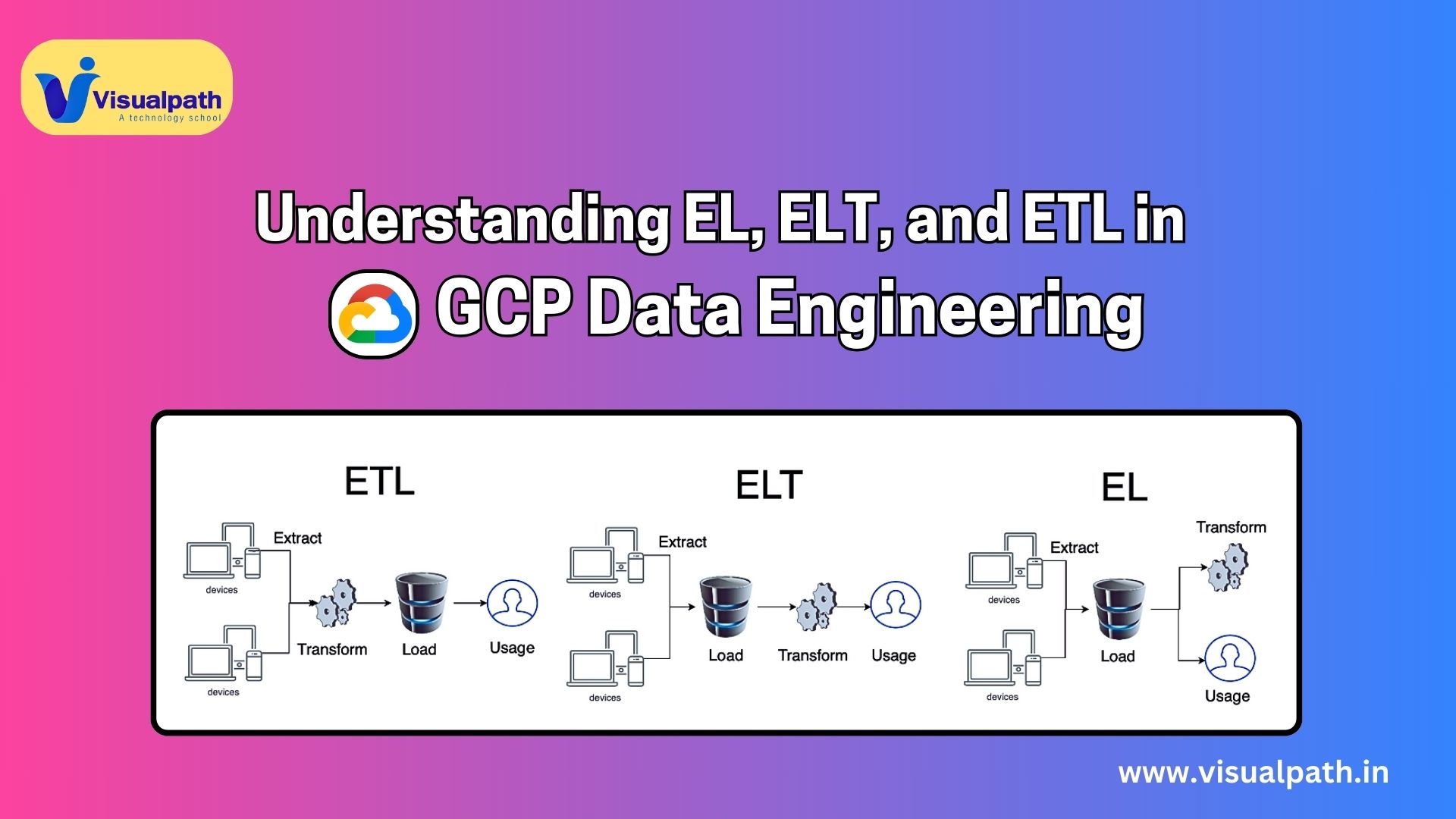
    In the realm of data engineering, particularly when working on Google Cloud Platform (GCP), the terms EL, ELT, and ETL refer to key processes that facilitate the flow and transformation of data from various sources to a destination, usually a data warehouse or data lake. For a GCP Data Engineer, it’s important to understand the differences between these processes and how to implement them efficiently using GCP services. GCP Data Engineering Training

    1. Extract, Load (EL)

    In EL (Extract, Load), data is first extracted from various sources and then directly loaded into a target system, typically a data lake like Google Cloud Storage (GCS) or BigQuery in GCP. No transformations occur during this process. EL is commonly used when:

    • The priority is to quickly ingest raw data.
    • Data needs to be stored for later processing.
    • There is a need for data backup, archiving, or unprocessed analytics.

    GCP Services for EL:

    • Cloud Dataflow: A fully managed streaming analytics service used to extract data from sources like Apache Kafka, Pub/Sub, and then load it directly into BigQuery.
    • Cloud Storage: Allows storing raw extracted data that can be later accessed and processed. GCP Data Engineer Training in Hyderabad

    Key Benefits of EL in GCP:

    • Faster initial data ingestion as transformations are deferred.
    • Suits scenarios with high data volumes and real-time ingestion needs.

    2. Extract, Transform, Load (ETL)

    ETL is the traditional data pipeline model where data is extracted, transformed into a desired format, and then loaded into the destination system. ETL is suitable when the data requires preprocessing, cleaning, or enrichment before analysis or storage.

    In the ETL process, the data transformation happens outside of the target system, often in intermediate storage or memory. This is particularly useful when dealing with large datasets that need thorough cleaning or when businesses want to standardize data before loading it into systems like BigQuery for analytics.

    GCP Services for ETL:

    • Cloud Dataflow: A powerful tool for both batch and real-time data processing, allowing engineers to extract data, apply transformations (e.g., filtering, aggregation), and load it into BigQuery or Cloud Storage.
    • Cloud Dataprep: A visually-driven data preparation tool that allows data engineers to clean, structure, and transform raw data without writing code.

    Key Benefits of ETL in GCP:

    • Enables extensive pre-processing and transformation of data before storage, ensuring the quality of data for analysis.
    • Helps businesses load only refined and structured data into their systems, improving the efficiency of analytics workflows.

    3. Extract, Load, Transform (ELT)

    ELT is a modern approach where data is first extracted and loaded into a storage system like BigQuery, and the transformation happens afterwards within the storage system itself. Unlike ETL, where transformations occur before loading, ELT leverages the computational power of modern data warehouses to perform transformations on loaded data.

    ELT is typically used in scenarios where the target system (e.g., BigQuery) has powerful data processing capabilities. This approach is often more flexible for handling large-scale data transformations as it delays them until after the data is loaded. Google Cloud Data Engineer Training

    GCP Services for ELT:

    • BigQuery: GCP’s fully managed, serverless data warehouse, ideal for ELT workflows. Data can be loaded in raw format, and SQL-based transformations can be applied as needed.
    • Cloud Composer (Apache Airflow): Orchestrates the workflow of ELT pipelines, managing extraction, loading, and the transformation process in a scheduled or event-driven manner.

    Key Benefits of ELT in GCP:

    • Greater scalability for large datasets, as transformations leverage the computational power of BigQuery.
    • Increased flexibility, allowing iterative and on-demand transformations without reloading data.

    Choosing the Right Process in GCP

    For a GCP Data Engineer, selecting between EL, ETL, and ELT depends on the specific use case:

    • EL: Best for raw data storage or when transformation can wait.
    • ETL: Ideal for structured, preprocessed data required for specific business use cases.
    • ELT: Optimal when dealing with large volumes of data and leveraging the power of modern data warehouses like BigQuery for flexible, on-demand transformations.

    By mastering these processes and understanding their differences, GCP data engineers can build efficient and scalable data pipelines that fit their organization’s needs. Google Cloud Data Engineer Online Training

    Visualpath is the Best Software Online Training Institute in Hyderabad. Avail complete GCP Data Engineering worldwide. You will get the best course at an affordable cost.

    WhatsApp: https://www.whatsapp.com/catalog/919989971070

    Visit  https://visualpath.in/gcp-data-engineering-online-traning.html
  • Azure Data Engineering? Essential Skills for a Data-Driven Future

    Azure Data Engineering? Essential Skills for a Data-Driven Future

    Introduction

    Azure Data Engineer Online Training has become a cornerstone for organizations looking to leverage data to drive business success. As businesses increasingly adopt cloud-based solutions, the role of data engineers in managing, transforming, and analysing data has gained critical importance. Azure Data Engineering offers a comprehensive set of tools and services, making it essential for professionals to develop key skills that meet today’s data-driven demands. Microsoft Azure Data Engineer Training

    Proficiency in Azure Data Services

    To succeed in Azure Data Engineering, mastering various Azure services is a must. Key services include:

    • Azure Data Factory: Used for building and automating ETL (Extract, Transform, Load) pipelines.
    • Azure Data Lake Storage: Enables scalable and secure data storage for large datasets.
    • Azure Synapse Analytics: Provides advanced analytics capabilities and integrates big data and data warehousing.
    • Azure Databricks: A powerful analytics engine for data processing and machine learning.

    Familiarity with these tools allows engineers to efficiently manage and process data across multiple platforms.

    Expertise in Data Modelling and Architecture

    A strong foundation in data modeling and architecture is crucial for Azure Data Engineers. Key areas to focus on include:

    • Database Design: Understanding how to create optimized databases that handle large volumes of data efficiently.
    • Data Warehousing: Building and managing data warehouses using Azure Synapse to store structured data.
    • Data Pipelines: Designing data pipelines that move and transform data from various sources to destinations like databases or lakes.

    Proficiency in Big Data Technologies

    With growing data volumes, Azure Data Engineers need to handle big data efficiently. Core technologies include:

    • Apache Spark: Widely used for distributed data processing and integrated with Azure Databricks.
    • Hadoop: For managing and storing large datasets in a distributed environment.
    • Stream Processing: Tools like Azure Stream Analytics are vital for processing real-time data.

    Programming and Scripting Skills

    Programming proficiency is essential for data engineers to automate workflows and manage data transformations. Key languages include:

    • SQL: Crucial for querying databases and managing relational data.
    • Python: Widely used for data manipulation, automation, and integration with Azure tools.
    • Scala: Often used in data processing frameworks like Apache Spark.

    Data Security and Compliance

    Ensuring data security is a top priority. Azure Data Engineers should understand:

    • Encryption and Access Control: How to implement encryption for data at rest and in transit. MS Azure Data Engineer Online Training 
    • Compliance: Ensuring that data practices align with regulations such as GDPR, HIPAA, and CCPA.

    Conclusion

    Azure Data Engineering offers an exciting opportunity for professionals to lead the data revolution. By mastering key skills like Azure services, data modeling, big data technologies, programming, and security, data engineers can help organizations unlock the full potential of their data. These skills will ensure engineers remain valuable in the fast-evolving, data-driven landscape.

    Visualpath is the Leading and Best Software Online Training Institute in Hyderabad. Avail complete Microsoft Azure Data Engineer Training Worldwide You will get the best course at an affordable cost.

    WhatsApp: https://www.whatsapp.com/catalog/919989971070

    Visit: https://visualpath.in/azure-data-engineer-online-training.html

  • What is AI on Google Cloud Platform GCP? | Key Components, Benefits

    What is AI on Google Cloud Platform GCP? | Key Components, Benefits

    AI on Google Cloud Platform (GCP)

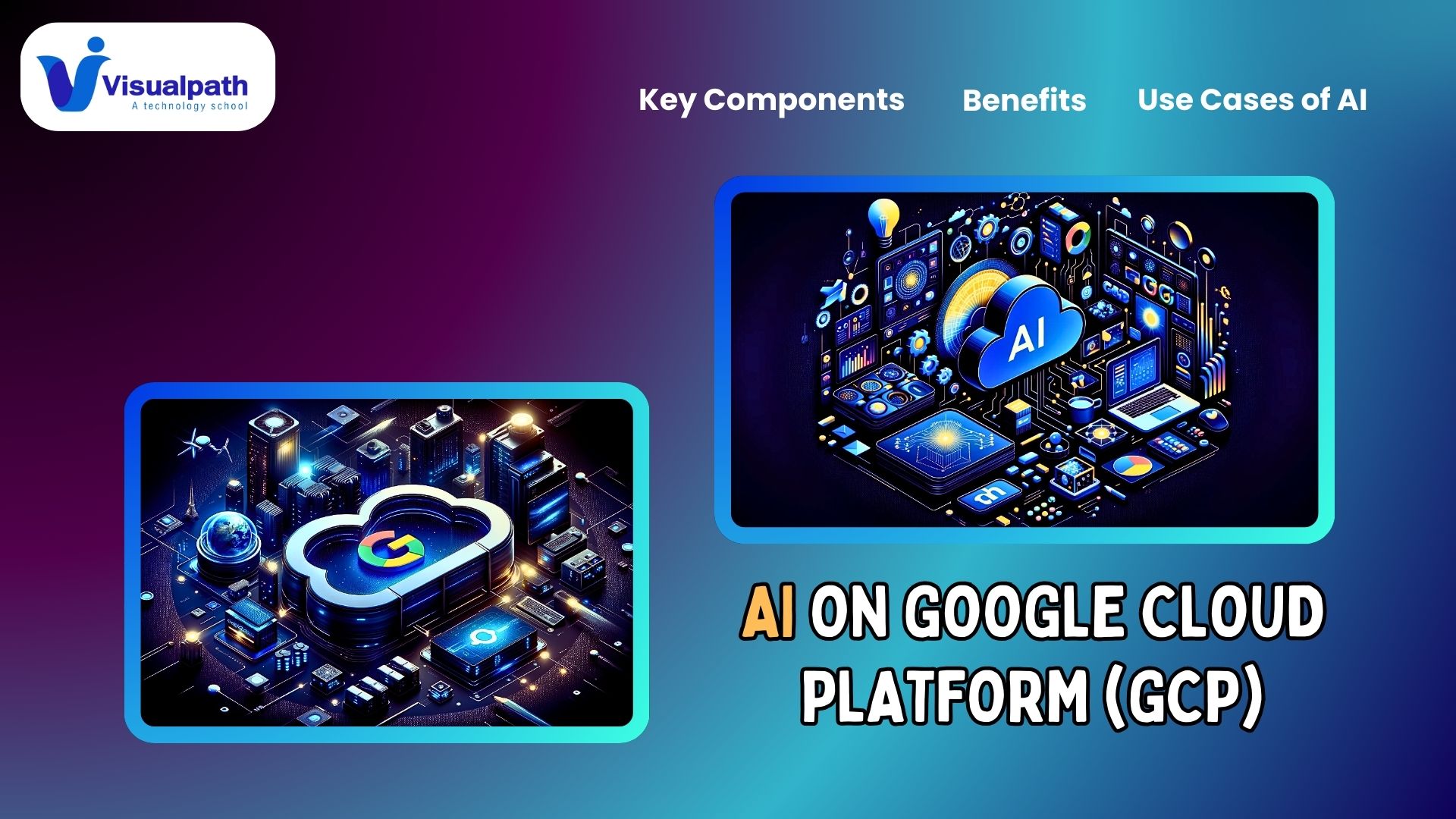
    Artificial Intelligence (AI) on Google Cloud Platform (GCP) refers to a suite of tools and services designed to help businesses and developers build, deploy, and scale AI-powered applications. GCP offers comprehensive AI and machine learning (ML) solutions that cater to various industries, from healthcare and finance to retail and manufacturing. The platform enables businesses to leverage AI to automate processes, gain insights from data, and enhance customer experiences. GCP Data Engineering Training

    Key Components of AI on GCP

    1. Google Cloud AI Platform
      The AI Platform is a fully-managed service that allows developers and data scientists to build, deploy, and scale machine learning models. It provides infrastructure and tools for every stage of the machine learning lifecycle, from data preparation and training to deployment and management. The AI Platform supports popular frameworks like TensorFlow, PyTorch, and Scikit-learn, allowing flexibility and ease of use.
    2. Pre-trained AI Models
      Google Cloud offers a wide range of pre-trained AI models through its AI Hub and AI APIs, allowing businesses to integrate AI without the need for extensive machine learning expertise. These models include image recognition (Vision AI), natural language processing (Natural Language API), and speech-to-text and text-to-speech capabilities (Speech AI). Pre-trained models can be customized with the customer’s data, offering tailored AI solutions. GCP Data Engineer Training in Hyderabad
    3. AutoML
      AutoML is a powerful tool on GCP that allows users to build custom machine-learning models with minimal coding and ML expertise. It automates the process of model training and tuning, enabling businesses to create models for image recognition, natural language, translation, and structured data. AutoML democratizes AI by making it accessible to a wider audience, including non-developers.
    4. BigQuery ML
      BigQuery ML brings machine learning directly to your data, allowing users to build and deploy machine learning models using SQL queries within BigQuery. It eliminates the need to move large datasets across systems for analysis, resulting in faster and more cost-effective machine learning workflows. Businesses can use BigQuery ML to predict customer behavior, optimize processes, and uncover insights from massive datasets.

    Use Cases of AI on GCP

    1. Healthcare
      AI on GCP has been instrumental in transforming the healthcare industry. GCP’s machine learning capabilities are being used to analyze medical data, detect diseases, and predict patient outcomes. For instance, medical image analysis using Vision AI helps in detecting abnormalities like tumours, while natural language processing can sift through vast medical records for better patient care.
    2. Retail
      In the retail sector, AI on GCP enhances the customer experience by providing personalized recommendations, optimizing supply chains, and improving demand forecasting. Retailers can use GCP’s AI tools to analyze customer behaviour, build recommendation engines, and implement AI chatbots for customer support.
    3. Manufacturing
      AI-driven solutions on GCP are helping manufacturers increase efficiency and reduce downtime by predicting equipment failures before they happen. With predictive maintenance models powered by AutoML and BigQuery ML, businesses can lower operational costs, streamline production, and improve overall equipment effectiveness. Google Cloud Data Engineer Training
    4. Finance
      In the financial industry, AI on GCP is used for fraud detection, risk management, and customer service automation. By analyzing historical financial data, AI models can predict fraudulent activities and provide early warnings, enhancing security and compliance.

    Benefits of AI on GCP

    1. Scalability
      GCP’s AI services are highly scalable, allowing businesses to expand their AI operations as needed. Whether handling small projects or massive datasets, GCP’s infrastructure is built to support growth.
    2. Ease of Use
      With tools like AutoML and pre-trained models, GCP makes AIaccessible to developers and non-technical users alike. This ease of use accelerates AI adoption across different business functions.
    3. Cost-Effectiveness
      GCP offers a pay-as-you-go pricing model, making AI solutions affordable for businesses of all sizes. The flexibility to choose services based on specific needs ensures that businesses only pay for what they use.

    Conclusion:

    AI on Google Cloud Platform empowers businesses to innovate and stay competitive by integrating intelligent systems into their operations. From building custom machine learning models to leveraging pre-trained AI solutions, GCP provides a flexible and scalable platform for AI development across industries. As AI continues to evolve, GCP’s robust infrastructure and tools position businesses to harness the power of AI for transformative results. Google Cloud Data Engineer Online Training

    Visualpath is the Best Software Online Training Institute in Hyderabad. Avail complete GCP Data Engineering worldwide. You will get the best course at an affordable cost.

    Attend Free Demo

    Call on – +91-9989971070

    WhatsApp: https://www.whatsapp.com/catalog/919989971070

    Visit  https://visualpath.in/gcp-data-engineering-online-traning.html
  • Real-Time Machine Learning: How MLOps Makes It Possible

    Real-Time Machine Learning: How MLOps Makes It Possible

    Machine Learning Operations (MLOps) is key to the success of real-time machine learning in AI. It helps manage and deploy models efficiently, making it easier to turn experimental AI into real-time, scalable solutions. Real-time machine learning enables instant decisions from live data, crucial for fields like financial trading and autonomous driving. This article will explain how MLOps makes real-time machine learning possible and what essential components are involved.

    Understanding Real-Time Machine Learning

    Real-time machine learning refers to the capability of AI systems to process and analyze data with minimal latency. This is crucial for applications where decisions must be made quickly to respond to changing conditions or user interactions. Examples include fraud detection systems that flag suspicious transactions instantly, recommendation engines that personalize content in real-time, and autonomous vehicles that interpret sensor data to navigate safely. MLOps Training in Ameerpet

    The challenge in real-time machine learning lies in the need for models that not only perform well but also operate efficiently under stringent time constraints. Traditional machine learning models are often trained and evaluated in batch mode, where data is processed in large chunks. In contrast, real-time systems must handle data streams continuously, requiring a different approach to model management and deployment.

    The Role of MLOps in Real-Time Machine Learning

    MLOps is an approach that applies DevOps principles to the machine learning lifecycle, aiming to streamline the development, deployment, and monitoring of ML models. For real-time machine learning, MLOps introduces several key practices and tools that address the unique requirements of operationalizing AI models.

    1. Continuous Integration and Deployment (CI/CD): CI/CD pipelines are central to MLOps, enabling the automated building, testing, and deployment of machine learning models. For real-time applications, this means that updates to models can be seamlessly integrated into the production environment without causing disruptions. CI/CDpipelines ensure that changes are tested thoroughly and deployed efficiently, reducing the time between model development and operational use.
    2. Model Monitoring and Management: Real-time machine learning systems require constant monitoring to ensure they perform as expected under varying conditions. MLOps incorporates tools for tracking model performance, detecting anomalies, and collecting metrics. This continuous monitoring helps in identifying issues such as model drift, where a model’s performance degrades over time due to changes in data patterns. Automated alerts and diagnostics facilitate prompt interventions to maintain the accuracy and reliability of real-time predictions. MLOps Online Training
    3. Scalability and Infrastructure Management: Handling real-time data streams necessitates scalable infrastructure capable of managing high throughput and low latency. MLOps involves the use of containerization technologies like Docker and orchestration platforms like Kubernetes to deploy and scale ML models efficiently. These technologies ensure that models can be scaled up or down based on demand, optimizing resource utilization and performance.
    4. Data Pipeline Automation: In real-time applications, the data pipeline must be capable of processing and transforming data streams with minimal delay. MLOps promotes the automation of data pipelines, ensuring that data flows smoothly from ingestion to processing and then to the model for prediction. Tools and frameworks such as Apache Kafka and Apache Flink facilitate the creation of robust and efficient data pipelines that support real-time operations.
    5. Model Versioning and Rollbacks: MLOps emphasizes the importance of version control for machine learning models. In a real-time context, this allows teams to maintain multiple versions of a model and perform rollbacks if necessary. Model versioning provides a safety net, enabling quick recovery from faulty updates and ensuring that the system can revert to a stable state if issues arise. MLOps Training in Hyderabad
    6. Collaboration and Governance: Effective collaboration between data scientists, engineers, and operations teams is crucial for successful real-time machine learning deployments. MLOps fosters a collaborative environment by providing shared tools and platforms for model development, testing, and deployment. Governance practices, including access controls and compliance checks, ensure that the deployment of real-time models adheres to organizational and regulatory standards.

    Case Studies and Examples

    Several industries have successfully leveraged MLOps to enable real-time machine learning:

    • Financial Services: Banks and financial institutions use real-time machine learning for fraud detection and algorithmic trading. By integrating MLOps practices, these organizations can deploy models that analyze transaction data in real-time, flagging fraudulent activities or making trading decisions with minimal latency.
    • E-commerce: Online retailers employ real-time recommendation systems to enhance user experience. MLOps allows these systems to continuously update and deploy models that personalize product recommendations based on user behavior and preferences, ensuring relevance and engagement. MLOps Course in Hyderabad
    • Healthcare: In healthcare, real-time machine learning aids in patient monitoring and diagnostic support. MLOps ensures that models analyzing patient data from wearables or electronic health records are consistently accurate and responsive to changing health metrics.

    Conclusion

    Real-time machine learning represents a significant advancement in the field of AI, offering the potential for instantaneous insights and actions. MLOps plays a crucial role in making real-time ML feasible by addressing the challenges associated with deployment, scalability, and monitoring. Through CI/CD pipelines, model management, scalable infrastructure, and automated data pipelines, MLOps ensures that real-time machine learning systems operate efficiently and reliably. As AI continues to evolve, the integration of MLOps will remain essential in unlocking the full potential of real-time machine learning applications. MLOps Training Online

    The Best Software Online Training Institute in Ameerpet, Hyderabad. Avail complete Machine Learning Operations Training by simply enrolling in our institute, Hyderabad. You will get the best course at an affordable cost.

    WhatsApp: https://www.whatsapp.com/catalog/919989971070/

    Visit: https://www.visualpath.in/mlops-online-training-course.html

  • What are the Benefits of Prompt Engineering?

    What are the Benefits of Prompt Engineering?

    Introduction:

    Prompt engineering refers to the process of carefully designing input prompts to guide AI models in generating optimal responses. This technique helps fine-tune AI outputs, ensuring they are relevant, accurate, and aligned with user expectations. Prompt Engineering Training

    Improved Accuracy and Relevance of AI Outputs:

    One of the primary benefits of prompt engineering is its ability to significantly improve the accuracy and relevance of AI-generated content. By providing well-crafted prompts, users can help AI models understand the context, scope, and specific requirements of a task. This reduces ambiguity and guides the model to produce more relevant responses.

    For instance, when asking an AI to summarize a long document, a vague prompt might lead to a summary that omits critical information. However, a detailed prompt that specifies which sections of the document are most important or which details should be emphasized can result in a more focused and useful output.

    Enhanced Creativity and Customization:

    Prompt engineering enables users to customize and enhance the creativity of AI responses. By experimenting with different prompts, users can elicit more innovative and imaginative outputs from the model. This is particularly beneficial for creative industries such as content creation, marketing, and design. Prompt Engineering Online Training

    For example, an AI model might be asked to generate story ideas or marketing slogans. The way the prompt is structured—whether it encourages humor, formality, or a specific tone—can drastically change the nature of the response.

    Time Efficiency and Productivity Gains:

    Effective prompt engineering can streamline workflows, saving both time and effort for users. When AI outputs are more precise and aligned with the task at hand, there is less need for manual editing, clarification, or rework. This can improve overall productivity, especially in industries where quick decision-making or content generation is essential.

    For businesses using AI to handle customer support, for example, a well-engineered prompt can reduce the need for follow-up clarifications, leading to quicker resolution times and higher customer satisfaction.

    Better User Experience and Interaction:

    Prompt engineering also improves the overall user experience when interacting with AI models. When users receive clear and concise answers to their queries, they are more likely to trust and engage with the AI system. Poorly designed prompts can lead to vague or irrelevant responses, which may frustrate users and diminish the value of the AI tool. Prompt Engineering Courses Online

    By providing clear guidance through prompts, users can ensure that AI responses are easy to understand and aligned with their needs. This is especially important in customer-facing applications, where the user experience is paramount.

    Flexibility Across Multiple Use Cases:

    AI models are highly versatile, and prompt engineering allows them to be applied across a wide range of use cases—from language translation and content generation to sentiment analysis and technical support. With the right prompts, the same AI model can be adapted to perform different tasks across various industries and functions.

    For example, an AI model could be used for market research by prompting it to analyze trends from customer feedback or social media data. The same model, with different prompts, could also be used to generate creative writing pieces or draft legal documents.

    Conclusion:

    Prompt engineering plays a critical role in maximizing the potential of AI models. By crafting precise, relevant, and creative input prompts, users can enhance the accuracy, creativity, and efficiency of AI outputs. The benefits of prompt engineering extend across industries, improving user experiences, driving productivity gains, and enabling AI systems to be tailored for various use cases.

    Visualpath is the Leading and Best Institute for learning Prompt Engineering Online Training in Ameerpet, Hyderabad. We provide Prompt Engineering Online Course, you will get the best course at an affordable cost.

    Visit : https://www.visualpath.in/prompt-engineering-course-in-hyderabad.html

    WhatsApp : https://www.whatsapp.com/catalog/919989971070/

  • Difference Between Azure Synapse Analytics and Azure AI

    Difference Between Azure Synapse Analytics and Azure AI

    Introduction:

    Microsoft Azure offers a wide range of cloud services that cater to different needs in data processing, analytics, and artificial intelligence (AI). Two of the most powerful services in this suite are Azure Synapse Analytics and Azure AI. While both are integral to modern data-driven businesses, they serve different purposes and are designed for distinct aspects of data handling and analysis. Understanding the differences between these two services is crucial for leveraging their capabilities effectively. Azure AI-102 Training in Hyderabad

    What is Azure Synapse Analytics?

    Azure Synapse Analytics is a comprehensive data analytics service designed to integrate big data and data warehousing. It provides a unified platform that brings together data integration, enterprise data warehousing, and big data analytics. Azure Synapse allows users to query data using both server less and dedicated resources—offering flexibility and efficiency. It’s designed to handle vast amounts of data, making it ideal for complex data processing and real-time analytics. AI-102 Certification Training

    Key Features of Azure Synapse Analytics

    1. Unified Analytics Experience:
      • Azure Synapse combines big data and data warehousing into a single service. It allows users to manage, analyse, and visualize data from various sources in a unified workspace.
    2. Synapse SQL:
      • Synapse SQL provides both on-demand (server less) and provisioned (dedicated) resources for querying data. This flexibility enables users to choose the best method depending on their needs, whether it’s for quick ad-hoc queries or long-running analytical processes.
    3. Integrated Spark Engine:
      • Azure Synapse includes an integrated Apache Spark engine for big data processing, which allows users to perform data exploration and machine learning tasks at scale. AI-102 Microsoft Azure AI Training
    4. Data Integration:
      • With Synapse Pipelines, users can orchestrate and automate data movement and transformation across various sources. This integration supports seamless ETL (Extract, Transform, Load) processes within the same environment.
    5. Security and Compliance:
      • Azure Synapse provides built-in security features, including data encryption, access controls, and compliance certifications, ensuring that data is managed securely and in accordance with industry regulations.
    6. Analytics at Scale:
      • Designed for massive datasets, Azure Synapse can scale to handle petabytes of data, making it suitable for enterprises with large-scale data needs.
    7. Real-time Analytics:
      • Azure Synapse supports real-time analytics on streaming data, allowing businesses to gain insights from data as it arrives, which is crucial for time-sensitive decision-making. Azure AI-102 Course in Hyderabad

    What is Azure AI?

    Azure AI is a collection of artificial intelligence services and tools that enable developers to build and deploy AI solutions. It encompasses a wide range of capabilities, including machine learning, natural language processing, computer vision, and conversational AI. Azure AI is designed to make AI accessible to everyone, whether they are experienced data scientists or developers new to AI, by providing pre-built models and no-code/low-code tools.

    Key Features of Azure AI

    1. Azure Cognitive Services:
      • A suite of pre-built APIs that allow developers to integrate AI capabilities like vision, speech, language understanding, and decision-making into their applications without needing deep AI expertise. Azure AI-102 Online Training
    2. Azure Machine Learning:
      • A platform for building, training, and deploying machine learning models. It offers tools for automated machine learning (AutoML), deep learning, and MLOps, making it easier to operationalize AI.
    3. Computer Vision:
      • Azure AI includes computer vision services that allow users to analyse images and videos, perform object detection, optical character recognition (OCR), and more.
    4. Natural Language Processing (NLP):
      • Tools like Text Analytics, Language Understanding (LUIS), and Translator are part of Azure AI, enabling applications to process and understand human language.
    5. Bot Service:
      • Azure AI provides a bot framework for building conversational AI, allowing developers to create and deploy intelligent chatbots for various use cases. Azure AI Engineer Training
    6. Speech Services:
      • Azure AI offers services for speech-to-text, text-to-speech, and real-time translation, enabling voice-based applications and enhancing accessibility.
    7. Custom Vision and Custom AI:
      • For more specific use cases, Azure AI allows users to build and deploy custom models that cater to unique business needs, such as custom image classification and anomaly detection.

    Comparing Azure Synapse Analytics and Azure AI

    While both Azure Synapse Analytics and Azure AI are powerful tools within the Azure ecosystem, they are designed for different purposes and use cases:

    1. Purpose:
      • Azure Synapse Analytics is primarily focused on data integration, warehousing, and large-scale analytics. It is designed to handle big data workloads and allows organizations to analyse massive datasets efficiently.
      • Azure AI is centred around building and deploying artificial intelligence solutions. It provides tools and services for machine learning, cognitive services, and AI-driven applications. Azure AI Engineer Online Training
    2. Target Users:
      • Azure Synapse Analytics is typically used by data engineers, data scientists, and business analysts who need to process and analyse large volumes of data, often for business intelligence and reporting purposes.
      • Azure AI is aimed at developers, AI engineers, and data scientists who want to integrate AI capabilities into applications or build sophisticated machine learning models.
    3. Core Capabilities:
      • Azure Synapse Analytics offers data warehousing, big data processing, and real-time analytics. Its core strength lies in managing and analysing data at scale.
      • Azure AI provides AI services such as machine learning, computer vision, NLP, and conversational AI. Its focus is on enabling AI-driven insights and automation. Microsoft Azure AI Engineer Training
    4. Integration:
      • Azure Synapse Analytics integrates well with other Azure data services like Azure Data Lake, Azure Data Factory, and Power BI, providing a comprehensive data management and analytics solution.
      • Azure AI integrates with other AI and machine learning tools, such as Azure Machine Learning, and can be combined with Azure Synapse for advanced analytics that incorporate AI.
    5. Scalability:
      • Azure Synapse Analytics is built to scale out massively, handling petabytes of data and supporting real-time analytics across vast datasets.
      • Azure AI scales in terms of deploying machine learning models and AI services across applications, enabling widespread AI adoption across various platforms.
    6. Real-Time Capabilities:
      • Azure Synapse Analytics excels in processing and analysing streaming data in real-time, making it ideal for scenarios that require immediate data insights.
      • Azure AI can also process real-time data, especially in scenarios involving real-time speech recognition, text analysis, or image processing. AI-102 Certification Training

    When to Use Each Service

    • Use Azure Synapse Analytics when your primary goal is to manage and analyse large datasets, perform complex queries across big data, or integrate various data sources into a unified analytics platform. It’s particularly useful for business intelligence, reporting, and large-scale data processing.
    • Use Azure AI when you need to build AI-driven applications, automate processes with machine learning, or integrate cognitive services like image recognition, speech processing, or natural language understanding into your solutions. Azure AI is ideal for creating intelligent applications that require advanced AI capabilities. Azure AI Engineer Training

    Conclusion

    Azure Synapse Analytics and Azure AI are complementary services that serve distinct purposes within the Azure ecosystem. While Azure Synapse Analytics is focused on big data analytics and data integration, Azure AI is geared towards enabling AI and machine learning capabilities. By understanding their differences and strengths, businesses can leverage both services to build robust, data-driven, and AI-powered solutions. Whether you are looking to analyse vast amounts of data or infuse AI into your applications, Azure has the tools to help you achieve your goals.

    Visualpath is the Best Software Online Training Institute in Hyderabad. Avail complete Azure AI Engineer Associate (AI-102) worldwide. You will get the best course at an affordable cost.

    WhatsApp: https://www.whatsapp.com/catalog/917032290546/

    Visit: https://visualpath.in/microsoft-azure-ai-102-online-training.html

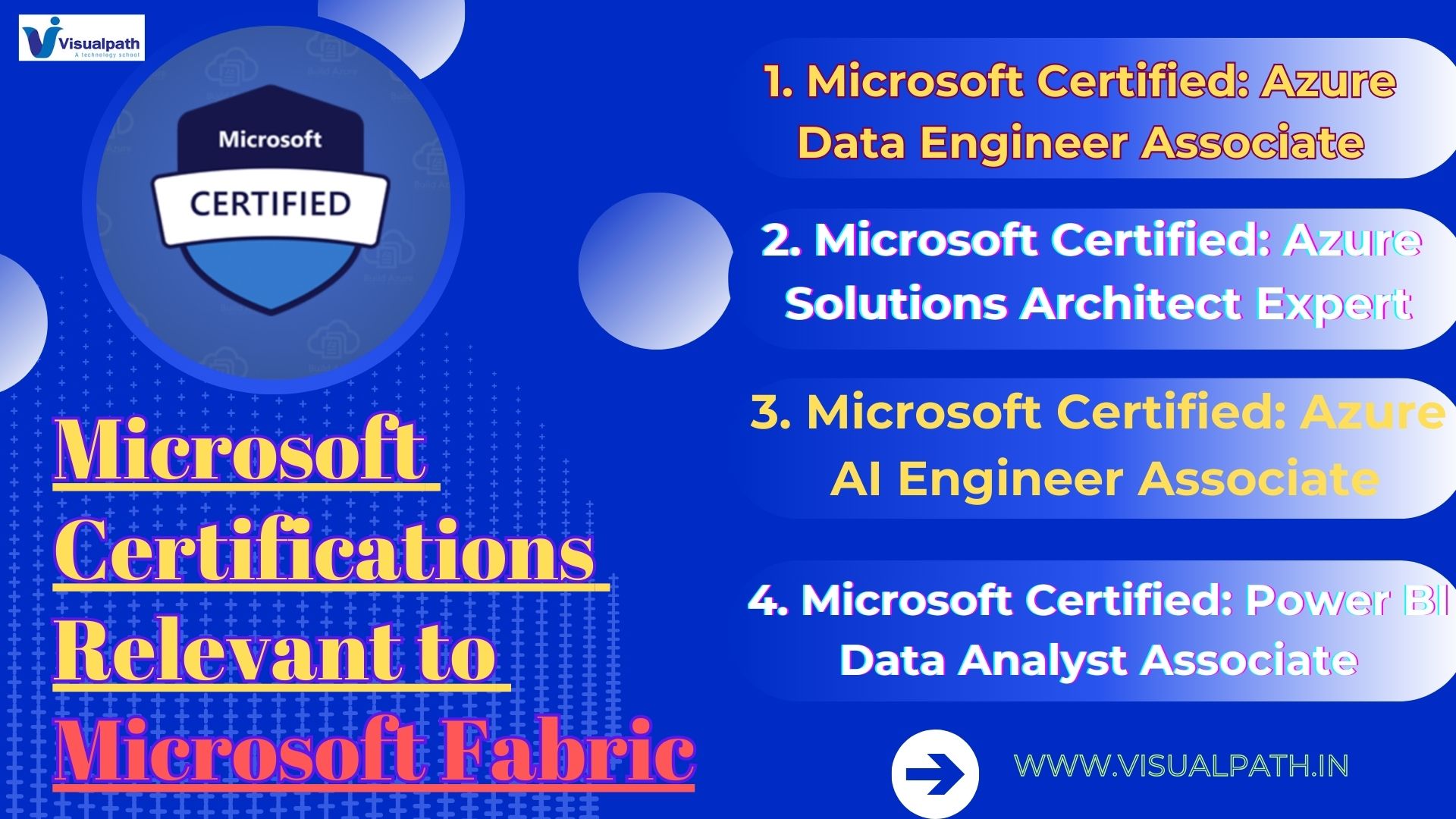
  • Microsoft Certifications Relevant to Microsoft Fabric

    Microsoft Certifications Relevant to Microsoft Fabric

    As the demand for data professionals continues to grow, Microsoft Fabric has emerged as a powerful, unified data platform that integrates various tools and services such as Data Factory, Synapse, and Power BI. For professionals looking to validate their skills in Microsoft Fabric, obtaining relevant Microsoft certifications is a strategic move. Microsoft Azure Fabric Training

    1. Microsoft Certified: Azure Data Engineer Associate

    • Relevance to Fabric: This certification is ideal for those who work with data engineering within Microsoft Fabric. It covers essential skills such as data integration, transformation, and implementation of data solutions using Azure technologies, which are crucial for managing the data pipelines in Fabric.  Microsoft Fabric Training
    • Exam: DP-203 (Data Engineering on Microsoft Azure).

    2. Microsoft Certified: Azure Solutions Architect Expert

    • Relevance to Fabric: This certification is designed for professionals who architect solutions using Azure services, including Microsoft Fabric. It focuses on advanced skills in designing and implementing Azure solutions, including data storage, security, and integration with Fabric.
    • Exams: AZ-305 (Designing Microsoft Azure Infrastructure Solutions).
      Microsoft Fabric Online Training Course

    3. Microsoft Certified: Azure AI Engineer Associate

    • Relevance to Fabric: As Microsoft Fabric integrates machine learning and AI capabilities, this certification is beneficial for professionals working on AI-driven projects within Fabric. It emphasizes skills in using Azure AI services, which can be seamlessly integrated with Fabric’s data science features. Microsoft Fabric Online Training
    • Exam: AI-102 (Designing and Implementing an Azure AI Solution).

    4. Microsoft Certified: Power BI Data Analyst Associate

    • Relevance to Fabric: Since Power BI is a core component of Microsoft Fabric, this certification is essential for data analysts who want to master data visualization and business intelligence within the Fabric environment. Microsoft Fabric Certification Course
    • Exam: PL-300 (Power BI Data Analyst).

    Pursuing these certifications not only enhances your expertise in Microsoft Fabric but also demonstrates your ability to design, implement, and manage advanced data solutions, making you a valuable asset in the data-driven world.
    Microsoft Fabric Online Training Institute

    Visualpath is the Leading and Best Software Online Training Institute in Hyderabad. Avail complete Microsoft Fabric Online Training Worldwide. You will get the best course at an affordable cost.

    WhatsApp: https://www.whatsapp.com/catalog/919989971070

    Visit   https:/www.visualpath.in/microsoft-fabric-online-training-hyderabad.html

  • Advanced MLOps: Techniques for Optimizing AI Deployments

    Advanced MLOps: Techniques for Optimizing AI Deployments

    Introduction

    Machine learning (ML) into business operations has transitioned from a novel capability to a critical necessity for staying competitive. As more organizations deploy machine learning models, the need to optimize these deployments becomes increasingly important. Advanced MLOps (Machine Learning Operations) is a set of practices designed to enhance the efficiency, scalability, and reliability of AI deployments. By leveraging advanced techniques, organizations can ensure that their models perform optimally in production environments, delivering consistent value to the business.

    The Evolution of MLOps

    MLOps has evolved significantly since its inception, growing from basic practices focused on model deployment and monitoring to a more sophisticated approach encompassing the entire ML lifecycle. Early MLOps efforts primarily dealt with automating the deployment process, ensuring that models could be quickly and reliably pushed to production. However, as the complexity of machine learning models and the environments in which they operate have grown, so too has the need for more advanced MLOps practices.

    Advanced MLOps goes beyond simple automation to address challenges such as scaling models to handle large datasets, maintaining model accuracy over time, and ensuring models are secure and compliant with regulations. These practices are essential for organizations that deploy machine learning models at scale and require consistent performance across different use cases and environments.

    Techniques for Optimizing AI Deployments

    1. Model Versioning and Management
      1. One of the fundamental aspects of advanced MLOps is robust model versioning and management. As organizations develop multiple models or iterations of a model, it becomes crucial to track and manage these versions effectively. Advanced model versioning techniques allow teams to maintain a detailed history of model changes, including the data used for training, hyperparameters, and performance metrics. This enables teams to easily roll back to previous versions if necessary and ensures that models can be reproduced and audited. MLOps Training in Ameerpet
      1. Tools like MLflow, DVC (Data Version Control), and Kubeflow provide powerful versioning capabilities that integrate seamlessly into MLOps pipelines. These tools allow for the automated tracking of model versions, making it easier to manage complex ML deployments and ensuring that models are always up-to-date.
    2. Automated Hyperparameter Optimization
      1. Hyperparameter tuning is a critical step in developing machine learning models, as it directly impacts model performance. Traditional manual tuning methods are time-consuming and often inefficient. Advanced MLOps practices involve automating hyperparameter optimization using techniques such as grid search, random search, and Bayesian optimization. MLOps Online Training
      1. Automated hyperparameter optimization can be integrated into CI/CD pipelines, allowing models to be continuously optimized as new data becomes available. This not only improves model performance but also reduces the time required to move from development to deployment. Tools like Optuna, Hyperopt, and Ray Tune are popular choices for implementing automated hyperparameter optimization in MLOps workflows.
    3. Scalable Model Deployment
      1. Deploying machine learning models at scale presents unique challenges, especially when models need to handle large volumes of data or requests in real-time. Advanced MLOps techniques focus on ensuring that models can be deployed in a way that scales seamlessly with demand. This often involves using containerization and orchestration tools like Docker and Kubernetes to manage model deployments.
      1. Kubernetes, in particular, offers powerful capabilities for scaling ML deployments. By leveraging Kubernetes‘ autoscaling features, organizations can ensure that their models are able to handle fluctuating workloads without compromising performance. Additionally, Kubernetes provides robust monitoring and logging capabilities, allowing teams to track model performance and quickly identify and address any issues.
    4. Model Monitoring and Drift Detection
      1. Once a model is deployed, continuous monitoring is essential to ensure it performs as expected. Advanced MLOps practices involve setting up comprehensive monitoring frameworks that track key performance indicators (KPIs) such as accuracy, latency, and throughput. More importantly, these frameworks must detect model drift—a phenomenon where the model’s performance degrades over time due to changes in the underlying data distribution. MLOps Training in Hyderabad
      1. Techniques like concept drift detection and real-time analytics can be employed to monitor models continuously. When drift is detected, automated retraining pipelines can be triggered to update the model with new data, ensuring that it remains accurate and relevant. Tools like Seldon Core, Alibi Detect, and Evidently AI provide advanced monitoring and drift detection capabilities tailored for MLOps environments.
    5. Security and Compliance
      1. As machine learning models are increasingly deployed in production, ensuring their security and compliance with industry regulations becomes a top priority. Advanced MLOps practices include implementing robust security measures, such as encrypting data and model artifacts, controlling access to model endpoints, and regularly auditing models for vulnerabilities. MLOps Course in Hyderabad
      1. Compliance with regulations like GDPR (General Data Protection Regulation) and CCPA (California Consumer Privacy Act) is also critical, especially when dealing with sensitive data. Advanced MLOps frameworks incorporate compliance checks into the deployment pipeline, ensuring that models adhere to legal requirements before being pushed to production. This proactive approach minimizes the risk of data breaches and ensures that models operate within legal and ethical boundaries.
    6. Model Explainability and Interpretability
      1. In many industries, understanding how a model makes decisions is just as important as the accuracy of those decisions. Advanced MLOps techniques involve integrating model explainability and interpretability into the deployment process. This ensures that stakeholders can understand and trust the model’s predictions, which is particularly important in regulated industries like finance and healthcare.
      1. Techniques such as SHAP (SHapley Additive exPlanations) and LIME (Local Interpretable Model-agnostic Explanations) can be used to generate explanations for model predictions. These explanations can be included in the deployment pipeline, providing transparency and fostering trust in the model’s outputs.

    Conclusion

    Advanced MLOps practices are essential for organizations that aim to optimize their AI deployments and maintain a competitive edge. By leveraging techniques such as automated hyperparameter optimization, scalable deployment strategies, and robust monitoring frameworks, organizations can ensure that their machine learning models perform optimally in production environments. Additionally, addressing security, compliance, and explainability concerns further enhances the reliability and trustworthiness of AI systems. MLOps Training Online

    The Best Software Online Training Institute in Ameerpet, Hyderabad. Avail complete Machine Learning Operations Training by simply enrolling in our institute, Hyderabad. You will get the best course at an affordable cost.

    WhatsApp: https://www.whatsapp.com/catalog/919989971070/

    Visit: https://www.visualpath.in/mlops-online-training-course.html

  • How to Build Scalable Solutions with Power Apps and Power Automate?

    How to Build Scalable Solutions with Power Apps and Power Automate?

    Introduction

    Power Apps Online Training, In today’s fast-paced business environment, scalability is crucial for sustaining growth and maintaining efficiency. Microsoft Power Apps and Power Automate offer powerful tools to build scalable solutions that adapt to evolving business needs. Whether you’re looking to automate workflows or create custom applications, these platforms enable businesses to scale without compromising performance or flexibility. Microsoft Power Platform Online Training

    Understand Your Business Requirements

    • Begin by thoroughly analyzing your current processes and identifying areas where automation or custom applications could add value.
    • Engage stakeholders across departments to gather input on their needs and expectations from the solution.
    • Define clear goals and KPIs to measure the success of the solution.

    Leverage the Power of Data verse

    • Use Microsoft Dataverse to create a centralized data platform that supports scalability.
    • Dataverse allows you to manage data securely and efficiently, ensuring seamless integration across different applications.
    • Take advantage of its built-in security features to control access and maintain data integrity.

    Design with Reusability in Mind

    • When building Power Apps, focus on creating modular components that can be reused across multiple apps.
    • Implement standardized templates and connectors that can be easily adapted to different use cases.
    • Reusability reduces development time and ensures consistency across your solutions.

    Automate Complex Workflows

    • Use Power Automate to design and automate workflows that handle repetitive tasks and complex processes.
    • Break down large workflows into smaller, manageable components that can be easily maintained and updated as the business grows.
    • Automating these processes ensures efficiency and reduces the risk of human error.

    Implement Scalable Infrastructure

    • Ensure that your Power Apps and Power Automate solutions are built on scalable infrastructure, such as Azure, to handle increased loads.
    • Regularly monitor performance and adjust resources as needed to prevent bottlenecks.
    • Consider integrating AI and machine learning capabilities to enhance the scalability and intelligence of your solutions.

    Continuous Monitoring and Optimization

    • Establish a monitoring system to track the performance of your solutions and identify areas for improvement.
    • Regularly update and optimize your Power Apps and Power Automate workflows to accommodate changes in business requirements.
    • Solicit feedback from users to make necessary adjustments that enhance the user experience and scalability.

    Conclusion

    Building scalable solutions with Power Apps and Power Automate requires a strategic approach that focuses on flexibility, efficiency, and reusability. By understanding your business needs, leveraging robust platforms like Dataverse, and continuously optimizing your solutions, you can ensure that your organization is well-equipped to handle growth and adapt to future challenges. Scalability isn’t just about handling more; it’s about doing so intelligently and efficiently, and these tools provide the foundation for that success.

    Visualpath is the Leading and Best Institute for learning in Hyderabad. We provide Microsoft Power Automate Training Course you will get the best course at an affordable cost.

    What’s App: https://www.whatsapp.com/catalog/919989971070/

    Visit:  https://visualpath.in/microsoft-powerapps-training.html

  • What Is GCP Persistent Disk? Key Benefits for Storage Needs

    What Is GCP Persistent Disk? Key Benefits for Storage Needs

    Introduction

    Docker & Kubernetes Multi-Cloud Training, In the world of cloud computing, reliable and scalable storage is paramount for managing containerized applications. Google Cloud Platform (GCP) offers Persistent Disk as a robust storage solution, particularly suited for Docker and Kubernetes environments. This article explores what GCP Persistent Disk is and the key benefits it brings to your storage needs, especially when working with containerized applications. Multi-Cloud Online Training Course

    What Is GCP Persistent Disk?

    GCP Persistent Disk is a durable, high-performance block storage service designed to work seamlessly with Google Compute Engine, Google Kubernetes Engine (GKE), and other GCP services. It provides persistent storage that can be attached to virtual machines (VMs) or Kubernetes pods, ensuring that your data remains intact even when the associated VM or pod is terminated or restarted.

    Key Benefits for Storage Needs

    Seamless Integration with Docker and Kubernetes:

    • GCP Persistent Disk integrates effortlessly with Docker and Kubernetes, allowing you to create and manage storage volumes that persist beyond the lifecycle of a single container or pod.
    • This ensures data consistency and reliability, which are critical for stateful applications.

    High Availability and Durability:

    • GCP Persistent Disks are replicated across multiple physical disks, ensuring high availability and durability of your data.
    • This replication protects against disk failures and provides a robust storage solution for applications that require consistent data availability.

    Flexible Storage Options:

    • GCP Persistent Disk offers both standard and SSD-based options, catering to different performance and cost requirements.
    • You can choose the storage type that best suits your workload, whether you need high IOPS for databases or cost-effective storage for less demanding applications. Multi-Cloud Training

    Dynamic Resizing:

    • One of the standout features of GCP Persistent Disk is its ability to be resized without downtime.
    • As your storage needs grow, you can dynamically increase the disk size without affecting your running applications, making it a flexible solution for scaling storage resources.

    Snapshot and Backup Capabilities:

    • GCP Persistent Disk supports snapshots, allowing you to create point-in-time backups of your data.
    • These snapshots can be used to restore data in case of accidental deletion or corruption, providing an additional layer of data protection.

    Automatic Encryption:

    • Security is a top priority in cloud storage, and GCP Persistent Disk comes with automatic encryption of data at rest.
    • This ensures that your data is protected against unauthorized access, meeting compliance requirements for sensitive data.

    Conclusion

    GCP Persistent Disk offers a powerful and flexible storage solution for containerized applications, particularly in Docker and Kubernetes environments. Its seamless integration, high availability, dynamic resizing, and robust security features make it an ideal choice for managing persistent storage needs in the cloud. Whether you’re running databases, stateful applications, or other critical workloads, GCP Persistent Disk ensures your data is secure, accessible, and scalable, helping you achieve operational efficiency in your cloud deployments.

    Visualpath is the Leading and Best Institute for learning in Hyderabad. We provide Docker & Kubernetes Multi-Cloud Training you will get the best course at an affordable cost.

    What’s App: https://www.whatsapp.com/catalog/919989971070/

    Visit: https://visualpath.in/kubernetes-multi-cloud-online-training.html

  • What is Dynamics 365 Supply Chain Management? An Overview

    What is Dynamics 365 Supply Chain Management? An Overview

    Microsoft Dynamics 365 Supply Chain Management is a robust enterprise resource planning (ERP) solution that helps organizations manage and optimize their supply chain processes. It integrates various facets of supply chain operations, from procurement and production to logistics and inventory management. This module is designed to give businesses visibility and control over their supply chains, allowing them to respond quickly to changing market conditions and customer demands. Dynamics 365 Supply Chain Management Training

    Core Features and Functionalities

    1. Inventory and Warehouse Management: Dynamics 365 Supply Chain Management offers advanced tools to manage inventory levels, optimize warehouse layouts, and track goods throughout the supply chain. It supports multi-site operations, enabling organizations to manage multiple warehouses in different locations from a centralized platform.

    2. Procurement and Sourcing: This module streamlines the procurement process by automating purchase orders, vendor management, and sourcing strategies. It allows companies to manage supplier relationships, negotiate contracts, and ensure timely deliveries while maintaining cost efficiency. D365 Supply Chain Management Functional (T&L)

    3. Production Control: The production control feature allows businesses to manage and optimize their manufacturing processes. From planning and scheduling to executing production orders, the module ensures that companies can meet customer demands while maintaining quality and efficiency.

    4. Sales and Distribution: Dynamics 365 helps businesses streamline their sales and distribution processes by automating order processing, managing customer relationships, and optimizing delivery schedules. It ensures timely and accurate order fulfilment, enhancing customer satisfaction.

    5. Supply Chain Insights: Leveraging artificial intelligence (AI) and machine learning (ML), Dynamics 365 Supply Chain Management offers predictive analytics and real-time insights. These insights help organizations make data-driven decisions, reduce risks, and anticipate supply chain disruptions before they impact the business. Dynamics AX Trade and Logistics Online Training

    Benefits of Dynamics 365 Supply Chain Management

    • Enhanced Visibility: By providing a unified view of the entire supply chain, Dynamics 365 enables businesses to monitor and optimize every stage of the process. This visibility helps in identifying inefficiencies and bottlenecks that could affect production or delivery timelines.
    • Agility and Flexibility: The solution allows businesses to adapt quickly to market fluctuations and changes in demand. It supports lean manufacturing and just-in-time inventory practices, ensuring that companies can remain competitive in dynamic environments.
    • Scalability: Dynamics 365 is a cloud-based platform, which means it can easily scale to meet the growing needs of a business. Whether a company is expanding into new markets or adding new products, the platform can accommodate growth without the need for significant infrastructure investments.

    Conclusion

    Microsoft Dynamics 365 Supply Chain Management is an essential tool for businesses looking to streamline their supply chain operations and stay competitive in a rapidly changing market. By providing end-to-end visibility, real-time insights, and advanced automation, it helps organizations reduce costs, improve efficiency, and meet customer expectations.

    Visualpath provides Best MS Dynamics Trade Logistics Training Hyderabad. Live Instructor-Led Online Classes delivered by experts from Our Industry. Get Real-time exposure of the technology. All the class recordings, presentations will be shared with you for reference. Call & WhatsApp +91-9989971070.

    WhatsApp:https://www.whatsapp.com/catalog/919989971070/

    Visit: https://www.visualpath.in/ms-dynamics-operations-trade-and-logistics-course.html

  • GCP Data Engineering (GCP): From Basic Concepts to Advanced Techniques

    GCP Data Engineering (GCP): From Basic Concepts to Advanced Techniques

    Google Cloud Platform (GCP) offers a comprehensive suite of tools for data engineering, enabling businesses to build, manage, and optimize their data pipelines. Whether you’re just starting with GCP or looking to master advanced data engineering techniques, this guide provides a detailed overview of the essential concepts and practices. GCP Data Engineering Training

    Basic Concepts:

    1. Introduction to GCP Data Engineering GCP Data Engineering involves the design and management of data pipelines that collect, process, and analyze data. GCP provides a range of services to support data engineering tasks, from data ingestion and storage to processing and analytics. Understanding the foundational components of GCP is crucial for building effective data pipelines.

    2. Core Services

    • BigQuery: A fully managed, serverless data warehouse that enables fast SQL queries on large datasets. BigQuery is essential for storing and analyzing structured data.
    • Cloud Storage: A scalable object storage service used for storing unstructured data, such as logs, images, and backups. It is often the first step in a data pipeline. GCP Data Engineer Training in Hyderabad
    • Pub/Sub: A messaging service for real-time data streaming and event-driven architectures. It allows you to ingest and distribute data at scale.
    • Dataflow: A fully managed service for processing both batch and stream data. Dataflow is built on Apache Beam and is used for ETL (Extract, Transform, Load) operations.

    3. Data Ingestion Data ingestion is the process of importing data from various sources into your GCP environment. This can be done through batch uploads to Cloud Storage or real-time streaming with Pub/Sub. Understanding how to ingest data efficiently is key to building reliable data pipelines.

    4. Data Transformation and Processing Once data is ingested, it needs to be transformed and processed before analysis. Dataflow is the primary tool for this task in GCP. It allows you to write data processing pipelines that can handle both real-time streaming and batch processing. Basic transformations include filtering, aggregating, and joining datasets.

    5. Data Storage and Warehousing Storing processed data in a way that facilitates easy access and analysis is crucial. BigQuery is the go-to service for data warehousing in GCP. It allows you to store vast amounts of data and run SQL queries with low latency. Understanding how to structure your data in BigQuery, including partitioning and clustering, is essential for efficient querying.

    Advanced Techniques

    1. Advanced Dataflow Pipelines As you advance in GCP Data Engineering, mastering complex Dataflow pipelines becomes crucial. This involves using features like windowing, triggers, and side inputs for more sophisticated data processing. Windowing, for instance, allows you to group data based on time intervals, enabling time-series analysis or real-time monitoring.

    2. Orchestration with Cloud Composer Cloud Composer, built on Apache Airflow, is GCP’s service for workflow orchestration. It allows you to schedule and manage complex data pipelines, ensuring that tasks are executed in the correct order and handling dependencies between different GCP services. Advanced users can create Directed Acyclic Graphs (DAGs) to automate multi-step data processes.

    3. Data Quality and Governance Ensuring data quality is critical in any data engineering project. GCP provides tools like Data Catalog for metadata management and Dataflow templates for data validation. Advanced techniques involve implementing data validation checks within your pipelines and using a Data Catalog to enforce data governance policies, ensuring data consistency and compliance with regulations. Google Cloud Data Engineer Training

    4. Optimization Techniques Optimizing the performance of your data pipelines is essential as data volumes grow. In BigQuery, techniques such as partitioning and clustering tables can significantly reduce query times and costs. In Dataflow, you can optimize resource allocation by configuring autoscaling and fine-tuning the parallelism of your pipelines.

    5. Machine Learning Integration Integrating machine learning (ML) into your data pipelines allows you to create more intelligent data processing workflows. GCP’s AI Platform and BigQuery ML enable you to train, deploy, and run ML models directly within your data pipelines. Advanced users can build predictive models that are automatically updated with new data, enabling real-time analytics and decision-making.

    6. Security and Compliance Data security is paramount, especially when dealing with sensitive information. GCP provides robust security features, including Identity and Access Management (IAM) for controlling access to resources, encryption at rest and in transit, and audit logging. Advanced users can implement VPC Service Controls to define security perimeters, ensuring that data remains within specified boundaries and is protected from unauthorized access.

    Conclusion:

    GCP Data Engineering offers a powerful and flexible platform for building scalable, efficient data pipelines. By mastering both the basic concepts and advanced techniques, you can leverage GCP’s services to transform raw data into valuable insights. Whether you’re handling real-time data streams or large-scale data warehousing, GCP provides the tools and capabilities needed to succeed in modern data engineering. Google Cloud Data Engineer Online Training

    Visualpath is the Best Software Online Training Institute in Hyderabad. Avail complete GCP Data Engineering worldwide. You will get the best course at an affordable cost.

    WhatsApp: https://www.whatsapp.com/catalog/919989971070

    Visit  https://visualpath.in/gcp-data-engineering-online-traning.html
  • Top 5 Security Strategies? for Data Engineers Using Azure

    Top 5 Security Strategies? for Data Engineers Using Azure

    Introduction:

    As Azure Data Engineer Online Training managing and securing data in the cloud is a key responsibility. With the growing reliance on cloud platforms like Microsoft Azure, ensuring the protection of sensitive data is critical. Azure offers a range of tools and best practices to help data engineers secure their data infrastructure. This article explores the top five security strategies to implement for robust data protection on Azure. Microsoft Azure Data Engineer Training

    Enable Role-Based Access Control (RBAC)

    • Assign least privilege roles: Ensure that users only have the minimum necessary permissions for their tasks.
    • Use built-in roles: Azure provides predefined roles for common scenarios, reducing the risk of misconfigurations.
    • Audit regularly: Review role assignments periodically to ensure that no unauthorized access has been granted.

    Implement Azure Active Directory (Azure AD)

    Strengthening Azure AD configurations help prevent unauthorized access to data and resources.

    • Enable multi-factor authentication (MFA): MFA adds an additional layer of security by requiring multiple verification methods before granting access.
    • Leverage conditional access policies: Define rules that determine when and where access to Azure resources is granted.
    • Use managed identities: Avoid hard-coding credentials by using managed identities, which allow Azure services to authenticate securely.

    Encrypt Data at Rest and in Transit

    Encryption is a critical security feature for protecting sensitive information from unauthorized access, whether the data is being stored or transferred.

    • Enable encryption by default: Azure Storage and databases offer automatic encryption for data at rest using Azure-managed keys.
    • Use customer-managed keys: For greater control, you can provide your own encryption keys, stored in Azure Key Vault.
    • Utilize SSL/TLS protocols: Ensure data in transit is encrypted using industry-standard protocols like SSL and TLS.

    Monitor and Audit with Azure Security Center

    Azure Security Center provides a unified security management and monitoring system for protecting workloads across Azure.

    • Enable security alerts: Set up alerts for unusual activities, such as unauthorized access attempts.
    • Conduct security assessments: Regularly evaluate your environment with Azure Security Center’s recommendations to ensure compliance and security best practices.

    Use Network Security Groups and Firewalls

    • Set up Network Security Groups (NSGs): NSGs filter traffic to and from Azure resources, enforcing security rules.  MS Azure Data Engineer Online Training 
    • Deploy Azure Firewall: A managed, cloud-based network security service, Azure Firewall helps protect your data infrastructure by filtering unwanted traffic.
    • Isolate sensitive resources: Use virtual networks (VNets) to isolate critical resources and control communication between them.

    Conclusion

    Securing data on Azure requires a multi-faceted approach that includes identity management, encryption, monitoring, and network security. By following these five strategies—implementing RBAC, strengthening Azure AD, encrypting data, monitoring with Azure Security Center, and utilizing firewalls and network security groups—data engineers can ensure that their Azure environments are robustly protected against threats.

    Visualpath is the Leading and Best Software Online Training Institute in Hyderabad. Avail complete Azure Data Engineering Certification Course Worldwide You will get the best course at an affordable cost.

    WhatsApp: https://www.whatsapp.com/catalog/919989971070

    Visit: https://visualpath.in/azure-data-engineer-online-training.html

  • Azure Networking in Azure DevOps: Ensuring Seamless Connectivity

    Azure Networking in Azure DevOps: Ensuring Seamless Connectivity

    Introduction to Azure Networking in DevOps

    In the world of DevOps, efficient networking is essential to ensure seamless communication between different components of an application, especially in cloud environments. Azure Networking provides a robust set of tools and services that integrate with Azure DevOps, enabling teams to build, deploy, and manage applications with high availability, security, and performance. Microsoft Azure DevOps Online Training

    Key Azure Networking Components for DevOps

    1. Azure Virtual Network (VNet): Azure Virtual Networks (VNet) are the backbone of Azure networking. VNets enable Azure resources like virtual machines (VMs) and services to securely communicate with each other, the internet, and on-premises networks. For DevOps teams, VNets provide isolation and security for application environments while ensuring secure access to required resources. Azure DevOps Training
    2. Azure Load Balancer: To ensure high availability, Azure Load Balancer distributes incoming traffic across multiple servers. This ensures that workloads in Azure DevOps pipelines can scale as demand increases, improving the reliability and performance of applications during deployment and in production environments. Azure DevOps Training in Hyderabad
    3. Azure Application Gateway: Azure Application Gateway serves as a Layer 7 load balancer, optimizing traffic routing and offering security features like web application firewall (WAF). It ensures that applications deployed via Azure DevOps are protected against common vulnerabilities, such as SQL injection and cross-site scripting, while delivering smooth traffic distribution.    Azure DevOps Training In Ameerpet
    4. Azure Traffic Manager: Azure Traffic Manager provides DNS-level traffic distribution across multiple Azure regions. For applications deployed using Azure DevOps, Traffic Manager enhances performance and availability by routing users to the best-performing or nearest region. Azure DevOps Certification Online Training
    5. Azure VPN Gateway: For hybrid cloud environments, Azure VPN Gateway allows secure communication between on-premises networks and Azure resources. This enables DevOps teams to connect to legacy systems or protected resources during deployment. Azure DevSecOps Online Training

    Conclusion

    Azure Networking plays a vital role in Azure DevOps, providing secure, scalable, and reliable connectivity for applications. By leveraging services like VNets, Load Balancer, and Traffic Manager, DevOps teams can ensure that applications perform optimally while maintaining high security and availability. Azure DevOps Online Training in Hyderabad

    Visualpath is the Best Software Online Training Institute in Hyderabad. Avail complete Azure DevOps Online Training worldwide. You will get the best course at an affordable cost.

    WhatsApp: https://www.whatsapp.com/catalog/919989971070

    Visit   https://visualpath.in/Microsoft-Azure-DevOps-online-Training.html

  • What is the Difference between HPA and VPA in Kubernetes?

    What is the Difference between HPA and VPA in Kubernetes?

    Introduction:

    Kubernetes, the leading container orchestration platform, is designed to manage containerized applications at scale. As applications experience varying levels of demand, it becomes crucial to adjust resources dynamically to maintain performance and efficiency. Docker and Kubernetes Training

    Horizontal Pod Autoscaler (HPA):

    Scaling by Replication:

    The Horizontal Pod Autoscaler (HPA) is a Kubernetes feature that automatically adjusts the number of pod replicas in a deployment, replica set, or stateful set based on observed metrics like CPU utilization, memory usage, or custom metrics provided by an external source. HPA is designed to handle fluctuations in load by increasing or decreasing the number of pod instances running the application.

    Key Features of HPA:

    Replication-Based Scaling: HPA scales the application horizontally by adding or removing pod replicas. This approach distributes the workload across multiple instances, allowing the application to handle more traffic.

    Metrics-Based Decisions: HPA relies on metrics collected from the Kubernetes Metrics Server or other custom metrics providers. These metrics determine when to scale up or down. Kubernetes Online Training

    Use Cases: HPA is ideal for applications that experience varying traffic patterns, such as web servers, where the workload can be distributed across multiple pods. For example, during peak hours, HPA can scale out additional pods to handle the increased load and scale them back down during off-peak times.

    Limitations of HPA:

    Fixed Resource Limits: Each pod replica has a fixed amount of CPU and memory allocated to it. If the resource requirements per pod change, HPA does not adjust the pod’s resource limits but only the number of replicas.

    Not Suitable for All Workloads: HPA works best with stateless applications where requests can be easily distributed across multiple instances. It may not be suitable for stateful applications that require consistent data across replicas.

    Vertical Pod Autoscaler (VPA):

    Scaling by Resource Adjustment:

    The Vertical Pod Autoscaler (VPA) is another Kubernetes feature that adjusts the CPU and memory resources allocated to individual pods based on their observed usage. Instead of adding or removing replicas, VPA scales the application vertically by increasing or decreasing the resource limits of existing pods.

    Key Features of VPA:

    Resource-Based Scaling: VPA adjusts the resource requests and limits of a pod to better match its actual usage. This ensures that each pod has the right amount of resources to operate efficiently. Docker Online Training

    Automatic Resource Adjustment: VPA monitors the resource consumption of pods over time and adjusts the allocated resources accordingly. This helps prevent both over-provisioning (wasting resources) and under-provisioning (causing performance issues).

    Use Cases: VPA is ideal for applications with varying resource requirements that are difficult to predict, such as batch processing jobs or machine learning workloads. For instance, a machine learning job might require more CPU and memory as the dataset grows, and VPA can automatically adjust the resources to meet these needs.

    Limitations of VPA:

    Pod Restarts: When VPA adjusts the resources for a pod, it typically requires restarting the pod to apply the new resource limits. This can cause temporary downtime, which may not be acceptable for all applications.

    Limited to Single Pods: Unlike HPA, which scales across multiple replicas, VPA focuses on optimizing the resources for individual pods. This means that VPA may not be sufficient for applications that need to scale out to handle increased load. Kubernetes Certification Training

    HPA vs. VPA:

    HPA and VPA serve different purposes in a Kubernetes environment, and they can be used together to achieve optimal scalability. HPA is best suited for scaling out applications by adding more instances, while VPA is ideal for fine-tuning the resources allocated to each instance.

    Conclusion:

    HPA and VPA are powerful tools in Kubernetes that address different aspects of autoscaling. HPA scales applications by adjusting the number of pod replicas, making it ideal for handling traffic spikes and distributing workload. VPA, on the other hand, adjusts the resources allocated to individual pods, ensuring that each pod operates efficiently without wasting resources.

    Visualpath is the Leading and Best Institute for learning Docker and Kubernetes Online in Ameerpet, Hyderabad. We provide Docker Online Training Course, you will get the best course at an affordable cost.

    Visit : https://www.visualpath.in/DevOps-docker-kubernetes-training.html

    WhatsApp : https://www.whatsapp.com/catalog/919989971070/