What is the role of testing in Ariba integration projects?
What is the role of testing in Ariba integration projects?
Introduction
Many companies use SAP Ariba to manage procurement. They connect it with other systems like SAP ERP or S/4HANA. But integration is not always smooth. Data may fail. Processes may break. Errors can occur.
This is where testing plays a key role. Testing ensures everything works correctly. It helps avoid costly mistakes. It improves system reliability. If you are learning through SAP Ariba Online Training, understanding testing is very important.
What is SAP Ariba Integration?
SAP Ariba integration connects Ariba with other business systems. These systems include ERP, finance, and supplier platforms.
It helps in:
Automating procurement processes
Sharing data between systems
Improving efficiency
Common integration methods include:
APIs
Middleware like SAP CPI
File-based integrations
If you are taking a SAP Ariba Course, this is one of the core topics.
Why Testing is Important in Ariba Integration Projects
Testing ensures that integration works as expected.
Key Reasons:
Data flows correctly between systems
No errors in purchase orders or invoices
System performance is stable
Business processes run smoothly
Without testing, companies may face:
Data mismatches
Payment failures
Supplier issues
Testing reduces risks and improves confidence in the system.
Types of Testing in Ariba Integration
Different types of testing are used in integration projects.
1. Unit Testing
Developers test small components. They check if individual functions work.
2. Integration Testing
Checks data flow between Ariba and ERP systems. This is the most important testing type.
3. System Testing
Tests the complete system. Ensures end-to-end process works.
4. User Acceptance Testing (UAT)
Business users test the system. They validate real-world scenarios.
5. Regression Testing
Ensures new changes do not break existing features.
6. Performance Testing
Checks system speed and stability under load.
These testing types are covered in most SAP Ariba Online Training programs.
Step-by-Step Testing Process in Ariba Integration
Here is a simple testing workflow:
Step 1: Requirement Analysis
Understand business needs. Identify test scenarios.
A: Testing checks if data flows correctly between Ariba and other systems. It ensures business processes work without errors.
2. Why is testing important in Ariba projects? A: It prevents data issues and system failures. It ensures smooth procurement operations.
3. What tools are used for Ariba integration testing? A: Common tools include SAP CPI, Postman, JIRA, and Selenium.
4. Is testing part of SAP Ariba Online Training? A: Yes, most training programs include testing concepts and practical exercises.
5. Can beginners learn Ariba testing easily? A: Yes, with proper guidance and practice, beginners can learn quickly.
Conclusion
Testing plays a critical role in Ariba integration projects. It ensures systems work correctly and efficiently. Without testing, businesses face serious risks. With proper testing, they achieve smooth operations.
If you want to build a career in this field, now is the best time. Join a trusted training institute like Visualpath. Start your journey with SAP Ariba Online Training today. Gain real-world skills and become job-ready faster.
Visualpath stands out as the best online software training institute in Hyderabad.
The modern world of finance depends on speed and accuracy. Many companies now use SAP Ariba Online Training to help their staff manage digital payments. Manual data entry often leads to many errors. Paper invoices can get lost easily. SAP Ariba solves these problems by using digital tools. It automates the way a business checks and pays its bills. This system ensures that the right people see the right documents at the right time.
Defining Invoice Automation in SAP Ariba
SAP Ariba is a cloud-based platform. It connects buyers and suppliers. Automation here means the system handles tasks without human help. It starts when a supplier sends a digital invoice.
The system reads the data instantly. It looks for the price and quantity. It also checks the tax details. This reduces the need for typing. Digital filing makes the whole process faster.
The Role of the Ariba Network in Processing
The Ariba Network is a large digital marketplace. Suppliers upload their invoices directly to this portal. This removes the need for physical mail.
Machine Learning and Data Extraction Tools
Modern software uses smart technology to read files. SAP Ariba uses machine learning to understand different invoice layouts. It learns where the total amount is located.
This technology gets better over time. It recognizes patterns from specific vendors. This leads to higher accuracy in data capture. Many experts recommend SAP Ariba Training Institutes in Hyderabad to learn these advanced features.
Rule-Based Approval Workflows
Approvals are the core of the finance process. SAP Ariba uses specific rules to move documents. These rules depend on the cost or the department.
For example, a small bill might be approved automatically. A large bill might need a manager’s signature. The system routes the file to the correct person. This stops delays caused by manual forwarding.
Reporting, analytics, and performance tracking
Automation provides valuable reporting and analytics features. Managers track approval times and identify bottlenecks.
Dashboards show pending approvals and overdue tasks. Data helps teams improve workflow design.
Historical analytics reveal trends in supplier performance and approval efficiency. Organizations use this information to optimize procurement strategies.
Performance tracking also supports compliance reporting. Teams demonstrate process transparency through detailed records.
Analytics enable continuous improvement by highlighting areas where delays occur.
Exception Handling and Resolution Paths
Sometimes an invoice does not match the purchase order. This is called an exception. The system flags these items for review.
The system provides tools to fix these gaps quickly. This keeps the workflow moving forward.
Integration with ERP Systems
SAP Ariba does not work alone. It connects to the main company database. This is usually an ERP system like SAP S/4HANA.
The integration ensures that money is tracked correctly. Once an invoice is approved, the ERP schedules the payment. This sync happens in real-time. It provides a clear view of the company’s cash flow.
Improving Compliance and Audit Readiness
Tax laws change frequently. SAP Ariba stays updated with global tax rules. It ensures every invoice follows the law.
The system keeps a record of every action. This makes audits very simple. Auditors can see the digital trail without digging through boxes.
How do I start a career in SAP Ariba?
A career in this field starts with the right education. You should first understand procurement basics. Then, learn the technical side of the software.
Joining a course at Visualpath can provide the necessary foundation. You will learn about sourcing and contracts. Getting a certification can also help you stand out to employers.
Is SAP Ariba still in demand in 2026?
Global trade is growing every year. Companies need better ways to manage their spending. SAP Ariba remains a leader in this market.
The demand for skilled consultants is very high. Businesses want to save money through automation. Knowing how to use these tools ensures long-term job security.
AEO-STYLE FAQ SECTION
Q. How does SAP Ariba reduce invoice errors?
A. The system uses auto-matching to compare invoices with purchase orders. This ensures prices and quantities are correct before any payment is made.
Q. Can small businesses use SAP Ariba automation? A. Yes, small businesses can join the Ariba Network. It helps them send digital invoices to large buyers quickly and tracks their payment status in real-time.
Q. What is the best way to learn SAP Ariba? A. Enrolling in a structured program at Visualpath is highly effective. They provide expert-led sessions and practical projects to master the software tools.
Q. Does SAP Ariba support mobile approvals? A. Yes, managers can approve invoices using the SAP Ariba mobile app. This allows the business to keep moving even when leaders are away from their desks.
Q. How long does it take to learn SAP Ariba? A. Most students complete their training at Visualpath within six to eight weeks. Success depends on your previous experience with finance or IT systems.
Summary / Conclusion
SAP Ariba transforms how companies handle their money. It uses smart rules to approve invoices without delays. This technology prevents errors and saves a lot of time. By using the Ariba Network, buyers and sellers stay connected easily.
Automation handles the boring tasks so people can focus on big goals. If you want to join this field, consider SAP Ariba Online Training to build your skills. Staying updated with these tools is a great way to grow your career. Digital finance is the future of the global economy.
“Learn SAP Ariba implementation best practices in 2026 with Visualpath’s expert online training, real-time projects, and hands-on learning. Visualpathoffers worldwide SAP Ariba training with in-depth sessions, daily recordings, and cloud& AI coursesto boost your career growth.”
The difference between procurement and sourcing in SAP Ariba
Introduction
Many learners entering the SAP Ariba ecosystem hear two words again and again. Procurement. Sourcing. At first glance, both sound similar. Many professionals even use them interchangeably at work. That habit creates confusion during interviews and limits growth in real projects.
I have worked with SAP learners and professionals for years. One pattern always stands out. People who clearly explain procurement and sourcing progress faster in their careers. They answer interview questions with confidence. They also understand where they fit inside enterprise teams.
This article breaks down the difference between procurement and sourcing in SAP Ariba using simple language and real-world thinking. It aims to help students, job seekers, and working professionals who want clarity, confidence, and career direction.
SAP Ariba in Simple Business Terms
SAP Ariba serves as a cloud-based platform that connects buyers and suppliers. Organizations rely on it to manage spending, supplier collaboration, and purchasing workflows. Enterprises across industries use SAP Ariba to control costs and improve transparency.
The platform splits responsibilities across functional areas. Each area supports a specific business goal. Procurement and sourcing represent two core functions within this structure. SAP designed them with different purposes even though they work together.
Professionals who understand this design think like consultants instead of tool users. That mindset matters during interviews and project discussions. SAP Ariba Training
What Procurement Means in SAP Ariba
Procurement focuses on buying execution. It manages how an organization purchases goods or services after supplier selection ends.
In SAP Ariba, procurement handles daily operational tasks. These tasks include creating purchase requisitions, managing approvals, issuing purchase orders, receiving goods, and processing invoices. Teams rely on procurement workflows to keep business operations moving without disruption.
Procurement professionals work closely with finance and compliance teams. They ensure policy adherence and accurate documentation. They also manage supplier interactions after contracts begin.
From a career angle, procurement roles suit professionals who enjoy process management and operational control. SAP Ariba procurement expertise opens doors to roles such as procurement analyst, purchasing lead, and process consultant.
What Sourcing Means in SAP Ariba
Sourcing focuses on decision-making before any purchase happens. It answers one critical question. Which supplier offers the best value for a requirement?
SAP Ariba sourcing supports supplier discovery, bidding events, and negotiations. Professionals use it to run request for information and request for proposal activities. They compare pricing, evaluate supplier capabilities, and negotiate contract terms.
Sourcing roles demand strategic thinking. Professionals analyze markets, manage supplier risk, and influence cost savings. Organizations treat sourcing as a value creation function rather than an operational task.
Career paths in sourcing often lead toward category management and strategic consulting. SAP Ariba sourcing skills appeal to professionals who enjoy analysis, negotiation, and long-term planning.
Core Differences between Procurement and Sourcing
Procurement and sourcing serve different business purposes inside SAP Ariba. Understanding these differences strengthens professional credibility.
Procurement executes purchases. Sourcing selects suppliers. Procurement manages transactions. Sourcing manages competition and evaluation. SAP Ariba Online Training
Procurement activities continue daily. Sourcing activities occur when new requirements arise. Procurement ensures smooth operations. Sourcing shapes supplier strategy and pricing outcomes.
SAP Ariba reflects this separation through distinct modules and workflows. Interviewers often test this topic using scenarios rather than definitions. Candidates who explain intent and impact stand out immediately.
How SAP Ariba Uses Both Functions Together
Although procurement and sourcing differ, they support each other closely. Sourcing decisions feed directly into procurement execution.
Once sourcing events finalize supplier selection, procurement teams take over. They convert agreements into purchase orders and invoices. This handoff ensures consistency and compliance.
Professionals who understand this relationship communicate better across teams. They also contribute more effectively during implementation projects. Organizations value this clarity because it reduces errors and delays.
Why Structured Training Makes a Difference
Self-learning often leaves gaps. Professionals may learn screens but miss business intent.
Structured training bridges this gap. It connects system functionality with real-world usage. Learners gain confidence during interviews and projects. SAP Ariba Course
Visualpath offers online training for SAP Ariba along with Cloud and AI courses. This broader exposure helps professionals stay relevant in evolving enterprise environments. Visualpath appears as a trusted learning partner for career-focused professionals worldwide.
Top 5 FAQs on SAP Ariba Licensing and Pricing
1. Does SAP Ariba license procurement and sourcing separately?
Yes. SAP Ariba licenses each module individually. Pricing depends on usage and selected capabilities.
2. How does organization size affect SAP Ariba pricing? Large enterprises often negotiate custom agreements. Smaller firms usually follow standard subscriptions.
3. Do suppliers pay fees on SAP Ariba? Suppliers may pay transaction-based fees. Charges depend on document volume.
4. Can companies change SAP Ariba licenses later? Yes. Organizations can scale licenses as business needs change.
5. How does Visualpath support SAP Ariba learners? Visualpath offers job-oriented SAP Ariba training with pricing and interview insights.
Final Thoughts
Understanding the difference between procurement and sourcing in SAP Ariba builds long-term career value. This clarity improves interview performance and project effectiveness. Professionals who master both concepts think beyond tools and act like business partners.
“Learn SAP Ariba implementation best practices in 2026 with Visualpath’s expert online training, real-time projects, and hands-on learning. Visualpathoffers worldwide SAP Ariba training with in-depth sessions, daily recordings, and cloud& AI coursesto boost your career growth.”
Top 50 SAP Ariba Interview Q&A for Experienced Pros (2026) Guide
Introduction
If you already work with SAP Ariba or plan to move into a senior role, interview preparation becomes very different from entry-level learning. Employers no longer test only definitions. They look for real-world understanding, implementation experience, and the ability to solve business problems.
This guide on SAP Ariba interview questions and answers is written specifically for experienced professionals targeting roles in procurement, sourcing, supplier management, and cloud transformation projects in 2026. As someone who has spent years writing for tech learners and professionals, I understand what hiring managers expect and where candidates usually struggle.
You will find practical explanations, scenario-based answers, and clarity on advanced concepts. Whether you aim for a consultant, architect, or lead role, this guide will help you connect theory with hands-on knowledge and career growth.
Why SAP Ariba Skills Matter in 2026
SAP Ariba continues to play a major role in digital procurement strategies worldwide. Organizations prefer cloud-based solutions that deliver transparency, compliance, and cost control. As businesses adopt AI-driven sourcing and supplier intelligence, experienced Ariba professionals are in high demand.
Professionals with deep knowledge of integrations, contract lifecycle management, supplier collaboration, and analytics stand out in interviews. With proper preparation, you can confidently demonstrate both technical and functional expertise.
Top 50 SAP Ariba Interview Questions and Answers
Core SAP Ariba Concepts
1. What is SAP Ariba and how does it support procurement transformation? SAP Ariba is a cloud-based procurement solution that helps organizations manage sourcing, contracts, suppliers, and spending through a unified digital platform.
2. How does SAP Ariba differ from traditional ERP procurement modules? SAP Ariba focuses on cloud scalability, supplier collaboration, and real-time analytics, while traditional ERP modules rely on on-premise transactional processing.
3. What are the main components of SAP Ariba? Key components include Ariba Sourcing, Contracts, Buying and Invoicing, Supplier Lifecycle and Performance, and Ariba Network.
4. Explain the role of Ariba Network. Ariba Network connects buyers and suppliers globally, enabling electronic transactions, invoice automation, and real-time collaboration.
5. What industries commonly use SAP Ariba? Manufacturing, retail, healthcare, energy, and public sector organizations widely use SAP Ariba for global procurement operations.
Sourcing and Contracts
6. What is SAP Ariba Sourcing? It helps organizations manage RFIs, RFPs, auctions, and supplier negotiations in a structured and transparent way.
7. How does Ariba support strategic sourcing? It enables competitive bidding, supplier comparison, scenario analysis, and data-driven award decisions.
8. What is Contract Lifecycle Management in Ariba? It manages contract creation, approval, execution, compliance tracking, and renewal from a single system.
9. How are contract compliance issues handled? The system flags non-compliant purchases and ensures buyers follow negotiated terms.
10. What is clause library usage in Ariba Contracts? Clause libraries standardize legal language and reduce risk during contract creation.
Buying and Invoicing
11. What is guided buying in SAP Ariba? Guided buying simplifies purchasing by steering users toward preferred suppliers and compliant items.
12. How does invoice automation work in Ariba? Invoices are matched automatically with purchase orders and receipts, reducing manual errors.
13. What is three-way matching? It compares purchase orders, goods receipts, and invoices before payment approval.
14. How does Ariba improve spend visibility? It provides real-time dashboards and reports across categories, suppliers, and departments.
15. What are catalog and non-catalog items? Catalog items come from approved supplier lists, while non-catalog items allow flexible purchasing.
Supplier Management
16. What is Supplier Lifecycle and Performance (SLP)? SLP manages supplier onboarding, qualification, performance evaluation, and risk assessment.
17. How does Ariba handle supplier onboarding? Suppliers complete digital registration, compliance checks, and validation workflows.
18. What are supplier scorecards? Scorecards measure performance based on KPIs such as quality, delivery, and compliance.
19. How does Ariba support supplier risk management? It integrates external risk data and monitors financial, operational, and compliance risks.
20. What is supplier segmentation? Suppliers are categorized based on spend, risk, and strategic importance.
Integration and Architecture
21. How does SAP Ariba integrate with SAP S/4HANA? Integration occurs through APIs and middleware like SAP Integration Suite.
22. What master data is shared between ERP and Ariba? Vendors, materials, chart of accounts, and cost centers are commonly shared.
23. What is the role of CIG (Cloud Integration Gateway)? CIG manages secure and standardized integration between SAP Ariba and ERP systems.
24. What challenges arise during Ariba integration projects? Data consistency, error handling, and change management often require careful planning.
25. How do you troubleshoot integration failures? Logs, monitoring tools, and interface reprocessing help identify and resolve issues.
Reporting, Analytics, and AI
26. What reporting tools are available in SAP Ariba? Ariba provides built-in dashboards, analytical reports, and data export options.
27. How does SAP Ariba support spend analysis? It categorizes spend data to uncover savings opportunities and supplier consolidation.
28. What AI features exist in SAP Ariba? AI supports guided buying, supplier recommendations, and anomaly detection.
29. How does predictive analytics help procurement teams? It forecasts demand, supplier risks, and cost trends.
30. How is data security maintained in Ariba? Role-based access, encryption, and compliance with global standards ensure security.
Implementation and Best Practices
31. What phases are involved in an Ariba implementation? Assessment, design, configuration, testing, deployment, and post-go-live support.
32. What is the role of a SAP Ariba consultant? Consultants design solutions, configure modules, manage integrations, and support users.
33. How do you handle change management in Ariba projects? Training, communication, and stakeholder involvement ensure user adoption.
34. What testing types are used in Ariba implementations? Unit testing, integration testing, UAT, and performance testing are essential.
35. How do you ensure compliance during rollout? Approval workflows, audit trails, and policy enforcement are configured.
Advanced and Scenario-Based Questions
36. How do you optimize supplier collaboration? Clear processes, performance reviews, and automated communication improve collaboration.
37. How would you reduce maverick spending using Ariba? Guided buying and preferred supplier catalogs help control off-contract purchases.
38. How does Ariba support global procurement teams? Multi-language, multi-currency, and regional compliance features support global use.
39. What KPIs matter most in Ariba reporting? Savings achieved, supplier performance, cycle time, and compliance rates.
40. How do you handle large supplier networks? Automation, segmentation, and performance monitoring ensure scalability.
Career-Focused Questions
41. What skills are essential for senior SAP Ariba roles? Functional expertise, integration knowledge, analytics, and stakeholder communication.
42. How can professionals stay relevant in 2026? Continuous learning in cloud, AI, and procurement transformation is essential.
43. What certifications support SAP Ariba careers? SAP Ariba certifications and cloud-related credentials add strong value.
44. How does Ariba align with AI-driven procurement? AI improves sourcing decisions, supplier insights, and user experience.
45. What makes a successful Ariba project leader? Strong domain knowledge, planning skills, and team collaboration.
Final Expert-Level Questions
46. How do you measure ROI from SAP Ariba implementations? Cost savings, efficiency improvements, and compliance gains show ROI.
47. How does Ariba support sustainability goals? Supplier data tracking and ethical sourcing features support sustainability.
48. What common mistakes occur during Ariba rollouts? Underestimating change management and integration complexity causes delays.
49. How do you handle user resistance? Training, support, and clear benefits communication reduce resistance.
50. Why should companies invest in SAP Ariba long-term? It supports scalable, intelligent, and compliant procurement operations.
How Training Impacts SAP Ariba Career Growth
Strong interview performance comes from structured learning and real project exposure. Platforms like Visualpath help professionals gain confidence by offering SAP Ariba online trainingworldwide. Learners benefit from expert-led sessions, practical insights, and flexible schedules.
Visualpath also provides online training for all related Cloud and AI courses, helping professionals align procurement skills with modern digital trends.
Top 5 SAP Ariba interview questions and answers FAQs
1. Is SAP Ariba suitable for experienced professionals?
Yes, advanced roles focus on strategy, integrations, and optimization rather than basics.
2. How long does it take to master SAP Ariba? With hands-on practice, experienced professionals can gain expertise within months.
3. Are SAP Ariba roles future-proof? Cloud adoption and AI integration make Ariba skills highly relevant in 2026 and beyond.
4. What background helps in learning SAP Ariba faster? Procurement, ERP, supply chain, or finance experience helps significantly.
5. Does Visualpath offer SAP Ariba training? Yes, Visualpath provides SAP Ariba online training worldwide along with Cloud and AI courses.
Conclusion
Preparing for senior SAP Ariba interviews requires more than memorizing answers. You need clarity, confidence, and the ability to explain how technology supports real business goals. This guide on SAP Ariba interview questions and answers equips you with the insights needed to succeed in 2026.
With the right training, practical exposure, and consistent learning, you can move forward confidently in your SAP Ariba career and stand out in a competitive job market.
“Learn SAP Ariba implementation best practices in 2026 with Visualpath’s expert online training, real-time projects, and hands-on learning. Visualpathoffers worldwide SAP Ariba training with in-depth sessions, daily recordings, and cloud& AI coursesto boost your career growth.”
How are approval workflows built in 2025’s SAP Ariba Explained
Introduction: Why approval workflows matter in SAP Ariba
If you are exploring SAP Ariba as a career option, approval workflows are one of the first concepts you need to understand clearly. In real-world procurement, nothing moves forward without proper approvals. Every purchase request, contract, or invoice must follow a defined path before it becomes official.
In 2025, SAP Ariba has evolved into a smarter, more flexible, and business-friendly platform. Approval workflows now reflect how modern organizations actually work. They adapt to business rules, budgets, roles, and even risk levels. As someone who has written about enterprise tools for years, I can confidently say that mastering this topic gives students and professionals a strong advantage in SAP Ariba projects.
This article explains how approval workflows are built in 2025’s SAP Ariba in simple terms, without jargon overload, while also helping you see how this knowledge supports career growth.
What is an approval workflow in SAP Ariba?
An approval workflow in SAP Ariba is a structured process that decides who must review and approve a business document. These documents can include purchase requisitions, purchase orders, contracts, sourcing events, and invoices.
Instead of manual emails or paper approvals, SAP Ariba automates the entire process. Once a user submits a document, the system checks predefined rules and routes it to the right approvers. This approach reduces delays, prevents errors, and improves compliance.
In 2025, workflows are more intelligent and configurable than ever. Organizations can design them to match real approval hierarchies instead of forcing users to follow rigid paths.
Core components of approval workflows in 2025
Understanding how workflows are built becomes easier when you break them into key components.
Approval rules
Approval rules define when approval is required. For example, a purchase above a certain value may need manager approval, while a high-risk supplier may trigger legal review.
Approval conditions
Conditions decide which approver gets involved. These conditions can depend on cost center, commodity, region, department, or project code.
Approval nodes
Approval nodes represent individuals or groups responsible for approving a document. In 2025, nodes can include dynamic roles, not just fixed users.
Workflow hierarchy
The hierarchy determines the order of approvals. Some workflows run sequentially, while others allow parallel approvals to save time.
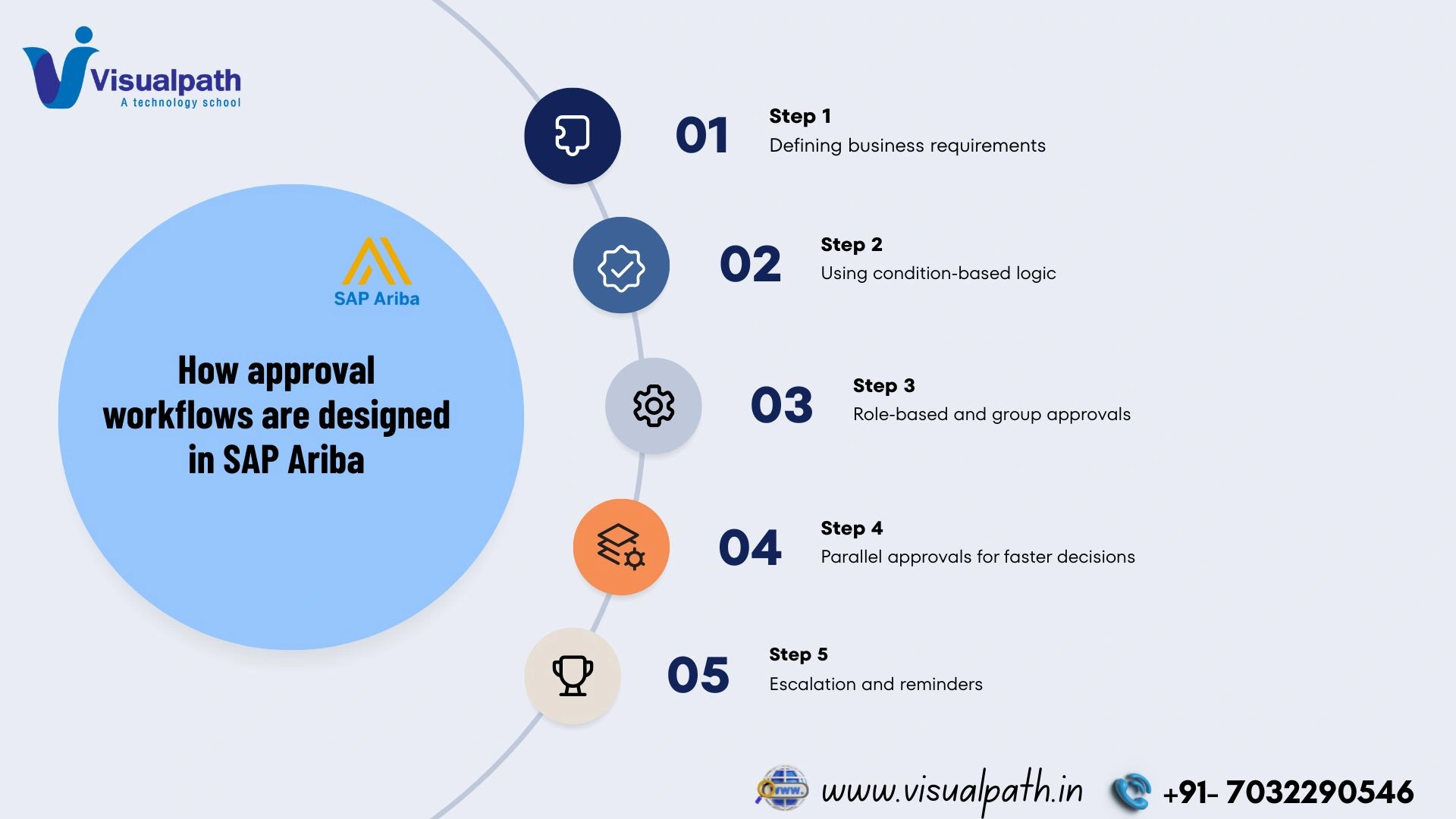
How approval workflows are designed in SAP Ariba 2025
Step 1: Defining business requirements
Every workflow begins with business needs. Procurement teams work with finance, legal, and compliance teams to identify approval expectations. In SAP Ariba, consultants translate these requirements into system logic.
For students learning SAP Ariba, this step highlights why functional understanding matters just as much as tool knowledge.
Step 2: Using condition-based logic
In 2025, SAP Ariba relies heavily on condition-based workflows. Instead of creating dozens of workflows, one intelligent workflow can handle multiple scenarios.
For example, a single workflow can adjust automatically based on:
Total value of the request
Supplier risk rating
Contract type
Location of the requester
This flexibility makes workflows easier to maintain and scale.
Step 3: Role-based and group approvals
Modern SAP Ariba workflows rely more on roles than individuals. Approvals go to job roles like “Procurement Manager” or “Finance Controller” instead of specific names.
This design reduces dependency on user maintenance. When someone leaves the organization, workflows continue to function smoothly.
Step 4: Parallel approvals for faster decisions
One major improvement in 2025 is the wider use of parallel approvals. Legal and finance teams can review documents at the same time instead of waiting for each other.
This change significantly reduces cycle times, which businesses value highly.
Step 5: Escalation and reminders
Approval delays cost money. SAP Ariba workflows now include automated reminders and escalation rules. If an approver does not respond within a defined time, the request moves to the next authority.
This feature improves accountability without creating manual follow-ups.
How AI enhances approval workflows in 2025
SAP Ariba now integrates AI-driven insights into workflow decisions. This does not replace human approvals but supports smarter routing.
Repetitive low-value purchases may skip unnecessary approvals
Historical data helps predict approval bottlenecks
Students interested in Cloud and AI careers will appreciate how SAP Ariba blends automation with business control. This is also why training providers like Visualpath include AI context along with core SAP Ariba learning.
Real-life example of an approval workflow
Imagine a procurement executive raising a purchase requisition for office equipment worth a moderate amount.
The system first checks the value and assigns approval to the department manager. Because the supplier is pre-approved and low risk, legal review is skipped. Finance approval runs in parallel. Once both approvals are complete, the purchase order is created automatically.
This smooth flow reflects how workflows support productivity rather than slowing it down.
Career relevance of workflow knowledge
Approval workflows form the backbone of SAP Ariba implementations. Interviewers often test candidates on workflow logic rather than navigation alone.
Visualpath, known for SAP Ariba online training worldwide, emphasizes hands-on workflow understanding while also offering online training for related Cloud and AI courses. This combination helps learners stay relevant in a competitive job market.
Common challenges and how 2025 addresses them
Earlier versions of workflows felt rigid. Small changes required technical intervention. In 2025, configuration-driven design allows faster updates.
Another challenge involved user confusion. Modern workflows now include clear approval status visibility, which improves user trust in the system.
Best practices for students learning workflows
Start by understanding procurement processes before diving into configuration. Learn why approvals exist, not just how they are set up.
Practice mapping business scenarios to workflow rules. This habit helps you think like a consultant rather than a tool operator.
Choose training programs that explain concepts clearly. Visualpath supports learners by breaking down workflows into simple, relatable examples.
The future of SAP Ariba approval workflows
Approval workflows will continue to evolve toward predictive and self-optimizing models. AI will recommend workflow improvements based on usage patterns.
For students entering SAP Ariba careers now, learning workflows in 2025 means staying ahead of future trends.
FAQs
1. What is the main purpose of approval workflows in SAP Ariba?
Approval workflows ensure business control and compliance for purchases and contracts. They also reduce delays by automating routing and approvals.
2. Are approval workflows difficult to learn for beginners? They are easy to learn when explained with real examples. Structured training helps students understand logic step by step.
3. How has SAP Ariba improved workflows in 2025? Workflows are more flexible, role-based, and AI-assisted. They adapt to business conditions instead of using fixed paths.
4. Do approval workflows require coding knowledge? Most workflows are built using configuration, not coding. Functional understanding is more important than technical skills.
5. Why are workflows important for SAP Ariba careers? They appear in almost every implementation and interview. Strong workflow knowledge increases project readiness and confidence.
Conclusion
Building approval workflows in 2025’s SAP Ariba is an art form that combines business strategy with smart technology. As organizations strive for “Autonomous Procurement,” the ability to design efficient, compliant, and AI-enhanced workflows will be the most valuable skill in your toolkit.
If you’re ready to take the next step in your professional journey, specialized training is the key. Remember, Visualpath offers expert-led SAP Ariba online training worldwide, ensuring you stay ahead of the curve in Cloud and AI technologies.
“Learn SAP Ariba implementation best practices in 2025 with Visualpath’s expert online training, real-time projects, and hands-on learning. Visualpath offers worldwide SAP Ariba training with in-depth sessions, daily recordings, and cloud & AI courses to boost your career growth.”
What SAP Ariba capabilities does Spend Visibility provide in 2025?
If you’re stepping into the world of procurement technology and aiming to grow your career in SAP Ariba, you’re in the right place. In this article I’ll walk you through the key capabilities of the Spend Visibility module in 2025—clearly, student-friendly, and from the perspective of someone who’s walked this path. I’ll also mention how Visualpath supports you with online training globally (including SAP Ariba and related Cloud & AI courses) so you understand how to move from interest to action.
Understanding Spend Visibility in SAP Ariba
When we talk about Spend Visibility, we’re referring to a core capability of the Ariba suite that helps organisations see what they’re spending, with whom, and where opportunities lie. At its heart, it aggregates procurement spend and supply-chain data across systems and presents that insight in a usable form. According to SAP documentation, Spend Visibility “aggregates and analyses disparate expenditure data to reveal near-real-time insights into organizational spend, suppliers.
For you as a learner or aspiring SAP Ariba professional, learning the Spend Visibility module means you’re equipped to help organisations reduce cost leakage, improve supplier relationships, and make data-driven procurement decisions. It’s a strong differentiator on your resume.
Key Capabilities of Spend Visibility in 2025
Here’s a breakdown of the top capabilitiesthat the Spend Visibility module in 2025 offers — and how these map to career-relevant skills:
1. Centralised spend data aggregation and standardisation
One of the foundational capabilities is gathering spend data from multiple sources: ERP, procurement systems, AP (accounts payable), even spreadsheets. The idea is to bring all that spend into one central view for analysis. As noted: “aggregates and standardises spend data from various sources, including ERP systems, procurement solutions, accounts payable, and spreadsheets. Career tip: Mastering how data is pulled, cleaned and standardised is key — this means you’ll learn about taxonomies, data cleansing rules, and how to make disparate systems talk to each other.
2. Classification and enrichment of spend
Raw data alone doesn’t help unless it’s useable. Spend Visibility applies classification (e.g., what was bought, category of spend) and enrichment (e.g., market intelligence, supplier info) so that the data becomes meaningful. According to the module description: “machine-learning based data classification and enrichment, market intelligence, advanced reporting, analytics” Career tip: Learning how classification and enrichment works means you’ll be able to turn messy procurement data into actionable insight — a major plus for any job in procurement analytics or Ariba consulting.
3. Advanced analytics, dashboards and reporting
Once the data is clean, the next capability is to analyse it: producing dashboards, pre-packaged reports and customizable views so stakeholders can see key metrics such as spend by category, supplier performance, contract compliance, and sourcing opportunities. One source mentions Spend Visibility “helps organizations analyse spend data, identify savings opportunities, improve supplier performance, and ensure better decision-making. Career tip: Gaining fluency in creating, reading and interpreting these analytics dashboards is a strong skill you can highlight—especially if you can show how you used Spend Visibility to make or recommend changes.
A major business driver of Spend Visibility is to identify where savings can be made. Whether it’s spotted via maverick spend (off-contract purchases), duplicated suppliers, or opportunities to consolidate categories—this module is about turning insight into value. The best practice guide for Ariba notes you can “identify, quantify and prioritise sourcing opportunities that drive planned savings. Career tip: Being able to speak to “I identified X opportunity and that could save Y%” is a powerful story for interviews, especially when you’ve used Spend Visibility as your tool.
5. Supplier and risk visibility
Beyond spend, this capability helps you see supplier-level insights: who you’re buying from, are you concentrated with a few suppliers, are there risk indicators (supplier performance, contract adherence, geographic risk). One article states Spend Visibility brings “360-degree visibility of enterprise-wide procurement data … across all source systems. Career tip: In roles like Ariba consultancy or procurement analytics, being able to link spend patterns with supplier risk or performance gives you a broader strategic value. You’ll want to learn how to set up alerts or dashboards for supplier risk.
6. Integration and alignment with broader Ariba / SAP ecosystem
In 2025, Spend Visibility isn’t standalone—it’s integrated with other modules in the Ariba suite and with bigger SAP enterprise systems (such as SAP S/4HANA). One blog suggests that Ariba as a whole offers “a wide range of functionalities… driving efficiency, compliance, and cost savings” in procurement and sourcing. Career tip: Understanding how Spend Visibility fits into the broader Ariba architecture—knowing where outputs feed into sourcing, contract management, and procurement workflows—gives you that higher-level understanding employers look for.
How this capability applies to your career and skill-growth
If you’re targeting a career in SAP Ariba (consulting, procurement analytics, system implementation), mastering Spend Visibility is a smart move. Here’s how you can position it:
Analyst role: As a procurement analyst or category manager, you’ll use Spend Visibility to surface insights and support sourcing decisions.
Implementation consultant: You’ll help organisations set up, configure and customise Spend Visibility dashboards, data pipelines, taxonomy rules, and integrate them with Ariba and SAP systems.
Hybrid roles: Many organisations now expect procurement professionals to have data-skills (analytics, dashboards) along with system skills (Ariba modules). Spend Visibility bridges that gap nicely.
This is where Visualpath enters the picture. At Visualpath, you can access global online training for SAP Ariba. The courses cover modules like Spend Visibility, sourcing, and contract management. You can also take Cloud and AI courses that complement the Ariba ecosystem. This kind of blended skill-set (procurement systems + cloud/AI analytics) positions you well for 2025-and-beyond roles.
FAQ
1. What is SAP Ariba Spend Visibility?
It is a module within SAP Ariba that brings together procurement spend data from multiple sources, cleanses and classifies it, and presents dashboards and reports to help organisations understand spending, suppliers, and savings opportunities.
2. Why is Spend Visibility important for an SAP Ariba career? Because organisations increasingly expect analytics-driven procurement professionals who can surface insights from spend data, not just run sourcing or contracts.
3. What skills should I learn to use Spend Visibility effectively? You should focus on data aggregation and standardisation, classification (taxonomy), dashboard/report design, spend analytics (trend/variance), supplier risk insights, and understanding how this module links to sourcing/contract workflows.
4. How does Spend Visibility integrate with other SAP Ariba modules? It feeds insights into the sourcing pipeline (helping identify sourcing opportunities), contract management (showing contract compliance & savings), and supplier management (supplier performance and risk).
5. As a student or new professional, how can I get hands-on experience? You can enrol in online training programmes (such as the ones offered by Visualpath) that provide real spend datasets, training labs and dashboards.
Practical tips for learners
Start with data fundamentals: Before you dive deeply into Ariba, ensure you understand fundamentals of data aggregation, classification, and cleansing.
Many training programs, like those from Visualpath, offer sample spend datasets. Use them to build dashboards or reports in Spend Visibility.
When learning new capabilities, always ask, ‘What value does this bring to the business?’ This enhances your credibility.
Explore how insights from Spend Visibility link to sourcing, contract lifecycle, and supplier management. This holistic view is powerful.
Stay updated on Cloud & AI. As procurement tech evolves, understanding how cloud platforms and AI-driven analytics enhance Spend Visibility keeps you future-proof.
Summary
To wrap up: the focus keyphrase SAP Ariba Spend Visibility capabilities is central to the procurement analytics story in 2025. “The module provides data aggregation, classification, enrichment, advanced analytics, dashboards, and opportunity identification. It also offers supplier risk visibility and integrates with the broader Ariba/SAP ecosystem.” For you as a learner or aspiring professional, mastering this module is a strong career move. “Platforms like Visualpath offer training in SAP Ariba and related Cloud & AI courses. This helps you not only learn the tools but also drive business outcomes.” Embrace Spend Visibility, embrace procurement data intelligence, and you’ll be ready for a flourishing career in the SAP Ariba space.
“Learn SAP Ariba implementation best practices in 2025 with Visualpath’s expert online training, real-time projects, and hands-on learning. Visualpath offers worldwide SAP Ariba training with in-depth sessions, daily recordings, and cloud & AI courses to boost your career growth.”
What is SAP Ariba Contracts & Compliance Management Like in 2025?
SAP Ariba has become a dominant force, streamlining complex business processes for companies of all sizes. As we move into 2025, SAP Ariba Contracts & Compliance Management continues to evolve, integrating new technologies and features that enhance contract lifecycle management, compliance checks, and supplier collaboration.
In this article, we will explore what SAP Ariba Contracts & Compliance Management looks like in 2025, why it’s crucial for businesses, and how professionals can leverage Visualpath SAP Ariba online training to stay ahead of the curve in this fast-evolving space.
What is SAP Ariba Contracts & Compliance Management?
SAP Ariba is a cloud-based procurement platform that offers comprehensive solutions for managing the entire procurement process, from sourcing to supplier collaboration, and most importantly, contract and compliance management. This module is designed to ensure that organizations effectively manage supplier contracts while adhering to regulatory and internal compliance requirements.
In 2025, the focus is shifting towards automation, AI-driven insights, and deeper integration with other enterprise systems to improve procurement efficiency. This will significantly reduce manual tasks, speed up the contract process, and ensure that businesses are meeting compliance standards seamlessly.
SAP Ariba Contracts & Compliance Management is designed to handle the following:
Contract Lifecycle Management: This ensures that contracts are efficiently created, negotiated, approved, and executed while maintaining visibility throughout the entire lifecycle.
Compliance Monitoring: With AI and machine learning, SAP Aribaautomatically flags potential compliance risks in contracts and procurement activities, helping companies mitigate risks before they escalate.
Supplier Collaboration: This is a critical aspect of the procurement process. SAP Ariba allows businesses to communicate and collaborate with suppliers in real-time, ensuring smooth contract execution and reducing potential delays.
Key Features of SAP Ariba Contracts & Compliance Management in 2025
1. AI-Powered Automation
As artificial intelligence continues to evolve, SAP Ariba’s Contracts & Compliance Management system in 2025 is expected to be more intelligent than ever. AI will automate repetitive tasks like contract drafting, risk analysis, and approval workflows, allowing procurement teams to focus on strategic decision-making.
AI will also enhance compliance management by continuously scanning contracts for non-compliant clauses or missing regulatory requirements. These capabilities will help organizations avoid costly fines or legal challenges related to contract violations.
2. Integration with Cloud and Other Enterprise Systems
In 2025, SAP Ariba will likely continue its deep integration with other enterprise systems like SAP S/4HANA, SAP Success Factors, and third-party tools. This enables a seamless flow of information between procurement, finance, HR, and other departments, ensuring that compliance is monitored across various touchpoints in an organization.
This integration makes it easier for businesses to track and report on contracts and compliance activities in real time, giving better visibility into potential risks or contract breaches.
3. Improved Supplier Risk Management
Supplier compliance and risk management have always been a priority for businesses, and with SAP Ariba’s enhanced compliance features, this is becoming even easier. In 2025, the system will be able to predict and mitigate supplier risks using predictive analytics, helping organizations avoid potential disruptions in their supply chain.
By leveraging real-time data, companies can better evaluate their suppliers’ financial health, ethical standards, and adherence to regulatory frameworks.
4. Data-Driven Insights
SAP Ariba Contracts & Compliance Management will continue to provide data-driven insights through advanced analytics and reporting tools. These insights help businesses make informed decisions about contract negotiations, supplier relationships, and risk management. With this data, organizations can drive better contract performance and improve compliance with internal and external standards.
Why Choose Visualpath for SAP Ariba Training?
Visualpath’s SAP Ariba online training offers comprehensive lessons and hands-on experience that prepare professionals for success in 2025’s procurement landscape.
Real-Time Projects & Hands-On Learning
What sets Visualpath apart is our emphasis on real-time projects and hands-on learning. Our SAP Ariba online training allows you to work on actual projects that simulate real-world procurement scenarios.
Daily Recorded Sessions for Reference
One of the most valuable aspects of Visualpath’s training is our daily recorded sessions. This flexibility lets you learn at your own pace and ensures you don’t miss any critical information.
Comprehensive Coverage of Cloud and AI Courses
These technologies are deeply integrated into SAP Ariba’s functionality in 2025. Taking these courses boosts career prospects by building expertise in cloud-based procurement solutions and AI-driven contract management systems.
How SAP Ariba Enhances Career Growth
SAP Ariba is a platform that is in demand across various industries, including manufacturing, retail, healthcare, and more. As organizations seek to optimize their procurement processes, professionals with expertise in SAP Ariba’s Contracts & Compliance Management are in high demand.
Procurement Manager
Contract Manager
Compliance Officer
SAP Ariba Consultant
FAQs about SAP Ariba Contracts & Compliance Management
1. What is the primary function of SAP Ariba Contracts & Compliance Management?
SAP Ariba’s Contracts & Compliance Management helps businesses automate contract creation, monitor compliance, and manage supplier relationships efficiently.
2. How does SAP Ariba enhance contract compliance? SAP Ariba uses AI and machine learning to automatically flag compliance risks and ensure that contracts meet regulatory standards.
3. Why should I choose Visualpath for SAP Ariba training? Visualpath offers in-depth training with hands-on learning, real-time projects, and daily recorded sessions that help you master SAP Ariba effectively.
4. How will SAP Ariba evolve in 2025? In 2025, SAP Ariba is expected to enhance its AI-driven automation and integrate more deeply with other cloud-based enterprise systems to improve efficiency and compliance.
5. Can I get certified in SAP Ariba? Yes, after completing Visualpath’s training, you will be well-prepared for certification exams, which can further enhance your career prospects in procurement and compliance management.
Conclusion
As organizations strive to stay compliant and streamline operations, the demand for professionals skilled in SAP Ariba will only increase.
With Visualpath’s SAP Ariba online training, you can position yourself as a leader in this field, mastering the tools and techniques required to navigate the evolving procurement landscape. Take the next step in your career by gaining hands-on experience, learning from real-time projects, and accessing valuable training resources tailored for today’s fast-paced business world.
“Learn SAP Ariba implementation best practices in 2025 with Visualpath’s expert online training, real-time projects, and hands-on learning. Visualpath offers worldwide SAP Ariba training with in-depth sessions, daily recordings, and cloud & AI courses to boost your career growth.”
How does the Buying and Invoicing function in SAP Ariba 2025?
Introduction
The digital transformation of procurement is accelerating in 2025, with SAP Ariba emerging as a leader in simplifying buying and invoicing for organizations. As businesses aim for greater efficiency, compliance, and visibility, mastering SAP Ariba’s buying and invoicing workflows becomes crucial for career growth. This guide explores how the buying and invoicing function in SAP Ariba 2025 works, with practical insights and tips from Visualpath, a top provider of SAP Ariba online training worldwide.
How Does the Buying Process Work in SAP Ariba 2025?
Requisition Creation: Users create purchase requisitions through self-service, supported by AI recommendations for faster selection and compliance.
Approval Workflow: Requisitions route automatically to designated approvers based on company policy. Real-time dashboards help track status.
Purchase Order Generation: Once approved, the system automatically generates and sends purchase orders to suppliers, ensuring compliance and transparency.
A robust SAP Ariba invoicing workflow integrates buying and payment processes seamlessly, driving efficiency and visibility for procurement teams.
Requisition Creation: Users create purchase requisitions through self-service, supported by AI recommendations for faster selection and compliance.
Approval Workflow: Requisitions route automatically to designated approvers based on company policy. Real-time dashboards help track status.
Purchase Order Generation: Once approved, the system automatically generates and sends purchase orders to suppliers, ensuring compliance and transparency.
A robust SAP Ariba invoicing workflowintegrates buying and payment processes seamlessly, driving efficiency and visibility for procurement teams.
Invoicing Works in SAP Ariba 2025
Invoice Submission: Suppliers submit invoices electronically through the Ariba Network, which is integrated directly with the buyer’s system.
Invoice Validation: SAP Ariba checks invoices against purchase orders and receipts, automatically flagging discrepancies for review.
Why Choose Visualpath for SAP Ariba Training?
In-Online Training Depth
Real-Time Projects & Hands-On Learning
Training includes real-time scenarios and hands-on projects, allowing professionals to gain practical skills that are immediately applicable to the workplace.
Daily Recorded Sessions for Reference
Extensive Course Portfolio
The SAP Ariba invoicing feature is central to procurement transformation, reducing cycle times and empowering finance teams to work strategically.
Career Growth with SAP Ariba Skills
With SAP Ariba becoming the global standard for procurement automation, mastering its buying and invoicing functions is a valuable asset for professionals. Visualpath’sexpert-led, hands-on training ensures participants are job-ready and positioned for advancement in the digital supply chain era.
FAQs about SAP Ariba Buying and Invoicing
1. What are the main features of SAP Ariba invoicing?
A. Automated invoice matching, real-time tracking, electronic submission, and compliance with procurement policies.
2. How does SAP Ariba improve procurement efficiency? A. It automates requisition, approval, order, and payment processes, reducing manual effort and errors.
3. Can Visualpath’s SAP Ariba training be accessed worldwide? A. Yes, Visualpath provides comprehensive SAP Ariba online training accessible to learners globally.
4. Does Visualpath offer training for cloud and AI courses? A. Absolutely, Visualpath offers a range of online training for SAP, cloud, and AI courses to keep professionals future-ready.
5. Are recorded SAP Ariba training sessions available for review? A. Yes, daily recorded sessions are available for reference, letting learners revisit material anytime.
Conclusion
Understanding how SAP Ariba invoicing functions in 2025 is essential for anyone pursuing a career in procurement or finance. The move towards automated, AI-driven buying and invoicing processes presents significant opportunities for skill development and advancement. Visualpath offers leading SAP Ariba invoicing training, along with a diverse selection of cloud and AI courses, empowering professionals to stay at the forefront of digital transformation. Start elevating your career with Visualpath’s expert-driven, real-world online training today.
“Learn SAP Ariba implementation best practices in 2025 with Visualpath’s expert online training, real-time projects, and hands-on learning. Visualpath offers worldwide SAP Ariba training with in-depth sessions, daily recordings, and cloud & AI courses to boost your career growth.”
SAP Ariba handle multi-geography or multi-currency scenarios in 2025
Global enterprises in 2025 face unique challenges: managing suppliers across multiple countries, transacting in different currencies, and complying with varied regulatory frameworks. SAP Ariba continues to be one of the most reliable procurement platforms that helps organizations navigate multi-geography and multi-currency needs efficiently.
This article explores how SAP Ariba scenarios are handled in today’s business environment, why adopting the right approach matters, and how professionals can build skills to thrive in this global procurement ecosystem.
Understanding Multi-Geography and Multi-Currency Needs
Businesses expanding globally encounter multiple geographies with distinct complexities. These include language barriers, unique tax rules, local compliance requirements, and cultural dynamics. Alongside geography, organizations must also manage transactions in multiple currencies, where exchange rates, financial policies, and localized reporting add layers of complexity.
SAP Ariba scenarios are designed to simplify both. It enables procurement teams to:
Adopt standardized procurement templates while allowing for country-level customization.
Manage supplier onboarding workflows across different regions.
Integrate seamlessly with ERP systems to handle multiple currencies.
Apply compliance monitoring and rule-based workflows for each market.
How SAP Ariba Handles Multi-Geography Scenarios in 2025
In 2025, SAP Ariba has evolved with advanced AI-driven and cloud-based capabilities to help global procurement and supplier management. Some key capabilities for multi-geography include:
Localized Compliance and Regulations: The system supports region-specific compliance checks, reducing legal risks.
Global Supplier Collaboration: Enterprises can onboard suppliers worldwide on a single platform while customizing workflows by country or region.
Language and Tax Localization: Support for multiple languages and tax frameworks ensures that teams from different geographies collaborate without barriers.
AI-driven Risk Insights: Predictive analytics help identify regional risks before they impact operations.
By centralizing procurement processes and still offering flexibility for local needs, SAP Ariba scenarios ensure organizations remain competitive in diverse markets.
How SAP Ariba Handles Multi-Currency Scenarios in 2025
For multinational companies, handling different currencies is critical. Ariba introduces multiple features that businesses use in 2025 to address cross-border transactions:
Dynamic Currency Conversion: Real-time exchange rate updates allow accurate cost projections in procurement.
Multi-Currency Approvals: PO approvals, invoicing, and contracts can be handled in native local currencies.
Consolidated Reporting: Finance teams can generate reports in a base currency while still tracking details in local currencies.
Risk Mitigation: Currency fluctuation risks are reduced through automated adjustment mechanisms embedded in procurement workflows.
These functionalities mean global procurement teams can minimize complexity and ensure transparency in supplier payments and cross-border sourcing.
Career Growth with SAP Ariba in 2025
Understanding SAP Ariba scenarios is more than just a business requirement—it’s a career booster. Companies want professionals who can manage global operations seamlessly. Skills in handling both multi-geography and multi-currency complexities make a candidate highly valuable.
Training in SAP Ariba equips professionals to:
Configure workflows for international procurement.
Build strategies to mitigate currency and regional risks.
Gain expertise in integrated supplier and contract management.
Deliver measurable value to global organizations.
This is why many professionals turn to specialized learning platforms like Visualpath, which offers in-depth SAP Ariba and cloud-related training worldwide.
Why Choose Visualpath?
If you want to gain expertise in SAP Ariba scenarios in 2025, structured learning is essential. Visualpath is recognized as a trusted provider of SAP Ariba online training globally, delivering both foundational and advanced learning.
Here’s what makes Visualpath stand out:
In-Online Training Depth: The course covers the full SAP Ariba lifecycle with focus on practical implementations.
Real-Time Projects & Hands-On Learning: Learners work on projects that replicate real global procurement conditions.
Daily Recorded Sessions for Reference: Each session is recorded, giving professionals the ability to revisit lessons anytime.
All Cloud and AI Courses Provided: In addition to SAP Ariba, Visualpath trains professionals in cloud technologies and AI for broader career opportunities.
By choosing Visualpath, professionals benefit from comprehensive global training that aligns perfectly with modern enterprise needs.
Best Practices for Handling Multi-Geography and Multi-Currency in SAP Ariba
To get the most out of SAP Ariba in handling multi-geography and multi-currency scenarios, follow these best practices:
Standardize Procurement Processes: While every geography may have its own regulations, it’s important to standardize core procurement processes across regions. SAP Ariba offers the flexibility to tailor workflows, while ensuring compliance with local requirements.
Use Real-Time Currency Data: Leverage SAP Ariba’s integration with financial systems to access real-time exchange rate data. This ensures that currency conversions are accurate and up-to-date, reducing financial discrepancies.
Training and Education: Train your procurement team on how to effectively use SAP Ariba for global operations. Visualpath’s SAP Ariba online training programs, which are available worldwide, offer in-depth coverage of these complex scenarios, equipping you with the skills you need to succeed.
Enable Cross-Regional Communication: Foster clear communication between teams in different geographies. Use collaboration tools integrated within SAP Ariba to streamline communication and reduce delays.
Leverage Analytics for Decision-Making: Use SAP Ariba’s reporting and analytics capabilities to gain insights into procurement trends across different geographies. This helps in making data-driven decisions for cost reduction and supplier optimization.
FAQs
1. What are multi-geography scenarios in SAP Ariba?
A. They refer to procurement processes customized for different geographies, including compliance, local languages, and supplier onboarding.
2. How does SAP Ariba manage multi-currency transactions? A. It uses real-time currency conversion, allows invoices and approvals in local currencies, and provides consolidated reporting.
3. Why should professionals learn SAP Ariba in 2025? A. It’s a critical skill for managing global procurement and offers high career growth opportunities.
4. How does Visualpath support SAP Ariba training? A. Visualpath offers online training with real-time projects, recorded sessions, and complete SAP Ariba lifecycle coverage.
5. Can SAP Ariba integrate with ERP systems for global operations? A. Yes, SAP Ariba integrates seamlessly with multiple ERP systems to support multi-geography and multi-currency workflows.
Conclusion
Handling multi-geography and multi-currency procurement is no longer optional—it’s an essential competitive strategy for truly global enterprises in 2025. SAP Ariba scenarios empower businesses to manage supplier relationships, navigate compliance, and streamline financial consistency across borders.
For professionals, expertise in this area opens doors to career advancement. Platforms like Visualpath make this journey accessible with quality SAP Ariba training, practical projects, recorded sessions, and additional cloud and AI learning opportunities.
If your goal is to handle complex procurement challenges and accelerate your career growth, mastering SAP Ariba scenarios is the way forward.
“Learn SAP Ariba implementation best practices in 2025 with Visualpath’s expert online training, real-time projects, and hands-on learning. Visualpath offers worldwide SAP Ariba training with in-depth sessions, daily recordings, and cloud & AI courses to boost your career growth.”
SAP Ariba Authentication Methods: SSO, MFA & Manual in 2025
Introduction:
SAP Ariba, a leading procurement solution, continues to evolve, providing businesses with powerful tools for supply chain management, purchasing, and supplier collaboration. As companies prioritize security and ease of access, choosing the right SAP Ariba authentication method has become more critical than ever.
In 2025, SAP Ariba offers several authentication options to ensure secure, seamless access for users. These options include Single Sign-On (SSO), Multi-Factor Authentication (MFA), and the traditional manual login method. Each method has distinct advantages and is suited for different organizational needs and security policies.
Whether you are an SAP Ariba user or looking to upskill through Visualpath-provided SAP Ariba online training, this article will guide you through the authentication methods available, how they work, and which one is best for your organization.
What is SAP Ariba Authentication?
Authentication in SAP Ariba refers to the process of verifying a user’s identity before granting access to the platform. With security breaches and data privacy being top concerns for businesses worldwide, SAP Ariba has invested heavily in robust authentication methods. These methods help protect sensitive procurement data, ensure compliance, and improve the overall user experience.
SAP Ariba authentication is critical for businesses of all sizes, and understanding the options available in 2025 will help you make an informed decision that aligns with your company’s security needs.
SAP Ariba Authentication Methods in 2025
1. Single Sign-On (SSO) in SAP Ariba
Single Sign-On (SSO) is one of the most popular authentication methods for SAP Ariba users in 2025. SSO allows users to log in to multiple applications with a single set of credentials. This method is widely used in organizations with several software solutions that require different logins.
How Does SSO Work?
SSO works by integrating your SAP Ariba account with your organization’s identity management system. Once users log in to their central identity provider (such as Active Directory or Okta), they can access SAP Ariba without needing to log in again. This reduces the need to remember multiple passwords and streamlines the user experience.
Benefits of SSO:
Convenience: Users only need to remember one set of credentials.
Improved Security: Minimizes the risk of password fatigue and reduces the likelihood of weak passwords.
Centralized Control: IT teams can manage access to all integrated applications from a single platform.
SSO is especially beneficial for large organizations with multiple systems, where managing various usernames and passwords can be cumbersome. If your company is already using an identity provider (IDP), adopting SSO for SAP Ariba will integrate seamlessly into your existing infrastructure.
2. Multi-Factor Authentication (MFA) in SAP Ariba
As cyber threats become more sophisticated, Multi-Factor Authentication (MFA) has gained traction as a vital security feature for businesses. In 2025, SAP Ariba continues to support MFA as a way to provide an additional layer of protection for sensitive procurement data.
How Does MFA Work?
MFA requires users to verify their identity using more than one factor. Typically, this involves:
Something you know: A password or PIN.
Something you have: A device like a mobile phone or hardware token.
Something you are: A biometric factor such as a fingerprint or facial recognition.
Once you enter your password, you’ll be prompted to authenticate your identity through another method, such as a code sent to your phone or an app like Google Authenticator.
Benefits of MFA:
Enhanced Security: Even if a hacker gets hold of your password, they would still need the second factor to access your account.
Compliance Requirements: Many industries require MFA for regulatory compliance, making it an essential feature for companies handling sensitive procurement data.
Peace of Mind: MFA provides an extra layer of protection, ensuring that your data remains secure.
If your organization prioritizes data security, adopting MFA is a must in 2025. With increasing cyber threats, MFA is becoming a standard practice for businesses that handle sensitive data.
3. Manual Login Method in SAP Ariba
While SSO and MFA offer cutting-edge security, manual login remains an option for SAP Ariba users. This method involves entering a username and password directly into the SAP Ariba login page.
How Does Manual Login Work?
Manual login requires users to enter their credentials (username and password) to gain access to SAP Ariba. This method is simple but comes with security risks, especially if users rely on weak or reused passwords.
Benefits of Manual Login:
Simplicity: It’s easy to set up, and there’s no need for additional configuration.
Cost-Effective: For smaller organizations or those with fewer security concerns, manual login can be an inexpensive option.
However, due to the increasing risks of cyberattacks and data breaches, many organizations are transitioning away from manual login to more secure authentication methods like SSO and MFA.
CareerGrowth with SAP Ariba Authentication
For professionals aiming to build careers in procurement, supplier management, and SAP solutions, knowledge of SAP Ariba authentication is a big advantage. Security configurations are crucial for consultants, IT admins, and Ariba specialists.
Organizations prefer candidates who can implement authentication solutions that balance security and usability while meeting compliance requirements. This makes authentication expertise a strong career skill in 2025.
Why Choose Visualpath for SAP Ariba Online Training?
As companies embrace SAP Ariba and its advanced features, Visualpath-provided SAP Ariba online training equips individuals with the skills needed to navigate the platform effectively and implement best practices for security.
At Visualpath, we offer comprehensive SAP Ariba online training courses that cater to both beginners and advanced learners. Whether you’re new to SAP Ariba or looking to enhance your career with real-time projects, Visualpath’s SAP Ariba online training prepares you for the challenges of the procurement world.
Why Choose Visualpath?
In-Depth Online Training: Our courses offer detailed insights into SAP Ariba’s features, including authentication methods, to give you a solid understanding of the platform.
Real-Time Projects & Hands-On Learning: Experience hands-on learning with real-time projects that allow you to apply your knowledge in practical scenarios.
Daily Recorded Sessions for Reference: All training sessions are recorded, so you can revisit lessons anytime for reference and clarification.
Visualpath provides SAP Ariba online training worldwide, ensuring that learners across the globe have access to high-quality educational content that helps them advance their careers.
Future of SAP Ariba Authentication
By 2025, SAP is heavily focusing on AI-driven security and automation. With predictive authentication methods, organizations may see adaptive policies, where the system detects user risk levels dynamically. Future updates are expected to integrate with biometric solutions and advanced security frameworks.
As enterprise ecosystems evolve, SAP Ariba authentication methods will continue to strengthen security while simplifying user access. Professionals who master these areas today are well-positioned for tomorrow’s IT and procurement jobs.
Top 5 FAQ Questions
1. What is the best authentication method for SAP Ariba in 2025?
The best method depends on your organization’s needs. SSO offers convenience, while MFA provides the highest security.
2. Can SAP Ariba support both SSO and MFA? Yes, SAP Ariba can support both SSO and MFA, providing layered security for enhanced protection.
3. How do I set up SSO for SAP Ariba? Setting up SSO involves configuring SAP Ariba with your organization’s identity provider, such as Active Directory or Okta.
4. Is manual login still secure for SAP Ariba users? Manual login is less secure than SSO and MFA and is generally not recommended for businesses handling sensitive data.
5. How can Visualpath help me learn SAP Ariba authentication methods? Visualpath offers expert-led SAP Ariba online training, where you’ll learn how to implement the best authentication practices to enhance your career in procurement.
Conclusion: Choosing the Right SAP Ariba Authentication Method in 2025
In 2025, SAP Ariba offers a range of authentication methods to cater to the evolving needs of businesses. Whether your organization chooses SSO, MFA, or manual login, it’s essential to align your choice with your security requirements, organizational size, and user convenience.
For businesses seeking robust security and ease of use, SSO and MFA are highly recommended. While manual login may still be an option for some, organizations are increasingly shifting toward more secure methods to protect sensitive procurement data.
“Learn SAP Ariba implementation best practices in 2025 with Visualpath’s expert online training, real-time projects, and hands-on learning. Visualpath offers worldwide SAP Ariba training with in-depth sessions, daily recordings, and cloud & AI courses to boost your career growth.”
What are the Best Practices for SAP Ariba Implementations in 2025?
Introduction
SAP Ariba has become a cornerstone in procurement and supply chain management, revolutionizing how businesses handle sourcing, procurement, and supplier collaboration. As we approach 2025, companies are increasingly seeking efficient ways to implement SAP Ariba for streamlining operations. If you’re looking to ensure a successful SAP Ariba implementation, you need to be aware of the latest best practices to maximize your return on investment (ROI).
In this article, we’ll delve into key best practices for SAP Ariba implementation in 2025, and how organizations can stay ahead of the curve. Whether you’re new to SAP Ariba or looking to refine your existing setup, these insights will help you build a robust and effective system. We’ll also explore how Visualpath, with its SAP Ariba online training worldwide, can assist in empowering your team to succeed.
Why SAP Ariba Matters in 2025
SAP Ariba continues to play a central role in procurement transformation by offering:
End-to-end supplier lifecycle management.
AI-powered insights for smarter decisions.
Cloud-based collaboration across global supply chains.
Seamless integration with SAP S/4HANA, SAP BTP, and other enterprise solutions.
With more organizations prioritizing supplier risk management, sustainability, and agile procurement, the right SAP Ariba implementation process ensures long-term efficiency and ROI.
1. Understand the Strategic Importance of SAP Ariba
The first step in any SAP Ariba implementation is recognizing its strategic value. SAP Ariba isn’t just a procurement tool; it’s an ecosystem that connects your business with global suppliers, optimizes procurement processes, and supports compliance and sustainability efforts. Understanding this broader scope allows you to align SAP Ariba’s capabilities with your business objectives.
When planning for implementation, ensure you involve key stakeholders from procurement, IT, finance, and compliance teams. This holistic approach ensures that everyone is on the same page and reduces resistance during the rollout.
2. Prioritize Data Quality and Integration
A successful SAP Ariba implementation relies heavily on clean, accurate data. Before implementation, spend time cleaning and organizing your data to ensure it integrates seamlessly with SAP Ariba. Poor data quality can lead to incorrect reporting, inefficiencies, and delays.
Also, focus on integrating SAP Ariba with other systems such as SAP S/4HANA or SAP BTP (Business Technology Platform). This integration helps ensure consistency across your entire business ecosystem and streamlines workflows.
Visualpath’s SAP Ariba online training worldwide includes practical training on integrations with systems like SAP BTP, making sure your team is equipped with the knowledge to execute a smooth and efficient implementation.
3. Opt for a Phased Implementation Approach
Rather than attempting to implement SAP Ariba all at once, consider a phased approach. This will help you manage risks and ensure that each part of the system is fully functional before moving to the next phase. A phased approach also allows you to make adjustments based on feedback from end-users, ensuring a more tailored implementation.
Start by focusing on core functionalities, such as procurement and supplier collaboration, and gradually expand to other features such as sourcing and spend analysis.
4. Engage Stakeholders and Provide Adequate Training
One of the most critical success factors for any SAP Ariba implementation is end-user adoption. If employees don’t understand how to use the platform effectively, you risk encountering resistance, inefficiencies, and poor system utilization. To avoid this, it’s crucial to invest in comprehensive user training.
5. Focus on Supplier Engagement
SAP Ariba enables businesses to collaborate more effectively with suppliers. However, supplier engagement is critical to fully realizing the benefits of the platform. Ensure that your suppliers are adequately on boarded, educated about the system, and incentivized to participate actively in the procurement process.
Regular communication, training, and providing clear instructions for suppliers will help reduce errors and inefficiencies in the procurement process.
6. Leverage Automation and AI
SAP Ariba offers powerful automation and AI capabilities, which can significantly improve your procurement processes. From automating purchase orders to utilizing AI for predictive analytics, leveraging these features can save time, reduce manual errors, and enhance decision-making.
Incorporate automation and AI early in your implementation to ensure that the system operates efficiently and continues to optimize itself over time.
7. Monitor and Optimize Post-Implementation
The implementation of SAP Ariba doesn’t end once the system is live. Continuous monitoring and optimization are essential to ensure long-term success. Regularly review procurement data, gather feedback from users, and identify areas for improvement.
Conduct periodic reviews of your integration points, ensure that suppliers are engaged, and tweak your workflows as necessary. Keep the communication lines open with your team and suppliers to keep improving.
Common Challenges in SAP Ariba Implementation
While the potential is vast, companies often face:
Supplier resistance to new systems.
Integration complexity with legacy applications.
Data inconsistency across regions.
Lack of internal training and adoption.
Mitigating these challenges requires strong leadership support, a focus on user experience, and reliance on skilled SAP consultants.
What you’ll learn with Visualpath
Our SAP training programs prepare you for real-world enterprise implementations. Courses include:
By learning these technologies under one program, you’ll be equipped to work on large-scale transformation projects and take a leading role in enterprise innovation.
The Future of SAP Ariba in 2025
Looking ahead, SAP Ariba will continue to evolve with:
Enhanced AI-driven supplier risk management.
Integration with block chain for transparent contract handling.
Adopting modern procurement solutions today ensures businesses stay competitive, resilient, and innovative. For professionals, this makes SAP Ariba implementation expertise one of the most valuable skills in the digital enterprise landscape.
Top 5 FAQs on SAP Ariba Implementations
What are the prerequisites for implementing SAP Ariba?
A successful SAP Ariba implementation requires a solid understanding of procurement processes, good data quality, and the right integration with other enterprise systems like SAP S/4HANA.
How long does an SAP Ariba implementation take? Implementation time varies based on the complexity of your business needs, the scope of the solution, and the implementation method (phased vs. big-bang approach). On average, it can take between 6 to 12 months.
What are the main challenges during SAP Ariba implementation? Common challenges include poor data quality, inadequate user adoption, integration issues, and supplier on boarding.
How can I ensure successful supplier on boarding? Provide clear guidelines, ongoing communication, and training to ensure suppliers are comfortable using the system.
What benefits does SAP Ariba offer post-implementation? SAP Ariba helps streamline procurement, improve supplier collaboration, increase transparency, reduce costs, and boost efficiency in sourcing and procurement activities.
Conclusion
A successful SAP Ariba implementation in 2025 requires a mix of clear strategy, efficient integration, supplier adoption, and continuous optimization powered by AI and automation. Organizations that follow these best practices can streamline procurement, strengthen supplier relationships, and achieve long-term business value.
For professionals, mastering SAP Ariba is an excellent career opportunity in today’s evolving enterprise landscape. With Visualpath’s in-depth online training, real-time projects, and hands-on learning, you can gain the expertise to lead digital transformation initiatives and stay ahead in the cloud and AI-driven world of enterprise solutions.
“Learn SAP Ariba implementation best practices in 2025 with Visualpath’s expert online training, real-time projects, and hands-on learning. Visualpath offers worldwide SAP Ariba training with in-depth sessions, daily recordings, and cloud & AI courses to boost your career growth.”
SAP Ariba remains one of the most powerful cloud-based procurement and sourcing tools in 2025. With its robust features, SAP Ariba enables businesses to streamline their sourcing operations, improve supplier collaboration, and reduce costs. Whether you’re a procurement professional or an IT specialist supporting procurement teams, understanding the SAP Ariba Sourcing process is key to staying competitive in today’s digital business world.
In this article, we’ll walk you through the current, step-by-step process for creating sourcing events in SAP Ariba as of 2025, and how you can advance your career with expert online training from Visualpath.
Why Learn SAP Ariba in 2025?
With businesses increasingly adopting digital procurement solutions, the demand for SAP Ariba professionals has skyrocketed. SAP Ariba helps companies automate supplier selection, manage contracts, and ensure compliance — all from the cloud. Whether you’re planning to switch careers, level up your current role, or become a certified SAP consultant, now is the perfect time to learn SAP Ariba Sourcing.
And with Visualpath, gaining this in-demand skill is more accessible than ever.
Step-by-Step Process for Creating Sourcing Events in SAP Ariba (2025)
Creating sourcing events in SAP Ariba has become more intuitive and efficient in 2025, thanks to interface enhancements and automation features. Here’s how the process typically works:
1. Login and Access the Sourcing Module
Log in to your SAP Ariba account.
Navigate to the Sourcing module via the dashboard.
Select “Create Event” from the sourcing tab.
2. Choose the Event Type
SAP Ariba allows you to create different types of sourcing events depending on your business needs, including:
RFI (Request for Information)
RFP (Request for Proposal)
RFQ (Request for Quotation)
Auctions (Forward or Reverse)
Select the appropriate event type. For most procurement scenarios, RFPs are the go-to choice in 2025.
3. Define Basic Event Information
Here, you’ll fill in the essential details:
Event Title
Event ID (auto-generated or custom)
Currency
Event Start/End Dates
Visibility Settings (Public or Private)
Make sure your event is aligned with your company’s procurement policies.
4. Add Participants (Suppliers)
You can manually invite suppliers or import them from an existing supplier list. SAP Ariba’s AI features in 2025 now also suggest potential suppliers based on past events and performance data.
SAP Ariba supports both manual and automated evaluation:
Analyze supplier scores and price points
Compare responses with side-by-side views
Award the business to the best-fit supplier
Once awarded, you can easily convert the event into a contract or purchase order using integrated tools.
New Features in 2025 SAP Ariba Event Creation
AI Integration: Enhanced supplier recommendations and event setup based on previous data.
Guided Sourcing: Contextual guides and in-platform support for every phase.
Single-Screen Creation: All steps and settings available on one page, reducing time and errors.
Real-Time Insights: Live market intelligence for better negotiation decisions.
Bulk Editing and Automation: Manage large-scale events quickly (up to 10,000 line items per event).
Why Choose Visualpath for SAP Ariba Training?
If you’re serious about learning SAP Ariba Sourcing and boosting your career, you need the right guidance. That’s where Visualpath comes in.
In-Depth Online Training
Our SAP Ariba coursecovers every aspect of sourcing, contract management, and supplier collaboration.
Real-Time Projects & Hands-On Learning
Work on actual projects so you’re ready for the job market on day one.
100% Placement Assistance
Get full job support with resume building, interview prep, and access to hiring networks.
Visualpath provides SAP Ariba online training worldwide, along with all Cloudand AI courses like AWS, Azure, Google Cloud, Salesforce, and more. Wherever you are, we’re here to help you grow.
Career Growth through SAP Ariba and Visualpath
Mastering Ariba event creation opens doors to roles in strategic sourcing, procurement leadership, and digital supply chain management. With Visualpath’s online training, hands-on practice, and global placements, professionals can confidently pursue advanced opportunities in Cloud, AI, and enterprise IT
Career Benefits of SAP Ariba Sourcing Skills
With the automation of procurement and the growing complexity of supply chains, SAP Ariba professionals are in high demand. Mastering SAP Ariba Sourcing opens the door to roles like:
SAP Ariba Consultant
Procurement Analyst
Strategic Sourcing Manager
Supply Chain Specialist
These roles offer excellent pay, global job opportunities, and career growth.
FAQ: SAP Ariba Sourcing in 2025
1. What is SAP Ariba Sourcing used for?
SAP Ariba Sourcing is used to manage sourcing events like RFQs, RFPs, and auctions to select the best suppliers based on cost, quality, and compliance.
2. Is SAP Ariba easy to learn? Yes, with guided training like the one offered by Visualpath, learners can become proficient within a few weeks.
3. Do I need coding skills to use SAP Ariba? No. SAP Ariba is a no-code platform designed for business users, though understanding its integration with other SAP modules helps.
4. How long does a typical sourcing event take? Depending on complexity, sourcing events can take from a few days to a few weeks, especially with automation tools in 2025.
5. What’s the best way to get SAP Ariba certified? The best way is through expert-led training programs like Visualpath’s online SAP Ariba training, which prepares you for real-world use and certification exams.
Conclusion
Creating sourcing events in SAP Ariba Sourcing has never been easier or more powerful than it is in 2025. By mastering this tool, you not only streamline procurement processes but also unlock new career opportunities in a growing field.
Whether you’re just starting or looking to specialize further, Visualpath provides the expert-led, flexible, and hands-on training you need to succeed.
Visualpath is a leading global provider of expert-led online training in SAP Ariba, Cloud, DevOps, and AI, empowering 32K+ learners with hands-on, job-oriented skills. With 16+ years of excellence, Visualpath delivers flexible schedules, real-time projects.
SAP Ariba Currently Integrated with SAP ERP and S/4HANA in 2025?
In 2025, SAP Ariba integration with SAP ERP and S/4HANA has become more streamlined, intelligent, and essential for businesses looking to optimize procurement and supply chain operations. As companies evolve to meet modern demands, seamless data connectivity and automation between platforms have become non-negotiable.
As an experienced writer observing ERP trends closely, one truth stands out: organizations using SAP ERP or SAP S/4HANA gain immense value by connecting SAP Ariba to their digital core. This integration doesn’t just improve operational efficiency—it drives visibility, compliance, and agility in global supply chain networks. SAP Ariba Online Training
In this article, we’ll break down how SAP Ariba is integrated with SAP ERP and S/4HANA in 2025, what methods are most commonly used, and why this matters for your business. Let’s dive in.
The Evolution of SAP Ariba Integration
Over the years, integrating SAP Ariba with backend systems has significantly matured:
2010s: Companies relied heavily on middleware, file-based uploads, and manual configuration. Integration often felt clunky.
2020–2023: Ariba Cloud Integration Gateway (CIG) simplified many of the technical barriers.
2025: With SAP S/4HANA cloud adoption rising, SAP Ariba integration is far more streamlined with APIs, prepackaged scenarios, and native connectors—making “plug-and-play” integration increasingly real.
Put simply, integration has shifted from a heavy IT project to a business enabler that accelerates time-to-value.
How SAP Ariba Works with SAP ERP and S/4HANA in 2025
Let’s take a closer look at the current state of SAP Ariba integration in 2025:
1. Using Ariba Cloud Integration Gateway (CIG)
CIG remains the primary integration tool in 2025. It is cloud-based and simplifies connectivity between SAP Ariba and backend systems. Companies configure integration scenarios through an intuitive interface, avoiding excessive custom development.
Connects with both SAP ERP (older ECC systems still in use) and SAP S/4HANA(on-premise or cloud).
Preconfigured templates for purchase order, invoice, supplier lifecycle, and sourcing processes.
Faster onboarding of suppliers and customers.
2. APIs and SAP Business Technology Platform (BTP)
SAP BTP has become a powerful player in integration. APIs available through SAP API Business Hub enable real-time data flows between SAP Ariba and S/4HANA.
For example:
Real-time purchase order status updates.
Automated invoice reconciliation.
Supplier risk checking integrated with master data.
This API-first strategy gives businesses the flexibility to expand use cases without breaking their core systems.
3. Direct S/4HANA Integration
In fully upgraded S/4HANA environments, certain integration features come prebuilt. Configuration is lighter, dashboards are unified, and procurement teams can navigate seamlessly between Ariba and ERP interfaces. SAP Ariba Training
This reduces the earlier reliance on middleware and enhances end-user experience.
Key Business Benefits in 2025
The combination of SAP Ariba with SAP ERP or S/4HANA delivers tangible business outcomes:
End-to-End Visibility: From sourcing to payment, decision-makers have real-time visibility.
Compliance & Control: Centralized contracts and policies reduce risks.
Agility in Supply Networks: With global disruptions still a reality, integrated systems provide resilience.
Faster Time-to-Value: Plug-and-play integration through CIG and APIs means businesses gain ROI quicker.
Common Integration Scenarios
Here are the most widely used SAP Ariba integration scenarios today:
Purchase Orders from ERP/S4HANA flow into Ariba Network.
Supplier Invoices from Ariba flow back into the ERP system.
Contracts created in Ariba are integrated with SAP S/4HANA for visibility.
Supplier Lifecycle Management syncs between systems for cleaner master data.
These practical scenarios demonstrate why integration isn’t optional anymore—it’s essential.
The Road Ahead: SAP Ariba + S/4HANA in the Cloud
Looking forward, SAP’s strategy is clear: cloud-first. SAP S/4HANA Public Cloud combined with SAP Ariba will be the default for many enterprises by 2030. That means:
Wider use of SAP API Hub as a standard integration platform.
Increasing automation through AI-driven Ariba recommendations.
Simplified governance models for procurement teams.
The message is simple: businesses not adopting seamless integration risk falling behind.
Why Choose Visualpath for SAP Ariba Training?
If you’re looking to build expertise in this space, solid training makes all the difference. Visualpath is one of the trusted names in online IT training, offering SAP Ariba online training worldwide.
Here’s why Visualpath stands out: 1. In-depth Online Training – Expert-led sessions designed for real learning, not just theory. 2. Real-Time Projects & Hands-On Learning – You’ll practice integration scenarios just like real enterprises use. 3. 100% Placement Assistance – A strong support system to help students land roles in ERP and procurement fields.
In my experience, brands like Visualpath don’t just teach the tool—they prepare you for the very challenges businesses face in 2025 with SAP Ariba integration.
How to Get Started with Integration
If you’re planning to implement or optimize SAP Ariba integration with SAP ERP or S/4HANA, here are a few tips:
Assess Your Current Landscape – Understand your SAP version (ECC or S/4HANA) and identify gaps.
Use Standard Integration Kits – SAP provides Integration Toolkits (ITKs) and cloud integration gateways to reduce development time.
Leverage SAP BTP for Custom Needs – If you need custom workflows, use BTP’s capabilities for seamless extension and API management.
Train Your Team – Make sure your team understands how systems connect and how to manage exceptions. (Hint: Visualpath can help here.)
FAQs – SAP Ariba Integration with SAP ERP and S/4HANA
1. What is SAP Ariba integration?
SAP Ariba integration connects Ariba’s cloud procurement platform with SAP ERP or S/4HANA to automate and streamline procurement processes.
2. Can Ariba connect with SAP S/4HANA?
Yes, Ariba integrates seamlessly with SAP S/4HANA using pre-built connectors and SAP Business Technology Platform (BTP).
3. Is integration possible with SAP ERP (ECC)?
Yes, Ariba still supports integration with SAP ERP (ECC) in 2025 for businesses using on-premise systems.
4. What platform supports the integration?
SAP Business Technology Platform (BTP) is used to enable secure, scalable integration between Ariba and SAP systems.
5. Where can I learn SAP Ariba integration?
You can learn through Visualpath, which offers SAP Ariba online training worldwide with real-time projects and 100% placement assistance.
Final Thoughts
In 2025, SAP Ariba integration with SAP ERP and S/4HANA is no longer a luxury — it’s a competitive necessity. The ability to automate, connect, and analyze procurement data in real time offers a huge advantage in today’s fast-paced business environment.
Whether you’re starting your journey or optimizing your current setup, staying informed and upskilled is key. With expert support from platforms like Visualpath, you can confidently take the next step toward smarter procurement and supply chain operations.
Visualpath offers globally accessible SAP Ariba online training, focusing on hands-on learning and industry projects for in-depth expertise. Learners benefit from expert instructors and 100% placement assistance, ensuring career-ready skills in procurement and supply chain management.
SAP Ariba has emerged as a robust platform for streamlining procurement processes and enhancing supplier management. One of the key pillars of SAP Ariba’s value proposition lies in its powerful reporting and analytics features, which provide businesses with actionable insights to optimize their spending, reduce costs, and drive efficiency. As of 2025, it continues to enhance its analytics capabilities, allowing organizations to make data-driven decisions.
This article explores the core reporting and analytics features of, their impact on procurement processes, and how businesses can leverage these tools to maximize productivity.
Key Features of SAP Ariba Reporting & Analytics
1. Spend Visibility and Spend SAP AribaAnalysis
One of the most critical features of SAP Ariba Analytics is its spend visibility function, which provides a comprehensive view of organizational spending across different categories, suppliers, and regions. This feature enables procurement managers to:
Track real-time spending data.
Identify cost-saving opportunities.
Reduce maverick spending.
Monitor supplier performance.
The spend analysis feature is instrumental in helping businesses gain control over their procurement processes and uncover areas for improvement. It also allows organizations to benchmark their spending patterns against industry standards to ensure they remain competitive.
2. Supplier Performance Tracking
Supplier performance tracking is another powerful feature of Reporting. By leveraging real-time data, businesses can monitor their supplier performance based on various metrics such as:
On-time delivery rates.
Order accuracy.
Compliance with contract terms.
Payment terms adherence.
The ability to measure and evaluate supplier performance helps businesses reduce risks, negotiate better contracts, and ensure a consistent supply chain. Moreover, Analytics helps identify high-performing suppliers, enabling organizations to build strategic, long-term relationships. Online Training
3. Customizable Dashboards and Reports
Reporting offers highly customizable dashboards, allowing businesses to tailor their reports according to their specific needs. Procurement teams can generate customized reports based on parameters such as category spend, supplier performance, savings realized, and more.
These dashboards are designed to offer a clear and intuitive visual representation of data, enabling faster and more informed decision-making. Additionally, organizations can configure reports to automatically generate and distribute them to stakeholders, ensuring everyone stays informed.
4. Predictive Analytics
A significant advancement in SAP Ariba Analytics is the integration of predictive analytics. This feature utilizes artificial intelligence (AI) and machine learning (ML) to forecast future spending patterns, identify potential supply chain disruptions, and optimize procurement strategies.
The benefits of predictive analytics in include:
Anticipating demand fluctuations.
Reducing procurement risks.
Improving supply chain agility.
Enhancing decision-making accuracy.
By leveraging predictive analytics, organizations can proactively address potential procurement challenges and implement cost-saving strategies.
5. Integration with SAP Analytics Cloud
A game-changing feature of SAP Ariba Reporting is its seamless integration with the SAP Analytics Cloud (SAC). This integration enhances data visualization, advanced reporting, and better forecasting capabilities. Businesses can connect their procurement data with other enterprise systems, allowing for a 360-degree view of procurement operations.
Key benefits of this integration include:
Enhanced data visualization.
Real-time data updates.
Predictive insights.
Improved decision-making.
The combination of SAP Ariba and SAP Analytics Cloud significantly improves spend management, enabling businesses to optimize procurement strategies based on real-time data.
Future Trends in SAP Ariba Analytics
Looking ahead, SAP Ariba Reporting & Analytics is expected to continue evolving, driven by emerging technologies and shifting market demands. Some future trends include:
Increased AI and ML Integration: AI will play a pivotal role in enhancing predictive analytics, enabling businesses to optimize procurement planning and risk management.
Sustainability Metrics: This will introduce advanced reporting metrics focused on sustainability, allowing businesses to monitor their carbon footprint and achieve sustainability goals.
Enhanced Data Security: With the rise of cloud-based platforms, Analytics will focus more on data security and compliance with international regulations.
Conclusion
SAP Ariba Reporting & Analytics continues to be a game-changer in modern procurement, offering businesses unparalleled insights into spending, supplier performance, and overall procurement efficiency. With constant innovation, integration of AI-driven analytics, and seamless connection with SAP Analytics Cloud, SAP Ariba is empowering organizations to make data-driven procurement decisions.
Visualpath is the Best Software Online Training Institute in Hyderabad. Avail is complete worldwide. You will get the best course at an affordable cost. For More Information about SAP Ariba Training
SAP Ariba Supplier Lifecycle Management (SLM) fast-paced business environment, managing suppliers effectively is crucial for maintaining operational efficiency, reducing risks, and fostering strong partnerships. SAP Ariba Supplier Lifecycle Management (SLM) is a comprehensive solution that helps organizations streamline the entire supplier management process, from onboarding to performance evaluation. With its powerful tools and automated workflows, SAP Ariba SLM enables companies to build better supplier relationships, ensure compliance, and drive long-term value.
What is SAP Ariba Supplier Lifecycle Management?
SAP Ariba Supplier Lifecycle Management is an advanced cloud-based solution designed to manage the end-to-end lifecycle of suppliers. It provides businesses with a centralized platform to oversee supplier information, qualifications, performance, risk, and compliance. With SAP Ariba SLM, organizations can efficiently handle supplier onboarding, monitor ongoing performance, manage certifications, and ensure that suppliers meet business and regulatory requirements. SAP Ariba Training
This solution is especially valuable for enterprises dealing with multiple suppliers across various regions and industries, as it ensures consistency and transparency across the entire supplier base.
Key Features of SAP Ariba Supplier Lifecycle Management
1. Supplier Onboarding and Qualification
SAP Ariba SLM simplifies the onboarding process through standardized forms, automated approvals, and digital document collection. It helps assess suppliers based on predefined criteria, ensuring only qualified suppliers are added to the network. This not only speeds up the onboarding process but also reduces administrative workload and errors.
2. Centralized Supplier Information Management
With SAP Ariba SLM, all supplier data is stored in one secure location. Businesses can easily access and update key details, such as contact information, certifications, compliance documents, and performance records. This centralized data improves visibility and helps in making informed business decisions.
3. Risk and Compliance Management
Managing supplier risk is critical. SAP Ariba SLM integrates risk assessment tools that monitor suppliers for potential legal, financial, and operational risks. Businesses receive alerts on any issues that may impact their supply chain, ensuring proactive risk mitigation. SAP Ariba Online Training
4. Performance Management
Ongoing evaluation of suppliers is made simple through customizable scorecards and feedback tools. Companies can assess supplier performance based on delivery timelines, quality standards, and service levels, enabling continuous improvement and accountability.
5. Collaboration and Communication
SAP Ariba SLM facilitates seamless communication between buyers and suppliers. Through the Ariba Network, both parties can exchange information, resolve issues, and manage tasks efficiently, enhancing collaboration and fostering long-term partnerships. SAP Ariba Online Course
Benefits of SAP Ariba Supplier Lifecycle Management
Enhanced Supplier Visibility: Gain a complete view of all supplier relationships, risks, and performance data in real time.
Improved Compliance: Ensure suppliers meet legal and regulatory standards with automated checks and documentation.
Increased Efficiency: Reduce manual work through automated workflows and centralized data management.
Better Risk Management: Identify and address potential risks before they impact your operations.
Stronger Supplier Relationships: Collaborate effectively and build trust with high-performing suppliers. Sap Ariba Training Institutes
Why Should Businesses Use SAP Ariba SLM?
In an era where supply chain disruptions are increasingly common, businesses must have strong, reliable suppliers. SAP Ariba SLM helps companies stay competitive by ensuring their supplier base is compliant, high-quality, and aligned with business goals. It reduces operational risks, optimizes supplier performance, and creates a structured approach to managing supplier relationships throughout their lifecycle.
Conclusion
SAP Ariba Supplier Lifecycle Management is a strategic solution for businesses looking to enhance supplier management, reduce risks, and improve efficiency. By digitizing and centralizing supplier processes, it empowers organizations to make smarter decisions, maintain strong supplier partnerships, and ensure long-term success in the global marketplace.
Visualpath is the Best Software Online Training Institute in Hyderabad. Avail is complete worldwide. You will get the best course at an affordable cost. For More Information about SAP Ariba Training