Tag: power bi

  • Who Benefits Most from PowerApps Development Tools?

    Who Benefits Most from PowerApps Development Tools?

    Microsoft PowerApps Training Courses, PowerApps is a transformative low-code application development platform that empowers individuals and organizations to create custom applications with ease. It enables users with varying technical expertise to develop tailored solutions for specific business needs, significantly reducing the dependency on traditional coding. But who are the key beneficiaries of PowerApps, and how do they use these tools to drive growth and efficiency?

    In this comprehensive guide, we explore the top groups that benefit most from PowerApps development tools and how the platform reshapes their workflows, productivity, and innovation strategies. Power Automate Training

    1. Small and Medium-Sized Businesses (SMBs)

    Small and medium-sized businesses often face challenges like limited budgets, restricted IT resources, and a need to stay competitive in their industries. PowerApps addresses these challenges by providing a cost-effective and efficient platform for custom app development.

    Key Benefits for SMBs:

    Cost-Effective Solutions: Traditional app development involves hiring skilled developers or outsourcing to IT firms, which can strain budgets. PowerApps allows SMBs to create apps in-house without significant financial investment.

    Enhanced Efficiency: By automating processes like inventory tracking, expense management, and customer communications, SMBs can free up valuable time and resources for strategic activities. Microsoft PowerApps Training Courses

    Rapid Deployment: SMBs benefit from the quick turnaround times of PowerApps, as it allows them to create, test, and deploy apps faster than traditional development cycles.

    For SMBs, PowerApps acts as a game-changer, enabling them to streamline operations, reduce costs, and focus on growth.

    2. Non-Technical Business Users

    One of PowerApps’ standout features is its accessibility. It enables non-technical users—those without programming expertise—to build functional applications using its intuitive drag-and-drop interface. This capability democratizes app development and empowers employees across various roles to address their specific needs.

    Key Benefits for Non-Technical Users:

    Empowered Workforce: Employees in roles such as human resources, marketing, or sales can independently create apps tailored to their tasks, such as employee onboarding, performance tracking, or lead management.

    Increased Productivity: Non-technical users no longer need to wait for IT teams to develop solutions. They can address challenges and implement solutions in real time.

    Custom Solutions: Users can create apps that perfectly align with their unique workflows, leading to better adoption and seamless integration into daily operations.

    By enabling non-technical users to take ownership of their tools, PowerApps fosters innovation and collaboration across departments.

    3. IT Professionals and Developers

    While PowerApps is designed for low-code or no-code users, it also holds significant value for IT professionals and developers. The platform allows them to optimize their workflows, focus on complex tasks, and bridge gaps between business needs and technical implementation.

    Key Benefits for IT Professionals:

    Streamlined Workflows: IT teams can use PowerApps to handle routine development tasks, freeing up time to focus on more critical and strategic projects.

    Advanced Customization: Developers can extend PowerApps with custom code, connectors, and APIs to build more complex applications.

    Collaboration with Business Teams: PowerApps creates a shared space where IT professionals and business users can collaborate on app development, ensuring alignment with organizational goals. Power Automate Training

    For IT teams, PowerApps accelerates development cycles, improves collaboration, and enhances the quality of deliverables.

    4. Large Enterprises

    Large organizations often face challenges related to scale, complexity, and departmental silos. PowerApps addresses these issues by providing a unified platform that integrates seamlessly with the Microsoft ecosystem and other enterprise tools.

    Key Benefits for Large Enterprises:

    Custom Apps for Departments: Different teams within an organization can develop their own apps for specific functions, such as project management, data analysis, or compliance tracking.

    Seamless Integration: PowerApps integrates with Microsoft tools like Dynamics 365, SharePoint, and Teams, enabling enterprises to create a cohesive ecosystem.

    Governance and Security: Large enterprises require robust security and compliance mechanisms. PowerApps provides centralized governance to manage access, monitor usage, and ensure data integrity.

    By leveraging PowerApps, enterprises can enhance operational efficiency, improve cross-departmental collaboration, and achieve their digital transformation goals.

    5. Startups and Entrepreneurs

    For startups and entrepreneurs, agility is paramount. PowerApps offers the speed and flexibility needed to develop and iterate on solutions quickly, helping them stay ahead in competitive markets.

    Key Benefits for Startups:

    Minimum Viable Product (MVP) Development: Entrepreneurs can create MVPs to test ideas, gather feedback, and iterate on them without requiring significant investment in development resources.

    Cost Savings: PowerApps eliminates the need for large IT teams or external development agencies, enabling startups to focus their budgets on core business activities.

    Rapid Innovation: The platform’s flexibility allows startups to experiment with and implement innovative solutions quickly.

    Startups using PowerApps can bring their ideas to life faster, reduce costs, and adapt to market demands effectively.

    6. Industries with Unique Needs

    Certain industries—such as healthcare, education, manufacturing, and retail—have unique operational challenges that require tailored solutions. PowerApps enables these industries to develop apps that address their specific needs.

    Key Use Cases by Industry:

    Healthcare: Create apps for patient scheduling, electronic medical records, and inventory tracking for medical supplies.

    Education: Develop tools for student enrollment, attendance tracking, and grading systems.

    Manufacturing: Build solutions for equipment maintenance, production scheduling, and supply chain management.

    Retail: Design apps for inventory management, point-of-sale systems, and customer loyalty programs.

    By addressing these unique requirements, PowerApps helps industries achieve greater efficiency and deliver better results.

    7. Organizations Undergoing Digital Transformation

    As businesses move toward digital transformation, the ability to innovate quickly and adapt to changing demands becomes critical. PowerApps serves as a key enabler in this journey.

    Key Benefits for Digital Transformation:

    Faster Innovation: Organizations can develop apps that automate and enhance processes, reducing time-to-market for new initiatives.

    Improved Data Utilization: PowerApps integrates with data platforms like Microsoft Dataverse, enabling businesses to make data-driven decisions.

    Enhanced Collaboration: With PowerApps, teams can collaborate on building and using apps that align with their transformation goals.

    For organizations undergoing digital transformation, PowerApps acts as a catalyst for innovation and modernization.

    Conclusion

    PowerApps is a versatile platform that caters to a diverse range of users and organizations. Whether you’re a small business looking to streamline operations, a non-technical user creating custom apps, or a large enterprise seeking scalable solutions, PowerApps provides the tools to meet your needs. It also empowers startups to innovate quickly and industries to address unique challenges.

    The low-code revolution spearheaded by PowerApps is transforming how businesses operate, innovate, and grow. By making application development accessible to all, it bridges the gap between ideas and implementation, driving efficiency, productivity, and success across sectors.

    With its ability to adapt to various use cases, PowerApps is a tool that delivers tangible value to everyone—from individual users to global enterprises.

    Visualpath is the Leading and Best Institute for learning in Hyderabad. We provide PowerApps and Power Automate Training. You will get the best course at an affordable cost.

    What’s App: https://www.whatsapp.com/catalog/919989971070/

    Visit:  https://www.visualpath.in/online-powerapps-training.html

  • How to Get Certified in Microsoft Fabric Course: Steps and Resources

    How to Get Certified in Microsoft Fabric Course: Steps and Resources

    Microsoft Fabric data integration and analytics becoming essential in today’s businesses, getting certified in Microsoft Fabric is a smart step for data professionals and those working in cloud environments. The Microsoft Fabric Course introduces essential skills and tools that help you harness data to drive insights and decisions effectively. This article will guide you through the steps to certification, available resources, and how Microsoft Fabric Training can elevate your career. By following these steps, you can not only understand Microsoft Fabric but also gain credentials that set you apart in the data-driven industry.

    Why Get Certified in Microsoft Fabric?

    Microsoft Fabric integrates data storage, analytics, machine learning, and real-time processing capabilities into a single platform. This integration allows businesses to access, analyze, and use data in ways that improve decision-making and optimize operations. With organizations increasingly investing in data-centric technology, there is a demand for professionals skilled in using tools like Microsoft Fabric. Obtaining a certification demonstrates your knowledge, hands-on experience, and commitment to mastering this in-demand platform. Microsoft Fabric Training in Hyderabad offers localized and in-depth learning, enabling you to develop these skills with an understanding of region-specific industry requirements.

    Steps to Getting Certified in Microsoft Fabric

    1. Begin with the Basics: Understand the Fundamentals of Microsoft Fabric

    To succeed in certification, it’s important to first establish a foundational understanding of Microsoft Fabric. Familiarize yourself with the platform’s main components—data integration, analytics, and machine learning. Many online resources cover these topics, but opting for a structured Microsoft Fabric Course ensures that you have a thorough and systematic learning experience. Courses specifically designed around Microsoft Fabric are available from Microsoft’s learning platform and other online educational sites, guiding you through its capabilities, from data preparation to model deployment.

    2. Complete Microsoft Fabric Training

    Structured training programs provide the hands-on skills necessary for using Microsoft Fabric proficiently. Microsoft Fabric Training in Hyderabad is an excellent option for individuals who prefer in-person training or local experts. These courses dive into real-world applications of the platform and allow you to understand the tool’s application in specific industries, such as finance, healthcare, and retail. In addition to foundational knowledge, training programs often cover advanced concepts, including real-time data analysis, machine learning integration, and data governance.

    3. Practice with Microsoft Fabric’s Online Labs and Sandbox Environment

    To gain confidence in using Microsoft Fabric, take advantage of Microsoft’s online labs and sandbox environment, where you can experiment with data sets, perform analytics, and build machine learning models. Practicing in a hands-on environment is essential for mastering the platform and preparing for certification exams. Microsoft’s sandbox lets you simulate real-life data scenarios, providing a clear picture of how different components of Fabric work together. Moreover, practice strengthens your understanding of data security, compliance, and performance optimization, which are crucial topics in the certification exams.

    4. Study Certification-Specific Resources

    To enhance your knowledge, refer to certification-specific resources such as official Microsoft documentation, whitepapers, and study guides. Microsoft often publishes whitepapers and online modules that help candidates understand key certification topics. These resources provide in-depth explanations of topics like data integration, data lakes, real-time analysis, and machine learning.

    Microsoft Fabric documentation, in particular, contains insights into specific platform features, common issues, and best practices. Learning from these resources, combined with structured Microsoft Fabric Training in Hyderabad or other training programs, will help solidify your expertise.

    5. Take Practice Exams

    Practice exams simulate the certification test experience and highlight areas where you need to improve. Microsoft provides practice exams that are designed to test your understanding and application of Fabric principles. By taking these mock exams, you can gauge your progress, familiarize yourself with the test format, and better manage your time during the actual exam.

    6. Register for the Microsoft Fabric Certification Exam

    Once you’ve completed the recommended training, reviewed the documentation, and taken practice exams, you can register for the Microsoft Fabric certification exam. Microsoft’s certification site allows you to choose a date and time that fits your schedule. Remember to review exam requirements, prerequisites, and policies to ensure a smooth testing experience.

    Benefits of Microsoft Fabric Certification

    Completing a certification program in Microsoft Fabric offers several career benefits. Firstly, certification validates your expertise in data integration, analytics, and machine learning, showcasing your ability to use Microsoft Fabric efficiently. This is especially valuable for professionals looking to advance their careers in data-driven fields. Additionally, certified individuals often have a competitive edge in job markets where organizations rely on data to make strategic decisions.

    Employers view certification as proof that you have the technical knowledge and practical skills to contribute effectively to their data projects. Microsoft Fabric Training in Hyderabad provides the added advantage of local industry insights, which can further improve your employability and salary prospects. Certified professionals are also better equipped to solve complex data challenges, manage large datasets, and deploy machine learning models effectively.

    Conclusion

    The journey to certification in Microsoft Fabric involves a combination of structured learning, practical application, and continuous study. Whether you enroll in a Microsoft Fabric Course or attend Microsoft Fabric Training in Hyderabad, building your knowledge in this field is an investment that pays dividends in the form of career advancement and job opportunities. By following the outlined steps and taking advantage of available resources, you can effectively prepare for the Microsoft Fabric certification exam and embark on a rewarding career path in data management and analytics.

    Visualpath is the Leading and Best Software Online Training Institute in Hyderabad. Avail complete Microsoft Fabric Training Worldwide. You will get the best course at an affordable cost.

    Attend Free Demo

    Call on – +91-9989971070

    WhatsApp: https://www.whatsapp.com/catalog/919989971070

    Visit   https://www.visualpath.in/online-microsoft-fabric-training.html

  • Types of Caching & Query History in Snowflake

    Types of Caching & Query History in Snowflake

    Snowflake, a cloud-based data platform, offers an efficient caching mechanism to boost performance and optimize query execution. Caching plays a crucial role in reducing query response time by reusing previously computed or retrieved data. Snowflake implements several types of caching, each designed to serve different aspects of its data architecture. Snowflake Online Training Course

    1. Result Cache

    The result cache stores the results of queries executed within the last 24 hours. When a query is repeated, Snowflake checks the cache to see if the result is already available. If the query hasn’t changed and the underlying data hasn’t been updated, Snowflake fetches the result directly from the cache, which leads to significantly faster query performance since no reprocessing is needed. The result cache is available across all virtual warehouses in an account.  Snowflake Training in Hyderabad

    This type of cache is especially useful for frequently run queries or dashboards that display the same information, as it helps avoid unnecessary resource consumption. Snowflake Training

    2. Metadata Cache

    Snowflake uses metadata caching to store information about the structure of databases, schemas, and tables. When queries are executed, metadata related to the objects being queried is cached. This reduces the need for Snowflake to repeatedly fetch schema definitions or table structures from storage, leading to faster query parsing and optimization. The metadata cache is not subject to the 24-hour limit and can be retained as long as the metadata remains valid.

    3. Data Cache (Local Disk Cache)

    The data cache, or local disk cache, resides in Snowflake’s virtual warehouses. It caches data blocks retrieved from cloud storage during query execution. If another query requests the same data, Snowflake checks the cache to retrieve these blocks rather than fetching them again from external storage. This improves performance for queries that repeatedly access the same data but have slightly different filtering conditions. However, this cache is temporary and tied to the lifecycle of the virtual warehouse.  Snowflake Online Training

    Query History and Caching

    Snowflake keeps a detailed query history that shows all queries executed within the past 14 days by default, including their execution times and cached status. Users can see whether a query was served from the result cache by reviewing the query history via the Snowflake UI or SQL commands. Query history helps in identifying frequently repeated queries that can benefit from caching, enabling users to optimize their workloads further.   Snowflake Online Course Hyderabad

    Conclusion

    Snowflake’s caching mechanisms—result cache, metadata cache, and data cache—are key to enhancing query performance and resource efficiency. Coupled with query history insights, they allow users to optimize queries, reduce costs, and improve overall system responsiveness.

    Visualpath is the Leading and Best Software Online Training Institute in Hyderabad. Avail complete Snowflake institute in Hyderabad Snowflake Online Training Worldwide. You will get the best course at an affordable cost.

    WhatsApp: https://www.whatsapp.com/catalog/919989971070

    Visit:   https://visualpath.in/snowflake-online-training.html

  • Snowflake: Understanding SQL Functions

    Snowflake: Understanding SQL Functions

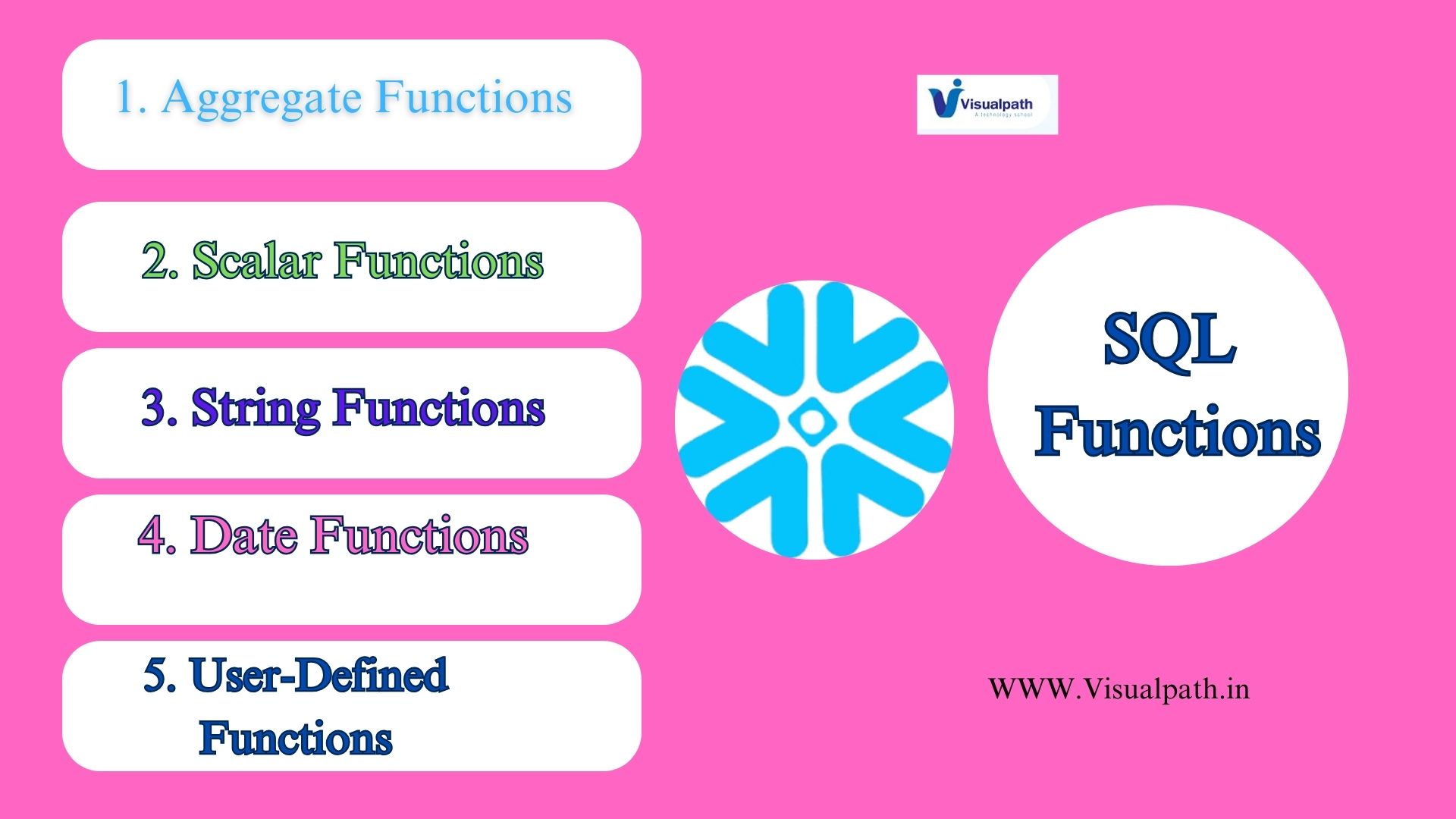
    SQL (Structured Query Language) functions are essential tools that simplify complex queries, improve code readability, and enhance database performance. These functions are predefined operations that take input values, perform specific tasks, and return output, often in the form of a single value or set of values. SQL functions are categorized into various types, including aggregate functions, scalar functions, string functions, date functions, and user-defined functions.

    1. Aggregate Functions

    Aggregate functions perform calculations on multiple rows of data and return a single result. Common examples include: Snowflake Online Training Course

    • SUM(): Calculates the total sum of a numeric column.
    • AVG(): Returns the average value of a numeric column.
    • COUNT(): Counts the number of rows in a dataset.
    • MIN() and MAX(): Retrieve the minimum and maximum values from a column.

    2. Scalar Functions

    Scalar functions return a single value based on the input values. Some common scalar functions are:  Snowflake Training

    • UCASE() / LCASE(): Converts a string to upper or lower case.
    • LEN(): Returns the length of a string.
    • ROUND(): Rounds a numeric value to the specified number of decimal places.   Snowflake Online Course Hyderabad

    3. String Functions

    String functions manipulate and format string values:

    • CONCAT(): Combines two or more strings.
    • SUBSTRING(): Extracts a portion of a string.
    • REPLACE(): Replaces occurrences of a substring within a string. Snowflake Training in Hyderabad

    4. Date Functions

    Date functions work with date and time values:

    • GETDATE(): Returns the current date and time.
    • DATEADD(): Adds a specified time interval to a date.
    • DATEDIFF(): Calculates the difference between two dates.

    5. User-Defined Functions

    These are custom functions created by users to perform specific tasks, providing flexibility and reusability in SQL code.  Snowflake Online Training

    SQL functions are vital for effective data management and analysis, streamlining database operations, and enhancing the efficiency of queries. Understanding and utilizing these functions can significantly optimize database interactions and data processing tasks.

    Visualpath is the Leading and Best Software Online Training Institute in Hyderabad. Avail complete Snowflake institute in Hyderabad Snowflake Online Training Worldwide. You will get the best course at an affordable cost.

    Attend Free Demo

    Call on – +91-9989971070

    WhatsApp: https://www.whatsapp.com/catalog/919989971070

    Visit:   https://visualpath.in/snowflake-online-training.html