Tag: GCP Cloud Data Engineer Training

  • Top GCP Data Engineering Training Institute in 2026

    Top GCP Data Engineering Training Institute in 2026

    Top GCP Data Engineering Training Institute in 2026

    Top GCP Data Engineering Training Institute in 2026
    Top GCP Data Engineering Training Institute in 2026

    Introduction

    GCP Data Engineer Training is one of the most practical career choices for students and working professionals who want strong growth in 2026. Every company today is working with data—customer data, sales data, application logs, and real-time events. Managing and transforming this data in the cloud has become a core business need. This is where a skilled Google Cloud Data Engineer plays an important role.

    But learning tools alone is not enough. The real challenge is choosing a training institute that helps you understand concepts clearly, practice them properly, and prepare for real job interviews. This article explains how Visualpath supports students at every stage of their cloud data engineering journey.

    Understanding the Role of a Cloud Data Engineer

    A cloud data engineer designs systems that collect data, process it, and make it useful for analysis. In real projects, this work involves building pipelines, managing data storage, ensuring data quality, and supporting analytics and AI teams. Companies expect engineers to think logically, solve problems, and build solutions that work at scale.

    Visualpath focuses on these practical expectations instead of just teaching definitions or commands.

    Visualpath’s Learning Philosophy: Simple, Practical, and Clear

    Visualpath believes that students learn best when concepts are explained in a simple way and supported with hands-on practice. Trainers take time to explain why something is done, not just how it is done. This helps learners build strong fundamentals and confidence.

    Every topic is connected to real project scenarios so students can understand how cloud data engineering works in real companies.

    Road Map For GCP Data Engineering Training Institute in 2026
    Road Map For GCP Data Engineering Training Institute in 2026

    Certification as a Career Booster

    The Google Data Engineer Certification is useful because it proves your ability to work with Google Cloud in real environments. Visualpath helps students prepare for this certification by covering important concepts in detail and explaining exam-style questions. Trainers guide students on architecture thinking, not just exam shortcuts, which helps both in certification and job interviews.

    Structured Learning for Long-Term Growth

    The GCP Data Engineer Course at Visualpath follows a step-by-step structure. Beginners are introduced to cloud and data basics before moving into complex data pipelines and performance optimization. This gradual approach reduces confusion and helps students stay consistent throughout the course.

    Assignments and practice tasks are designed to improve logical thinking and problem-solving skills.

    Learning in a Real IT Environment in Hyderabad

    With GCP Data Engineer Training in Hyderabad, students get the advantage of learning in one of India’s strongest IT markets. Visualpath trainers have real industry experience, which reflects in the way they teach. Examples and explanations are often taken from live projects and production systems, helping learners understand how companies actually work.

    Building Confidence with Hands-On Cloud Experience

    The GCP Cloud Data Engineer Training program at Visualpath focuses heavily on practice. Students work on real cloud setups, build pipelines, and troubleshoot errors. Making mistakes and fixing them is part of the learning process. This hands-on experience builds confidence and prepares students for real job responsibilities.

    Career-Oriented Training in Ameerpet

    The GCP Data Engineering Course in Hyderabad offered at Visualpath’s Ameerpet center is especially helpful for job seekers. Along with technical training, students receive guidance on resume preparation, interview questions, and career planning. Trainers explain how to present projects clearly during interviews, which many candidates struggle with.

    Guidance for Opportunities Beyond One City

    Visualpath also prepares students for opportunities in major tech hubs like Bangalore through Google Cloud Data Engineer Training in Bangalore–oriented guidance. Students learn about different company expectations, interview styles, and project environments commonly found in product-based and service-based organizations.

    Supporting Learners in Chennai’s Growing Cloud Market

    With GCP Data Engineer Training in Chennai, Visualpath helps learners understand how cloud data engineering roles are growing in manufacturing, finance, and SaaS companies. The training focuses on stable fundamentals that remain useful across industries and technologies.

    Consistent Training Quality Across India

    The GCP Cloud Data Engineer Training in India by Visualpath maintains the same teaching standards everywhere. Whether a student learns online or offline, the focus remains on clarity, practice, and real-world understanding. This consistency helps students feel supported throughout the learning journey.

    Focused Learning for Ameerpet Students

    The GCP Data Engineering Course in Ameerpet is designed for students who want strong technical skills in a short time without stress. Trainers support learners patiently and explain topics multiple times if needed. This is especially useful for beginners and career switchers.

    Flexible Online Learning for Busy Professionals

    For learners who cannot attend classroom sessions, GCP Data Engineer Online Training offers live interactive classes. Students can ask questions, revisit recorded sessions, and practice at their own pace. This flexibility helps working professionals continue learning without leaving their jobs.

    Frequently Asked Questions (FAQs)

    1. Is cloud data engineering difficult for beginners?
    It can feel challenging at first, but with proper guidance and practice, beginners can learn it step by step.
    2. Does Visualpath focus more on theory or practice?
    Visualpath focuses strongly on practical learning supported by clear theoretical explanations.
    3. Will this training help in real interviews?
    Yes. Interview preparation, project explanation, and problem-solving are part of the training.
    4. How long does it take to become job-ready?
    This depends on practice and consistency, but most students gain confidence within a few months.
    5. Can working professionals manage this course?
    Yes. The course structure and online options are suitable for working professionals.

    Conclusion

    Choosing the right training institute can shape your entire career. In 2026, cloud data engineering offers long-term growth, but success depends on learning the right way. Visualpath focuses on clarity, patience, and real-world understanding, helping students move smoothly from learning to employment. With proper guidance and consistent practice, anyone serious about building a future in cloud data engineering can achieve their goals.

    Visualpath is the Leading and Best Software Online Training Institute in Hyderabad.

    For More Information about Best GCP Data Engineering

    Contact Call/WhatsApp: +91-7032290546

    Visit: https://www.visualpath.in/gcp-data-engineer-online-training.html
  • What Is the Role of Dataflow in GCP Data Engineering?

    What Is the Role of Dataflow in GCP Data Engineering?

    GCP Data Engineer Processing and analysing massive volumes of data in real time has become essential for businesses to stay competitive. Google Cloud Platform (GCP) offers a suite of powerful tools for data engineering, and Dataflow stands out as one of the most versatile and scalable services for stream and batch data processing. Designed to handle complex ETL pipelines, real-time analytics, and large-scale data transformation, Dataflow enables developers and data engineers to build reliable and high-performance data processing solutions. This article explores the role of Dataflow in GCP Data Engineering, its key features, use cases, and advantages for modern data pipelines.

    1. Overview of GCP Data Engineering

    Data engineering on GCP revolves around building scalable data pipelines to ingest, transform, store, and analyze data. GCP provides services such as BigQuery, Cloud Storage, Pub/Sub, Cloud Composer, and Dataflow to support the full data lifecycle. Among these, Dataflow is instrumental in processing data efficiently in both real-time and batch modes, allowing businesses to derive insights faster and with greater accuracy.

    2. What is Google Cloud Dataflow?

    Google Cloud Dataflow is a fully managed, serverless data processing service that supports both streaming and batch processing. It is based on the open-source Apache Beam model, which allows users to write a single pipeline that can run on multiple execution engines. Dataflow automatically manages resources, parallel execution, scaling, and fault tolerance, making it ideal for developers looking to minimize infrastructure management while maximizing performance.

    3. Key Features of Dataflow

    • Unified Programming Model: Dataflow supports Apache Beam, enabling developers to write both stream and batch processing jobs in a unified model.
    • Auto-scaling and Load Balancing: Dataflow automatically adjusts the resources allocated to a job based on the workload, ensuring optimal performance and cost-efficiency.
    • Built-in Monitoring and Logging: Integrated with Cloud Monitoring and Logging, Dataflow allows real-time insights into pipeline performance and health.
    • Seamless Integration with Other GCP Services: Easily connect with Pub/Sub for real-time ingestion, BigQuery for analytics, and Cloud Storage for data lakes.
    • No Ops Management: Since it’s serverless, there’s no need to manage infrastructure, which accelerates development and deployment. GCP Cloud Data Engineer Training

    4. Use Cases of Dataflow in Data Engineering

    • Real-time Analytics: Process event data from sensors, web logs, or application streams using Pub/Sub and Dataflow for immediate insights.
    • ETL Pipelines: Dataflow is ideal for Extract, Transform, Load (ETL) processes that move and clean data before storing it in Big Query or a data lake.
    • Data Enrichment: Enrich incoming data streams with metadata or lookup values in real time, ensuring contextual relevance.
    • Data Migration: Efficiently transform and transfer large datasets between systems during cloud migration efforts.
    • Machine Learning Pipelines: Preprocess and filter data for training ML models, ensuring high-quality input for model development.

    5. Benefits of Using Dataflow

    • Scalability: Easily handle terabytes or petabytes of data without worrying about provisioning.
    • Cost Efficiency: Pay only for the resources used, with fine-grained control over job duration and processing.
    • Developer Productivity: Use familiar programming languages (Java, Python) and write once, run anywhere with Apache Beam.
    • Resilience and Reliability: Automatic retries, checkpointing, and failover mechanisms enhance pipeline reliability.

    Conclusion

    Google Cloud Dataflow plays a crucial role in modern GCP data engineering by enabling scalable, efficient, and real-time data processing. Whether you’re building streaming analytics platforms or performing massive ETL operations, Dataflow’s serverless nature, auto-scaling, and rich integrations make it a go-to tool for data engineers. By reducing the operational overhead and offering a unified model for batch and streaming, Dataflow accelerates the development of intelligent, responsive, and data-driven applications. As organizations continue to shift toward real-time decision-making, Dataflow stands at the forefront of cloud-native data engineering solutions.

    Trending Courses: Cyber Security, Salesforce Marketing Cloud, Gen AI for DevOps

    Visualpath is the Leading and Best Software Online Training Institute in Hyderabad

    For More Information about Best GCP Data Engineering

    Contact Call/WhatsApp: +91-7032290546

    Visit: https://www.visualpath.in/gcp-data-engineer-online-training.html
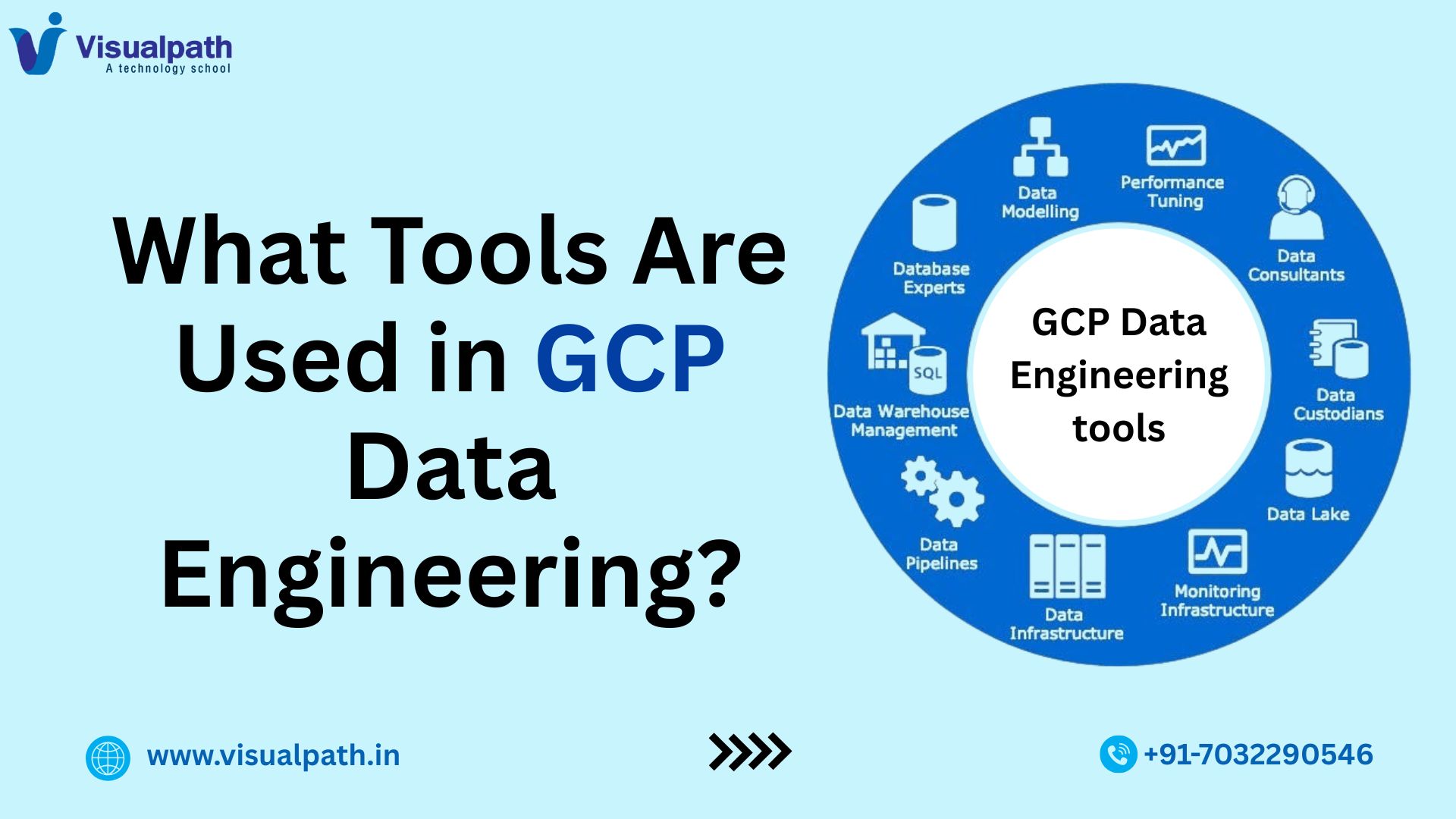
  • What Tools Are Used in GCP Data Engineering?

    What Tools Are Used in GCP Data Engineering?

    Google Cloud Platform (GCP) offer a robust ecosystem for data engineers to build, process, and analyze large-scale datasets efficiently. GCP Data Engineering focuses on designing, constructing, and managing scalable data processing systems. But what tools make this possible?

    Below, we explore the key tools and services used in what tools are Used in GCP Data Engineering and how they contribute to creating modern data pipelines.

    1. BigQuery – Serverless Data Warehouse

    BigQuery is the cornerstone of GCP’s analytics services. It’s a fully managed, serverless, highly scalable, and cost-effective multi-cloud data warehouse designed for business agility.

    • Use Case: Ideal for running fast SQL queries on petabyte-scale datasets.
    • Key Features: Real-time analytics, built-in machine learning (BigQuery ML), and seamless integration with other GCP services.

    BigQuery enables data engineers to avoid infrastructure management while focusing on writing queries and getting insights quickly.

    2. Cloud Dataflow – Stream and Batch Processing

    An entirely managed solution for running Apache Beam pipelines is Cloud Dataflow. It supports both batch and stream data processing and is especially useful for handling large data transformations in real time.

    • Use Case: Ideal for building ETL (Extract, Transform, Load) pipelines.
    • Key Features: Autoscaling, dynamic work rebalancing, and no-ops execution.

    Data engineers use Dataflow to ingest data from multiple sources, clean it, and load it into storage or analytics platforms like BigQuery.

    3. Cloud Pub/Sub – Real-Time Messaging

    A global messaging and event ingestion service called Cloud Pub/Sub is used to gather and disseminate data in real time.

    • Use Case: Event-driven systems, real-time analytics, and log ingestion.
    • Key Features: High throughput, low latency, and durable message storage.

    It allows seamless integration between data sources and processing systems, acting as a backbone for streaming architectures. Google Data Engineer Certification

    4. Cloud Composer – Workflow Orchestration

    Cloud Composer is a fully managed workflow orchestration tool based on Apache Airflow.

    • Use Case: Managing and scheduling complex workflows and data pipelines.
    • Key Features: Integration with GCP services, version control, and easy monitoring.

    Cloud Composer helps data engineers automate tasks like data ingestion, transformation, and reporting by coordinating across services.

    5. Dataproc – Managed Spark and Hadoop

    Cloud Dataproc offers a fast, easy-to-use, fully managed cloud service for running Apache Spark, Apache Hadoop, and other open-source big data tools.

    • Use Case: Machine learning, data lakes, and massive batch processing.
    • Key Features: Rapid cluster provisioning, customizable environments, and low-cost operation. GCP Data Engineer Training

    Dataproc is particularly beneficial when migrating existing Hadoop/Spark jobs to GCP with minimal rework.

    6. Cloud Storage  Scalable Data Lake

    Google Cloud Storage is used to store large unstructured data, making it a foundation for data lakes.

    • Use Case: Storing raw, intermediate, or archived datasets.
    • Key Features: High durability, multiple storage classes, and integration with GCP analytics services.

    Data engineers typically use Cloud Storage to stage files before ingestion or retain historical datasets.

    7. Looker and Data Studio – Data Visualization

    Visualization is crucial for interpreting data. Looker and Data Studio are GCP’s business intelligence tools.

    • Use Case: Creating dashboards and reports for decision-makers.

    Key Features: Real-time data connections, easily shareable images, and customisable visualizations

    They allow non-technical users to explore data insights built on the backend by engineers.

    Conclusion

    GCP offers a rich toolkit for Data Engineering, from ingestion and processing to analysis and visualization. Tools like BigQuery, Dataflow, Pub/Sub, and Composer form the backbone of modern cloud-native data pipelines. Whether you’re dealing with batch or stream data, GCP provides scalable, secure, and integrated solutions that streamline the engineering process and allow organizations to derive insights faster and more reliably.

    By mastering these tools, data engineers can unlock the full potential of GCP and deliver value to their organizations through efficient, real-time, and cost-effective data operations.

    Trending Courses: Cyber Security, Salesforce Marketing Cloud, Gen AI for DevOps

  • What Tools Power GCP Data Engineering Workflows?

    What Tools Power GCP Data Engineering Workflows?

    Cloud-based data engineering has become essential for building scalable, flexible, and real-time data systems. But which tools really power GCP data engineering, and how do they work together in real-world pipelines?

    In this article, we’ll explore the core tools that form the backbone of what tools power GCP data engineering Workflow and how they enable teams to manage, transform, and analyze data at scale.

    1. Cloud Storage: The Foundation of Data Ingestion

    Every data pipeline starts with data ingestion. GCP’s Cloud Storage acts as the primary landing zone for raw data—whether it comes from logs, applications, APIs, or external systems. It supports both batch and streaming ingestion, allowing engineers to store large volumes of unstructured or semi-structured data at low cost.

    Cloud Storage integrates seamlessly with other GCP tools, making it the ideal starting point for most workflows.

    2. Cloud Pub/Sub: Real-Time Event Ingestion

    For real-time applications, Cloud Pub/Sub is a powerful messaging service that ingests event data from sources like IoT devices, apps, or user activity logs. It allows decoupling between producers and consumers, enabling highly scalable, real-time data pipelines.

    Pub/Sub is often used in combination with Dataflow to process and route streaming data for analytics, machine learning, or storage.

    3. Dataflow: Stream and Batch Processing Engine

    Apache Beam-based Cloud Dataflow is one of the most critical tools in GCP . It allows engineers to write a single pipeline that handles both batch and stream data processing. Because Dataflow is fully managed, GCP takes care of scaling, provisioning, and optimization.

    Dataflow can clean, enrich, transform, or aggregate data and then write the results to destinations such as BigQuery, Cloud Storage, or even machine learning models.

    4. BigQuery: The Analytics Workhorse

    GCP’s serverless, petabyte-scale data warehouse, BigQuery, is made for quick SQL searches with large datasets. Data engineers use BigQuery to store, analyze, and report on structured and semi-structured data. It supports standard SQL and integrates with various BI tools like Looker and Data Studio. Google Data Engineer Certification

    Its built-in machine learning (BigQuery ML) and geospatial capabilities make it much more than just a warehouse—it’s an analytics powerhouse.

    5. Cloud Composer: Orchestration with Airflow

    GCP’s managed version of Apache Airflow, Cloud Composer, lets you plan, coordinate, and keep an eye on intricate processes It’s the glue that ties together multiple steps in a data pipeline such as triggering a Dataflow job after a Pub/Sub event or loading data into BigQuery after transformation.

    By using Composer, engineers can ensure dependencies are met, and failures are handled gracefully in a well-documented DAG (Directed Acyclic Graph).

    6. Dataproc: Managed Hadoop and Spark

    When teams need custom or legacy big data processing using open-source tools like Apache Spark or Hadoop, Cloud Dataproc is the go-to choice. It is completely controlled and works well with BigQuery and Cloud Storage. Dataproc allows fine-grained control over infrastructure, which can be essential for certain use cases like large-scale ETL or ML training.

    7. Data Catalog and Data Governance Tools

    Managing metadata, lineage, and access is vital. Alongside it, Cloud DLP (Data Loss Prevention) helps with identifying and protecting sensitive information, supporting privacy and compliance needs.

    Conclusion: A Unified Ecosystem

    GCP’s data engineering toolkit is designed for flexibility, scalability, and ease of use. From real-time streaming to batch processing, storage, orchestration, and analytics, Google Cloud provides a comprehensive ecosystem for data engineers.

    By combining tools like Pub/Sub, Dataflow, BigQuery, and Cloud Composer, teams can build end-to-end pipelines that are resilient, efficient, and production-ready—empowering organizations to unlock the full value of their data.

    Trending Courses: Cyber Security, Salesforce Marketing Cloud, Gen AI for DevOps

    Visualpath is the Leading and Best Software Online Training Institute in Hyderabad

    For More Information about Best GCP Data Engineering

    Contact Call/WhatsApp: +91-7032290546

    Visit: https://www.visualpath.in/gcp-data-engineer-online-training.html

  • What Are the Key Features of GCP Data Engineer?

    What Are the Key Features of GCP Data Engineer?

    Google Cloud Data Engineer organizations are constantly seeking scalable, reliable, and efficient ways to collect, store, process, and analyze massive volumes of data. What Are the Key Features of GCP Data Engineer has emerged as one of the leading cloud solutions, offering a rich ecosystem of tools tailored for data engineering. But what exactly are the key features that make GCP Data Engineering stand out?

    This article explores the essential features of a GCP Data Engineer role and the tools they typically work with to deliver high-performance data solutions.

    1. Scalable Data Processing with Dataflow

    One of the core tools in a GCP Data Engineer’s toolkit is Apache Beam-based Dataflow, which supports both batch and stream data processing. This fully managed service allows data engineers to build complex pipelines using Python or Java. The ability to autoscale and handle backpressure makes it ideal for real-time data use cases such as fraud detection or live analytics.

    Key benefits include:

    • Unified programming model (batch and stream)
    • Autoscaling and dynamic work rebalancing
    • Integration with Pub/Sub, BigQuery, and Cloud Storage

    2. Event-Driven Architecture with Pub/Sub

    Modern data systems require real-time data ingestion. A messaging solution called Cloud Pub/Sub is utilized to efficiently ingest event data. It supports the creation of asynchronous, decoupled pipelines which are critical for microservices and distributed systems.

    Engineers use Pub/Sub for:

    • Ingesting streaming logs, IoT data, or user activity
    • Building real-time dashboards
    • Triggering downstream Dataflow or Cloud Functions processes

    3. Workflow Orchestration with Cloud Composer

    Data pipelines often involve multiple steps data ingestion, transformation, and loading. Cloud Composer, built on Apache Airflow, is GCP’s workflow orchestration tool that automates pipeline execution and monitoring.

    Key capabilities:

    • Cross-platform workflow automation
    • Native GCP service integration
    • Customizable DAGs for complex workflows
    • Monitoring and alerting with Cloud Logging

    4. Data Transformation and Integration Tools

    • GCP offers a number of tools for data integration and transformation, including Google Data Engineer Certification
    • Dataprep by Trifacta for visual, code-free data wrangling
    • Cloud Data Fusion for ETL/ELT pipeline development

    These tools support drag-and-drop interfaces, pre-built connectors, and extensive logging to streamline transformation workflows.

    5. Security and Compliance Built-In

    Security is a top priority for GCP. Data engineers benefit from features like:

    • VPC Service Controls for perimeter-based security
    • Data encryption at rest and in transit
    • Audit logging for tracking data access and changes

    These built-in security features simplify compliance with regulations like GDPR, HIPAA, and PCI-DSS. Google Cloud Data Engineer Training

    6. Monitoring and Observability

    Maintaining healthy pipelines requires visibility. GCP offers powerful monitoring tools like:

    • Cloud Monitoring and Cloud Logging for real-time insights
    • Error Reporting and Cloud Trace for troubleshooting
    • Pipeline dashboards in Dataflow and Composer
    • Data engineers can proactively identify and fix problems with the help of these technologies.

    Conclusion

    GCP Data Engineering is built around scalable, fully managed services that empower engineers to focus on building robust data pipelines rather than managing infrastructure. From real-time streaming with Pub/Sub and Dataflow to warehousing in BigQuery and orchestration with Cloud Composer, GCP offers a comprehensive toolkit for modern data engineering.

    Whether you’re a startup handling gigabytes or an enterprise managing petabytes, GCP provides the performance, flexibility, and security required to build data solutions at scale.

    Trending Courses: Cyber Security, Salesforce Marketing Cloud, Gen AI for DevOps

  • What is Big Query and how is it used in GCP?

    What is Big Query and how is it used in GCP?

    GCP Data Engineer organizations require powerful and scalable tools to analyze massive datasets quickly and cost-effectively. Google Cloud Platform (GCP) offers a suite of tools to address this need, with Big Query standing out as its flagship data warehouse solution. As a fully-managed, serverless, and highly scalable enterprise data warehouse, BigQuery enables businesses to gain real-time insights from vast amounts of data with the ease of using standard SQL.

    Whether you’re a data engineer, analyst, or scientist, understanding how Big Query fits into the broader GCP ecosystem is essential for designing modern data pipelines and analytics platforms.

    Understanding BigQuery: The Basics

    BigQuery is a cloud-native, fully-managed data warehouse developed by Google. It allows users to execute SQL queries over large datasets with extremely high speed and efficiency, thanks to Google’s Dremel technology and columnar storage. Google Data Engineer Certification

    One of BigQuery’s biggest advantages is that it is serverless—you don’t need to manage infrastructure, allocate resources, or worry about scaling. Key features include:

    • Standard SQL support
    • Real-time analytics
    • Automatic scalability
    • Pay-per-query pricing
    • Integration with GCP tools like Dataflow, Pub/Sub, and Cloud Storag

    BigQuery Architecture

    At a high level, BigQuery consists of:

    • Storage Layer: Stores structured data in a columnar format, separate from compute.
    • Query Engine: Processes queries using Dremel, enabling fast execution.
    • Metadata Management: Tracks tables, schemas, and partitions for efficient querying.
    • Security and Access Control: Uses IAM (Identity and Access Management) for role-based access.

    How BigQuery Is Used in GCP

    BigQuery plays a central role in the data engineering ecosystem of GCP. Below are some common use cases and integrations:

    1. Data Warehousing and BI

    BigQuery is often used as a central data warehouse where data from multiple sources—applications, logs, marketing tools, IoT devices—is stored and analyzed. It integrates seamlessly with BI tools like Looker, Tableau, and Google Data Studio for visualization and reporting.

    2. Real-Time Analytics

    When paired with Cloud Pub/Sub and Cloud Dataflow, BigQuery can power real-time dashboards and streaming analytics. For example, sensor data or user activity logs can be streamed into BigQuery within seconds. GCP Cloud Data Engineer Training

    3. Machine Learning

    BigQuery ML enables users to create and execute machine learning models directly within BigQuery using SQL. This lowers the barrier to entry for non-programmers who want to perform tasks like regression, classification, and time-series forecasting.

    4. ELT Pipelines

    BigQuery works exceptionally well for ELT (Extract, Load, Transform) workflows. Data is ingested into BigQuery in raw form from sources like Cloud Storage, Dataproc, or Data Fusion, and transformations are applied using SQL.

    Conclusion

    BigQuery has emerged as a cornerstone of modern cloud data architecture. Its serverless model, scalability, speed, and ease of use make it an invaluable tool for data engineers, analysts, and decision-makers who want to derive insights without the hassle of managing infrastructure.

    By seamlessly integrating with other GCP services such as Dataflow, Pub/Sub, and AI tools, BigQuery enables robust and flexible data workflows—from ingestion to visualization. Whether you’re building dashboards, streaming pipelines, or predictive models, BigQuery offers the performance and reliability needed to work efficiently at scale.

    Trending Courses: Cyber Security, Salesforce Marketing Cloud, Gen AI for DevOps

  • Building ETL Pipelines on GCP: A Starter Guide

    Building ETL Pipelines on GCP: A Starter Guide

    Google Cloud Platform (GCP) offers a powerful ecosystem of tools that makes building scalable and reliable ETL pipelines accessible, even for beginners. Whether you’re handling batch or streaming data, GCP provides a flexible and secure environment to manage data workflows end-to-end. This guide offers a beginner-friendly roadmap to understand and build ETL pipelines using GCP’s services such as CloudStorage, Dataflow, BigQuery, and more.

    1. Understanding ETL and Why It Matters

    ETL refers to the process of:

    • Extracting data from multiple sources,
    • Transforming it into a usable format,

    A well-designed ETL pipeline ensures data quality, enhances performance, and allows for scalable data analysis. With cloud-native solutions like GCP, you can automate, monitor, and scale these pipelines with minimal operational overhead. Google Data Engineer Certification

    2. Key GCP Services for ETL

    Here are the main GCP tools commonly used in ETL workflows:

    • Cloud Storage: Acts as the landing zone for raw data in various formats (CSV, JSON, Parquet, etc.).
    • Cloud Pub/Sub: Ideal for real-time data ingestion and messaging between services.
    • Cloud Dataflow: A serverless stream and batch processing tool that lets you build complex data transformation logic using Apache Beam.
    • BigQuery: A fully-managed data warehouse designed for fast SQL analytics on large datasets.
    • Cloud Composer: Based on Apache Airflow, this is used for orchestrating complex ETL workflows across GCP services.

    Each tool is designed to integrate seamlessly with others, creating a unified data pipeline ecosystem.

    3. Steps to Build a Basic ETL Pipeline on GCP

    Let’s break down a typical pipeline into actionable steps:

    Step 1: Data Ingestion

    Start by storing raw data in Cloud Storage or ingest streaming data using Cloud Pub/Sub.

    Step 2: Data Transformation

    Use Cloud Dataflow to clean, filter, enrich, or join data sets. Apache Beam SDKs (Java or Python) are used to define the transformations.

    Step 3: Load to BigQuery

    Once transformed, load the cleaned data into BigQuery for querying and analysis. Data can be loaded using Dataflow sinks or BigQuery’s load jobs.

    Step 4: Orchestration

    Manage dependencies and schedule recurring workflows using Cloud Composer. It can also monitor tasks and send alerts on failure. GCP Cloud Data Engineer Training

    4. Best Practices for ETL on GCP

    • Design for scalability: Use Dataflow for both batch and streaming to handle data spikes efficiently.
    • Ensure security: Utilize Identity and Access Management (IAM) roles and encryption for data protection.
    • Monitor performance: Use Cloud Monitoring and Cloud Logging to track job status and optimize pipeline performance.
    • Automate testing: Incorporate validation checks and data quality tests in transformation logic.
    • Cost optimization: Monitor usage and take advantage of BigQuery’s partitioning and clustering features to minimize query costs.

    Conclusion

    Building ETL pipelines on GCP doesn’t have to be daunting. With tools like Dataflow, BigQuery, and Cloud Composer, even beginners can implement robust and scalable data pipelines. By following a clear architectural approach and embracing best practices, you can ensure that your ETL processes are efficient, secure, and ready for scale. Whether you’re working with structured data or real-time streams, GCP provides all the building blocks you need to turn raw data into actionable insights. Start small, iterate fast, and soon you’ll be managing enterprise-grade ETL pipelines in the cloud.

    Trending Courses: Salesforce Marketing Cloud, Cyber Security, Gen AI for DevOps

  • GCP Data Engineering: Key Tools and Concepts

    GCP Data Engineering: Key Tools and Concepts

    GCP Data engineers are becoming more and more important as data continues to influence strategic choices in a variety of businesses. Data engineers can effectively gather, process, transform, and manage large datasets with the help of Google Cloud Platform’s (GCP) robust toolkit. Whether you’re building ETL pipelines, managing data lakes, or operationalizing machine learning workflows, GCP provides the infrastructure and services needed to build scalable, cost-effective, and reliable data solutions. This article explores the key tools and concepts within GCP’s data engineering ecosystem that every aspiring or experienced data engineer should understand.

    1. Cloud Storage: The Foundation of Data Lakes

    Any data engineering process starts with data storage.GCP’s Cloud Storage is an extremely robust, scalable, and reasonably priced object storage solution that can store both organized and unstructured data. It serves as the landing zone for raw data ingested from various sources and is commonly used as a staging area in data pipelines. Cloud Storage integrates seamlessly with other GCP services, making it a central hub in the data architecture.

    2. BigQuery: Serverless Data Warehousing     

    GCP’s fully-managed serverless data warehouse, BigQuery, is made to execute quick SQL queries on big datasets.It supports ANSI SQL, offers built-in machine learning capabilities (BigQuery ML), and allows for near real-time analytics. Because BigQuery keeps computation and storage separate, businesses may scale their resources separately. Its pay-per-query model and data federation capabilities make it versatile for analytics-driven use cases.

    3. Dataflow: Real-Time and Batch Data Processing

    Dataflow, based on Apache Beam, is a fully-managed service for processing both streaming and batch data. It simplifies the development of complex pipelines and ensures autoscaling and dynamic resource management. With the Beam SDK, data engineers can create a pipeline once and have it operate anywhere, whether on-premises or on GCP Data Engineering. Use cases, including log processing, event-driven architectures, and real-time fraud detection, are perfect for dataflow. GCP Cloud Data Engineer Training

     4. Pub/Sub: Messaging and Event Ingestion

    A messaging service called Cloud Pub/Sub was created to absorb and provide real-time event data.It supports asynchronous communication between services, making it ideal for decoupled, event-driven systems. Pub/Sub plays a key role in ingesting streaming data into GCP pipelines and works well with services like Dataflow, BigQuery, and Cloud Functions for seamless integration and processing.

    5. Dataproc: Managed Spark and Hadoop

    For teams familiar with open-source big data tools like Apache Spark, Hadoop, and Hive, Dataproc offers a managed, cost-effective alternative that reduces operational overhead. Dataproc clusters can be spun up quickly and scaled down automatically, supporting transient workloads and reducing costs. It’s well-suited for traditional ETL, machine learning preprocessing, and large-scale data transformations. GCP Data Engineer Course

    6. Cloud Composer: Workflow Orchestration

    Cloud Composer, built on Apache Airflow, helps manage and schedule complex workflows across GCP services. It enables data engineers to define dependencies, automate job executions, and handle retries and failures programmatically. Cloud Composer is essential for orchestrating pipelines that involve multiple GCP Data Engineering services and ensuring smooth data flow across systems.

    7. Data Governance and Security

    Data governance, lineage, and security are non-negotiable in a modern data ecosystem. GCP offers robust tools like Data Catalog (for metadata management), Cloud DLP (for data loss prevention), and IAM (for fine-grained access control). These tools help ensure that data is not only accessible but also secure and compliant with regulatory standards.

    Conclusion

    Google Data Engineer Certification empowers data engineers with a rich, integrated set of tools designed to manage the entire data lifecycle—from ingestion and processing to analysis and governance. Whether you’re dealing with real-time event streams or petabytes of batch data, GCP provides the flexibility, scalability, and innovation needed to build modern data architectures. Mastering these key tools and concepts is essential for any data engineer looking to thrive in a cloud-first, data-driven world. With GCP, the possibilities are as vast as the data you can harness.

    Trending Courses: Salesforce Marketing Cloud, Cyber Security, Gen AI for DevOps

  • How to Optimize Data Processing in Google Cloud Platform?

    How to Optimize Data Processing in Google Cloud Platform?

    Introduction to Google Cloud Platform (GCP)

    Google Cloud Platform (GCP) offers a robust ecosystem for data engineering, enabling businesses to process large volumes of data efficiently. However, optimizing data processing in GCP requires leveraging the right tools, best practices, and cost-effective strategies. This article explores key methods for enhancing performance, reducing costs, and improving efficiency in GCP data engineering workflows.

    Key Strategies for Optimizing Data Processing in GCP

    1. Choosing the Right Storage Solution

    Efficient data processing starts with selecting the appropriate storage solution. GCP provides various storage options such as: GCP Data Engineer Online Training

    • BigQuery – Ideal for analytical queries on massive datasets.
    • Cloud Storage – Best for unstructured data and archival purposes.
    • Cloud Spanner – Suitable for global, scalable, and transactional databases.
    • Cloud SQL & Firestore – Perfect for structured data and real-time applications. Choosing the right storage solution helps reduce latency and optimize performance.

    2. Leveraging BigQuery Optimization Techniques

    BigQuery is GCP powerful data warehouse, and optimizing its usage can significantly improve query performance. Consider these techniques:

    • Partitioning and Clustering: Organize tables effectively to reduce scanned data volume.
    • **Avoiding SELECT *: Query only necessary columns to minimize resource consumption.
    • Materialized Views: Use precomputed views for frequently accessed data.
    • Query Caching: Take advantage of automatic caching to speed up repeated queries.

    3. Utilizing Dataflow for Scalable Processing

    Apache Beam-powered Dataflow allows real-time and batch data processing at scale. To optimize its performance: Google Data Engineer Certification

    • Use Autoscaling: Automatically adjusts worker nodes based on workload.
    • Optimize Windowing and Triggers: Process streaming data efficiently.
    • Use Shuffle Optimization: Reduces data movement for better processing speed.

    4. Implementing Efficient Data Pipeline Design

    When designing data pipelines in GCP, follow these best practices:

    • Use Cloud Composer (Apache Airflow): Automate and schedule workflows.
    • Optimize DAG (Directed Acyclic Graph) Execution: Reduce dependencies and parallelize tasks.
    • Enable Data Deduplication: Prevent redundant processing by implementing deduplication strategies.

    5. Enhancing Performance with Cloud Dataproc

    Cloud Dataproc, GCP’s managed Spark and Hadoop service, benefits from:

    • Autoscaling Clusters: Dynamically adjusting resources based on demand.
    • Preemptible VMs: Cost-effective processing with temporary instances.
    • Efficient Data Shuffling: Minimize data movement between nodes. GCP Cloud Data Engineer Training

    6. Cost Optimization Techniques

    Managing costs is crucial in GCP. Follow these tips to control expenses:

    • Use Committed Use Discounts (CUDs): Get discounted pricing for long-term commitments.
    • Enable Cost Monitoring: Track spending with GCP’s built-in billing tools.
    • Optimize Storage Lifecycle Policies: Move infrequently accessed data to cost-effective tiers.

    Conclusion

    Optimizing Data Processing in GCP involves selecting the right storage solutions, optimizing query execution, leveraging scalable tools like Dataflow and Dataproc, and implementing cost-saving measures. By applying these best practices, organizations can maximize performance while keeping costs under control. Whether you’re a beginner or an experienced data engineer, continuous monitoring and optimization are key to leveraging GCP efficiently. Start implementing these strategies today to improve your data processing workflows!

    Trending Courses: Salesforce Marketing Cloud, Cyber Security, Gen AI for DevOps

  • GCP Data Engineer complete training for Beginners

    GCP Data Engineer complete training for Beginners

    Google Cloud Platform (GCP) is one of the leading cloud computing services that offers a comprehensive suite of tools for data engineering. Data processing system design, construction, operationalization, security, and monitoring fall within the purview of a GCP data engineer. This guide will provide an overview of GCP data engineering, its key components, and essential skills needed to become proficient in this field.

    Key Components of GCP Data Engineering

    1. Google Cloud Storage (GCS)

    GCS is a scalable object storage service used to store structured and unstructured data. It supports multiple storage classes, including Standard, Nearline, Coldline, and Archive, to optimize costs based on access frequency.

    2. BigQuery

    BigQuery is a fully managed data warehouse that allows for fast SQL queries on large datasets. It eliminates the need for infrastructure management and provides high availability and scalability. GCP Data Engineer Training

    3. Cloud Pub/Sub

    This is a messaging service that enables real-time data streaming and event-driven architectures. It is used to ingest and distribute event data efficiently.

    4. Dataflow

    Dataflow is a fully managed stream and batch data processing service that uses Apache Beam. It is commonly used for ETL (Extract, Transform, Load) pipelines.

    5. Cloud Dataproc

    Cloud Dataproc is a managed service for running Apache Spark and Hadoop clusters. It enables users to process large datasets using open-source frameworks.

    6. Cloud Composer

    Built on top of Apache Airflow, Cloud Composer is a managed workflow orchestration service. It helps automate, schedule, and monitor data pipelines.

    7. Cloud SQL and Cloud Spanner

    Cloud SQL is a managed relational database service for MySQL, PostgreSQL, and SQL Server, while Cloud Spanner is a globally distributed database designed for high availability and scalability.

    8. Data Catalog

    This service helps organizations discover, manage, and understand their data assets by providing metadata management and data governance. Google Cloud Data Engineer training

    Data Engineering Workflow in GCP

    A typical data engineering workflow in GCP involves the following steps:

    1. Data Ingestion – Using tools like Cloud Storage, Pub/Sub, or Transfer Appliance to collect data from various sources.
    2. Data Processing – Leveraging services like Dataflow, Dataproc, or BigQuery to clean and transform data.
    3. Data Storage – Storing processed data in BigQuery, Cloud SQL, or Cloud Spanner.
    4. Data Analysis & Visualization – Using Looker, Data Studio, or third-party BI tools to generate insights.
    5. Data Orchestration – Managing workflows with Cloud Composer.

    Essential Skills for GCP Data Engineers

    To become proficient in GCP data engineering, one should focus on the following skills:

    • SQL Proficiency: Understanding SQL queries for data analysis in BigQuery.
    • Python and Java: Commonly used for writing data processing scripts in Apache Beam and Spark.
    • Cloud Architecture: Understanding GCP’s infrastructure and services.
    • ETL Pipelines: Designing and optimizing data workflows using Dataflow and Dataproc.
    • Security and Governance: Implementing IAM (Identity and Access Management) policies, encryption, and compliance best practices.
    • Monitoring and Optimization: Using Stackdriver and Cloud Monitoring to track system performance and troubleshoot issues. GCP Cloud Data Engineer Training

    Best Practices for GCP Data Engineering

    1. Optimize BigQuery Queries – Use partitioning and clustering for efficient data retrieval.
    2. Leverage Autoscaling – Use autoscaling features in Dataproc and Dataflow to optimize costs.
    3. Ensure Data Security – Implement IAM roles, encryption, and VPC Service Controls.
    4. Automate Workflows – Use Cloud Composer for orchestration to reduce manual intervention.
    5. Monitor Costs – Regularly analyze resource usage to prevent unexpected billing spikes.

    Conclusion

    GCP offers a robust and scalable data engineering ecosystem that caters to both small and enterprise-level data solutions. Learning the fundamentals of storage, processing, and analysis services will help beginners transition into skilled GCP Data Engineers. By mastering key tools such as BigQuery, Dataflow, and Cloud Composer, along with strong SQL and Python skills, aspiring data engineers can build efficient and cost-effective data pipelines. As organizations continue to generate vast amounts of data, expertise in GCP data engineering remains in high demand, making it a valuable career path for those interested in cloud-based data management.

    Visualpath is the Leading and Best Software Online Training Institute in Hyderabad.

    For More Information about Best  GCP Data Engineering Training

    Contact Call/WhatsApp: +91-7032290546

    Visit: https://www.visualpath.in/gcp-data-engineer-online-training.html
  • GCP Data Engineer Course for Beginners | 2025

    GCP Data Engineer Course for Beginners | 2025

    GCP Data Engineer Overview

    The GCP Data Engineer Course is a comprehensive program designed to equip professionals with the skills to build, manage, and optimize data solutions on the Google Cloud Platform (GCP). With the rise of cloud technologies, the demand for certified data engineers who can handle vast amounts of data effectively is higher than ever. Whether you’re a beginner or an experienced professional, understanding GCP’s capabilities is crucial to staying competitive in today’s data-driven market.

    GCP Data Engineer Course for Beginners

    The GCP Data Engineer Course provides an excellent starting point for those new to data engineering. Beginners learn foundational concepts like data processing, storage, and analysis, all tailored to GCP’s ecosystem. From understanding how Google BigQuery works to mastering data pipelines with Google Cloud Dataflow, this course lays the groundwork for a successful career in data engineering.

    Furthermore, enrolling in GCP Cloud Data Engineer Training allows you to practice hands-on labs and real-world scenarios. These practical exercises ensure that you understand theoretical concepts and gain the confidence to implement them in professional environments. By the end of this course, beginners are well-prepared to tackle more advanced topics in data engineering.

    Advanced Skills with GCP Cloud Data Engineer Training

    The next step in mastering GCP data engineering involves delving into advanced tools and techniques. GCP Cloud Data Engineer Training is tailored for professionals who wish to enhance their expertise in managing large-scale data solutions. Key topics covered include building robust data pipelines, optimizing performance in BigQuery, and leveraging Google Kubernetes Engine (GKE) for data orchestration.

    One of the highlights of this training is its focus on preparing candidates for the GCP Data Engineer Certification exam. This globally recognized certification validates your ability to design and maintain data processing systems and to analyze and process data using GCP services effectively. Achieving this certification not only boosts your career prospects but also demonstrates your proficiency in GCP’s powerful data engineering capabilities.

    Why Pursue a GCP Data Engineer Certification?

    Earning a GCP Data Engineer Certification can significantly impact your professional growth. This certification proves your expertise in building and managing data solutions in one of the most widely used cloud platforms. Whether you are looking for a career shift or aiming for a promotion, this certification is a valuable asset.

    Moreover, the GCP Cloud Data Engineer Training provides in-depth preparation for the certification exam. It focuses on critical skills such as designing scalable systems, securing data, and integrating various GCP services to solve real-world data problems. By earning this certification, you demonstrate your readiness to tackle complex data engineering tasks, making you a sought-after professional in the industry.

    Conclusion:

    The GCP Data Engineer Course is the ideal pathway for anyone looking to excel in the field of data engineering. From beginners to seasoned professionals, this course covers essential concepts and provides practical experience with GCP’s data tools. The accompanying GCP Cloud Data Engineer Training ensures that you are well-prepared for the industry-leading GCP Data Engineer Certification, enabling you to stand out in the competitive job market.

    By investing in your skills with GCP, you position yourself at the forefront of modern data engineering, ready to harness the power of the cloud to drive innovation and success. Whether you’re managing data pipelines, analyzing massive datasets, or optimizing cloud solutions, GCP equips you with the tools to excel in any data-driven role.

    Visualpath is the Best Software Online Training Institute in Hyderabad. Avail complete GCP Data Engineering worldwide. You will get the best course at an affordable cost.

    Attend Free Demo

    Call on – +91-9989971070.

    WhatsApp: https://www.whatsapp.com/catalog/919989971070/

    Visit  https://www.visualpath.in/online-gcp-data-engineer-training-in-hyderabad.html

    Visit our new course: https://www.visualpath.in/online-best-cyber-security-courses.html