Tag: Docker Online Training

  • The Future of Kubernetes & Docker

    The Future of Kubernetes & Docker

    Kubernetes and Docker have revolutionized how applications are developed, deployed, and managed. As cloud-native technologies continue to evolve, the future of Kubernetes and Docker promises further innovation, enhanced automation, and improved security. In this article, we will explore the trends and advancements shaping the future of these powerful container orchestration and management tools.

    The Evolution of Kubernetes & Docker

    Docker introduced containerization, enabling developers to package applications and dependencies into lightweight, portable containers. Kubernetes, on the other hand, emerged as the industry-standard container orchestration platform, automating deployment, scaling, and management. Docker and Kubernetes Training

    Over the years, both technologies have seen widespread adoption, with Kubernetes becoming the backbone of cloud-native architectures. As organizations continue to embrace microservices, cloud computing, and DevOps practices, Kubernetes and Docker are evolving to meet new challenges.

    Key Trends Shaping the Future

    1. Serverless Kubernetes & Function as a Service (FaaS)

    Serverless computing is gaining traction, allowing developers to run code without managing infrastructure. Kubernetes is evolving to support serverless workloads through projects like Knative, which enables Function-as-a-service (FaaS) capabilities within Kubernetes environments.

    2. Edge Computing & Kubernetes

    As IoT and 5G networks expand, Kubernetes is moving beyond traditional data centers and cloud environments to support edge computing. Lightweight Kubernetes distributions, such as K3s, are enabling containerized workloads at the edge, providing lower latency and improved efficiency. Docker and Kubernetes Course

    3. Security & Compliance Enhancements

    With the increasing adoption of Kubernetes and Docker, security remains a top priority. Emerging security tools and frameworks, such as Kubernetes-native security policies and image-scanning tools, are enhancing container security. Technologies like Confidential Containers and runtime security monitoring are expected to strengthen containerized workloads.

    4. AI & Machine Learning Integration

    Kubernetes is becoming the preferred platform for AI and machine learning workloads. Tools like Kubeflow enable seamless orchestration of machine learning pipelines, making it easier for data scientists to train, deploy, and manage models in production environments.

    5. Multi-Cloud & Hybrid Cloud Deployments

    Organizations are increasingly leveraging multi-cloud and hybrid cloud strategies to optimize costs and performance. Kubernetes simplifies workload portability across cloud providers, with projects like Anthos and OpenShift facilitating seamless multi-cloud management.

    6. Simplified Kubernetes Management

    Kubernetes has a steep learning curve, but future advancements aim to simplify cluster management. Tools like Kubernetes Operators, AI-driven automation, and managed Kubernetes services (e.g., Azure Kubernetes Service, Google Kubernetes Engine, Amazon EKS) are making Kubernetes more accessible to developers. Docker and Kubernetes Online Training

    The Role of Docker in the Future

    Docker’s role is evolving as Kubernetes has become the dominant container orchestration platform. While Docker Swarm has declined in popularity, Docker remains essential for container development, image creation, and runtime management. The future of Docker includes:

    • Rootless Containers: Enhancing security by allowing containers to run without root privileges.
    • Docker Extensions: Expanding functionality with third-party integrations and developer tools.
    • Improved Performance: Optimizing build times and reducing image sizes for efficient deployment.

    Conclusion

    The future of Kubernetes and Docker is driven by innovation in serverless computing, security, AI integration, edge computing, and multi-cloud deployments. As these technologies evolve, organizations will benefit from improved automation, scalability, and security in their cloud-native applications. By staying ahead of these trends, businesses can leverage Kubernetes and Docker to drive digital transformation and achieve greater efficiency in application development and deployment.

    Visualpath is the Best Software Online Training Institute in Hyderabad. Avail complete worldwide. You will get the best course at an affordable cost. For More Information about Docker and Kubernetes Training

    Contact Call/WhatsApp: +91-9989971070

    Visit: https://www.visualpath.in/online-docker-and-kubernetes-training.html
  • How to Use Docker & Kubernetes for Developers

    How to Use Docker & Kubernetes for Developers

    Docker and Kubernetes have become essential tools for modern developers. They simplify the process of building, managing, and deploying applications. Understanding how to use Docker and Kubernetes can help developers streamline their workflows and improve efficiency. In this article, we will explore how these tools work together and their benefits for developers.

    What is Docker?

    Docker is a platform that allows developers to create, package, and run applications in containers. Containers are lightweight and include everything needed to run an application, such as code, libraries, and dependencies. This ensures that applications work consistently across different environments. Docker and Kubernetes Training

    Benefits of Docker for Developers:

    • Easy to Use: Developers can package their applications with all dependencies into a single container.
    • Portability: Containers run consistently on any platform, from a developer’s laptop to the cloud.
    • Faster Development: Docker speeds up the development process by providing pre-built images.
    • Version Control: Docker allows developers to manage versions of their applications easily.

    What is Kubernetes?

    Kubernetes is a system that helps manage, scale, and deploy containerized applications. It automates many tasks, such as load balancing, scaling, and restarting failed containers.

    Benefits of Kubernetes for Developers:

    • Automated Management: Kubernetes handles the deployment and scaling of applications automatically.
    • High Availability: Distributing traffic across containers ensures that applications remain available.
    • Scalability: Developers can scale their applications easily without downtime.
    • Resource Efficiency: Kubernetes optimizes the use of computing resources.

    Using Docker and Kubernetes Together

    It works together to simplify the development and deployment process. is used to create and package applications, while Kubernetes is used to manage and scale them. Here is how developers benefit from using both:

    • Consistent Environment: Developers can use Docker to build containers that run the same way in any environment. Kubernetes then deploys and manages these containers efficiently. Docker and Kubernetes Course
    • Faster Collaboration: Teams can share Docker images, ensuring that everyone is working with the same setup.
    • Easy Scaling: containers automatically based on traffic and demand.
    • Improved Deployment: Developers can update applications without downtime using Kubernetes rolling updates.

    Best Practices for Developers

    • Use Lightweight Docker Images: Smaller images reduce build times and use fewer resources.
    • Label Docker Containers Properly: This helps with organization and management.
    • Configure Kubernetes Properly: Use namespaces to manage multiple projects.
    • Monitor Performance: Use Kubernetes tools to monitor container health.
    • Secure Applications: Limit access to sensitive data within containers.

    Why Developers Should Use

    • Efficiency: Docker containers start quickly and use fewer resources.
    • Portability: Applications run the same in development, testing, and production.
    • Scalability: Kubernetes handles increased traffic without manual intervention.
    • Automation: Kubernetes automates deployment, scaling, and recovery.
    • Flexibility: Developers can use various programming languages and frameworks. Docker and Kubernetes Online Training

    Conclusion

    Docker and Kubernetes are powerful tools that help developers build, manage, and deploy applications more efficiently. Docker simplifies the creation of consistent development environments, while Kubernetes automates deployment and scaling. By using these tools together, developers can improve productivity and deliver reliable applications. Understanding and implementing Docker and Kubernetes in your workflow will enhance your development skills and ensure successful project delivery.

    Visualpath is the Best Software Online Training Institute in Hyderabad. Avail complete worldwide. You will get the best course at an affordable cost. For More Information about Docker and Kubernetes Training

    Contact Call/WhatsApp: +91-9989971070

    Visit: https://www.visualpath.in/online-docker-and-kubernetes-training.html
  • The Role of Kube-APIserver in Kubernetes

    The Role of Kube-APIserver in Kubernetes

    The kube-apiserver holds an irreplaceable position, acting as the central component for managing and securing communication within a cluster. As one of the key control plane elements, its primary function revolves around exposing the Kubernetes API. Without the kube-apiserver, users and various components would not be able to interact with the cluster or access its resources. This article explores the vital role of the kube-apiserver, explaining its significance in architecture and how it contributes to a smooth operational environment. Docker and Kubernetes Training

    What is the Kube APIserver?

    The kube-apiserver is the front end of the Kubernetes control plane. It is a RESTful API server that handles the interaction between Kubernetes components and the outside world. When users, applications, or other services want to interact with a Kubernetes cluster, the kube-apiserver acts as the gateway to initiate and manage these requests. Whether the request involves deploying a pod, scaling an application, or retrieving cluster information, the kube-apiserver is responsible for validating and processing these API calls.

    Through the kube-apiserver, Kubernetes maintains an interface that makes it possible for various parts of the system to communicate efficiently.

    To avoid passive voice, you can rephrase the sentence to make the subject of the action clearer. For example:

    “It also secures all API interactions and manages resources consistently.”

    This revision focuses on the actions (securing and managing) and clarifies the subject performing those actions.

    Role of the Kube API server in Cluster Management

    The kube-apiserver plays a pivotal role in cluster management by acting as a mediator for the control plane components. Let’s break down the primary responsibilities of the kube-Episerver:

    1. Centralized API Endpoint The kube-apiserver serves as the only entry point for accessing the Kubernetes API. Any request to view or modify cluster state, whether it’s querying nodes or creating new deployments, goes through the API server. It validates the request, ensures proper authentication and authorization, and then forwards the request to the appropriate component for execution.
    2. Handling Client Requests Whenever an application or a user interacts with the Kubernetes cluster, the request is first sent to the kube-apiserver. It processes these incoming requests, checks them for accuracy, and communicates with other parts of the system to fulfill the request. This process can include checking the desired state of the cluster and ensuring it aligns with the current state.
    3. Validation and Authentication One of the essential roles of the kube-apiserver is validating all incoming requests. Every API request made to Kubernetes undergoes rigorous checks for authentication and authorization. The kube-apiserver verifies that the requester has the necessary permissions before performing any action.
    4. Service Discovery The kube-apiserver also contributes to the service discovery process. Kubernetes clusters often consist of multiple services and pods. The API server stores and manages the information about these services, allowing other components and users to query and locate services based on their requirements.
    5. Managing Cluster State The kube-apiserver communicates with etcd, the distributed key-value store that holds the cluster’s state data. This interaction allows Kubernetes to maintain an up-to-date record of the cluster’s configuration, including nodes, services, pods, and deployments. The system continuously synchronizes the state of the cluster to ensure consistency across it.
    6. Watchers and Event Handling the kube-apiserver enables clients to watch for changes to resources in real-time. By setting up watch requests, users and components receive notifications when specific resources are modified. This feature ensures that all components stay in sync and detects any state changes in the cluster immediately. Docker and Kubernetes Course

    Importance of the Kube API Server in Security

    Security is one of the primary concerns in managing Kubernetes clusters. The kube-apiserver plays an essential role in enforcing the security policies of the cluster. The kube-apiserver validates, authenticates, and authorizes requests to ensure that only authorized users or components can access and modify resources. This process involves verifying the identity of users or services, checking permissions, and enforcing security policies to prevent unauthorized actions. Let’s look at how the kube-Episerver contributes to security:

    1. Authorization Policies The kube-apiserver is responsible for enforcing role-based access control (RBAC) policies. With RBAC, it can determine which users or services have access to specific resources within the cluster. This level of fine-grained access control prevents unauthorized users from making changes to critical infrastructure components.
    2. Encryption The kube-apiserver uses encryption to safeguard sensitive data, both at rest and in transit. This ensures that any communication between components or external clients remains secure, protecting the cluster from potential security threats.
    3. Audit Logging The kube-apiserver records all interactions with the Kubernetes cluster in audit logs. These logs can be used for security auditing, providing administrators with a trace of all activities within the cluster. This feature is vital for identifying potential security incidents and ensuring compliance with regulatory requirements.

    Communication with Other Components

    The kube-API server does not operate in isolation; it communicates extensively with other Kubernetes components to ensure proper cluster functionality:

    • Kube-controller-manager: The kube-apiserver interacts with the kube-controller-manager to perform tasks such as managing replicas, scaling applications, and ensuring that the cluster meets its desired state. The kube-controller-manager relies on the kube-apiserver for up-to-date information about resources.
    • Kube-scheduler: When a new pod needs to be scheduled, the kube-scheduler consults the kube-apiserver for resource availability. It then schedules the pod on an appropriate node based on the current state of the cluster.
    • The kube-apiserver communicates directly with etcd to read and write the cluster state. etcd acts as the persistent store for the configuration data, while the kube-apiserver ensures that all changes are synchronized with this storage.
    • Kubernetes Clients: External clients, including kubectl, the Kubernetes command-line tool, make requests to the kube-apiserver to interact with the cluster. These clients issue API requests and the kube-apiserver returns the necessary responses, enabling seamless interaction. Kubernetes Certification Training Course

    Conclusion

    In conclusion, the kube-Episerver is an essential and powerful component of the Kubernetes control plane. It acts as the gateway for all cluster interactions, from handling user requests to ensuring cluster security. By processing API calls, managing state data, and ensuring real-time synchronization, the kube-Episerver is fundamental to the smooth operation of Kubernetes clusters. As the focal point of communication within the system, it facilitates the seamless operation of Kubernetes, helping to manage containerized applications at scale.

    Its security features, such as authentication, authorization, encryption, and audit logging, make it an essential component in maintaining the integrity and safety of the cluster. Understanding the role of the Kube-Episerver is key to effectively managing Kubernetes environments and ensuring that they are secure, efficient, and scalable.

    With its central role in managing communication, state, and security, the kube-Episerver continues to be the backbone of Kubernetes cluster management. As Kubernetes continues to evolve, the kube-Episerver will undoubtedly remain a crucial component in modern cloud-native environments. Visualpath is the Best Software Online Training Institute in Hyderabad. Avail complete Docker and Kubernetes Training worldwide. You will get the best course at an affordable cost.

  • What is Storage, Networking, Fundamentals, Security in Docker and Kubernetes?

    What is Storage, Networking, Fundamentals, Security in Docker and Kubernetes?

    Introduction:

    Kubernetes Online Training is essential for individuals looking to master the intricacies of container orchestration and micro services management. When it comes to containerization, Docker and Kubernetes are two of the most important technologies that IT professionals need to understand. Docker simplifies the creation, deployment, and execution of containers, while Kubernetes excels in orchestrating these containers at scale. To get a deeper understanding of these tools, it is crucial to delve into the aspects of storage, networking, fundamentals, and security in both Docker and Kubernetes. This article will provide a comprehensive overview, touching upon these areas with practical tips.
    Storage in Docker and Kubernetes
    Docker Storage
    Storage in Docker revolves around the concept of volumes and bind mounts. Docker volumes allow data to persist beyond the lifecycle of a container, ensuring that important application data is not lost when a container is stopped or restarted.
    ·         Volumes: Managed by Docker and stored outside the container’s file system, volumes are the most common way to persist data.
    ·         Bind Mounts: Use a specific directory on the host machine’s file system to store data.
    ·         Temporary File Systems (tmpfs): Stores data in the memory of the host system.
    To learn how to effectively manage storage in Docker, enrolling in a Docker and Kubernetes Course is ideal, as it covers various storage strategies to optimize performance and ensure data reliability.
    Kubernetes Storage
    In Kubernetes, persistent storage is more complex because containers are ephemeral and can move across nodes. Kubernetes uses Persistent Volumes (PVs) and Persistent Volume Claims (PVCs) to manage storage independently of the container lifecycle. Kubernetes provides multiple storage solutions:
    ·         Persistent Volumes (PV): These represent actual storage resources, like cloud storage or network-attached storage (NAS).

    ·         Persistent Volume Claims (PVC): These are requests by containers for storage, abstracting away the underlying infrastructure.

    ·         Storage Classes: Kubernetes uses storage classes to define different types of storage (e.g., SSDs or magnetic drives) for various workloads.
    Networking in Docker and Kubernetes
    Docker Networking
    Docker provides several built-in networking options:
    ·         Bridge Network: The default network for containers, where they communicate through a virtual Ethernet bridge.
    ·         Host Network: Containers share the host’s networking stack, reducing network isolation.
    ·         Overlay Network: Used for container-to-container communication across different Docker hosts.
    ·         With Docker Online Training, you will learn to configure these networks, ensuring containers can communicate securely and efficiently.
    Kubernetes Networking
    Kubernetes abstracts networking in a more advanced way. Each pod in Kubernetes gets its own IP address, and services inside the cluster use DNS to discover and communicate with each other.
    Some key components of Kubernetes networking include:
    ·         Kube-proxy: Manages networking rules on nodes and routes traffic to containers.
    ·         Service: Exposes a set of pods as a network service, providing load balancing and fault tolerance.
    ·         Ingress: Manages external access to services, often for HTTP and HTTPS traffic.
    Enrolling in a Kubernetes Online Training course is crucial to understanding how Kubernetes manages networking at scale and how to implement advanced networking strategies for production systems.
    Fundamentals of Docker and Kubernetes
    Docker Fundamentals
    Docker simplifies the creation of containers using images, which are lightweight and fast to start. A basic Docker workflow involves:
    ·         Building an Image: Using a Docker file, which specifies instructions to assemble an image.
    ·         Running a Container: Containers are instances of images, which run applications with specific configurations.
    ·         Managing Containers: Docker provides commands to start, stop, and manage the lifecycle of containers.
    ·         Docker Online Training often begins with these basics, ensuring learners understand the core building blocks of Docker.
    Kubernetes Fundamentals
    Kubernetes automates the orchestration of containerized applications, and its fundamental components include:
    ·         Pods: The smallest deployable units in Kubernetes, typically a group of containers that share the same resources.
    ·         Nodes: The worker machines where pods are deployed.
    ·         Control Plane: Includes components like the Kube-apiserver, etcd, controller manager, and scheduler that manage the state of the Kubernetes cluster.
    ·         A Kubernetes Certification Training Course provides hands-on experience in setting up Kubernetes clusters and managing workloads.
    Security in Docker and Kubernetes
    Docker Security
    Security is a top priority in Docker environments. The key security measures include:
    ·         Namespace Isolation: Docker containers are isolated using namespaces, preventing unauthorized access to resources.
    ·         Control Groups (cgroups): These limit the resources that a container can use, ensuring a fair distribution of CPU and memory.
    ·         Security Profiles: Docker integrates with AppArmor and SELinux to provide additional security controls over containers.
    Learning about these mechanisms in a Docker and Kubernetes Course is critical for creating secure container environments.
    Kubernetes Security
    Kubernetes security includes multiple layers to protect applications, data, and users:
    ·         Role-Based Access Control (RBAC): Controls access to resources in the cluster based on user roles.
    ·         Secrets Management: Kubernetes handles sensitive data, like API keys and passwords, using secrets.
    ·         Pod Security Policies (PSP): Define the security conditions that a pod must meet to be deployed.
    With Kubernetes Certification Training, students learn to secure Kubernetes clusters using best practices, including enabling logging, auditing, and intrusion detection systems.
    Tips for Managing Docker and Kubernetes Environments
    ·         Keep Images Lightweight: Use minimal base images to reduce vulnerabilities and improve startup times.
    ·         Monitor Containers: Implement robust monitoring solutions to track container performance and detect issues.
    ·         Automate Deployment: Use CI/CD pipelines to automate the building, testing, and deployment of containers.
    ·         Ensure Security Best Practices: Regularly update images, use role-based access controls, and scan containers for vulnerabilities.
    Plan for Scalability: Design your Kubernetes clusters with scaling in mind to handle peak traffic efficiently.
    Conclusion
    Docker and Kubernetes are essential tools for modern application development and deployment. Understanding the storage, networking, fundamentals, and security aspects of these technologies is critical for managing containerized applications effectively. By enrolling in a Kubernetes Online Training or Docker and Kubernetes Course, you will gain the skills necessary to navigate these environments confidently. Mastering the fundamentals of Docker and Kubernetes through Kubernetes Certification Training Course and Docker Online Training will ensure you are equipped to handle complex containerized environments, secure your applications, and scale them as needed.

    Visualpath is the Best Software Online Training Institute in Hyderabad. Avail complete Docker and Kubernetes worldwide. You will get the best course at an affordable cost.

    Attend Free Demo

    Call on – +91-9989971070.

    WhatsApp: https://www.whatsapp.com/catalog/919989971070/

    Visit: https://www.visualpath.in/online-docker-and-kubernetes-training.html
  • What are Pods, Services, Deployments, and Replica Sets in Docker and Kubernetes?

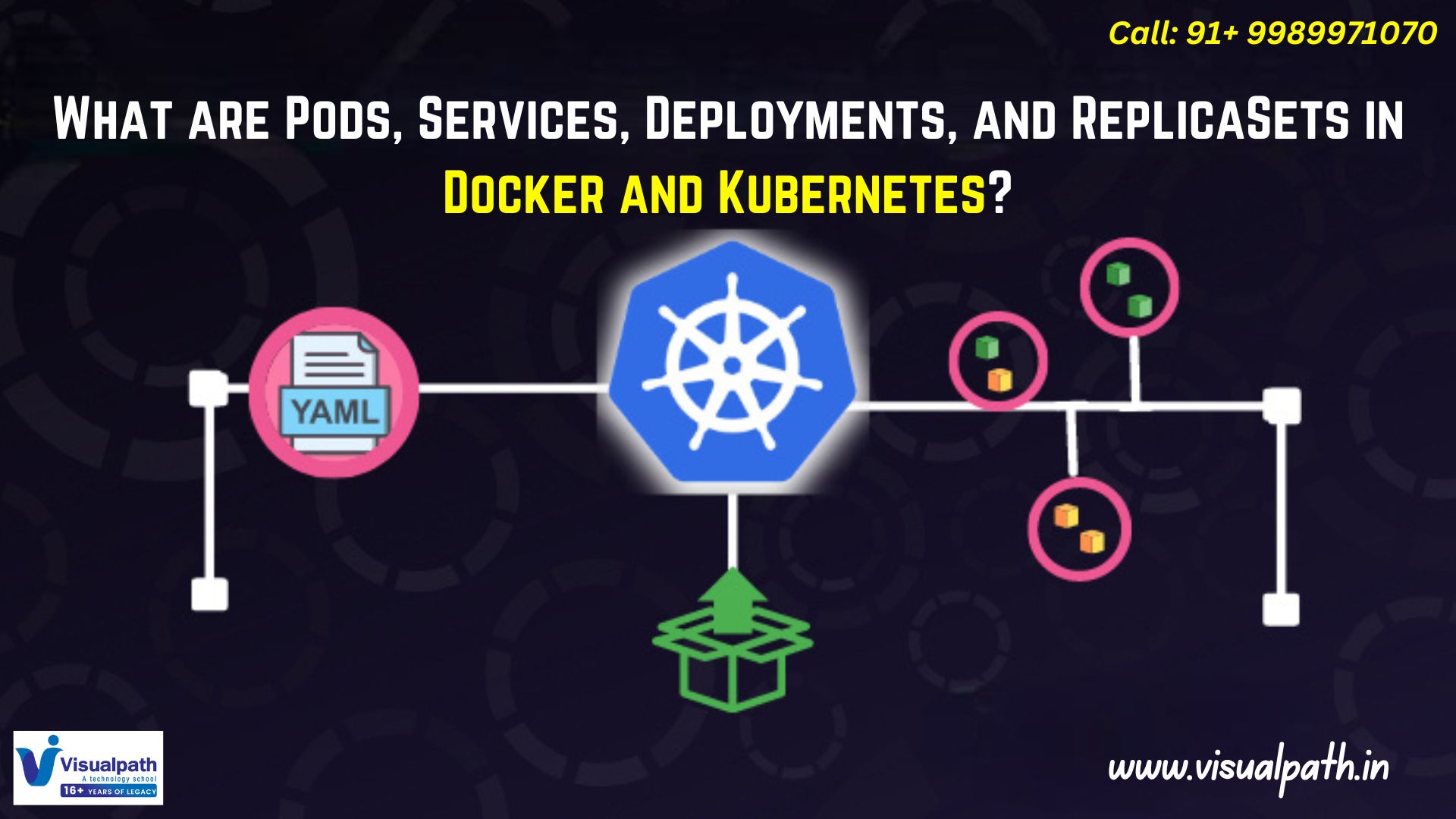
    What are Pods, Services, Deployments, and Replica Sets in Docker and Kubernetes?

    Introduction:

    Kubernetes Online Training can significantly enhance your understanding of key concepts like Pods, Services, Deployments, and Replica Sets. Both Docker and Kubernetes work together to orchestrate, manage, and scale containerized applications, making them essential in modern DevOps practices. Docker is responsible for containerizing the application, while Kubernetes orchestrates those containers, ensuring they run efficiently across different environments. In this article, we will explore these key components in Docker and Kubernetes and how they contribute to an efficient, scalable system.

    Understanding Pods in Docker and Kubernetes

    Pods are the fundamental units in Kubernetes that house one or more containers. In simple terms, a pod can be considered a wrapper around containers, ensuring that they work as a single entity. This is important when multiple containers need to share resources, such as storage volumes or networking setups. A pod may contain one container or a tightly coupled group of containers that need to operate together.

    In a Kubernetes cluster, pods are ephemeral, meaning they can be created and destroyed based on resource availability or deployment changes. To manage these pods more effectively, you need an orchestration system that automates scaling, updates, and rollback procedures, all of which can be learned in a Docker and Kubernetes Course. Kubernetes provides the capabilities to deploy multiple instances of pods to maintain high availability and load balance the workload.

    Pods provide a standardized environment for containers, enabling better communication within the same pod. For example, micro services running within the same pod can efficiently communicate via local networking, making the entire system more robust and scalable. Pods are integral to Kubernetes, and mastering their structure and behaviour is essential when managing large-scale containerized applications.

    Services in Docker and Kubernetes: Managing Networking and Load Balancing

    Services in Kubernetes play a crucial role in managing networking between pods and external entities. A service acts as a stable interface for a set of pods that may change dynamically as containers are created or destroyed. In practice, the IP addresses of pods are not constant, which could complicate communication within the cluster. Services solve this problem by acting as a proxy that routes requests to the appropriate pod, regardless of its current IP address.

    In Kubernetes Online Training, you will learn that services come in different types, such as ClusterIP, NodePort, and Load Balancer, each catering to different networking needs. For instance, the ClusterIP service exposes the pods within the cluster, making it useful for internal communication, while the Load Balancer service allows external entities to access your application. Services can also provide load balancing, distributing traffic across multiple pods to ensure reliability and availability.

    By understanding services and how they work, you can significantly improve the networking and scaling strategies for your Docker and Kubernetes deployments. Whether you’re dealing with micro services or a monolithic architecture, services are critical for seamless container management.

    Deployments: Managing the Lifecycle of Pods

    A deployment in Kubernetes is used to manage the entire lifecycle of your pods. It defines how your application will run, ensuring that the desired number of pod replicas is maintained, even during failures or updates. When you make changes to your application, a deployment handles the rollout of new versions, minimizing downtime and allowing rollback in case of failure.

    In a Docker and Kubernetes Course, deployments are often taught as essential to maintaining high availability. Kubernetes automates the process of updating pods by gradually phasing out the old version and replacing it with the new one. This ensures that your application remains available, even during updates.

    Moreover, deployments are crucial for ensuring consistency across various environments, from development to production. They allow developers and DevOps engineers to define the desired state of an application and then let Kubernetes work to maintain that state. By learning how to effectively configure deployments, you can automate a lot of the manual work that would otherwise be required for managing large, distributed applications.

    Replica Sets: Ensuring Application Redundancy and Scalability

    Replica Sets in Kubernetes are designed to ensure that a specified number of pod replicas are running at all times. This is crucial for applications that require redundancy to handle high loads or to ensure that no downtime occurs. A Replica Set monitors the cluster and ensures that if a pod goes down, a new one is immediately spun up to replace it. This is a key feature for maintaining high availability, especially in production environments.

    In Kubernetes Online Training, you will learn that Replica Sets are commonly used with deployments to maintain the desired number of running instances of a pod. By managing pod replicas automatically, Replica Sets make it easier to scale applications horizontally. For example, during periods of high traffic, you can scale up the number of pods to meet demand and then scale back down when the load decreases. This elasticity is essential for modern cloud-native applications, ensuring that resources are used efficiently.

    Docker and Kubernetes Overview with Tips

    Docker and Kubernetes have become synonymous with modern cloud-native architectures, enabling organizations to deliver applications faster and with greater scalability. Docker simplifies the process of creating containers, while Kubernetes provides an extensive orchestration framework to manage those containers at scale. Whether you are running a few micro services or a large distributed system, combining Docker with Kubernetes offers immense benefits in terms of automation, resource management, and fault tolerance.

    Some practical tips for using Docker and Kubernetes include:

    1. Start Small: When beginning with Docker and Kubernetes, it’s best to start small by containerizing a single application and deploying it in a Kubernetes cluster. This will give you hands-on experience with Pods, Services, and Deployments before scaling up to more complex applications.
    2. Leverage Automation: Use Kubernetes’ automation features, like Deployments and Replica Sets, to minimize manual intervention. This ensures that your applications remain scalable and resilient, even in the face of failures.
    3. Monitor and Optimize: Kubernetes provides various tools to monitor the performance of your pods and services. Use these tools to optimize resource usage and avoid over-provisioning, which can increase costs.
    4. Embrace CI/CD: Kubernetes works well with Continuous Integration/Continuous Deployment (CI/CD) pipelines, allowing for seamless updates to your applications with minimal downtime. By integrating Kubernetes with your CI/CD tools, you can automate the entire deployment process.

    Conclusion

    In conclusion, understanding Pods, Services, Deployments, and Replica Sets is essential for anyone looking to master Docker and Kubernetes. These components are the backbone of Kubernetes’ orchestration capabilities, ensuring that applications run smoothly and can scale effectively. Enrolling in a Kubernetes Online Training program will equip you with the skills to configure and manage these key elements, while a Docker and Kubernetes Course can provide a deeper understanding of how Docker containers and Kubernetes work together to create robust, scalable systems. By learning these concepts, you can ensure that your applications are highly available, scalable, and resilient in any environment.

    Visualpath is the Best Software Online Training Institute in Hyderabad. Avail complete Docker and Kubernetes worldwide. You will get the best course at an affordable cost.

    Attend Free Demo

    Call on – +91-9989971070.

    WhatsApp: https://www.whatsapp.com/catalog/919989971070/

    Visit: https://www.visualpath.in/online-docker-and-kubernetes-training.html
    Visit Our  New Course: https://www.visualpath.in/online-best-cyber-security-courses.html

  • Docker Online Training What is Docker Compose and How is it Used?

    Docker Online Training What is Docker Compose and How is it Used?

    Introduction:

    Docker Online Training offers an in-depth understanding of how containerization technologies, like Docker and Kubernetes, function in modern application deployment. Docker Compose, one of Docker’s essential tools, simplifies managing multi-container applications. It allows developers to define, configure, and run multiple containers simultaneously with just one command. Paired with Kubernetes, these tools revolutionize the way software is deployed, scaled, and managed. This overview explains Docker Compose’s role and provides tips on effectively using Docker and Kubernetes Course together for efficient container orchestration.

    Docker Online Training: An Essential Tool for Developers

    Docker Compose is a tool designed to handle multi-container Docker applications. In a world where microservices are increasingly the preferred architecture, Docker Compose plays a crucial role in simplifying container management. Traditionally, each container in Docker needs to be started and configured manually, which can be tedious when dealing with complex applications consisting of multiple interconnected containers. Docker Compose resolves this by allowing users to define their multi-container applications in a single docker-compose.yml file.

    This file contains information about all the containers required for the application, including configuration settings, networking details, and data volumes. Instead of starting each container manually, developers can use a single command to deploy all containers at once. This is especially useful when working with environments where services, such as web servers, databases, and cache systems, need to run together. Docker Compose ensures that these services communicate with each other seamlessly, making it an invaluable tool for both development and production environments.

    Incorporating Docker Compose into Docker Online Training ensures developers learn how to manage containerized applications more efficiently. By gaining a deeper understanding of Docker Compose, professionals can enhance their workflow, allowing for faster deployments and simplified development cycles. Using Docker Compose in conjunction with Kubernetes provides a comprehensive solution for managing modern applications.

    How Docker and Kubernetes Work Together

    While Docker Compose is effective in managing multi-container applications on a single host, scaling these applications in a production environment often requires more sophisticated orchestration, which is where Kubernetes comes into play. Kubernetes, an open-source container orchestration platform, excels at automating the deployment, scaling, and management of containerized applications across multiple hosts. When organizations require high availability, fault tolerance, and the ability to manage thousands of containers, Kubernetes becomes the preferred solution.

    Docker handles the containerization aspect, ensuring that the application components are packaged with all their dependencies. On the other hand, Kubernetes takes charge of deploying these containers across multiple nodes in a cluster, ensuring that they are efficiently distributed and can communicate with each other. Additionally, Kubernetes offers features like automatic scaling, load balancing, and self-healing, where it can restart failed containers automatically.

    For developers and IT professionals who want to master both technologies, enrolling in a Docker and Kubernetes Course is essential. This training provides a detailed overview of how to use Docker Compose for development and Kubernetes for production-level orchestration. By leveraging both tools, teams can maintain development agility while ensuring robust and scalable application deployments.

    Tips for Effective Use of Docker Compose with Kubernetes

    1. Define Dependencies Clearly: In Docker Compose, ensure that service dependencies (e.g., web servers relying on databases) are well defined in the docker-compose.yml file. This prevents issues during container start up and ensures smooth inter-service communication.
    2. Optimize Networking: Docker Compose allows you to configure custom networks for your containers. Use this feature to isolate services that do not need to communicate with each other, which improves security and performance.
    3. Transitioning to Kubernetes: When moving from a Docker Compose environment to Kubernetes, tools like Kompose can be helpful. Kompose converts a Docker Compose file into Kubernetes resources (like pods and services), streamlining the migration process.
    4. Use Volume Mounting Wisely: Both Docker Compose and Kubernetes support volume mounting, which is critical for data persistence. Ensure that persistent data, such as database files, are stored on mounted volumes to prevent data loss during container restarts or crashes.
    5. Automate Workflows: Utilize automation tools to handle repetitive tasks like container build and deployment. Both Docker Compose and Kubernetes work well with Continuous Integration/Continuous Deployment (CI/CD) pipelines, making it easier to push new updates without manual intervention.

    Conclusion

    Docker Compose simplifies the management of multi-container applications, providing developers with an efficient way to define, configure, and run containers. When combined with Kubernetes, organizations can scale these applications across clusters of hosts, ensuring high availability and fault tolerance. For developers and DevOps teams looking to harness the full potential of containerized applications, learning these tools is essential.

    Enrolling in Docker Online Training and a comprehensive Docker and Kubernetes Course will equip professionals with the skills to manage containerized applications effectively in both development and production environments. By mastering these technologies, organizations can streamline their application deployment processes and ensure scalability without coding complexities.

    Visualpath is the Best Software Online Training Institute in Hyderabad. Avail complete Docker and Kubernetes worldwide. You will get the best course at an affordable cost.

    Attend Free Demo

    Call on – +91-9989971070.

    WhatsApp: https://www.whatsapp.com/catalog/919989971070/

    Visit: https://www.visualpath.in/online-docker-and-kubernetes-training.html
    Visit Our  New Course: https://www.visualpath.in/online-best-cyber-security-courses.html

  • What Are The Main Functions of Docker?

    What Are The Main Functions of Docker?

    Introduction:

    Docker has revolutionized the way software is developed, shipped, and deployed. As a platform that uses containerization technology, Docker simplifies the process of creating, managing, and running applications in consistent environments. Docker and Kubernetes Training

    Containerization of Applications:

    At the core of Docker’s functionality is containerization. Containers are lightweight, standalone, and executable packages that include everything needed to run a piece of software: code, runtime, system tools, libraries, and settings. This allows developers to isolate applications from their environment, ensuring consistent behavior regardless of where the container runs, whether it’s on a developer’s laptop, a staging server, or in production.

    Portability Across Different Platforms:

    One of Docker’s most notable functions is portability. Docker containers are designed to run consistently across various platforms, including different operating systems, cloud environments, and on-premise servers. This means that an application packaged in a Docker container can be moved seamlessly between development, testing, and production without compatibility issues.

    With Docker, developers can focus on writing code, confident that their applications will run smoothly across different infrastructures. This portability also makes Docker an essential tool for continuous integration and continuous deployment (CI/CD) pipelines, where software is frequently moved between environments. Kubernetes Online Training

    Simplified Dependency Management:

    Managing dependencies is one of the key challenges in software development, especially when working with multiple libraries, packages, and frameworks. Docker solves this by allowing developers to include all dependencies within a container. The Docker container image holds everything the application needs to run, ensuring that it has access to the right version of every dependency.

    Docker eliminates conflicts that often arise from dependency mismatches, particularly in multi-developer teams or when maintaining multiple projects on the same machine.

    Efficient Resource Utilization:

    Compared to traditional virtual machines (VMs), Docker containers are much more lightweight and efficient. While VMs emulate entire operating systems and require substantial resources, Docker containers share the same OS kernel, using fewer resources and allowing for faster startup times.

    This efficient resource utilization means that more containers can run on a single server compared to virtual machines, optimizing infrastructure costs and improving scalability. Docker Online Training

    Version Control for Application Environments:

    Docker provides an essential function through its image version control, which allows developers to track and manage different versions of application environments. Docker images are built from Dockerfiles, which contain a set of instructions that define the environment. Once built, these images can be versioned, tagged, and distributed via Docker Hub or private repositories.

    Isolation and Security:

    Another key function of Docker is the isolation it provides. Each Docker container operates independently and is isolated from other containers and the host machine. This means that issues such as crashes, memory leaks, or security vulnerabilities in one container do not affect others. Docker also enhances security by ensuring that containers have limited access to the host system.

    Conclusion:

    Docker has become an indispensable tool in modern software development due to its core functions: containerization, portability, simplified dependency management, efficient resource utilization, version control, and isolation. By leveraging these features, developers can build, ship, and run applications in a more consistent, secure, and efficient manner.

    Visualpath is the Leading and Best Institute for learning Docker and Kubernetes Online in Ameerpet, Hyderabad. We provide Docker Online Training Course, you will get the best course at an affordable cost.

    Visit: https://www.visualpath.in/DevOps-docker-kubernetes-training.html

    WhatsApp : https://www.whatsapp.com/catalog/919989971070/

  • Kubernetes: How do Monitoring Tools Work?

    Kubernetes: How do Monitoring Tools Work?

    Introduction:

    Monitoring tools are critical for maintaining system performance, security, and reliability. Whether it’s an IT infrastructure, network, or application, these tools provide real-time insights, helping teams detect and resolve issues before they cause significant problems. Docker and Kubernetes Training

    Core Functions of Monitoring Tools:

    Monitoring tools operate by continuously observing and collecting data from various components of an IT ecosystem. These components include servers, databases, applications, network devices, and even cloud services. The collected data is then analyzed to track performance, detect anomalies, and identify potential threats. At the heart of these tools is the ability to track and measure metrics such as CPU usage, memory consumption, network traffic, response times, error rates, and disk space.

    Key Steps in How Monitoring Tools Work:

    Data Collection:

    Monitoring tools rely on agents or agentless methods to gather data. In an agent-based system, small programs or agents are installed on the devices being monitored. These agents track performance metrics, event logs, and system processes, and send the information to a central monitoring server. In contrast, agentless systems use existing protocols like SNMP (Simple Network Management Protocol) or APIs to collect data without installing software on individual devices. Kubernetes Online Training

    Data Aggregation and Analysis:

    Once data is collected, it is aggregated in a central system. Monitoring tools store the data, allowing it to be analyzed historically, as well as in real-time. The data is often displayed through dashboards or graphical interfaces that give IT teams an overview of system health and performance. Some tools also use machine learning algorithms to establish performance baselines and detect patterns of abnormal activity.

    Alerting:

    One of the most critical functions of a monitoring tool is alerting. When a metric crosses a predefined threshold, such as CPU usage exceeding 90% or application response times slowing beyond acceptable levels, the system triggers an alert. Alerts can be sent via email, SMS, or integrated with messaging platforms like Slack.

    This immediate notification allows IT teams to take proactive measures, minimizing downtime and mitigating damage before it impacts end users. Some monitoring tools can even trigger automated responses, such as restarting services or redistributing workloads, to resolve the issue without human intervention. Docker Online Training

    Reporting and Visualization:

    Monitoring tools offer detailed reports and visualizations that help teams understand system performance over time. These reports can highlight patterns, such as a gradual increase in resource usage or recurring performance drops at certain times of the day.

    Visualization tools such as graphs, heatmaps, or charts offer a clear view of trends, helping teams plan for scaling needs, resource allocation, and capacity management. Advanced tools provide customizable dashboards, allowing users to focus on the most critical metrics.

    Importance of Monitoring Tools:

    Monitoring tools are invaluable for ensuring the smooth operation of IT systems and applications. Without monitoring, teams would have limited visibility into what is happening across their infrastructure, making it challenging to identify issues before they escalate. Proactive problem-solving is one of the most significant benefits. With real-time monitoring and alerting, IT teams can address problems before they become full-scale outages, reducing downtime and maintaining system availability.

    Conclusion:

    Monitoring tools are essential for modern IT management, offering real-time insights, early detection of issues, and detailed reports for system optimization. From data collection and aggregation to alerting and visualization, these tools provide a comprehensive view of system health, enabling organizations to keep their infrastructure secure, stable, and performant.

    Visualpath is the Leading and Best Institute for learning Docker and Kubernetes Online in Ameerpet, Hyderabad. We provide Docker Online Training Course, you will get the best course at an affordable cost.

    Visit: https://www.visualpath.in/DevOps-docker-kubernetes-training.html

    WhatsApp : https://www.whatsapp.com/catalog/919989971070/

  • What is the Use of a Docker Network plugin?

    What is the Use of a Docker Network plugin?

    Introduction:

    Docker has become a leading platform for developing, shipping, and running applications. Containers are lightweight, portable, and consistent across different environments, making them ideal for modern application development. Docker and Kubernetes Training

    What is a Docker Network Plugin?

    A Docker Network plugin is an extension that enhances Docker’s native networking capabilities. By default, Docker provides basic networking options, such as bridge networks, host networks, and overlay networks. While these built-in options are sufficient for many use cases, they may not meet the requirements of more complex, multi-host, or cloud-native applications.

    Types of Docker Network Plugins:

    Docker Network plugins come in various forms, catering to different networking needs.

    Some common types include:

    Bridge Plugins: Extend the default bridge network functionality, enabling more advanced configurations like multi-host networking.

    Overlay Plugins: Enhance overlay networks to support cross-host communication in distributed environments. Kubernetes Online Training

    SDN (Software-Defined Networking) Plugins: Integrate with SDN solutions to manage network policies, security, and segmentation across containers.

    Cloud-Native Plugins: Designed for cloud environments, these plugins allow seamless integration with cloud provider networks, making it easier to deploy and manage containers in multi-cloud setups.

    Key Benefits of Docker Network Plugins:

    Enhanced Flexibility and Customization:

    Docker Network plugins allow for a high degree of customization, enabling users to tailor their networking setup to specific application requirements. Whether it’s integrating with a corporate network, implementing a custom routing scheme, or adopting a specific security protocol, network plugins provide the flexibility to achieve these goals.

    Improved Scalability:

    As applications scale, so does the complexity of their networking needs. Docker Network plugins facilitate scalable networking solutions that can handle large-scale deployments across multiple hosts or even different data centers. For example, plugins like Calico or Weave provide scalable networking with built-in support for advanced features like IP address management, load balancing, and network segmentation. Docker Online Training

    Integration with Existing Infrastructure:

    For organizations with existing network infrastructure, Docker Network plugins enable seamless integration without disrupting current operations. Plugins can connect Docker containers to VLANs, SDN controllers, or cloud provider networks, ensuring that containerized applications can coexist with traditional workloads.

    Enhanced Security:

    Security is a paramount concern in any networked environment. Docker Network plugins often come with advanced security features, such as network segmentation, encryption, and policy enforcement. These features help protect containerized applications from threats and ensure compliance with organizational security standards.

    Simplified Multi-Cloud and Hybrid Cloud Networking:

    In today’s cloud-centric world, applications are often deployed across multiple clouds or hybrid environments. Docker Network plugins designed for cloud-native applications simplify the process of connecting containers across different cloud providers.

    Conclusion:

    Docker Network plugins are indispensable tools for anyone looking to extend and customize Docker’s networking capabilities. By enabling advanced networking features, integrating with existing infrastructure, and providing enhanced security and scalability, these plugins empower developers and operators to build more robust, flexible, and secure containerized environments.

    Visualpath is the Leading and Best Institute for learning Docker and Kubernetes Online in Ameerpet, Hyderabad. We provide Docker Online Training Course, you will get the best course at an affordable cost.

    Visit : https://www.visualpath.in/DevOps-docker-kubernetes-training.html

    WhatsApp : https://www.whatsapp.com/catalog/919989971070/

  • What is the Difference between HPA and VPA in Kubernetes?

    What is the Difference between HPA and VPA in Kubernetes?

    Introduction:

    Kubernetes, the leading container orchestration platform, is designed to manage containerized applications at scale. As applications experience varying levels of demand, it becomes crucial to adjust resources dynamically to maintain performance and efficiency. Docker and Kubernetes Training

    Horizontal Pod Autoscaler (HPA):

    Scaling by Replication:

    The Horizontal Pod Autoscaler (HPA) is a Kubernetes feature that automatically adjusts the number of pod replicas in a deployment, replica set, or stateful set based on observed metrics like CPU utilization, memory usage, or custom metrics provided by an external source. HPA is designed to handle fluctuations in load by increasing or decreasing the number of pod instances running the application.

    Key Features of HPA:

    Replication-Based Scaling: HPA scales the application horizontally by adding or removing pod replicas. This approach distributes the workload across multiple instances, allowing the application to handle more traffic.

    Metrics-Based Decisions: HPA relies on metrics collected from the Kubernetes Metrics Server or other custom metrics providers. These metrics determine when to scale up or down. Kubernetes Online Training

    Use Cases: HPA is ideal for applications that experience varying traffic patterns, such as web servers, where the workload can be distributed across multiple pods. For example, during peak hours, HPA can scale out additional pods to handle the increased load and scale them back down during off-peak times.

    Limitations of HPA:

    Fixed Resource Limits: Each pod replica has a fixed amount of CPU and memory allocated to it. If the resource requirements per pod change, HPA does not adjust the pod’s resource limits but only the number of replicas.

    Not Suitable for All Workloads: HPA works best with stateless applications where requests can be easily distributed across multiple instances. It may not be suitable for stateful applications that require consistent data across replicas.

    Vertical Pod Autoscaler (VPA):

    Scaling by Resource Adjustment:

    The Vertical Pod Autoscaler (VPA) is another Kubernetes feature that adjusts the CPU and memory resources allocated to individual pods based on their observed usage. Instead of adding or removing replicas, VPA scales the application vertically by increasing or decreasing the resource limits of existing pods.

    Key Features of VPA:

    Resource-Based Scaling: VPA adjusts the resource requests and limits of a pod to better match its actual usage. This ensures that each pod has the right amount of resources to operate efficiently. Docker Online Training

    Automatic Resource Adjustment: VPA monitors the resource consumption of pods over time and adjusts the allocated resources accordingly. This helps prevent both over-provisioning (wasting resources) and under-provisioning (causing performance issues).

    Use Cases: VPA is ideal for applications with varying resource requirements that are difficult to predict, such as batch processing jobs or machine learning workloads. For instance, a machine learning job might require more CPU and memory as the dataset grows, and VPA can automatically adjust the resources to meet these needs.

    Limitations of VPA:

    Pod Restarts: When VPA adjusts the resources for a pod, it typically requires restarting the pod to apply the new resource limits. This can cause temporary downtime, which may not be acceptable for all applications.

    Limited to Single Pods: Unlike HPA, which scales across multiple replicas, VPA focuses on optimizing the resources for individual pods. This means that VPA may not be sufficient for applications that need to scale out to handle increased load. Kubernetes Certification Training

    HPA vs. VPA:

    HPA and VPA serve different purposes in a Kubernetes environment, and they can be used together to achieve optimal scalability. HPA is best suited for scaling out applications by adding more instances, while VPA is ideal for fine-tuning the resources allocated to each instance.

    Conclusion:

    HPA and VPA are powerful tools in Kubernetes that address different aspects of autoscaling. HPA scales applications by adjusting the number of pod replicas, making it ideal for handling traffic spikes and distributing workload. VPA, on the other hand, adjusts the resources allocated to individual pods, ensuring that each pod operates efficiently without wasting resources.

    Visualpath is the Leading and Best Institute for learning Docker and Kubernetes Online in Ameerpet, Hyderabad. We provide Docker Online Training Course, you will get the best course at an affordable cost.

    Visit : https://www.visualpath.in/DevOps-docker-kubernetes-training.html

    WhatsApp : https://www.whatsapp.com/catalog/919989971070/

  • GitHub Actions use Kubernetes?

    GitHub Actions use Kubernetes?

    Introduction:

    Kubernetes GitHub Actions, a powerful CI/CD tool integrated into GitHub, allows developers to automate, customize, and execute software development workflows directly in their repositories. Combining GitHub Actions with Kubernetes, an open-source container orchestration platform, creates a robust pipeline for deploying, scaling, and managing containerized applications.

    Synergy Between GitHub Actions and Kubernetes:

    Automating Deployments:

    GitHub Actions provides a flexible and scalable way to automate the deployment process to Kubernetes clusters. By leveraging GitHub Actions, developers can define workflows that automatically trigger deployments when code is pushed to a repository. Workflows in GitHub Actions can be configured to build Docker images, push them to container registries like Docker Hub or GitHub Container Registry, and then deploy these images to a Kubernetes cluster. Docker and Kubernetes Training

    Enhanced CI/CD Pipelines:

    Kubernetes’ robust features, such as auto-scaling, self-healing, and rolling updates, complement GitHub Actions’ automation capabilities, creating an enhanced CI/CD pipeline. With GitHub Actions, developers can set up workflows that not only deploy applications but also perform health checks, run integration tests, and roll back to previous versions if something goes wrong.

    This integration facilitates blue-green deployments and canary releases, which are advanced deployment strategies that minimize downtime and reduce the risk of introducing bugs into production.

    Streamlining Development and Operations:

    Simplifying Kubernetes Management:

    GitHub Actions can simplify the management of Kubernetes clusters by automating routine tasks. For instance, workflows can be created to scale the number of pods based on the current load, clean up unused resources, or update configurations. Additionally, GitHub Actions can integrate with various Kubernetes tools and services, such as Helm for package management, Kustomize for configuration management, and kubectl for command-line operations. Kubernetes Online Training

    Collaboration and Visibility:

    Using GitHub Actions with Kubernetes fosters better collaboration among development, operations, and quality assurance teams. GitHub Actions’ integration with GitHub repositories ensures that all workflow configurations, deployment scripts, and documentation are stored in a single, version-controlled location. This centralization enhances visibility and traceability, making it easier for teams to understand and reproduce the deployment process.

    Conclusion:

    The integration of GitHub Actions with Kubernetes offers a powerful combination for modern software development and deployment. By automating and streamlining the CI/CD pipeline, this synergy enhances productivity, reduces errors, and ensures faster delivery of high-quality software.

    Visualpath is the Leading and Best Institute for learning Docker and Kubernetes Online in Ameerpet, Hyderabad. We provide Docker Online Training Course, you will get the best course at an affordable cost.

    Visit : https://www.visualpath.in/DevOps-docker-kubernetes-training.html

    WhatsApp : https://www.whatsapp.com/catalog/919989971070/ 

  • How to Integrate ArgoCD with Kubernetes?

    How to Integrate ArgoCD with Kubernetes?

    Introduction:

    Kubernetes, the leading container orchestration platform, has revolutionized the way applications are deployed and managed. However, managing Kubernetes deployments can still be challenging. Docker and Kubernetes Training

    What is ArgoCD?

    ArgoCD is a Kubernetes-native continuous delivery tool that follows the GitOps methodology. GitOps is a paradigm that uses Git repositories as the single source of truth for declarative infrastructure and applications. With ArgoCD, you can define your desired application state in Git repositories, and ArgoCD will ensure that the current state of your Kubernetes clusters matches the desired state described in your Git repositories.

    Benefits of Integrating ArgoCD with Kubernetes:

    Automated Deployments: ArgoCD automates the process of deploying applications to Kubernetes, reducing the need for manual intervention and minimizing human errors.

    Declarative Configuration: By using declarative configurations stored in Git, you can version control your application deployments, making rollbacks and audits straightforward. Kubernetes Online Training

    Continuous Syncing: ArgoCD continuously monitors your Git repositories and your Kubernetes clusters, ensuring that any drift between the desired state and the actual state is corrected automatically.

    Enhanced Security: Since ArgoCD operates based on Git repositories, you can leverage Git’s access control and audit capabilities to secure your deployment workflows.

    Steps to Integrate ArgoCD with Kubernetes:

    Prerequisites:

    Before you start, ensure you have the following:

    A running Kubernetes cluster. kubectl installed and configured to interact with your Kubernetes cluster. A Git repository containing your Kubernetes manifests or Helm charts.

    Install ArgoCD:

    The first step is to install ArgoCD in your Kubernetes cluster. You can do this by applying the ArgoCD installation manifests provided by the ArgoCD team. This involves creating the necessary namespaces, roles, role bindings, services, and deployments for ArgoCD to operate. Docker Online Training

    Access ArgoCD:

    Once ArgoCD is installed, you can access its web UI to manage your applications. You will need to retrieve the initial password for the admin user and the URL for the ArgoCD server. This information is typically available in the Kubernetes secrets created during the installation process.

    Configure a Git Repository:

    Next, you need to configure a Git repository that contains your application manifests or Helm charts. This repository will serve as the source of truth for your deployments. Ensure that the repository structure aligns with ArgoCD’s expectations, typically with a directory for each application environment (e.g., staging, production).

    Create an ArgoCD Application:

    An ArgoCD Application represents a collection of Kubernetes resources defined in a Git repository. To create an application, you can use the ArgoCD web UI, CLI, or declarative YAML manifests. Specify the Git repository URL, the path to the manifests, the target Kubernetes cluster, and the namespace where the resources should be deployed.

    Conclusion:

    Integrating ArgoCD with Kubernetes brings the power of GitOps to your CI/CD pipelines, enhancing automation, security, and efficiency. By following the steps outlined above, you can streamline your Kubernetes deployments, reduce manual errors, and achieve a more reliable and scalable software delivery process.

    Visualpath is the Leading and Best Institute for learning Docker and Kubernetes Online in Ameerpet, Hyderabad. We provide Docker Online Training Course, you will get the best course at an affordable cost.

    Call on – +91-9989971070

    Visit : https://www.visualpath.in/DevOps-docker-kubernetes-training.html

    WhatsApp : https://www.whatsapp.com/catalog/919989971070/

  • What are the Components of Kubernetes Network?

    What are the Components of Kubernetes Network?

    Introduction:

    Kubernetes, or K8s, has revolutionized the way we deploy and manage containerized applications, providing a robust and scalable framework. A critical aspect of Kubernetes is its networking model, which ensures that containers can communicate with each other, with services, and with the outside world. Docker and Kubernetes Training

    Core Components of Kubernetes Networking:

    Kubernetes networking involves several key components, each playing a vital role in ensuring seamless communication within and outside the cluster.

    Pods and Pod Networking:

    Pods are the basic deployable units in Kubernetes, each containing one or more containers. In Kubernetes, each pod is assigned a unique IP address, and containers within a pod share this IP address and port space. This design simplifies the networking model because:

    Containers in the same pod can communicate with each other using localhost.

    Pods can communicate with other pods directly via their IP addresses.

    This IP-per-pod model eliminates the need for port mapping, as each pod has its own IP address within the cluster. Kubernetes Online Training

    Cluster IP and Service Networking:

    Kubernetes services provide a stable IP address and DNS name to a set of pods, abstracting the underlying pod IP addresses and enabling reliable communication between services.

    There are several types of services in Kubernetes:

    ClusterIP: Exposes the service on a cluster-internal IP. This is the default type and makes the service only reachable within the cluster.

    NodePort: Exposes the service on each node’s IP at a static port. This allows the service to be accessed from outside the cluster by requesting <NodeIP>:<NodePort>.

    LoadBalancer: Exposes the service externally using a cloud provider’s load balancer.

    ExternalName: Maps the service to the contents of the externalName field by returning a CNAME record with its value. Docker Online Training

    Services maintain a consistent endpoint regardless of the changes in the underlying pods, thus providing a stable communication path.

    DNS: Kubernetes comes with a built-in DNS service that automatically creates DNS records for Kubernetes services. This allows pods and services to communicate using DNS names rather than IP addresses, facilitating dynamic service discovery and simplifying communication within the cluster.

    Network Policies:

    Network Policies are a Kubernetes resource that controls the network traffic to and from pods. They allow fine-grained control over how pods communicate with each other and with external endpoints. Network policies are crucial for securing Kubernetes clusters by restricting unnecessary and potentially harmful communications.

    Ingress:

    Ingress is an API object that manages external access to the services in a cluster, typically HTTP. Kubernetes Certification Training

    It provides features like:

    Load Balancing: Distributing traffic across multiple backend services.

    SSL Termination: Managing SSL/TLS certificates and termination.

    Name-based Virtual Hosting: Routing traffic based on the host name.

    Ingress controllers implement the Ingress resources and manage the routing of external traffic to the appropriate services inside the cluster.

    Container Network Interface (CNI):

    CNI is a specification and libraries for writing plugins to configure network interfaces in Linux containers. Kubernetes uses CNI plugins to provide networking capabilities. Various CNI plugins are available, each offering different features and functionalities.

    Conclusion:

    Kubernetes networking is a complex but crucial aspect of running containerized applications at scale. Understanding its components—Pods, Services, DNS, Network Policies, Ingress, Kube-proxy, and CNI plugins—is essential for setting up and maintaining a robust Kubernetes environment.

    Visualpath is the Leading and Best Institute for learning Docker and Kubernetes Online in Ameerpet, Hyderabad. We provide Docker Online Training Course, you will get the best course at an affordable cost.

    Call on – +91-9989971070

    Visit : https://www.visualpath.in/DevOps-docker-kubernetes-training.html

    WhatsApp : https://www.whatsapp.com/catalog/917032290546/

  • What is the Underlying Technology of Docker?

    What is the Underlying Technology of Docker?

    Introduction:

    Docker underlying technology, containerization, offers a powerful solution to the age-old problem of “it works on my machine” by ensuring consistent environments from development to production. Kubernetes Online Training

    The Essence of Containerization:

    At the heart of Docker lies containerization, a lightweight form of virtualization that allows multiple containers to run on a single host machine. Unlike traditional virtual machines (VMs) that require a complete operating system for each instance, containers share the host OS kernel, making them more efficient and faster to start. Containers encapsulate an application and its dependencies into a single package, ensuring that it runs uniformly across various environments.

    Key Components of Docker:

    Docker Engine: The core of Docker, the Docker Engine, is responsible for creating and managing containers. It consists of a server (a daemon process), a REST API for interacting with the daemon, and a command-line interface (CLI) for issuing commands. Docker and Kubernetes Training

    Docker Images: Docker images are immutable templates that define the contents of a container. They are built from a series of layers, each representing a change or addition to the image. Images are created using a Dockerfile, a text file that contains instructions for building the image.

    Docker Containers: Containers are instances of Docker images. They are created from images and run in isolated environments. Containers can be started, stopped, moved, and deleted using Docker commands. Each container is assigned a unique ID and can be interacted with through the Docker CLI or API.

    Docker Registries: Registries are repositories for storing and distributing Docker images. Public registries, like Docker Hub, allow users to share and access images from around the world. Private registries can be set up for internal use within an organization, providing secure storage and access to proprietary images.

    How Docker Works:

    Namespaces: Docker uses Linux namespaces to provide isolated workspaces for containers. Namespaces ensure that each container has its own view of the system, including process trees, network interfaces, and mount points. This isolation prevents containers from interfering with each other or the host system. Docker Online Training

    Control Groups (cgroups): Docker leverages cgroups to limit and prioritize resources such as CPU, memory, and disk I/O for containers. Cgroups ensure that containers do not consume more resources than allocated, maintaining system stability and performance.

    Union File Systems: Docker uses union file systems (such as OverlayFS) to manage the layers of images and containers. These file systems allow multiple file system layers to be transparently overlaid, providing efficient storage and quick image creation.

    Container Runtime: The container runtime is responsible for executing containers. Docker initially used its own runtime, but with the advent of the Open Container Initiative (OCI), it now supports runc, a lightweight, standards-compliant runtime.

    Conclusion:

    Docker’s containerization technology has fundamentally changed the landscape of software development and deployment. By providing a consistent, efficient, and scalable way to package and run applications, Docker has addressed many challenges faced by developers and operations teams.

    Visualpath is the Leading and Best Institute for learning Docker and Kubernetes Online in Ameerpet, Hyderabad. We provide Docker Online Training Course, you will get the best course at an affordable cost.

    Call on – +91-9989971070

    Visit : https://www.visualpath.in/DevOps-docker-kubernetes-training.html

    WhatsApp : https://www.whatsapp.com/catalog/917032290546/

  • How to implement Docker Compose?

    How to implement Docker Compose?

    Introduction:

    Docker Compose is a powerful tool that simplifies the management of multi-container applications. As modern applications often consist of multiple interconnected services, managing these services individually can be complex and time-consuming. Docker and Kubernetes Training

    Why Use Docker Compose?

    Docker Compose offers several benefits that make it an essential tool for developers working with containerized applications

    Simplified Configuration: With Docker Compose, you can define your entire multi-container application in a single YAML file. This file describes the services, networks, and volumes needed, making it easy to understand and manage the application’s infrastructure.

    Automated Service Management: Docker Compose allows you to start, stop, and manage all the services in your application with a single command. This automation reduces the chances of human error and ensures that all services are correctly initialized. Kubernetes Online Training

    Consistent Environment: By using Docker Compose, you can ensure that your application runs in the same environment across different stages of development, testing, and production. This consistency minimizes the risk of environment-related issues.

    Scalability: Docker Compose makes it easy to scale your application by defining how many instances of each service you want to run. This feature is particularly useful for load balancing and handling increased traffic.

    Key Components of Docker Compose:

    Understanding the key components of Docker Compose is crucial for effectively using the tool:

    Services: Services are the main building blocks of a Docker Compose application. Each service corresponds to a container that runs a specific task or microservice, such as a web server, database, or cache. The configuration for each service includes the image to be used, environment variables, ports, and dependencies. Docker Online Training

    Networks: Docker Compose allows you to define custom networks for your services. These networks facilitate communication between services, ensuring that they can interact with each other seamlessly. By default, Docker Compose creates a network for each application, but you can also define additional networks as needed.

    How Docker Compose Works:

    Define the Services: Create a docker-compose.yml file that defines all the services, networks, and volumes needed for your application. This file serves as the blueprint for your multi-container setup.

    Deploy the Application: Use the docker-compose up command to start and run all the services defined in the YAML file. Docker Compose will automatically pull the required images, create the containers, and configure the networks and volumes. Kubernetes Certification Training

    Manage the Application: Docker Compose provides various commands to manage your application. For example, you can use docker-compose down to stop and remove all the containers, networks, and volumes created by the up command.

    Conclusion:

    Docker Compose is a valuable tool for managing multi-container applications efficiently. By defining your services, networks, and volumes in a simple YAML file, you can streamline the deployment and management of your application.

    Visualpath is the Leading and Best Institute for learning Docker and Kubernetes Online in Ameerpet, Hyderabad. We provide Docker Online Training Course, you will get the best course at an affordable cost.

    Call on – +91-9989971070

    Visit : https://www.visualpath.in/DevOps-docker-kubernetes-training.html

    WhatsApp : https://www.whatsapp.com/catalog/917032290546/