Tag: AI Agents Training Online

  • How do AI Agents support marketing automation?

    How do AI Agents support marketing automation?

    Marketing automation has evolved significantly with the rise of intelligent systems capable of autonomously performing tasks, analyzing data, and optimizing campaigns. Among these innovations, AI agents have become a transformative force, helping marketers deliver personalized, timely, and scalable experiences. With businesses now adopting technologies like AI Agents Training, intelligent automation has become more accessible and powerful, reshaping the marketing landscape.

    1. Enhancing Customer Personalization

    AI agents play a major role in understanding user behavior across channels. They analyze browsing patterns, purchase history, engagement timelines, and preferences to create highly targeted messages. This level of personalization is nearly impossible with manual efforts alone. AI agents can:

    • Recommend products dynamically
    • Segment users based on behavioral triggers
    • Predict the right timing for engagement
    • Tailor email and SMS campaigns automatically

    Such automation ensures that customers receive the most relevant content, increasing conversion rates and long-term brand loyalty.

    2. Automating Repetitive Marketing Tasks

    Manual and repetitive marketing tasks consume significant time and resources. AI agents streamline these activities by automating campaign scheduling, lead scoring, social media posting, reporting, and more. Marketers can focus on strategy while the agents handle execution.

    Automated workflows triggered by user actions—such as engagement, cart abandonment, or downloads—ensure that potential leads continue moving smoothly through the marketing funnel.

    In the middle of the article, as businesses scale their digital presence, solutions like AI Agent Online Training help teams implement automation more strategically and accurately.

    3. Improving Lead Qualification and Scoring

    AI agents are particularly useful for identifying potential buyers. By evaluating user behavior, engagement levels, demographic data, and historical interactions, agents can assign accurate scores to leads. This helps marketing teams know:

    • Which leads are ready for sales
    • Which need nurturing
    • Which can be moved to automated onboarding

    AI-driven lead scoring increases efficiency by allowing marketing and sales teams to prioritize high-intent prospects.

    4. Supporting Predictive Analytics and Decision-Making

    One of the biggest advantages of AI agents is their predictive capability. They process large data sets to forecast customer behavior, campaign performance, and revenue outcomes. Examples include:

    • Predicting customer churn
    • Estimating campaign ROI
    • Suggesting optimal ad budget allocation
    • Recommending the next best action for each lead

    By making data-driven decisions, marketers reduce risk and increase the accuracy of their campaigns.

    5. Optimizing Content Creation and Campaign Messaging

    AI agents assist in generating content ideas, drafting marketing copies, optimizing blogs, and creating social media posts. They evaluate what content formats drive maximum engagement and recommend improvements. AI agents can also perform sentiment analysis to determine how customers feel about the brand and suggest content that resonates better.

    Automation in content workflows ensures consistency and reduces production time across all channels.

    6. Enabling Omnichannel Marketing Automation

    Modern customers interact with brands on multiple platforms—email, WhatsApp, Instagram, chatbots, and websites. AI agents unify these experiences by:

    • Tracking customer journeys across channels
    • Sending automated responses
    • Managing real-time queries
    • Ensuring consistent messaging everywhere

    This leads to a smoother user experience and higher brand retention.

    7. Enhancing Customer Support with Intelligent Chatbots

    AI-powered agents act as first-level customer support tools. They:

    • Answer FAQs
    • Provide product recommendations
    • Guide users through purchasing decisions
    • Collect feedback
    • Route complex queries to human agents

    24/7 chatbot support improves customer satisfaction and reduces operational costs for businesses.

    8. Strengthening Campaign Performance Monitoring

    AI agents monitor campaigns in real time, keep track of KPIs, and generate performance insights without human intervention. They identify what’s working and what’s not—allowing marketers to optimize campaigns instantly. Regular reporting, predictive alerts, and automated performance summaries help businesses stay ahead of market trends.

    Just above the conclusion, training programs like AI Agents Course Online empower marketing professionals to fully utilize these AI-driven enhancements and stay competitive in the digital era.

    FAQ,s

    1. How do AI Agents improve marketing automation?
    They personalize campaigns and automate workflows for better results.
    2. How do AI Agents enhance customer engagement?
    They deliver tailored messages across multiple channels in real time.
    3. How do AI Agents help in lead scoring?
    They analyze behavior to rank leads and boost conversion accuracy.
    4. How do AI Agents support predictive marketing?
    They forecast trends and customer actions using data insights.
    5. Why are AI Agents important for future marketing?
    They scale automation, cut manual work, and drive smarter decisions.

    Conclusion

    AI agents have become an essential part of modern marketing automation. By enhancing personalization, optimizing workflows, predicting user behavior, and enabling better decision-making, they allow organizations to run more effective and scalable marketing programs. As AI continues to advance, marketing teams that adopt intelligent agents will gain a significant advantage, delivering smarter, faster, and more personalized experiences across all digital platforms.

    Visualpath stands out as the best online software training institute in Hyderabad.

    For More Information about the AI Agents Online Training

    Contact Call/WhatsApp: +91-7032290546

    Visit:  https://www.visualpath.in/ai-agents-course-online.html
  • Top Business Use Cases of AI Agents in 2025

    Top Business Use Cases of AI Agents in 2025

    Artificial Intelligence (AI) is no longer a futuristic concept — it’s a practical force reshaping how organizations operate. Among the most dynamic innovations in this space are AI Agents — intelligent systems capable of perceiving, reasoning, learning, and taking actions to achieve specific goals. Businesses across industries are leveraging these agents to automate processes, enhance customer interactions, and drive innovation. Companies investing in AI Agents Training are discovering that these technologies can dramatically boost productivity, efficiency, and competitive advantage.

    1. Customer Service Automation

    One of the most popular and impactful use cases of AI Agents is in customer support. Intelligent virtual assistants and chatbots can engage customers 24/7, resolving common queries and routing complex issues to human representatives. These agents can analyze past interactions to personalize responses, ensuring a more satisfying customer experience. This automation not only reduces operational costs but also enhances brand loyalty by providing quick and consistent service.

    2. Sales and Marketing Optimization

    AI Agents have revolutionized how businesses approach sales and marketing. By collecting and analyzing consumer data, these agents can predict purchasing patterns, suggest personalized offers, and automate follow-ups. Predictive models embedded in AI Agents help sales teams identify high-value leads and improve conversion rates. Through AI Agent Online Training, professionals can learn to integrate intelligent systems into CRM platforms, social media, and email campaigns for smarter marketing automation.

    3. Human Resources and Talent Management

    In HR, AI Agents are helping organizations streamline talent acquisition and management. From resume screening to employee onboarding, AI systems handle repetitive administrative tasks, allowing HR teams to focus on strategy and engagement. Some agents even monitor employee satisfaction through sentiment analysis and feedback surveys, enabling proactive HR decisions. AI-driven HR tools ensure fairer hiring practices by removing unconscious bias in candidate evaluations.


    4. Financial Services and Risk Analysis

    Financial institutions are leveraging AI Agents to perform high-speed data analysis, detect fraudulent activities, and manage risk. These agents continuously monitor transactions and flag suspicious behavior in real-time. In banking and insurance, AI Agents assist with credit scoring, loan approval processes, and personalized customer recommendations. By automating these critical operations, businesses improve decision accuracy and reduce risk exposure, ensuring compliance and trust.

    5. Supply Chain and Logistics Management

    Another key area where AI Agents shine is logistics. Intelligent agents can track shipments, predict delivery times, and optimize inventory levels. They can also react to unexpected disruptions, such as supply delays or demand fluctuations, and adjust routes accordingly. This level of autonomy allows companies to maintain seamless supply chain operations, even under challenging conditions. AI-driven logistics systems contribute significantly to cost savings and operational efficiency.

    6. Healthcare Assistance and Diagnostics

    In healthcare, AI Agents are improving patient care and medical diagnostics. These systems analyze medical data, predict disease progression, and assist doctors in clinical decision-making. Virtual health assistants remind patients to take medications, book appointments, and even monitor vital signs through connected devices. AI Agents can also accelerate drug discovery by simulating biological processes and identifying potential compounds faster than traditional methods.

    7. Cybersecurity and Threat Detection

    As digital systems grow more complex, cybersecurity threats become more sophisticated. AI Agents play a crucial role in continuously monitoring network traffic, identifying vulnerabilities, and preventing data breaches. Unlike static rule-based systems, intelligent agents adapt to evolving threats by learning from attack patterns. This proactive approach enables organizations to maintain robust security without overloading IT teams.

    8. Manufacturing and Industrial Automation

    Manufacturers are embracing AI Agents for process automation and predictive maintenance. Intelligent agents monitor machine performance, predict equipment failures, and schedule maintenance before downtime occurs. By analyzing sensor data in real time, they help factories optimize production schedules and reduce waste. This not only increases productivity but also enhances workplace safety and product quality — two essential metrics in modern manufacturing.

    9. Business Process Automation and Decision Support

    AI Agents excel at streamlining repetitive business processes and providing decision support. They can interpret complex data sets, identify patterns, and suggest strategic actions. By integrating with enterprise resource planning (ERP) systems, AI Agents help executives make informed decisions faster. Professionals enrolling in an AI Agents Course Online can learn to build and deploy intelligent automation solutions tailored to specific business needs, maximizing efficiency and innovation.

    10. Personalized Customer Experiences

    Finally, AI Agents play a vital role in delivering hyper-personalized experiences to users. From recommendation engines in e-commerce to adaptive learning platforms in education, AI Agents tailor interactions based on user preferences and behavior. This personalization enhances satisfaction and builds long-term customer relationships.

    FAQ,s

    1. What are AI Agents used for in business?
    They automate workflows, boost productivity, and enhance customer engagement.
    2. How do AI Agents improve customer service?
    They provide 24/7 support with chatbots, reducing wait times and improving satisfaction.
    3. Can AI Agents help in marketing and sales?
    Yes, they analyze data, predict trends, and personalize marketing campaigns effectively.
    4. How do AI Agents support HR and finance teams?
    They automate hiring, risk analysis, fraud detection, and improve operational accuracy.
    5. Why should professionals learn AI Agents in 2025?
    AI Agents’ skills open new career paths and empower innovation in all industries.

    Conclusion

    The rise of AI Agents marks a new era in enterprise automation and decision intelligence. Organizations that strategically implement these systems are gaining measurable advantages in efficiency, scalability, and customer satisfaction. As industries continue to evolve, AI Agents will remain at the forefront of digital transformation — driving innovation across every sector.

    Visualpath stands out as the best online software training institute in Hyderabad.

    For More Information about the AI Agents Online Training

    Contact Call/WhatsApp: +91-7032290546

    Visit:  https://www.visualpath.in/ai-agents-course-online.html
  • AI Agents in Customer Service: Driving Smart Automation

    AI Agents in Customer Service: Driving Smart Automation

    Customer service is evolving rapidly with the rise of intelligent automation tools. Businesses across industries are leveraging AI Agents Training to equip their teams with the skills needed to build and manage these digital assistants effectively. AI Agents are transforming the way companies interact with customers—offering faster responses, personalized support, and round-the-clock service without human fatigue. Their adaptability makes them essential assets for improving the customer experience while reducing operational costs.

    1. What Are AI Agents in Customer Service?

    AI Agents are intelligent systems designed to perform tasks on behalf of users or other systems. In customer service, these agents act as digital representatives capable of handling inquiries, troubleshooting issues, and guiding customers through various processes. Unlike traditional chatbots, modern AI Agents use advanced natural language processing (NLP), machine learning (ML), and sentiment analysis to understand the context and intent behind customer queries. This allows them to deliver more accurate and human-like responses, significantly improving the quality of interaction.

    2. Enhancing Efficiency and Response Times

    One of the biggest advantages of AI Agents in customer service automation is their ability to operate 24/7. They provide instant responses to routine questions, reducing the workload on human agents and ensuring customers receive immediate assistance. AI Agents can simultaneously manage thousands of conversations—something impossible for human teams alone. Through AI Agent Online Training, professionals can learn how to implement these systems efficiently, configure workflows, and integrate them into CRM platforms such as Salesforce or Zendesk. This leads to smoother customer journeys and higher satisfaction rates.

    3. Personalization and Customer Insights

    AI Agents don’t just automate conversations—they personalize them. By analyzing customer data such as purchase history, browsing patterns, and sentiment, AI Agents can tailor responses to individual preferences. This results in a more engaging and empathetic experience. For instance, if a customer has a history of product complaints, the AI Agent can proactively offer assistance or discounts. Additionally, AI Agents continuously learn from interactions, allowing businesses to refine their support models over time. These insights can also help identify trends and improve marketing strategies.

    4. Reducing Costs and Increasing Scalability

    AI-driven customer service automation reduces costs by minimizing the need for large human support teams. Routine inquiries—like password resets or shipping status updates—can be managed entirely by AI Agents. As a result, human agents can focus on complex, high-value interactions that require emotional intelligence or negotiation skills. Scaling customer service operations becomes effortless since AI Agents can handle large query volumes without requiring additional staff. Moreover, organizations that invest in AI Agents Course Online gain the expertise needed to customize and scale AI-driven solutions efficiently.

    5. Integration with Omnichannel Platforms

    Today’s customers engage with brands across multiple channels—email, chat, social media, and voice assistants. AI Agents unify these interactions by integrating seamlessly across all communication platforms. This ensures that no matter where a customer contacts a company, the AI Agent provides consistent and accurate support. Furthermore, AI Agents can escalate complex cases to human representatives while retaining the context of the interaction. This smooth transition enhances the overall customer experience and ensures faster problem resolution.

    6. Real-World Use Cases of AI Agents in Customer Service

    • E-commerce: AI Agents manage order tracking, product recommendations, and return requests.
    • Banking: Agents assist with account inquiries, fraud detection, and financial advice.
    • Telecommunications: Automated agents handle billing queries, plan upgrades, and technical troubleshooting.
    • Healthcare: AI Agents help patients schedule appointments, access medical records, and receive medication reminders.
    • Travel Industry: They provide flight updates, booking assistance, and itinerary changes with real-time accuracy.

    These real-world applications demonstrate the flexibility of AI Agents and their ability to transform customer interactions across diverse sectors.

    7. Future of Customer Service with AI Agents

    The future of customer service automation is powered by generative AI and autonomous agents capable of understanding emotions, making decisions, and adapting in real time. As businesses continue to adopt AI-driven technologies, the demand for professionals skilled in AI Agent development and management will soar. Training programs focused on AI Agents Training, AI Agent Online Training, and AI Agents Course Online will become crucial for organizations aiming to stay competitive.

    FAQ,s

    1. How do AI Agents improve customer service?
    They automate responses, cut wait times, and enhance customer satisfaction.
    2. What are the benefits of AI Agents in automation?
    They boost efficiency, reduce costs, and provide 24/7 support.
    3. How do AI Agents personalize customer interactions?
    They use data insights to tailor responses to each customer’s needs.
    4. Which industries use AI Agents for support?
    E-commerce, banking, healthcare, telecom, and travel sectors widely use them.
    5. What is the future of AI Agents in customer service?
    They’ll evolve into smarter, autonomous systems driving customer experiences.

    Conclusion

    AI Agents are redefining customer service by automating routine tasks, improving personalization, and delivering consistent, round-the-clock support. Their integration with advanced AI technologies and omnichannel communication tools ensures a seamless customer experience. Organizations that invest in AI Agent skill development today will lead tomorrow’s customer service revolution.

    Visualpath stands out as the best online software training institute in Hyderabad.

    For More Information about the AI Agents Online Training

    Contact Call/WhatsApp: +91-7032290546

    Visit:  https://www.visualpath.in/ai-agents-course-online.html
  • Understanding the Role of Environments in AI Agent Design

    Understanding the Role of Environments in AI Agent Design

    Artificial Intelligence (AI) agents operate in diverse settings, and their effectiveness depends largely on the environments in which they function. These environments define how agents perceive, learn, and act. A deep understanding of this relationship is crucial for anyone interested in building intelligent systems through AI Agents Training, as it forms the foundation for designing adaptive and goal-oriented behaviors.

    1. What Is an Environment in AI Agent Design?

    In AI, the environment refers to everything an agent interacts with while performing tasks. It includes the physical or virtual space, data inputs, constraints, and feedback mechanisms that influence agent actions. For instance, a chatbot’s environment is the conversation interface, while a self-driving car’s environment includes roads, sensors, pedestrians, and traffic signals.

    Each type of environment—fully observable, partially observable, deterministic, stochastic, static, or dynamic—presents unique challenges. Understanding these distinctions helps developers model how an agent perceives reality and decides on optimal actions.

    2. The Interaction between Agents and Environments

    An AI agent functions through a continuous cycle of perceive–decide–act. The environment supplies information via sensors, and the agent processes this information to make decisions using predefined rules or learning algorithms. Actuators then carry out actions that modify the environment, creating a feedback loop.

    This dynamic interaction is the heart of AI agent design. A well-designed environment provides clear signals, rewards, or penalties that help the agent learn efficiently. Environments that are too complex or ambiguous can slow learning or lead to poor decision-making.

    3. Types of Environments in AI Systems

    Designing an AI agent requires understanding the environment type it will function in. Some of the most common categories include:

    1. Fully Observable vs. Partially Observable Environments – In fully observable environments, agents have complete knowledge of the system state (e.g., chess). In contrast, partially observable ones (like stock trading) force agents to make predictions based on incomplete data.
    2. Deterministic vs. Stochastic Environments – Deterministic environments have predictable outcomes, while stochastic ones include randomness, requiring probabilistic reasoning.
    3. Static vs. Dynamic Environments – In static settings, the world remains unchanged during decision-making, but in dynamic environments, changes occur continuously, such as in autonomous driving.
    4. Discrete vs. Continuous Environments – Discrete environments have a limited number of possible states, while continuous environments can change fluidly.

    These categories guide designers in selecting the right algorithms and training approaches for each AI model.

    4. How Environments Shape AI Agent Behavior

    The environment determines what an agent learns and how it learns. For instance, reinforcement learning agents rely on reward signals from the environment to improve over time. If an environment provides rich feedback, agents can quickly optimize behavior. Conversely, sparse or misleading signals can make learning inefficient.

    Similarly, environments also affect exploration strategies. An agent in a safe environment may explore freely, while in risk-sensitive domains (like healthcare), it must act cautiously. Developers must balance environmental complexity to ensure meaningful learning outcomes.

    5. Environment Simulation and Testing

    Before deploying AI agents in real-world conditions, simulations play a vital role. Developers build controlled environments that mimic real scenarios, allowing them to test responses, evaluate decision accuracy, and tune performance.

    Platforms such as Unity ML-Agents, OpenAI Gym, and Microsoft Project Bonsai provide customizable environments for training and evaluation. By experimenting in simulated settings, agents become robust and ready for unpredictable real-world interactions.

    These tools form an essential part of AI Agent Online Training, offering hands-on experience in designing, testing, and refining AI models across various industries.

    6. Role of Data and Feedback in AI Environments

    Data acts as the bridge between the environment and the agent. High-quality, relevant data allows agents to build accurate models of their surroundings. Feedback mechanisms—positive or negative—help in optimizing behavior.

    For example, reinforcement learning environments reward desirable actions and penalize incorrect ones. This process gradually leads the agent toward rational decision-making. Continuous monitoring and updating of environmental data ensure that the AI system remains adaptive to changes over time.

    7. Challenges in Designing AI Environments

    While designing environments, developers face challenges such as:

    1. Overfitting to Simulated Conditions – Agents may perform well in training but fail in real-world settings.
    2. Ambiguous Feedback Loops – Poorly designed rewards can lead to unintended behaviors.
    3. Complexity and Resource Constraints – Building realistic simulations can be computationally expensive.
    4. Ethical and Safety Considerations – Environments involving human interaction must prioritize fairness, transparency, and safety.

    Addressing these challenges requires a balance between realism, simplicity, and computational efficiency.

    8. Future of AI Agent Environments

    As AI evolves, so will the sophistication of environments. With the rise of digital twins, metaverse simulations, and adaptive learning ecosystems, environments are becoming more immersive and data-driven. Future AI agents will learn in real-time, interacting seamlessly with virtual and physical systems.

    Moreover, hybrid environments—combining real-world and simulated data—will accelerate AI learning cycles and improve transferability between domains. This trend highlights the importance of advanced learning through AI Agents Course Online, where developers can practice building and deploying agents in realistic, scalable settings.

    FAQ,s

    1. What is an environment in AI Agent design?
    It’s the setting where an AI agent senses, acts, and learns to achieve its goals.
    2. How do environments affect AI Agent behavior?
    They shape how agents perceive data, make decisions, and adapt to changes.
    3. What are the main types of AI environments?
    Fully observable, stochastic, dynamic, discrete, and continuous types.
    4. Why is simulation important for AI environments?
    It allows safe testing, performance tuning, and risk-free AI learning.
    5. What’s the future of AI environments?
    AI will train in hybrid, real-time, and data-rich digital ecosystems.

    Conclusion

    The environment is not just a background element—it defines how an AI agent perceives, learns, and evolves. A well-structured environment ensures effective training, realistic testing, and reliable deployment. As organizations embrace AI-driven automation, understanding the interaction between agents and environments becomes indispensable for innovation, performance, and safety in intelligent systems.

    Visualpath stands out as the best online software training institute in Hyderabad.

    For More Information about the AI Agents Online Training

    Contact Call/WhatsApp: +91-7032290546

    Visit:  https://www.visualpath.in/ai-agents-course-online.html
  • Reactive vs Deliberative Agents in AI: Key Differences

    Reactive vs Deliberative Agents in AI: Key Differences

    In the world of Artificial Intelligence (AI), agents play a pivotal role in how systems interact with their environment, make decisions, and perform actions autonomously. Two of the most widely studied types are reactive agents and deliberative agents. Understanding their differences helps developers design intelligent systems that balance responsiveness and reasoning. Learners pursuing AI Agents Training often start by exploring these fundamental agent types before advancing to complex multi-agent systems.

    1. What Are AI Agents?

    AI agents are intelligent entities capable of perceiving their environment through sensors and acting upon it through actuators to achieve specific goals. They follow the principle of rationality — choosing the best possible action for a given situation. Depending on how they make decisions and plan actions, AI agents are classified into various types, with reactive and deliberative models being the two foundational approaches.

    Reactive agents focus on immediate responses, while deliberative agents take time to analyze and plan. Both serve unique purposes depending on the complexity and time sensitivity of the problem being addressed.

    2. Understanding Reactive Agents

    Reactive agents are the simplest form of intelligent agents. They operate based on the current state of the environment and predefined rules. They do not rely on historical data or long-term planning. Instead, they react instantly to environmental changes.

    For example, a thermostat adjusting room temperature based on current readings or a robot avoiding obstacles using sensor data are typical reactive systems. These agents work on the perception–action model, meaning they directly map inputs to outputs.

    Key characteristics of reactive agents include:

    • No internal representation of the environment.
    • Immediate, rule-based decision-making.
    • Fast and efficient for simple tasks.
    • Limited adaptability and reasoning capability.

    Reactive agents are widely used in real-time systems like industrial automation, robotics, and gaming, where speed and responsiveness are crucial.

    3. Understanding Deliberative Agents

    Deliberative agents, in contrast, are designed to “think” before they act. They maintain an internal model of the world and use it to make informed decisions. These agents involve planning, reasoning, and goal evaluation — mimicking human-like cognitive behavior.

    For instance, a self-driving car planning an optimal route based on traffic conditions or an AI personal assistant scheduling meetings are examples of deliberative systems. They use advanced algorithms to predict outcomes and make decisions accordingly.

    Key characteristics of deliberative agents include:

    • Internal model of the environment.
    • Ability to plan ahead and simulate future actions.
    • Higher computational cost but greater intelligence.
    • Suitable for complex, goal-oriented tasks.

    While reactive agents are fast, deliberative agents are smart. They excel in scenarios that require reasoning, problem-solving, and adaptability.

    4. Comparing Reactive and Deliberative Agents

    To understand their practical differences, it’s essential to compare how these two agent types perform in various situations.

    AspectReactive AgentsDeliberative Agents
    Decision-MakingImmediate and rule-basedPlanned and reasoned
    Memory UseNoneUses internal models and memory
    Response TimeVery fastRelatively slower
    ComplexitySimpleComputationally intensive
    AdaptabilityLimitedHigh adaptability
    ExamplesObstacle-avoiding robots, thermostatsSelf-driving cars, personal AI assistants

    In summary, reactive agents excel in fast-changing, real-time environments, while deliberative agents are ideal for strategic decision-making where foresight is essential.

    5. Hybrid Agents: The Best of Both Worlds

    To overcome the limitations of both models, hybrid agents have been developed. These combine the fast reaction of reactive agents with the intelligent reasoning of deliberative systems. Hybrid agents can react instantly when required but can also plan when time allows.

    For example, in robotics, a hybrid agent can avoid obstacles reactively but also plan routes or missions deliberatively. This layered architecture provides flexibility and efficiency.

    In modern applications, AI Agent Online Training often introduces hybrid models to help learners build adaptable systems capable of balancing immediate responses with long-term planning.

    6. Use Cases and Practical Applications

    Reactive and deliberative agents are used across a wide range of industries:

    1. Robotics: Reactive agents handle obstacle avoidance, while deliberative agents plan navigation paths.
    2. Healthcare: Deliberative systems assist in diagnosis, while reactive systems monitor real-time vitals.
    3. Finance: Deliberative agents plan investment strategies, and reactive ones execute trades instantly.
    4. Gaming: Reactive agents control NPC behaviors, while deliberative ones simulate strategic decision-making.
    5. Smart Devices: Hybrid agents manage home automation with both real-time responses and planned routines.

    This dual functionality is what makes AI agent systems so valuable in modern intelligent technologies.

    7. Challenges in Designing AI Agents

    Despite their benefits, designing effective AI agents presents challenges. For reactive agents, the main issue lies in limited learning capabilities. They can’t handle unpredictable environments well. For deliberative agents, the problem is processing speed — reasoning takes time and resources.

    Developers must balance these factors when designing AI-based systems, often by combining both approaches into hybrid models that can adapt to dynamic needs.

    8. The Future of AI Agent Development

    The field of AI agent design is evolving rapidly. With the integration of large language models (LLMs), cloud computing, and reinforcement learning, future agents will be capable of combining speed, intelligence, and adaptability at unprecedented levels.

    Organizations are now focusing on training professionals who can design such intelligent systems. This is why enrolling in an AI Agents Course Online can be an excellent step for individuals aiming to master next-generation AI concepts and applications.

    FAQ,s

    1. What are reactive agents in AI?
    Reactive agents act instantly to stimuli without planning or using past data.
    2. What are deliberative agents in AI?
    Deliberative agents plan actions using internal models and reasoning processes.
    3. How do reactive and deliberative agents differ?
    Reactive agents respond fast; deliberative ones think and plan before acting.
    4. What are hybrid agents in AI?
    Hybrid agents blend reactive speed with deliberative intelligence for flexibility.
    5. Why learn about AI agents?
    Understanding AI agents helps build smart, responsive, and goal-driven systems.

    Conclusion

    Reactive and deliberative agents serve as the foundation for intelligent system design. While reactive agents focus on immediate action, deliberative ones emphasize reasoning and planning. Together, they provide the flexibility needed to build smart, responsive, and adaptive AI solutions.

     Visualpath stands out as the best online software training institute in Hyderabad.

    For More Information about the AI Agents Online Training

    Contact Call/WhatsApp: +91-7032290546

    Visit:  https://www.visualpath.in/ai-agents-course-online.html
  • What are the different types of AI Agents?

    What are the different types of AI Agents?

    Artificial Intelligence (AI) is reshaping industries by introducing intelligent systems capable of decision-making and self-learning. At the heart of this transformation lies AI Agents Training, designed to help machines act autonomously in dynamic environments. An AI Agent perceives its surroundings, processes information, and takes action to achieve specific goals. These agents can operate independently or collaboratively, making them essential for everything from chatbots to self-driving cars.

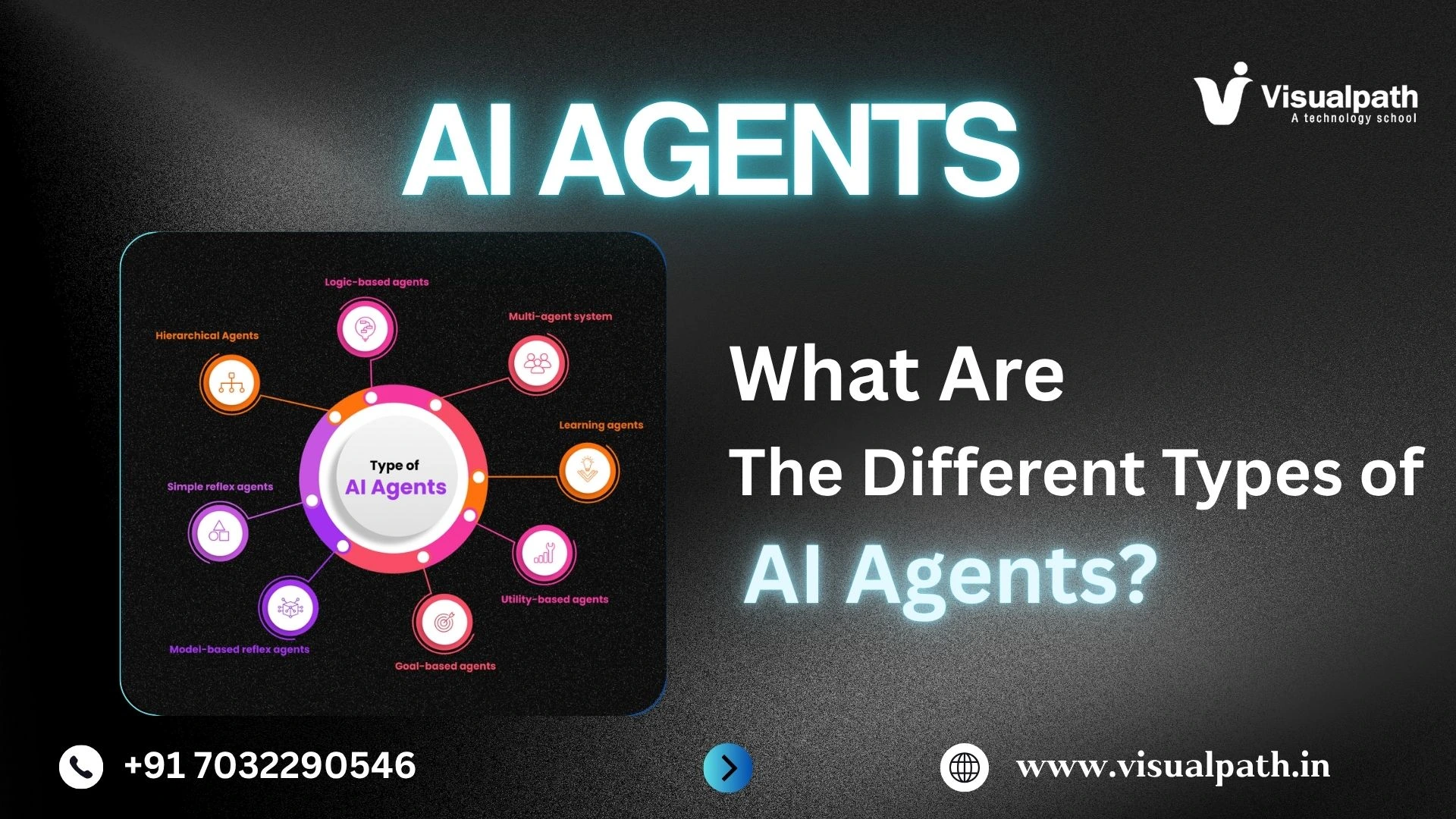
    AI Agents are categorized based on their ability to perceive, reason, and act. Each type has a unique approach to problem-solving and interaction with its environment. Understanding these types is vital for anyone aspiring to work in the field of AI or automation.

    1. Simple Reflex Agents

    Simple Reflex Agents operate solely on the current percept — the information they receive from their environment at a given moment. They use a set of predefined rules known as condition-action rules. For example, an AI thermostat adjusts temperature based on current readings, not on any previous data. These agents are efficient for straightforward tasks but cannot learn or adapt to new situations.

    2. Model-Based Reflex Agents

    Unlike simple reflex agents, Model-Based Reflex Agents maintain an internal model of the world. This model helps them track changes and make more informed decisions. By understanding past states, they can predict outcomes and choose the best possible action. For instance, in robotics, these agents help machines remember their path to avoid collisions or retrace their steps.

    3. Goal-Based Agents

    Goal-Based Agents go a step further by incorporating objectives into their design. Instead of reacting to the environment, these agents plan their actions to achieve desired goals. They evaluate possible outcomes and select actions that move them closer to success. Navigation systems that plan optimal routes are perfect examples of goal-based AI Agents. These systems constantly adjust routes based on traffic conditions and user preferences.

    4. Utility-Based Agents

    While goal-based agents focus on achieving objectives, Utility-Based Agents consider both success and efficiency. They assign numerical values (utilities) to outcomes and choose the one that maximizes satisfaction. This approach is common in financial applications and recommendation systems, where agents must balance multiple factors to provide the best possible decision.

    5. Learning Agents

    Learning Agents have the unique ability to improve their performance through experience. They consist of four key components: the learning element, performance element, critic, and problem generator. Over time, they analyze feedback, adapt their behavior, and refine their strategies. This makes them highly useful in complex, dynamic environments such as stock market prediction, autonomous driving, and personalized marketing.

    These agents represent a major leap toward autonomous decision-making and are the foundation for many AI-driven technologies today. Their ability to evolve and learn mirrors human-like intelligence, making them a vital part of modern AI systems.

    6. Multi-Agent Systems

    In real-world scenarios, multiple agents often work together to solve problems. Multi-Agent Systems (MAS) involve coordination and communication between different agents to achieve a shared goal. For example, in logistics, AI Agents collaborate to optimize delivery routes and manage warehouse operations. Each agent has specific responsibilities, and together, they ensure smooth and efficient outcomes.

    This collective intelligence enables AI systems to tackle large-scale, distributed problems that individual agents could not handle alone. Collaboration, negotiation, and communication form the backbone of multi-agent architectures.

    Learning and Building AI Agent Systems

    As industries increasingly adopt intelligent automation, the demand for skilled professionals who understand AI Agent architectures is rapidly growing. Learning how to build and deploy these agents through AI Agent Online Training equips individuals with hands-on knowledge of decision-making algorithms, data modeling, and interaction systems. Training in this domain also helps professionals design AI-driven applications that can adapt, learn, and perform tasks autonomously.

    Online courses on AI Agents often cover foundational concepts, frameworks like LangChain or Microsoft Semantic Kernel, and practical implementations using real-world datasets. This blend of theory and practice ensures learners gain both conceptual clarity and technical expertise.

    7. Emerging Trends in AI Agent Technology

    AI Agents are continuously evolving with advancements in generative AI, large language models, and contextual memory systems. Recent innovations enable agents to perform multi-step reasoning, self-correction, and even autonomous collaboration. The integration of AI with Internet of Things (IoT), cloud computing, and big data analytics is also expanding the scope of what AI Agents can accomplish.

    These agents are not limited to single tasks anymore — they now assist in complex workflows like coding, data analysis, business operations, and virtual assistance. The future holds even more promise, with agents that can reason across multiple domains and operate seamlessly in real-time environments.

    Preparing for the Future of Intelligent Systems

    For professionals and students aspiring to excel in this field, enrolling in AI Agents Course Online can be a game-changer. Such programs provide comprehensive knowledge of agent-based modeling, reinforcement learning, and system integration. They also help learners stay ahead of the curve in the fast-growing world of AI automation.

    FAQ,s

    1. What are AI Agents?
    Software entities that perceive, decide, and act intelligently.
    2. What are the main types of AI Agents?
    Simple, model-based, goal-based, utility, and learning agents.
    3. How do Learning Agents work?
    They adapt and improve using feedback and past experiences.
    4. What is a Multi-Agent System?
    A group of agents collaborating to achieve shared goals.
    5. Why learn AI Agent technologies in 2025?
    High demand for automation skills in AI-driven industries.

    Conclusion

    AI Agents have become the driving force behind automation, decision-making, and digital transformation. Understanding their different types helps developers and businesses choose the right kind of intelligence for specific applications. From simple reflex mechanisms to complex learning systems, AI Agents continue to push the boundaries of what machines can achieve, paving the way for a smarter and more efficient future.

    Visualpath stands out as the best online software training institute in Hyderabad.

    For More Information about the AI Agents Online Training

    Contact Call/WhatsApp: +91-7032290546

    Visit:  https://www.visualpath.in/ai-agents-course-online.html

  • What Are the Main Components of an AI Agent System?

    What Are the Main Components of an AI Agent System?

    Artificial Intelligence (AI) has rapidly transformed how machines think, reason, and act. At the heart of this revolution are AI Agents Training systems that simulate human-like intelligence through interaction, decision-making, and automation. AI Agents are autonomous programs designed to perceive their environment, make decisions, and take appropriate actions to achieve specific goals. Understanding the main components of these agents helps learners and developers design smarter, more adaptable AI models.

    1. Perception – The Sensing Mechanism

    The first major component of an AI Agent system is perception. This involves sensors that collect data from the environment. Just like humans rely on their senses, AI Agents depend on sensors or data inputs to understand the world around them. These sensors can range from simple input devices to advanced systems such as cameras, microphones, or IoT sensors.

    For instance, a self-driving car uses radar, cameras, and LiDAR to detect obstacles, while a chatbot processes user text as its sensory input. The accuracy and reliability of perception directly impact how well an agent can perform its tasks.

    2. Environment – The Context for Action

    An AI Agent doesn’t operate in isolation. The environment provides the context where the agent performs actions and receives feedback. The environment can be static or dynamic, deterministic or stochastic, and accessible or partially observable.

    In AI Agent Online Training, understanding the environment’s dynamics is crucial because the agent’s design depends on how predictable or uncertain the environment is. For example, an automated stock trading agent must adapt quickly to fluctuating market data, while a vacuum-cleaning robot works in a more predictable environment.

    3. Reasoning and Decision-Making

    Once the agent perceives data from the environment, it must reason and decide what action to take next. This component is known as the decision-making module. It involves algorithms and logic systems that analyze data, interpret meaning, and select the best possible course of action based on goals and available knowledge.

    Different AI paradigms — such as rule-based systems, machine learning, or reinforcement learning — influence how reasoning is carried out. In reactive agents, decision-making is immediate and based on current data. In contrast, deliberative agents plan ahead by predicting outcomes before acting.

    4. Knowledge Base – The Brain of the Agent

    The knowledge base represents the memory or stored understanding of an agent. It contains facts, rules, and data that the agent uses to make intelligent decisions. This knowledge can be static (predefined rules) or dynamic (updated through learning).

    In intelligent agents, the quality of the knowledge base defines how “smart” the agent is. For example, virtual assistants like Siri or Alexa depend on vast databases to respond accurately to user queries.

    Knowledge representation techniques, such as semantic networks, ontologies, or machine learning models, allow the agent to interpret and apply information effectively.

    5. Learning – Adapting to New Information

    One of the most powerful features of AI Agents is their ability to learn. Through continuous interaction with the environment, agents can improve their decision-making over time. Machine learning algorithms, particularly reinforcement learning, play a vital role in this process.

    Agents use trial and error to evaluate the success of their actions and refine their strategies. Over time, this learning loop helps them optimize performance and handle complex, unpredictable situations.

    6. Action – The Execution Mechanism

    After deciding what to do, the agent executes the chosen actions through actuators. These can be physical components (like robotic arms) or digital processes (such as sending an email or updating a database).

    The effectiveness of an AI Agent depends on how accurately and efficiently it translates decisions into actions. In real-world applications, timing, precision, and coordination are critical for performance and safety.

    7. Performance Measurement – Evaluating Intelligence

    A well-designed AI Agent must be continuously evaluated to ensure it meets its objectives. Performance metrics help determine whether the agent’s actions are effective and efficient.

    In many cases, these metrics are based on how closely the agent achieves its defined goals under different environmental conditions. For example, in gaming AI, performance can be measured through success rates or score improvements; in industrial AI, it might be operational efficiency or predictive accuracy.

    8. Communication – Collaboration between Agents

    In systems with multiple agents, communication is key. Multi-agent systems rely on interaction between agents to achieve collective intelligence. These agents share data, coordinate actions, and sometimes compete or cooperate to achieve shared goals.

    Protocols such as Agent Communication Language (ACL) and FIPA standards enable seamless interaction between different agents and systems, ensuring collaborative efficiency.

    Importance of Learning in AI Development

    Modern intelligent systems combine all these components to create adaptable, autonomous solutions. As part of an AI Agents Course Online, learners explore how these modules interact, from perception to reasoning to learning, using frameworks like LangChain or AutoGen. These platforms simplify building agents that can understand, plan, and act autonomously across different domains.

    FAQ,s

    1. What are the main components of an AI Agent system?
    A: Perception, environment, reasoning, learning, and action form its core.
    2. How does an AI Agent perceive its environment?
    A: Through sensors and data inputs like cameras, text, or voice.
    3. Why is reasoning important in AI Agents?
    A: It enables decision-making based on goals, rules, and data analysis.
    4. What role does learning play in AI Agents?
    A: It helps agents adapt and improve through feedback and experience.
    5. How are AI Agents used in real-world applications?
    A: They automate tasks in healthcare, finance, education, and robotics.

    Conclusion: Building the Future with AI Agent Systems

    The main components of an AI Agent system—perception, environment, reasoning, knowledge base, learning, and action—together form the foundation of intelligent automation. As industries adopt AI-driven processes, understanding these building blocks becomes essential for developers and professionals aiming to create autonomous, adaptive systems.

    Visualpath stands out as the best online software training institute in Hyderabad.

    For More Information about the AI Agents Online Training

    Contact Call/WhatsApp: +91-7032290546

    Visit:  https://www.visualpath.in/ai-agents-course-online.html