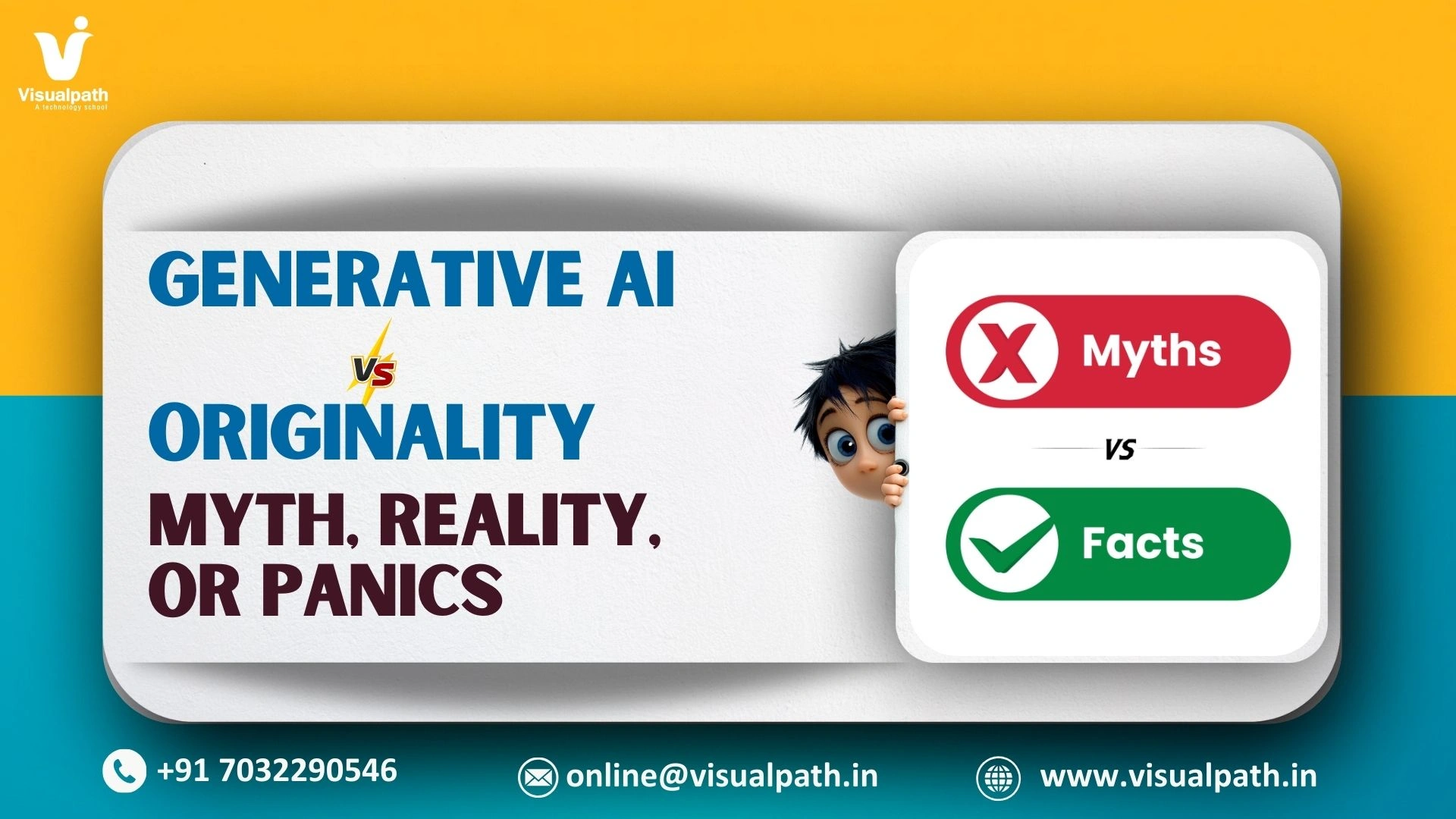
Generative AI vs. Originality: Myth, Reality, or Panic?

-
Generative AI vs. Originality: Myth, Reality, or Panic?
- 1. The Originality Question No One Can Agree On
- 2. What Generative AI Training Actually Does
- 3. The Myth: AI Is Just a Copy Machine
- 5. The Panic: Why Creatives Are Worried
- 6. What GenAI Training Means for Human Artists
- 7. Originality Was Never Pure Anyway
- 8. Where the Line Actually Gets Blurry
- 9. So Should You Panic? Probably Not. But Don't Relax Either.
- FAQs
1. The Originality Question No One Can Agree On
Ask a room full of artists, developers, lawyers, and philosophers whether AI can be “original” and you will get a full-blown argument in about 30 seconds.
Some say Generative AI Vs originality is just a remix engine with a good PR team. Others argue it produces genuinely novel outputs that no human would have created. Both sides are partially right, which is exactly why this debate is so annoying to navigate.
The real problem is that nobody is working from the same definition of “original.” Before you can decide whether Generative AI Training kills creativity or just changes it, you need to be honest about what originality actually meant in the first place.
2. What Generative AI Training Actually Does
Here is the plain version: Generative AI Training is the process of feeding a model enormous amounts of data, text, images, code, music, and teaching it to recognize statistical patterns.
The model does not store that data like a hard drive. It compresses patterns into billions of numerical weights and learns to predict what comes next in a sequence.
So when you ask a model to write a poem about grief, it is not copying a poem about grief from its training set. It is generating something based on the distribution of language patterns it absorbed during GenAI Training. That distinction matters a lot, but it does not fully resolve the originality question either.
3. The Myth: AI Is Just a Copy Machine
The most common accusation is that AI simply regurgitates things it has seen. This is mostly wrong, and it is worth being specific about why.
Generative AI Training does not produce outputs that are copies of training data in the same way a photocopier does.
If you ask two people who have both read every Shakespeare play to write a sonnet, you get two different results. Neither is copying Shakespeare. They have both internalized patterns, structures, and emotional cadences and are generating something new from that internalized knowledge.
Yes, there are edge cases. Models do sometimes reproduce memorized sequences, especially when training data was repeated many times. That is a real problem worth fixing. But conflating occasional memorization with the entire concept of GenAI Training being theft is a significant logical overreach.
4. The Reality: Patterns Are Not Plagiarism
Learning from existing work and copying existing work are two different things. That applies to humans and it applies to AI models. A film student watches thousands of movies. A novelist reads hundreds of books. A designer studies decades of typography. We do not call that plagiarism. We call it education.
The uncomfortable truth is that Generative AI Training mirrors how human learning works at a structural level.
The main differences are scale and speed, not the fundamental process. That does not mean the legal and ethical questions around training data consent are resolved. They are not. But the philosophical argument that AI cannot be original because it trained on human work collapses under the same scrutiny when applied to humans.
5. The Panic: Why Creatives Are Worried
Here is where the panic becomes legitimate. The worry is not just about whether AI is “truly original.” It is about economic displacement, attribution, and power.
Illustrators, writers, musicians, and voice actors are watching companies build products using Generative AI Training pipelines that were fed on their work, often without consent or compensation, and then deploying those products to replace them in the market. That is a real grievance. The originality debate is almost a distraction from this more concrete problem.
The question of whether AI outputs are original matters less to a working illustrator than the question of whether their livelihood survives the next five years. Both questions deserve serious attention but they are not the same question.
6. What GenAI Training Means for Human Artists
The honest answer is that the impact varies enormously depending on the type of creative work and the market it sits in.
Stock illustration, generic copywriting, and basic music composition are already being disrupted. These are markets where volume and speed matter more than depth or personal voice.
Work that is deeply personal, culturally specific, or requires real-world experience and relationship-building is far less threatened. A novelist with a distinctive voice writing about their own lived experience is not easily replaced. A journalist with deep sourcing and community trust is not easily replaced. But the artist doing visual work for mid-tier marketing campaigns? That market is shifting fast.
GenAI Training is already producing outputs that satisfy buyers who previously paid humans for certain categories of creative work. That is not a myth and it is not panic. It is a structural shift happening in real time.
7. Originality Was Never Pure Anyway
This is the part people do not want to hear. Human creativity has always been deeply derivative. Every artistic movement built on the previous one. Every genre is a set of conventions borrowed and modified.
Shakespeare borrowed his plots. Beatles songs were heavily influenced by American blues. Picasso famously said good artists borrow and great artists steal.
This does not devalue human creativity. It just means the standard we are holding AI to, some pristine version of originality that springs from nothing, is a standard no human has ever met either.
The more honest question is whether AI outputs carry the kind of intentionality, meaning, and context that we value in human creative work. That is a much more interesting and harder question.
8. Where the Line Actually Gets Blurry
The genuinely hard cases are not about whether AI is creative. They are about specific practices within Generative AI Training that raise real ethical flags.
Training on opt-out rather than opt-in systems. Training on work that was created with explicit copyright notices. Style mimicry at a level of specificity that targets individual artists by name.
Generating content that closely imitates a living creator’s style for commercial gain. These are not abstract philosophical problems. They are concrete practices where current law is unsettled and where community norms are still forming.
Anyone telling you these issues are already resolved is selling you something. The law around Generative AI Training and copyright is actively being litigated in multiple jurisdictions. The outcomes will shape how these systems are built and who they benefit.
9. So Should You Panic? Probably Not. But Don’t Relax Either.
The panic framing is counterproductive. It produces heat without light and tends to shut down the more nuanced conversations that actually need to happen. AI does not kill originality in any deep philosophical sense. Humans will keep creating meaningful work. That part is not in serious doubt.
But the structural disruption to creative markets is real. The ethical questions around GenAI Training data are real. The power imbalance between well-resourced AI companies and individual creators is real.
The right response is to stay informed, push for better regulation and consent frameworks, support the legal efforts being made by affected creators, and keep making the kind of work that requires genuine human experience. That is not a satisfying battle cry. But it is the honest one.
FAQs
A. In most current cases, yes. Most large-scale Generative AI Training pipelines have been built on publicly scraped data that included copyrighted work.
A. AI outputs can be novel and non-repetitive, which satisfies one common definition of original. Whether they carry intentionality or meaning in the way human creative work does is a harder question.
A. No, not entirely. Some categories of commercial creative work are being disrupted significantly.
A. Plagiarism is presenting someone else’s specific work as your own. GenAI Training involves learning statistical patterns from data, not storing and reproducing specific works.
To explore more insights on Generative AI and practical technology trends, visit our website: https://www.visualpath.in/generative-ai-course-online-training.html or contact us:- https://wa.me/c/917032290546 today. Visualpath provides clear guidance and learning support for modern AI skills.