AI Stack vs Data Stack: What’s the Difference?
Introduction
AI Stack vs Data Stack is a common topic for beginners in modern tech. Many learners start with AI Stack Training to understand how systems use data to make decisions. However, confusion often comes from mixing AI tools with data tools. While both stacks work together, they serve different purposes. This article explains the difference in a simple and clear way.
Clear Definition
An AI stack is a group of tools used to build intelligent systems. These systems can learn, predict, and automate tasks. It includes models, algorithms, and deployment tools.
A data stack is a group of tools used to collect, store, and process data. It prepares data for analysis or for use in AI systems.
In simple terms, the data stack handles raw data, while the AI stack uses that data to create smart outcomes.
Why It Matters
Understanding the difference helps learners choose the right path. If you want to build dashboards or manage databases, focus on the data stack. If you want to create machine learning models, focus on the AI stack.
In real projects, both stacks work together. Clean data from the data stack improves AI model performance. Without proper data, AI systems cannot work well.
Core Components
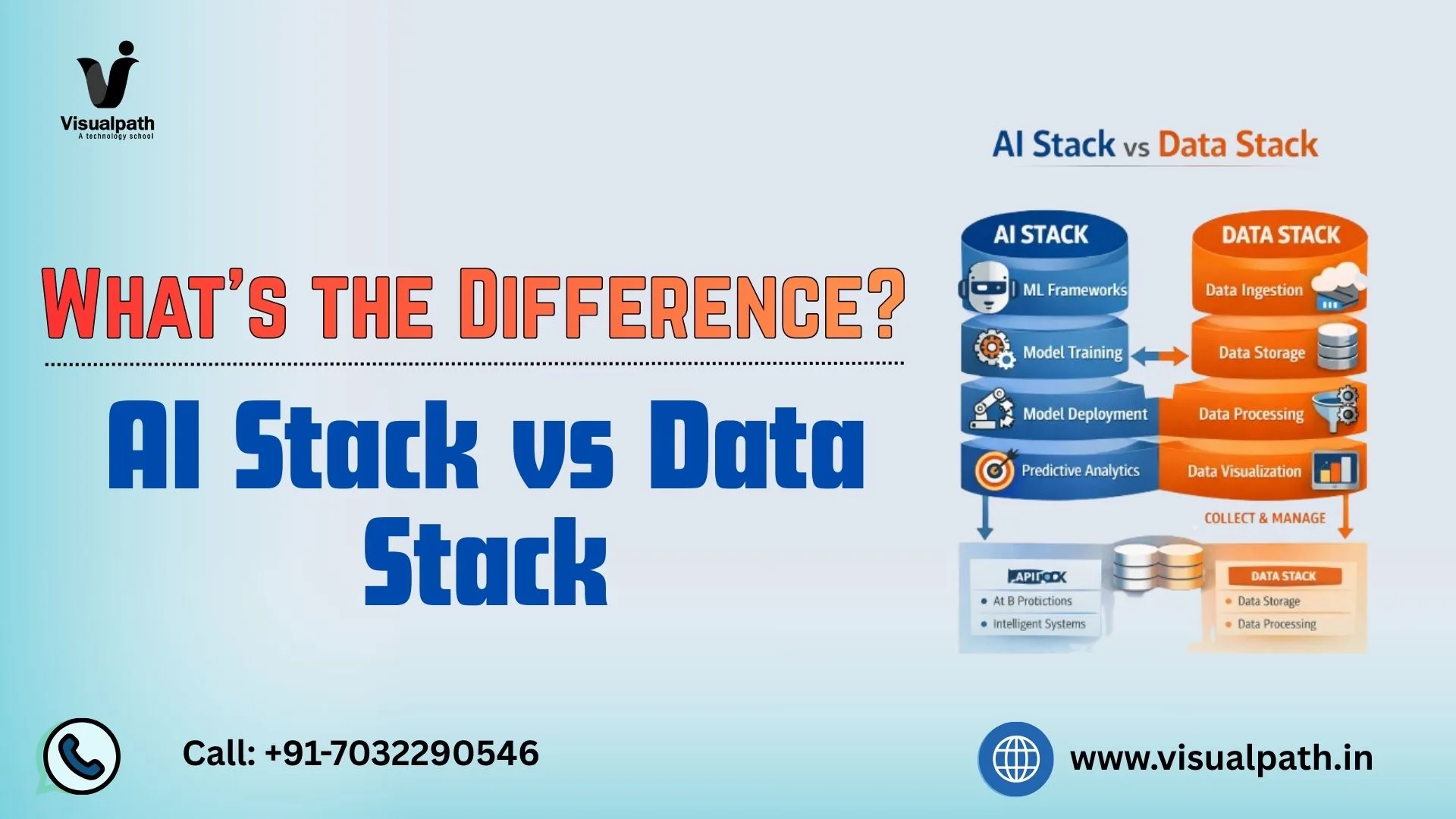
The data stack includes:
- Data ingestion tools (collect data from sources)
- Data storage systems (data lakes, warehouses)
- Data processing tools (ETL pipelines)
- Data visualization tools (dashboards)
The AI stack includes:
- Machine learning frameworks
- Model training tools
- Model evaluation systems
- Deployment platforms
Each stack has a clear role. One prepares the data, and the other builds intelligence on top of it.
Architecture Overview
The data stack sits at the base. It collects data from apps, sensors, or user inputs. Then it cleans and organizes this data.
On top of this layer, the AI stack uses the processed data. It trains models using historical data. After that, models are deployed to make predictions in real time.
This layered structure is common in modern systems built between 2024 and 2026.
(Conceptual Flow)
First, data is collected from different sources. For example, an e-commerce app collects user clicks and purchases.
Next, the data stack cleans and stores this data. It removes errors and organizes it into tables.
Then, the AI stack takes this clean data. A machine learning model is trained to predict user behavior.
Finally, the model is deployed. It suggests products to users based on past actions.
This step-by-step flow shows how both stacks depend on each other.
Key Features
Data stack features:
- Handles large volumes of data
- Ensures data quality
- Supports real-time and batch processing
AI stack features:
- Learns from data patterns
- Improves accuracy over time
- Automates decision-making
Each stack has unique strengths. Together, they create complete systems.
Practical Use Cases
In healthcare, the data stack collects patient records. The AI stack predicts disease risks.
In banking, the data stack tracks transactions. The AI stack detects fraud.
In retail, the data stack stores customer data. The AI stack recommends products.
Many learners join an AI Stack Course to understand how these systems work in real business scenarios.
Limitations / Challenges
Data stack challenges:
- Data quality issues
- High storage costs
- Complex pipelines
AI stack challenges:
- Requires large datasets
- Model bias risks
- Difficult deployment
Both stacks need skilled professionals. Without proper setup, results may not be accurate.
FAQs
Conclusion
AI Stack vs Data Stack is not a competition. Both are essential parts of modern technology systems. The data stack prepares and organizes information. The AI stack uses that information to create intelligent outputs.
For learners, the choice depends on career goals. If you enjoy working with data pipelines and storage, start with the data stack. If you prefer building predictive models, focus on AI.
Today, companies expect professionals to understand both stacks at a basic level. Many training paths now include combined learning, including AI Stack Course Online programs. As systems grow more complex, this combined knowledge becomes more valuable.
Finally, structured learning like AI Stack Training helps build strong foundations. It ensures you understand not just tools, but also how real-world systems are designed and used.
Visualpath is a leading software and online training institute in
Hyderabad, offering industry-focused courses with expert trainers.
For More Information AI Stack Online Training
Contact Call/WhatsApp: +91-7032290546
Visit: https://www.visualpath.in/aistack-online-training.html