
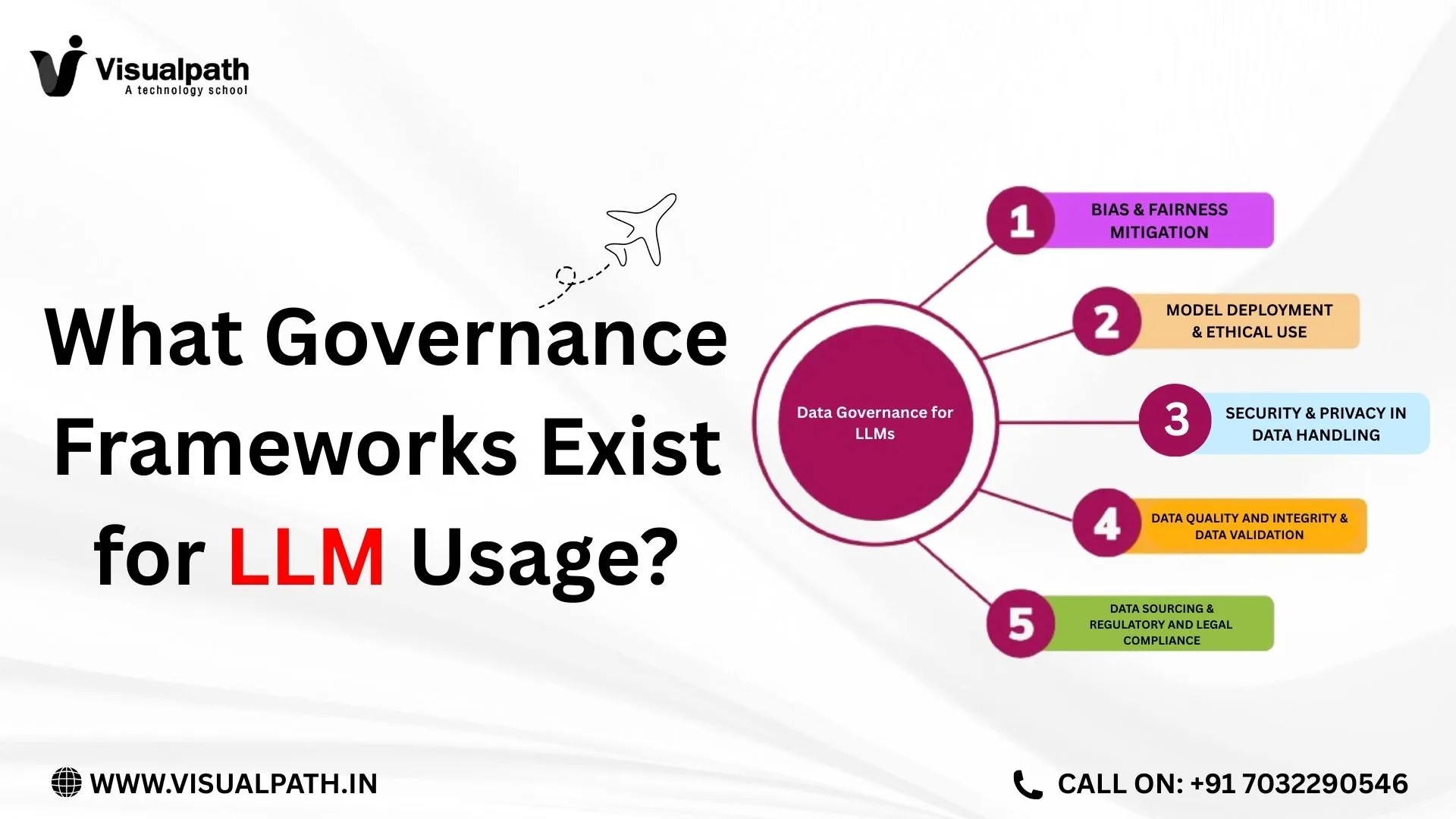
What Governance Frameworks Exist for LLM Usage?
- What Governance Frameworks Exist for LLM Usage?
- Introduction
- Why Governance Matters for LLM Usage
- Key Governance Frameworks for LLM Usage
- Organizational Governance Models
- Transparency and Accountability Mechanisms
- Security and Data Protection Frameworks
- Continuous Monitoring and Improvement
- FAQs
- Conclusion
Introduction
AI LLM technologies are rapidly becoming part of everyday life, shaping how people communicate, work, learn, and make decisions. From drafting documents to supporting customer interactions, large language models are now deeply embedded in human workflows. As organizations and individuals rely more on these systems, the need for clear governance becomes essential. Governance is not about restricting innovation; it is about creating trust, accountability, and transparency so that humans remain in control of how these systems influence society. In the middle of this growing awareness, professionals enrolling in an AI LLM Course are increasingly encouraged to understand not just how models work, but how they should be used responsibly.
Governance frameworks provide structured guidance on how LLMs should be designed, deployed, monitored, and improved while respecting human values, legal boundaries, and ethical principles. These frameworks help organizations balance innovation with responsibility, ensuring that technology supports people rather than replacing human judgment.
Why Governance Matters for LLM Usage
LLMs can influence opinions, automate decisions, and generate content that appears highly convincing. Without governance, these capabilities can lead to misinformation, biased outcomes, privacy violations, or misuse of sensitive data. Governance frameworks exist to answer fundamental questions such as who is accountable for model outputs, how risks are identified, and how harm can be prevented or corrected.
From a human perspective, governance helps protect end users, employees, and customers. It creates clear rules so people know when to trust outputs and when human oversight is required. Governance also reassures stakeholders that LLMs are being used ethically, transparently, and lawfully.
Key Governance Frameworks for LLM Usage
Several governance frameworks have emerged globally, shaped by governments, international organizations, and industry leaders. While their language differs, they share common goals: fairness, accountability, transparency, and safety.
1. Ethical AI Frameworks
Ethical AI frameworks focus on aligning LLM usage with human values. These frameworks emphasize fairness, non-discrimination, explainability, and respect for human autonomy. They encourage organizations to evaluate how model outputs might impact different groups of people and to take corrective actions when bias or harm is identified.
Ethical frameworks often require human review processes, especially in sensitive areas such as hiring, finance, healthcare, or legal services. The goal is not to eliminate automation but to ensure humans remain responsible decision-makers.
2. Regulatory and Legal Frameworks
Legal governance frameworks define what is allowed and what is not. Regulations such as data protection laws, consumer protection rules, and sector-specific compliance requirements directly influence how LLMs can be trained and deployed. These frameworks mandate consent, data minimization, and clear accountability when systems cause harm.
Organizations must document how data is collected, how models are trained, and how outputs are used. Professionals pursuing AI LLM Online Training often realize that understanding compliance is just as important as understanding model architecture.
3. Risk Management Frameworks
Risk-based governance frameworks focus on identifying, assessing, and mitigating potential harms associated with LLM usage. These include risks related to misinformation, security vulnerabilities, reputational damage, and operational failures.
Risk management frameworks encourage regular audits, stress testing, and scenario planning. By anticipating how an LLM might fail or be misused, organizations can put safeguards in place before issues affect real people.
Organizational Governance Models
Beyond external frameworks, many organizations develop internal governance structures to manage LLM usage responsibly.
Human Oversight Committees
Some organizations establish cross-functional committees that include legal experts, domain specialists, and business leaders. These groups review use cases, approve deployments, and monitor outcomes to ensure alignment with human and organizational values.
Usage Policies and Standards
Clear internal policies define where and how LLMs can be used. These policies often specify acceptable use, prohibited applications, and escalation processes when issues arise. Employees are trained to understand that LLM outputs are supportive tools, not final authorities.
Transparency and Accountability Mechanisms
Transparency is a cornerstone of LLM governance. Users should know when they are interacting with an LLM and understand its limitations. Governance frameworks encourage documentation, clear disclosures, and feedback mechanisms so people can report errors or concerns.
Accountability mechanisms ensure that responsibility always lies with humans or organizations, not the model itself. This reinforces trust and prevents the false assumption that automated outputs are always correct.
Security and Data Protection Frameworks
Security-focused governance frameworks address how data is stored, accessed, and protected. They define controls to prevent data leakage, unauthorized access, and misuse of sensitive information.
Many learners in AI LLM Testing Training programs recognize that testing is not just about accuracy, but about ensuring models behave safely under real-world conditions. Robust testing supports governance by validating that safeguards work as intended.
Continuous Monitoring and Improvement
Importantly, governance is not a one-time initiative. Instead, it requires ongoing evaluation and refinement. As expectations, regulations, and technologies evolve, governance practices must adapt accordingly. Continuous monitoring ensures that systems remain aligned with human needs over time.
FAQs
Conclusion
Strong governance frameworks ensure that LLMs remain tools that support human creativity, judgment, and responsibility. By prioritizing ethics, accountability, transparency, and continuous oversight, organizations can confidently use language models in ways that benefit people and society. Governance is ultimately about keeping humans at the center of technological progress, ensuring that innovation serves real needs without compromising trust or values.
TRENDING COURSES: Oracle Integration Cloud, AWS Data Engineering, SAP Datasphere
Visualpath is the Leading and Best Software Online Training Institute in Hyderabad.
For More Information about Best AI LLM
Contact Call/WhatsApp: +91-7032290546


