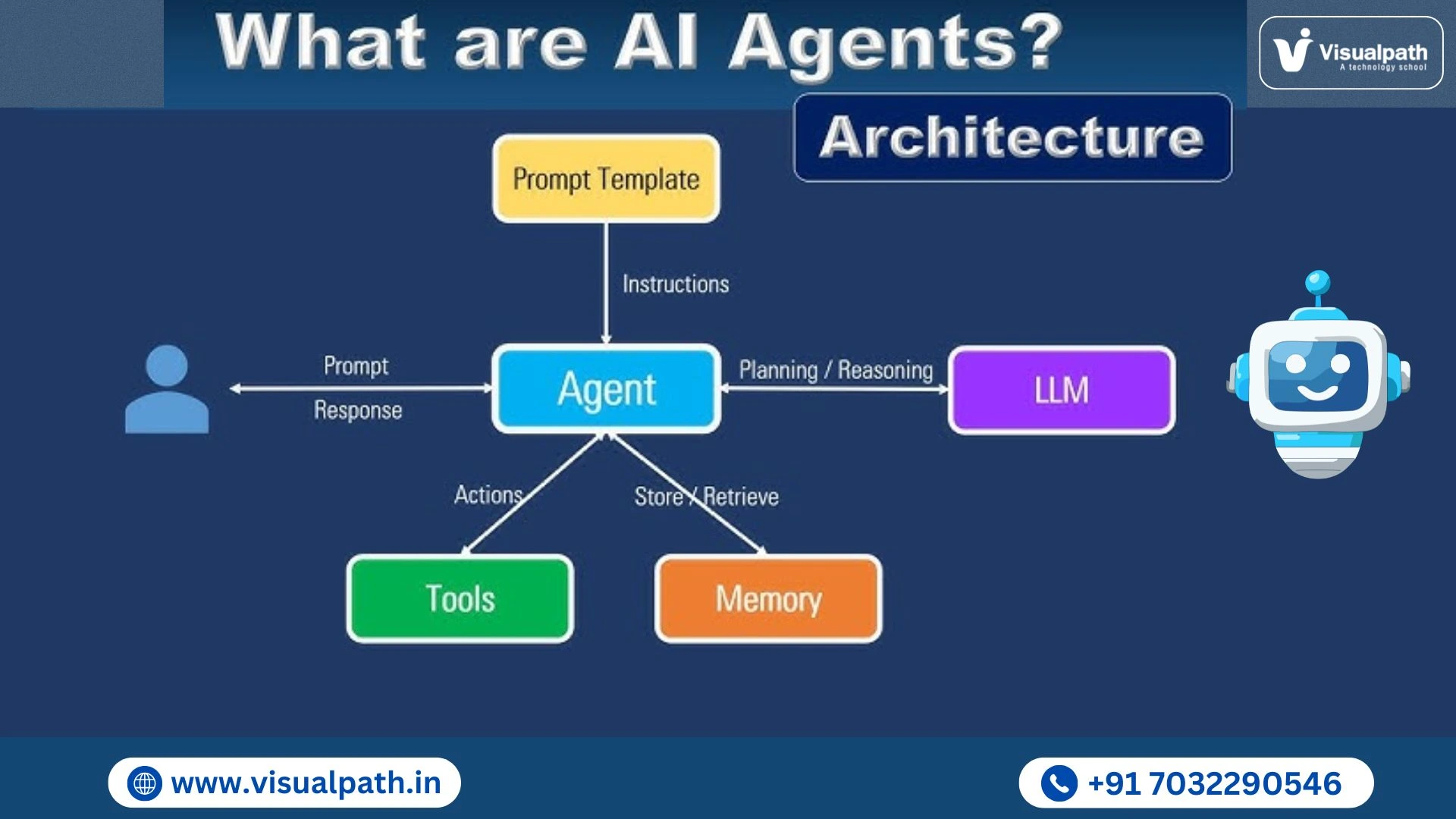
Artificial Intelligence (AI) has rapidly transformed how machines think, reason, and act. At the heart of this revolution are AI Agents Training systems that simulate human-like intelligence through interaction, decision-making, and automation. AI Agents are autonomous programs designed to perceive their environment, make decisions, and take appropriate actions to achieve specific goals. Understanding the main components of these agents helps learners and developers design smarter, more adaptable AI models.
1. Perception – The Sensing Mechanism
The first major component of an AI Agent system is perception. This involves sensors that collect data from the environment. Just like humans rely on their senses, AI Agents depend on sensors or data inputs to understand the world around them. These sensors can range from simple input devices to advanced systems such as cameras, microphones, or IoT sensors.
For instance, a self-driving car uses radar, cameras, and LiDAR to detect obstacles, while a chatbot processes user text as its sensory input. The accuracy and reliability of perception directly impact how well an agent can perform its tasks.
2. Environment – The Context for Action
An AI Agent doesn’t operate in isolation. The environment provides the context where the agent performs actions and receives feedback. The environment can be static or dynamic, deterministic or stochastic, and accessible or partially observable.
In AI Agent Online Training, understanding the environment’s dynamics is crucial because the agent’s design depends on how predictable or uncertain the environment is. For example, an automated stock trading agent must adapt quickly to fluctuating market data, while a vacuum-cleaning robot works in a more predictable environment.
3. Reasoning and Decision-Making
Once the agent perceives data from the environment, it must reason and decide what action to take next. This component is known as the decision-making module. It involves algorithms and logic systems that analyze data, interpret meaning, and select the best possible course of action based on goals and available knowledge.
Different AI paradigms — such as rule-based systems, machine learning, or reinforcement learning — influence how reasoning is carried out. In reactive agents, decision-making is immediate and based on current data. In contrast, deliberative agents plan ahead by predicting outcomes before acting.
4. Knowledge Base – The Brain of the Agent
The knowledge base represents the memory or stored understanding of an agent. It contains facts, rules, and data that the agent uses to make intelligent decisions. This knowledge can be static (predefined rules) or dynamic (updated through learning).
In intelligent agents, the quality of the knowledge base defines how “smart” the agent is. For example, virtual assistants like Siri or Alexa depend on vast databases to respond accurately to user queries.
Knowledge representation techniques, such as semantic networks, ontologies, or machine learning models, allow the agent to interpret and apply information effectively.
5. Learning – Adapting to New Information
One of the most powerful features of AI Agents is their ability to learn. Through continuous interaction with the environment, agents can improve their decision-making over time. Machine learning algorithms, particularly reinforcement learning, play a vital role in this process.
Agents use trial and error to evaluate the success of their actions and refine their strategies. Over time, this learning loop helps them optimize performance and handle complex, unpredictable situations.
6. Action – The Execution Mechanism
After deciding what to do, the agent executes the chosen actions through actuators. These can be physical components (like robotic arms) or digital processes (such as sending an email or updating a database).
The effectiveness of an AI Agent depends on how accurately and efficiently it translates decisions into actions. In real-world applications, timing, precision, and coordination are critical for performance and safety.
7. Performance Measurement – Evaluating Intelligence
A well-designed AI Agent must be continuously evaluated to ensure it meets its objectives. Performance metrics help determine whether the agent’s actions are effective and efficient.
In many cases, these metrics are based on how closely the agent achieves its defined goals under different environmental conditions. For example, in gaming AI, performance can be measured through success rates or score improvements; in industrial AI, it might be operational efficiency or predictive accuracy.
8. Communication – Collaboration between Agents
In systems with multiple agents, communication is key. Multi-agent systems rely on interaction between agents to achieve collective intelligence. These agents share data, coordinate actions, and sometimes compete or cooperate to achieve shared goals.
Protocols such as Agent Communication Language (ACL) and FIPA standards enable seamless interaction between different agents and systems, ensuring collaborative efficiency.
Importance of Learning in AI Development
Modern intelligent systems combine all these components to create adaptable, autonomous solutions. As part of an AI Agents Course Online, learners explore how these modules interact, from perception to reasoning to learning, using frameworks like LangChain or AutoGen. These platforms simplify building agents that can understand, plan, and act autonomously across different domains.
FAQ,s
Conclusion: Building the Future with AI Agent Systems
The main components of an AI Agent system—perception, environment, reasoning, knowledge base, learning, and action—together form the foundation of intelligent automation. As industries adopt AI-driven processes, understanding these building blocks becomes essential for developers and professionals aiming to create autonomous, adaptive systems.
Visualpath stands out as the best online software training institute in Hyderabad.
For More Information about the AI Agents Online Training
Contact Call/WhatsApp: +91-7032290546
Visit: https://www.visualpath.in/ai-agents-course-online.html