In the world of Artificial Intelligence (AI), agents play a pivotal role in how systems interact with their environment, make decisions, and perform actions autonomously. Two of the most widely studied types are reactive agents and deliberative agents. Understanding their differences helps developers design intelligent systems that balance responsiveness and reasoning. Learners pursuing AI Agents Training often start by exploring these fundamental agent types before advancing to complex multi-agent systems.
1. What Are AI Agents?
AI agents are intelligent entities capable of perceiving their environment through sensors and acting upon it through actuators to achieve specific goals. They follow the principle of rationality — choosing the best possible action for a given situation. Depending on how they make decisions and plan actions, AI agents are classified into various types, with reactive and deliberative models being the two foundational approaches.
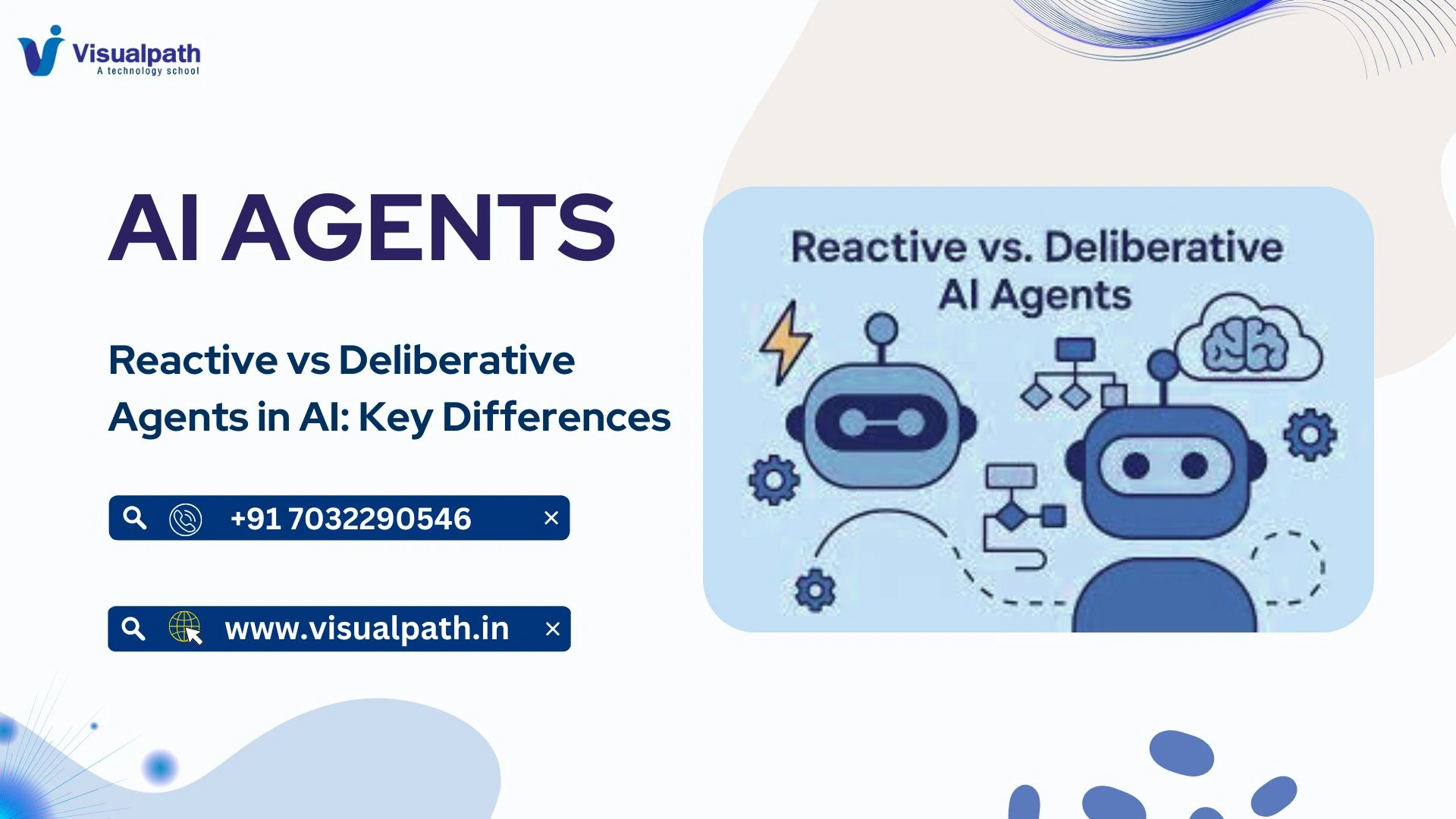
Reactive agents focus on immediate responses, while deliberative agents take time to analyze and plan. Both serve unique purposes depending on the complexity and time sensitivity of the problem being addressed.
2. Understanding Reactive Agents
Reactive agents are the simplest form of intelligent agents. They operate based on the current state of the environment and predefined rules. They do not rely on historical data or long-term planning. Instead, they react instantly to environmental changes.
For example, a thermostat adjusting room temperature based on current readings or a robot avoiding obstacles using sensor data are typical reactive systems. These agents work on the perception–action model, meaning they directly map inputs to outputs.
Key characteristics of reactive agents include:
- No internal representation of the environment.
- Immediate, rule-based decision-making.
- Fast and efficient for simple tasks.
- Limited adaptability and reasoning capability.
Reactive agents are widely used in real-time systems like industrial automation, robotics, and gaming, where speed and responsiveness are crucial.
3. Understanding Deliberative Agents
Deliberative agents, in contrast, are designed to “think” before they act. They maintain an internal model of the world and use it to make informed decisions. These agents involve planning, reasoning, and goal evaluation — mimicking human-like cognitive behavior.
For instance, a self-driving car planning an optimal route based on traffic conditions or an AI personal assistant scheduling meetings are examples of deliberative systems. They use advanced algorithms to predict outcomes and make decisions accordingly.
Key characteristics of deliberative agents include:
- Internal model of the environment.
- Ability to plan ahead and simulate future actions.
- Higher computational cost but greater intelligence.
- Suitable for complex, goal-oriented tasks.
While reactive agents are fast, deliberative agents are smart. They excel in scenarios that require reasoning, problem-solving, and adaptability.
4. Comparing Reactive and Deliberative Agents
To understand their practical differences, it’s essential to compare how these two agent types perform in various situations.
| Aspect | Reactive Agents | Deliberative Agents |
| Decision-Making | Immediate and rule-based | Planned and reasoned |
| Memory Use | None | Uses internal models and memory |
| Response Time | Very fast | Relatively slower |
| Complexity | Simple | Computationally intensive |
| Adaptability | Limited | High adaptability |
| Examples | Obstacle-avoiding robots, thermostats | Self-driving cars, personal AI assistants |
In summary, reactive agents excel in fast-changing, real-time environments, while deliberative agents are ideal for strategic decision-making where foresight is essential.
5. Hybrid Agents: The Best of Both Worlds
To overcome the limitations of both models, hybrid agents have been developed. These combine the fast reaction of reactive agents with the intelligent reasoning of deliberative systems. Hybrid agents can react instantly when required but can also plan when time allows.
For example, in robotics, a hybrid agent can avoid obstacles reactively but also plan routes or missions deliberatively. This layered architecture provides flexibility and efficiency.
In modern applications, AI Agent Online Training often introduces hybrid models to help learners build adaptable systems capable of balancing immediate responses with long-term planning.
6. Use Cases and Practical Applications
Reactive and deliberative agents are used across a wide range of industries:
- Robotics: Reactive agents handle obstacle avoidance, while deliberative agents plan navigation paths.
- Healthcare: Deliberative systems assist in diagnosis, while reactive systems monitor real-time vitals.
- Finance: Deliberative agents plan investment strategies, and reactive ones execute trades instantly.
- Gaming: Reactive agents control NPC behaviors, while deliberative ones simulate strategic decision-making.
- Smart Devices: Hybrid agents manage home automation with both real-time responses and planned routines.
This dual functionality is what makes AI agent systems so valuable in modern intelligent technologies.
7. Challenges in Designing AI Agents
Despite their benefits, designing effective AI agents presents challenges. For reactive agents, the main issue lies in limited learning capabilities. They can’t handle unpredictable environments well. For deliberative agents, the problem is processing speed — reasoning takes time and resources.
Developers must balance these factors when designing AI-based systems, often by combining both approaches into hybrid models that can adapt to dynamic needs.
8. The Future of AI Agent Development
The field of AI agent design is evolving rapidly. With the integration of large language models (LLMs), cloud computing, and reinforcement learning, future agents will be capable of combining speed, intelligence, and adaptability at unprecedented levels.
Organizations are now focusing on training professionals who can design such intelligent systems. This is why enrolling in an AI Agents Course Online can be an excellent step for individuals aiming to master next-generation AI concepts and applications.
FAQ,s
Conclusion
Reactive and deliberative agents serve as the foundation for intelligent system design. While reactive agents focus on immediate action, deliberative ones emphasize reasoning and planning. Together, they provide the flexibility needed to build smart, responsive, and adaptive AI solutions.
Visualpath stands out as the best online software training institute in Hyderabad.
For More Information about the AI Agents Online Training
Contact Call/WhatsApp: +91-7032290546
Visit: https://www.visualpath.in/ai-agents-course-online.html